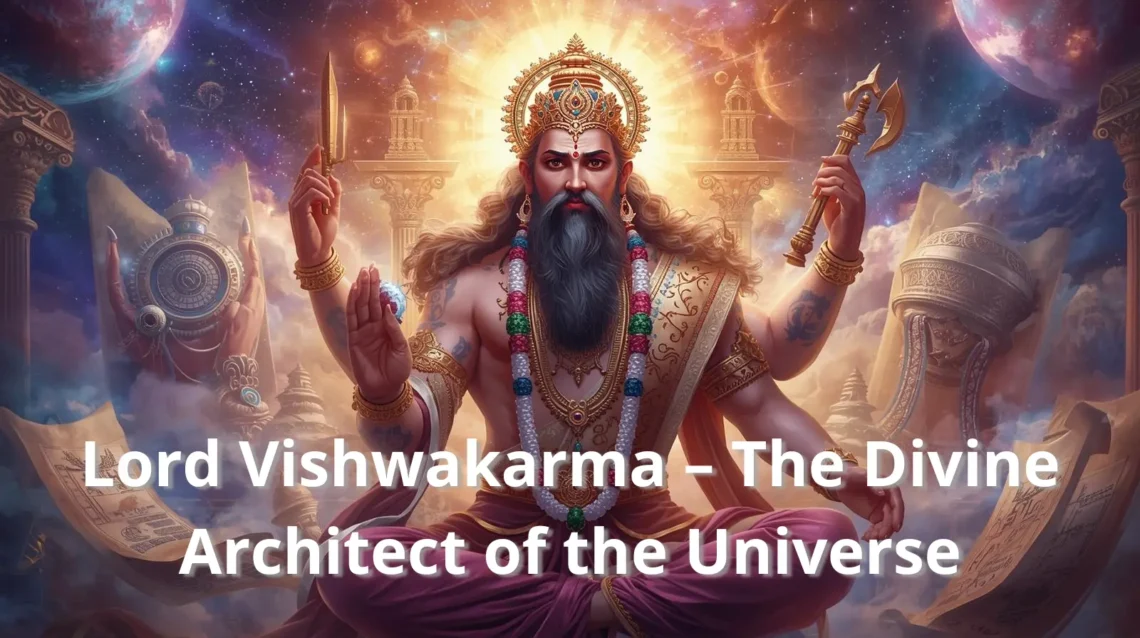
Lord Vishwakarma – Divine Architect of the Universe
Introduction
In the vast pantheon of Sanatan Dharma, every deity represents an eternal principle of life. Among them, Lord Vishwakarma stands as the embodiment of creativity, engineering, and craftsmanship. Known as the Devashilpi (celestial architect), he is revered as the first engineer, sculptor, and divine craftsman. Vishwakarma Pooja, celebrated every year on Kanya Sankranti , is not just a religious festival—it is an acknowledgment of human skill, labor, and the tools that sustain civilization.
Who is Lord Vishwakarma?
Lord Vishwakarma is described in the Rigveda, Mahabharata, and Puranas as the divine architect of the gods. His name itself comes from “Vishwa” (universe) and “Karma” (creator or action), meaning the creator of the universe.
Scriptural Mentions:
- In the Rigveda, he is called the Devata of craftsmanship, the one who built the heavens and the earth.
- In the Mahabharata, Lord Vishwakarma is mentioned as the architect of the celestial chariots and divine weapons used in epic battles.
- Vishwakarma created the golden city of Lanka for Lord Shiva and Goddess Parvati to reside in after their marriage.
- He also constructed Dwarka for Lord Krishna and Indraprastha for the Pandavas.
Divine Creations Attributed to Vishwakarma:
- Pushpaka Vimana – the flying chariot of Kubera, later used by Ravana.
- Sudharshana Chakra – the celestial discus of Lord Vishnu.
- Trishula – the mighty trident of Lord Shiva.
- Vajra – the thunderbolt weapon of Indra, crafted from sage Dadhichi’s bones.
Thus, Lord Vishwakarma is not just a deity of architecture but also of technology, design, and invention—qualities that are timeless.
Why Do We Celebrate Vishwakarma Pooja?
The celebration of Vishwakarma Pooja goes beyond mere ritual. It signifies a deep cultural and spiritual acknowledgment of work, innovation, and gratitude.
- Respect for the Divine Creator Worshipping Vishwakarma is equivalent to honoring the universal principle of creation. Just as Saraswati symbolizes knowledge and Lakshmi symbolizes wealth, Vishwakarma symbolizes skill and innovation.
- Purity of Tools and Workspace Tools, machines, and vehicles are considered sacred extensions of human labor. On this day, workers clean, decorate, and worship them, ensuring purity and divine blessings.
- Unity Between Labor and Leadership In many factories and offices, owners and workers celebrate together, breaking barriers of hierarchy. This reflects the Sanatan philosophy of “Saha Na Vavatu, Saha Nau Bhunaktu” (May we work together, may we share together).
- Gratitude and Renewal Vishwakarma Pooja is about expressing gratitude for the means of livelihood and beginning a new with enthusiasm and divine energy.
Rituals of Vishwakarma Pooja
- Altar Setup: An idol or image of Lord Vishwakarma is placed in workshops, offices, and homes.
- Worship of Tools and Machines: From spanners and chisels to computers and automobiles, every tool is cleaned, decorated with flowers, vermillion, and incense.
- Offerings: Fruits, sweets, betel leaves, and traditional prasad are distributed among workers and families.
- Community Meals: In industrial areas, special feasts and langars are organized for workers and their families.
- Flying of Kites (in some regions like Bihar, Jharkhand, Bengal, and Odisha): Kite flying symbolizes rising high with divine blessings and celebrating freedom of spirit.
Regional Importance of Vishwakarma Pooja
- Eastern India (Bihar, West Bengal, Odisha, Jharkhand): Workers and artisans worship their tools, while colorful kites fill the skies.
- Northern India (Punjab, Haryana, Uttar Pradesh): Industrial workshops and factories hold elaborate rituals with workers praying for safety and prosperity.
- Southern India (Karnataka, Tamil Nadu, Andhra Pradesh): Lord Vishwakarma is revered by engineers and architects, with ceremonies in temples and workplaces.
- Western India (Gujarat, Maharashtra, Rajasthan): Industries, artisans, and mechanics participate actively, considering it an auspicious day for new beginnings.
Modern Relevance of Vishwakarma Pooja
In today’s era of technology and innovation, Vishwakarma Pooja carries even greater meaning:
- For Engineers: Reminds them of the sacredness of design, construction, and precision.
- For IT Professionals: Computers and gadgets are also considered tools, thus worshipped on this day.
- For Entrepreneurs and Business Owners: A time to honor not just profits but also the labor and skills of their teams.
- For Workers and Artisans: Recognition of their contribution to society and blessings for safety at work.
It is, in essence, a festival that upholds the dignity of labor, innovation, and gratitude.
Philosophical Significance
Vishwakarma Pooja also carries a philosophical depth. It reminds us that creation itself is divine, and by engaging in skillful work, we participate in the ongoing act of creation (Shrishti). The festival aligns with the karma yoga philosophy taught in the Bhagavad Gita—performing work as worship, without attachment to results.
Conclusion
Lord Vishwakarma is much more than a mythological figure; he is the symbol of creativity, innovation, and labor that builds civilizations. Vishwakarma Pooja reminds us to treat our work as sacred, our tools as divine, and our skills as gifts to be used responsibly.
In an age where machines and technology dominate, Vishwakarma Pooja ensures that we do not forget the human values of gratitude, dedication, and excellence. Just as Lord Vishwakarma built eternal wonders, may we too dedicate ourselves to building a future rooted in skill, harmony, and progress.



One Comment
99ok5
Hey folks, just checked out 99ok5 and it’s got a decent selection of games. Nothing groundbreaking, but good if you’re looking for something new to try. Check it out at 99ok5