
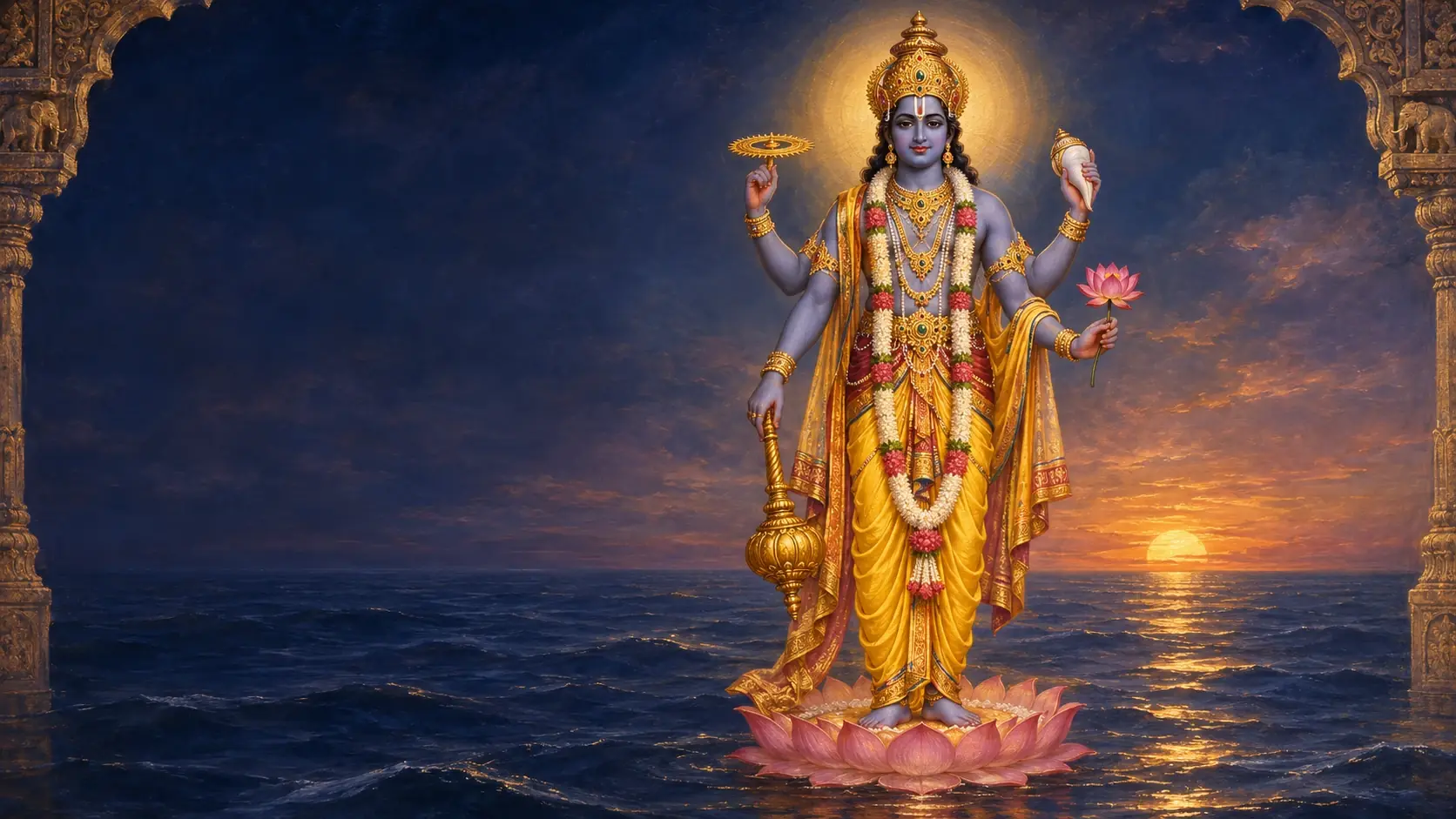
Why these ten, and why this order
Dashavatara simply means "the ten avatars", but no single list of ten is shared by every text. A reading path has to choose one and say so plainly.
This series follows the list in the Garuda Purana (1.86.10-11). There the ten are named in a passage that says Vishnu takes form "for the protection of dharma": the fish first, then the tortoise, the boar, the man-lion, Vamana, Parashurama, Rama the son of Dasharatha, Krishna, Buddha and Kalki. The Agni Purana tells the avatars in the same sequence in its opening chapters.
This is also the list most often printed and painted today, which makes it a practical place to begin. It is not the only authentic one.
Where other lists differ
Balarama, and no Buddha. Across much of South India, and in Sri Vaishnava teaching, Balarama is counted eighth and Krishna ninth, and the Buddha is not included.
Balarama and the Buddha, with Krishna as the source. Jayadeva's Dashavatara hymn in the Gita Govinda praises Matsya, Kurma, Varaha, Narasimha, Vamana, Parashurama, Rama, Balarama (as Haladhara, the bearer of the plough), Buddha and Kalki. Krishna is not one of the ten. The hymn is addressed to him as the one who takes all ten forms. Gaudiya Vaishnava tradition reads the avatars the same way, following the Bhagavata Purana's statement that Krishna is Bhagavan himself (1.3.28).
A regional ninth place. In Odisha, Jagannath is often shown in the ninth place. In Maharashtra and Goa, some depictions give it to Vithoba.
Longer lists. The Bhagavata Purana names twenty-two forms in one passage (1.3.6-25), including the sage Kapila, Dhanvantari and Vyasa, and then adds that the avatars are as countless as streams flowing from a lake that never runs dry (1.3.26).
None of this is confusion. Each list reflects what a text or a community most wanted to remember. Where a chapter in this series depends on one of these differences, it will say which tradition it is following.
Kalki: the avatar yet to come
Nine of the ten are told as things that have happened. Kalki is spoken of in the future tense. The Bhagavata Purana (12.2.18) places his birth at the end of Kali Yuga, in the village of Shambhala. This series will treat him as the tradition does: as something awaited, not as history.
How to read this series
Start with the opening feature, which explains who Vishnu is in Vaishnava traditions and what the word avatara means. After that, each chapter stands on its own. You can read them in order or go straight to the story you came for.
Every chapter names the texts its story comes from, and says so where tellings differ.