Why Does Vishnu Take Different Forms?
A fish in a flood. A tortoise under a mountain. A boar, a man-lion, a small brahmin boy who covers the worlds in three steps. A prince who walks into exile, and a cowherd who speaks the Bhagavad Gita on a battlefield.
Hindu tradition says all of these are one and the same Lord. So the question comes naturally: why does Vishnu take different forms?
Vaishnava traditions give a simple answer. The form changes because the need changes. Who comes, and why he comes, does not change. The Sanskrit word for this coming is avatara, and this whole series is built on it.
Who Is Vishnu?
The name Vishnu is traditionally explained from a Sanskrit root meaning "to pervade". He is the one who is present in everything.
He is praised already in the Rigveda, where a hymn (1.154) remembers the three great strides with which he measured out the worlds. In the epics and the Puranas he is Narayana, who rests on the serpent Shesha upon the cosmic ocean and holds creation together. When Brahma, Vishnu and Shiva are named side by side as the Trimurti, Vishnu is the one who preserves.
For his own devotees he is more than one of three. Sri Vaishnava and Madhva traditions worship Vishnu-Narayana, together with Lakshmi, as the Supreme Being. Gaudiya Vaishnavas and several other Krishna-centred traditions say the same of Krishna, and see Vishnu as his form. Smarta tradition honours Vishnu as one of five forms of the one reality.
What these traditions share is the conviction that the Lord does not stay distant.
What Avatara Means
Avatara comes from the Sanskrit ava, "down", and the root tri, "to cross". An avatar is a crossing down: a descent.
In plain language, three things are being said.
It is the Lord himself who comes. An avatar is not a messenger or a prophet sent on someone's behalf.
It is a choice, not a fate. Ordinary beings are born because of their karma. In the Bhagavad Gita (4.6) Krishna says that although he is unborn and the Lord of all beings, he comes into being through his own power.
It is for the world's sake. The descent has a purpose outside himself.
One detail is worth knowing. The Gita never uses the word avatara. Krishna says "I send myself forth" and "I come into being". The word itself became the standard name for these descents in the Puranas.
Later teachers also sorted the descents into kinds, some full and some partial. Those distinctions belong to particular schools, and the chapters ahead will name the school whenever they matter.
Descent and the Restoration of Dharma
The clearest statement of why the Lord descends is in the Bhagavad Gita.
Bhagavad Gita 4.7-8. यदा यदा हि धर्मस्य ग्लानिर्भवति भारत। अभ्युत्थानमधर्मस्य तदात्मानं सृजाम्यहम्॥ परित्राणाय साधूनां विनाशाय च दुष्कृताम्। धर्मसंस्थापनार्थाय सम्भवामि युगे युगे॥
"Whenever dharma declines, O Bharata, and adharma rises, I send myself forth. To protect the good, to destroy the wicked, and to set dharma firmly in place, I come into being age after age."
The Garuda Purana introduces its list of ten avatars with the same purpose (1.86.10): the forms are taken to protect dharma and to destroy adharma.
Dharma here means more than religion. It is the order that holds things together: truth, justice, right relationship, the balance of the worlds. Each avatar story follows the same three movements. Something that holds the world together is in danger. The Lord descends in exactly the form that moment needs. Balance is restored.
Story highlight. That is why the forms differ. A flood calls for a fish. A demon who cannot be killed by man or beast, by day or by night, calls for something that is neither, at an hour that is neither. A king's pride is answered by a boy who asks for almost nothing.
Devotional traditions add one more reason. The Lord also comes to be near those who love him: to be seen, remembered and sung.
The stories themselves are for the chapters that follow.
Shankha, Chakra, Gada, Padma: Reading the Four Hands
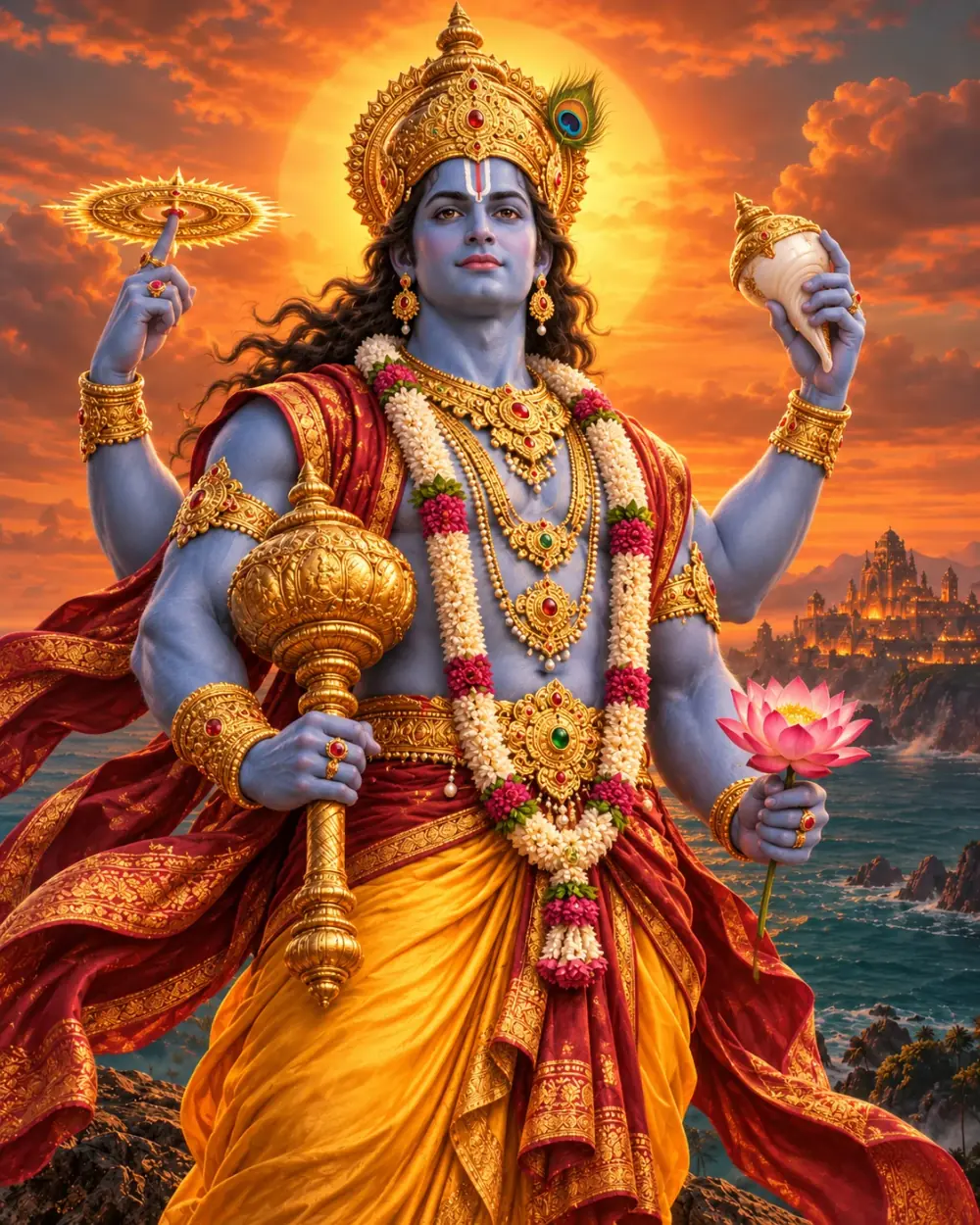
The portrait above shows Vishnu as he is most often pictured: four-armed, with one attribute for each hand. He balances the discus on a finger of his upper right hand and holds the conch in his upper left. His lower right hand holds the mace, and his lower left a lotus. These four are how he is recognised in temples and homes across India.
Shankha, the conch. His conch is named Panchajanya. A conch is blown to open worship, and in the epics to open battle. The Vishnu Purana (1.22) reads the conch, together with his bow, as the sense of self from which the elements and the senses unfold. Popular teaching hears in it the first sound, Om.
Chakra, the discus. His discus is Sudarshana, "fair to behold". The Vishnu Purana reads it as the mind, whose thoughts move faster than the wind. It is also widely understood as the wheel of time.
Gada, the mace. His mace is Kaumodaki. The Vishnu Purana reads it as intellect, the power of understanding. In everyday devotion it stands for strength, and for the authority to check what is wrong.
Padma, the lotus. The lotus grows in mud and stays unstained, so it is widely read as purity and as creation opening out. The Puranas describe Brahma seated on a lotus that rises from Vishnu's navel, which is why Vishnu is also called Padmanabha. The lotus is Lakshmi's flower as well.
Which hand holds which attribute is not fixed, and the arrangement in this painting is only one of many. Texts such as the Agni Purana (chapter 48) name twenty-four forms of Vishnu, among them Keshava, Narayana and Madhava, and tell them apart by how the four attributes are arranged. The next time you stand before an image of Vishnu, look at the hands first.
How Vishnu Is Worshipped
Vishnu is worshipped under many names. The Vishnu Sahasranama, his thousand names, is taught by Bhishma to Yudhishthira in the Anushasana Parva of the Mahabharata and is recited daily in many homes. Ekadashi, the eleventh day of each lunar fortnight, is kept for him, and tulsi leaves are offered in his worship.
Among his great temples are Ranganathaswamy at Srirangam, Venkateswara at Tirumala, Badrinath in the Himalaya, Jagannath at Puri and Padmanabhaswamy at Thiruvananthapuram. The Tamil Alvar saints sang of 108 sacred abodes, the Divya Desams.
What Comes Next
Vishnu: Dashavatara and Beyond takes the avatars one chapter at a time. The reading path begins with the ten best-known avatars, from Matsya the fish to Kalki, who is yet to come, and then goes on to forms honoured in particular texts and regions.
Lists of the ten differ, and the series page explains which list it follows and why. Each chapter will tell one story in full and name the texts it comes from.