
The Sanatan Way
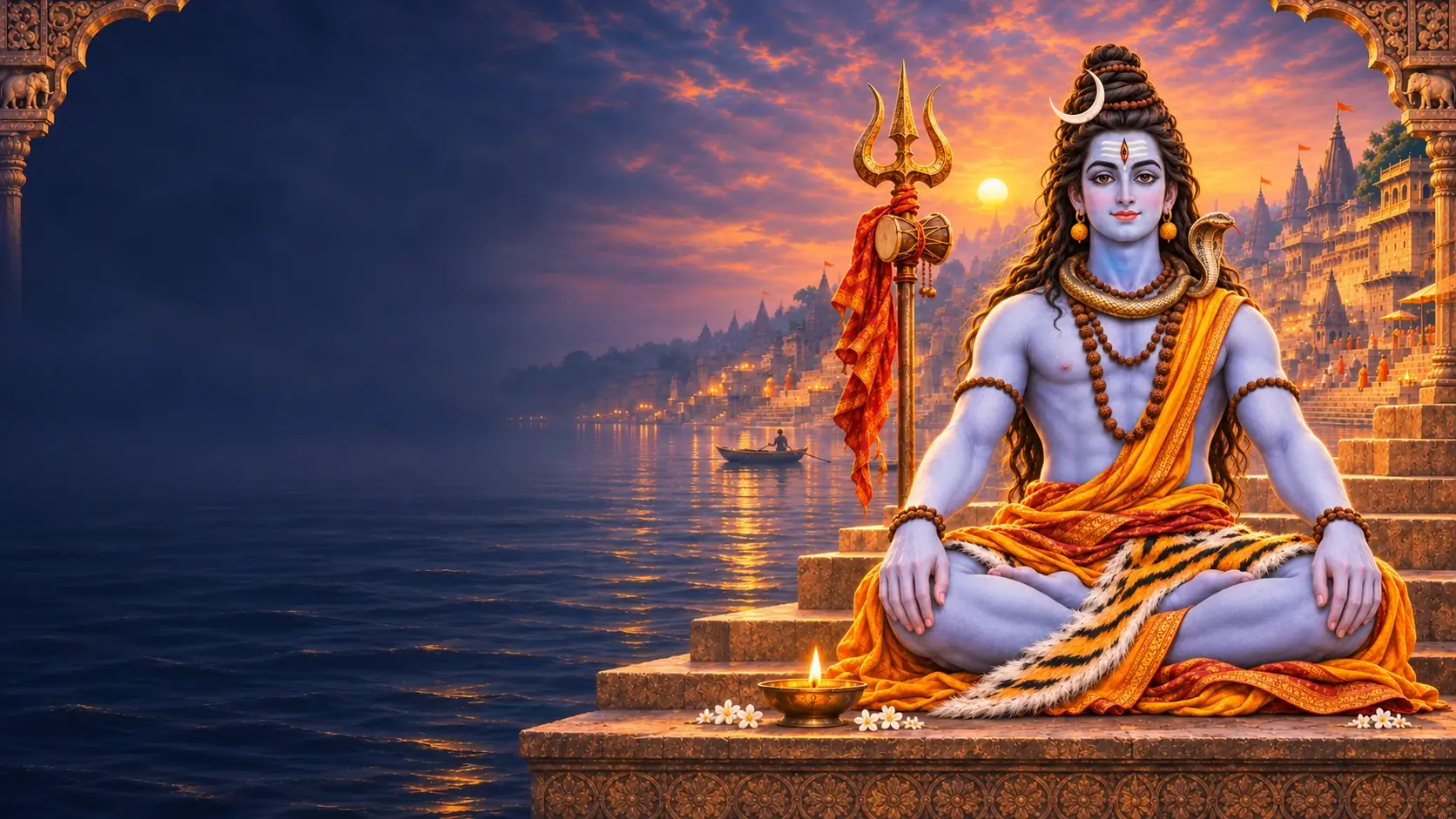
Shiva seated cross-legged on carved stone ghat steps at the right of a wide dawn scene in Varanasi. A crescent moon rests in his matted hair, his throat is blue, a cobra coils at his neck, and a trishul hung with a damaru and a red cloth stands beside him. A brass lamp burns before him. To the left, the Ganga stretches into the morning mist with a lone boat, lamp-lit temples line the far ghats, and carved stone arches frame the upper corners.

A Divine League series

Shiva: Forms and Avatars

The forms Shiva is worshipped in, and the manifestations particular texts describe.

Shiva is worshipped as the dancer, the teacher, the fierce guardian and the Lord who is half Parvati. This series looks at those forms one by one, and at the manifestations that specific texts call his avataras, using each source's own words.

The reading path

Chapters

Every chapter is listed here. A chapter opens once its profile is published.

Forms of Shiva

Temple and Agamic traditions speak of Shiva's forms (murti, rupa): ways the one Lord is seen and worshipped, not separate births.

The list used hereShaiva Siddhanta and the temple traditions of the South hold that Shiva is never born, and speak of forms he takes for a purpose. Each chapter names the temple and the tradition its form is most tied to.

  • NatarajaनटराजThe Lord of the dance at Chidambaram. The Tamil Shaiva Siddhanta text Unmai Vilakkam (verse 36) reads his dance as the five acts: creation, preservation, dissolution, concealment and grace.Upcoming chapter
  • Kaal Bhairavकाल भैरवThe fierce guardian form, honoured in Kashi as the city's kotwal. The Shiva Purana tells of Bhairava in its Shatarudra Samhita (chapters 8 and 9).Upcoming chapter
  • Ardhanarishvaraअर्धनारीश्वरHalf Shiva, half Parvati, in one body. The Shatarudra Samhita (chapter 3) tells of this form in its account of creation.Upcoming chapter
  • Dakshinamurtiदक्षिणामूर्तिThe south-facing teacher who instructs the sages in silence.Upcoming chapter
  • Lingodbhavaलिंगोद्भवShiva appearing from a pillar of fire that has no beginning and no end, while Brahma and Vishnu search for its limits.Upcoming chapter

Manifestations described in specific sources

The Shatarudra Samhita of the Shiva Purana uses the word avatara for many of these. Other Shaiva schools avoid that word. Each chapter keeps the term its source uses and says where traditions differ.

The list used hereThe Shatarudra Samhita includes, among others, the five forms beginning with Sadyojata (chapter 1), the eight forms (chapter 2), the twenty-eight Yogeshvara incarnations of the Dvapara ages, ending with Lakulin (chapters 4 and 5), Nandishvara (chapters 6 and 7), Sharabha (chapters 11 and 12), Durvasa (chapter 19), Hanuman (chapter 20), Kirata (chapters 37 to 41) and the twelve Jyotirlingas (chapter 42). Chapter numbers follow J. L. Shastri's translation.

  • Virabhadraवीरभद्रThe warrior who rises from Shiva's matted hair in his anger at Daksha's sacrifice. The Shiva Purana tells it in the Sati Khanda of the Rudra Samhita (chapters 32 to 37).Upcoming chapter
  • SharabhaशरभThe form the Shatarudra Samhita (chapters 11 and 12) says Shiva took to calm Narasimha. Vaishnava tellings differ sharply, and the chapter will say so.Upcoming chapter
  • Nandishvaraनंदीश्वरTold in the Shatarudra Samhita (chapters 6 and 7) as an avatara of Shiva, born as the son of the sage Shilada.Upcoming chapter
  • KirataकिरातThe mountain hunter who tests Arjuna before granting him the Pashupata weapon, told in the Mahabharata and in the Shatarudra Samhita (chapters 37 to 41).Upcoming chapter
  • LakulishaलकुलीशThe last of the twenty-eight Yogeshvara incarnations in the Shatarudra Samhita (chapter 5), where he is called Lakulin, revered as the teacher of the Pashupata tradition.Upcoming chapter

Forms and avatars: why this series has two parts

The Vishnu series is built on one word, avatara: the Lord descends, is born, and lives a story in the world. Shiva's traditions do not all use that word, and the difference is worth keeping.

Shaiva Siddhanta, the great Agamic tradition of the South, holds that Shiva is never born from a womb. He shows himself in forms (murti, rupa) for a purpose and remains what he is. Temples are built around these forms: the dancer at Chidambaram, the teacher facing south, the fierce guardian of Kashi.

Other texts speak more freely. The Shatarudra Samhita of the Shiva Purana opens by promising to narrate the incarnations of Shiva, and goes on to tell of many: Nandishvara, Sharabha, Durvasa, Hanuman, the hunter Kirata and others.

So the series keeps them in two groups. The forms of Shiva come first, each with the temple and tradition it is most tied to. The manifestations described in specific sources follow, each told in its own source's words.

Where traditions differ

Hanuman. The Shatarudra Samhita (chapter 20) calls Hanuman an incarnation of Shiva. Many Vaishnava tellings, and the Valmiki Ramayana itself, speak of him as the son of Vayu without that connection. His profile in the League notes both.

Sharabha and Narasimha. The Shatarudra Samhita tells of Shiva taking the form of Sharabha to calm Narasimha's fury. Vaishnava traditions do not accept this ending, and some tell a reply of their own. The chapter will set the tellings side by side.

How many, and in what order. The Shiva Purana gives several lists, of five forms, of eight forms, of twenty-eight Yogeshvara incarnations across the ages, and of the twelve Jyotirlingas as incarnations. Other Puranas count differently. The series groups manifestations by source rather than merging them into one list.

How to read this series

Start with the opening feature, which begins at a small shrine in Kashi and asks how the Lord of the Universe becomes someone a devotee can call Baba. After that, each chapter stands on its own.

Every chapter names the texts its story comes from, and says so where tellings differ.

Sources and traditions

A note on traditions

Whether Shiva takes avataras at all is answered differently: the Shiva Purana's Shatarudra Samhita speaks freely of avataras, while Shaiva Siddhanta speaks of forms assumed by a Lord who is never born. Whether Hanuman is an avatara of Shiva, and how the Sharabha and Narasimha story ends, differ between Shaiva and Vaishnava tellings. This series reports each source in its own words and does not rank them.

  1. Shiva Purana, Shatarudra Samhita. Opens with the promise to narrate the incarnations of Shiva (1.2). Chapters cited in the outline: 1 to 7, 8 and 9 (Bhairava), 11 and 12 (Sharabha), 19, 20 (Hanuman), 37 to 41 (Kirata) and 42 (the Jyotirlingas). Checked in J. L. Shastri's translation.
  2. Shiva Purana, Rudra Samhita, Sati Khanda, chapters 32 to 37. Virabhadra is born from Shiva's matted hair and destroys Daksha's sacrifice.
  3. Unmai Vilakkam, verse 36. The Shaiva Siddhanta reading of Nataraja's dance as the five acts, as quoted in Ananda K. Coomaraswamy's essay The Dance of Shiva (1918).

Every week

The Divine League publishes one feature a week. Chapters of this series arrive in that same weekly rhythm, alongside the League's other profiles, so the next chapter may not be the very next feature.

← Back to the League

🙏

Stay on the Path

Get notified when we publish new articles. No spam, just pure Sanatan Dharma knowledge.

Subscribe