A Lota of Water in Kashi
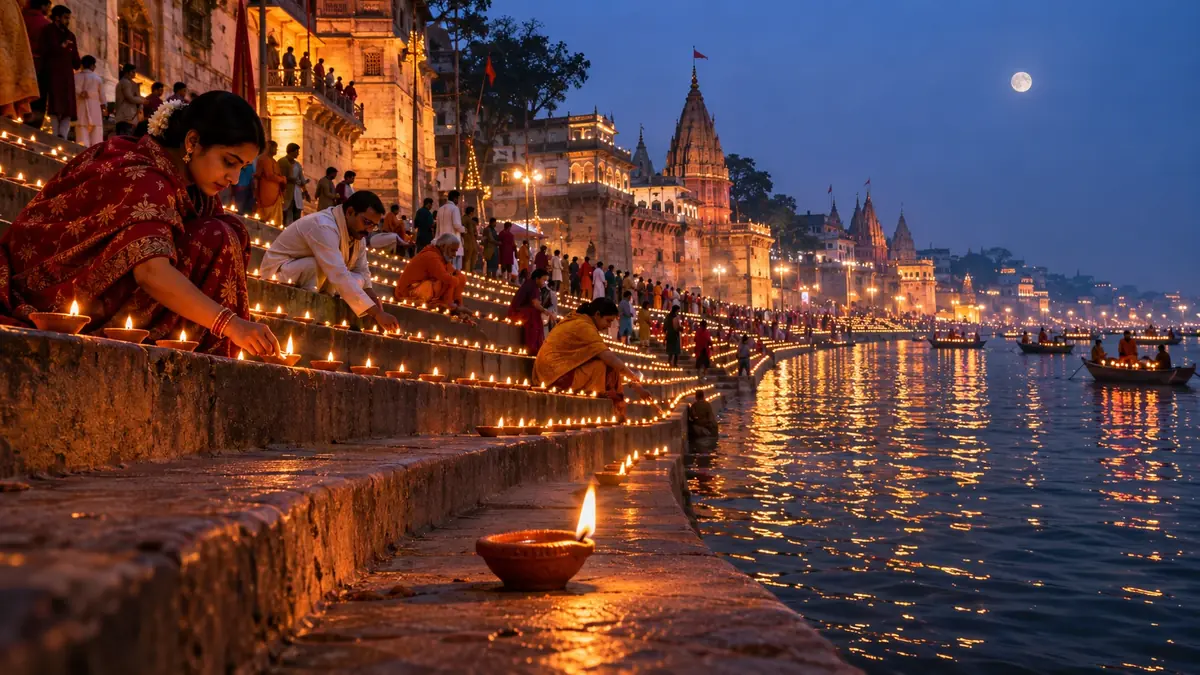
Picture a small Shiva shrine in one of the lanes of Kashi, not much wider than a doorway. A brass bell hangs from a chain, worn bright where a thousand hands have rung it. Inside, a dark stone Shivalinga sits in its basin, wet and cool, with a few bel leaves resting on top.
A devotee comes in on the way back from the river, a brass lota of Ganga water in one hand. There is no priest and no ceremony. The devotee tips the lota, and the water runs slowly over the linga and down into the basin. Then, under their breath, the devotee speaks to the Lord the way you would speak to someone at home: "Baba."
That one word holds a puzzle. The Lord of this shrine is Vishwanath, the Lord of the Universe, whom the Puranas describe as beyond all measure. How does the Lord of the Universe become someone a devotee can speak to so intimately?
Kashi's answer is in the two names it uses for him most.
Vishwanath and Bholenath
Vishwanath joins vishva, "all, the universe", and natha, "lord". It is the name of the presiding deity of Kashi, whose Jyotirlinga stands in the Kashi Vishwanath temple, and it says how vast he is. When the Shiva Purana lists the twelve Jyotirlingas (Koti Rudra Samhita 1.21-24), the one in Varanasi is Vishvesha, the Lord of all.
Bholenath comes from everyday Hindi, not from Sanskrit scripture. Bhola means simple, guileless, without calculation. Bholenath is the Lord who is easily pleased, the meaning carried in Sanskrit by the epithet Ashutosha, "quickly satisfied". In the Shiva Purana, Parvati's mother Mena says it to him directly: you are quickly pleased. The name says how near he is.
The Shiva Purana (Koti Rudra Samhita, chapter 40) tells a story that devotees use to explain the second name.
Story highlight. A hunter named Gurudruha climbs a bilva tree to wait for deer through the night of Shivaratri. Hungry and wakeful, he shifts on the branch, and bel leaves and drops of water from his pot fall on a Shivalinga hidden below. He has no idea he is worshipping. By morning, the story says, that unknowing offering and that sleepless night have won him Shiva's grace.
Both names belong in any introduction to Mahadev, because Shaiva devotion holds them together. The Lord of the Universe has no need of anything. That is exactly why a little water and a leaf are enough.
Kashi lives this every day. Pilgrims carry Ganga water up from the ghats to pour on the Jyotirlinga, and households keep their own small linga for the same offering. Bel leaves are sold in bundles at the temple lanes. People greet one another with Har Har Mahadev, and when they speak of the presiding deity they say Baba Vishwanath, as one would speak of the eldest of a family. The Shiva Purana calls the city Avimukta, "never abandoned" (Koti Rudra Samhita 23.22), because Shiva never leaves it.
So the answer to the puzzle is that the devotee is not choosing between the two names. Vishwanath tells you who it is you are speaking to. Bholenath tells you that he will listen. "Baba" holds both at once.
Reading Shiva's Portrait
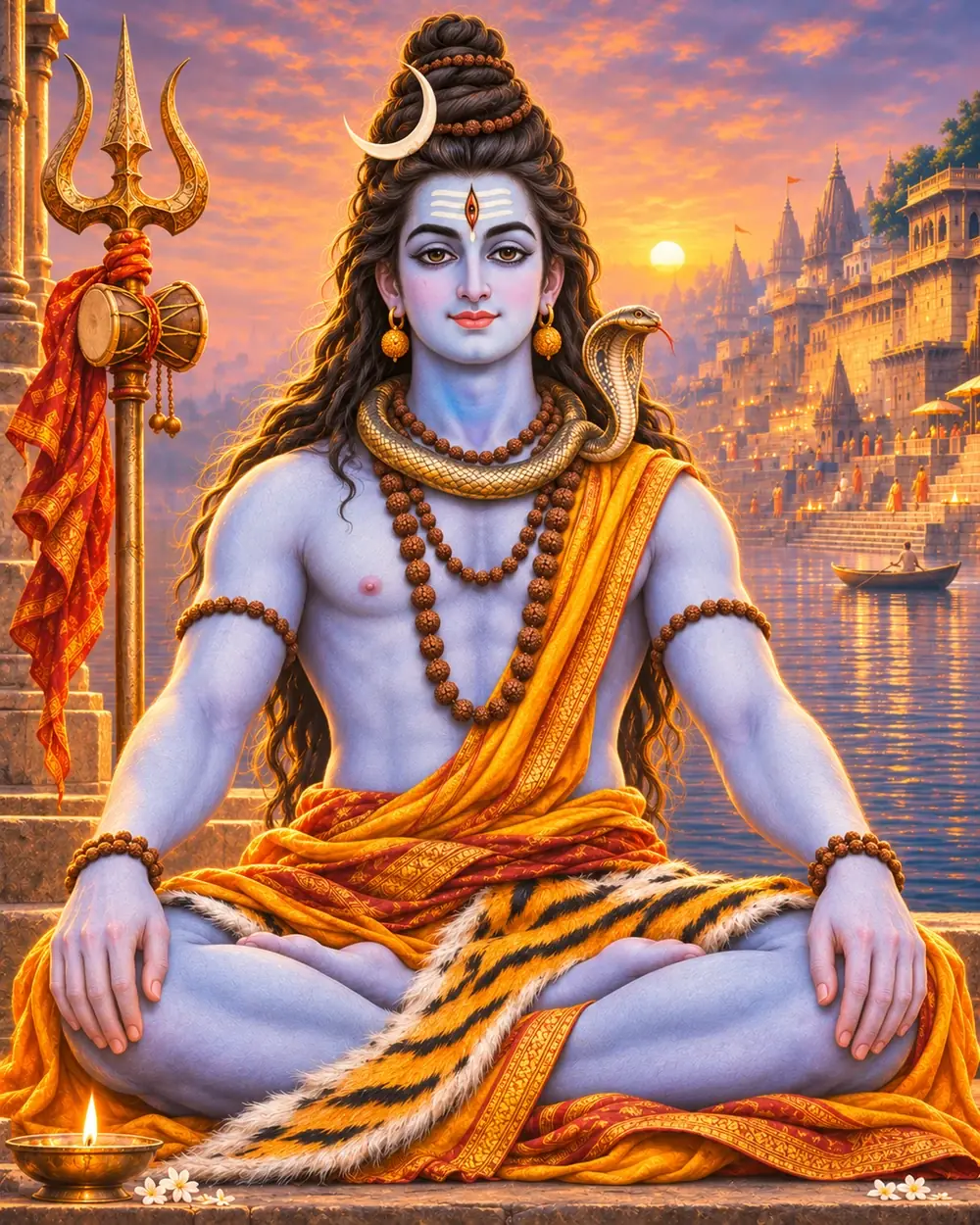
The portrait above shows Shiva as he is often painted in North India: seated in meditation, ash-pale, with matted hair piled high and the Ganga flowing behind him. Look closely and three details tell you three stories.
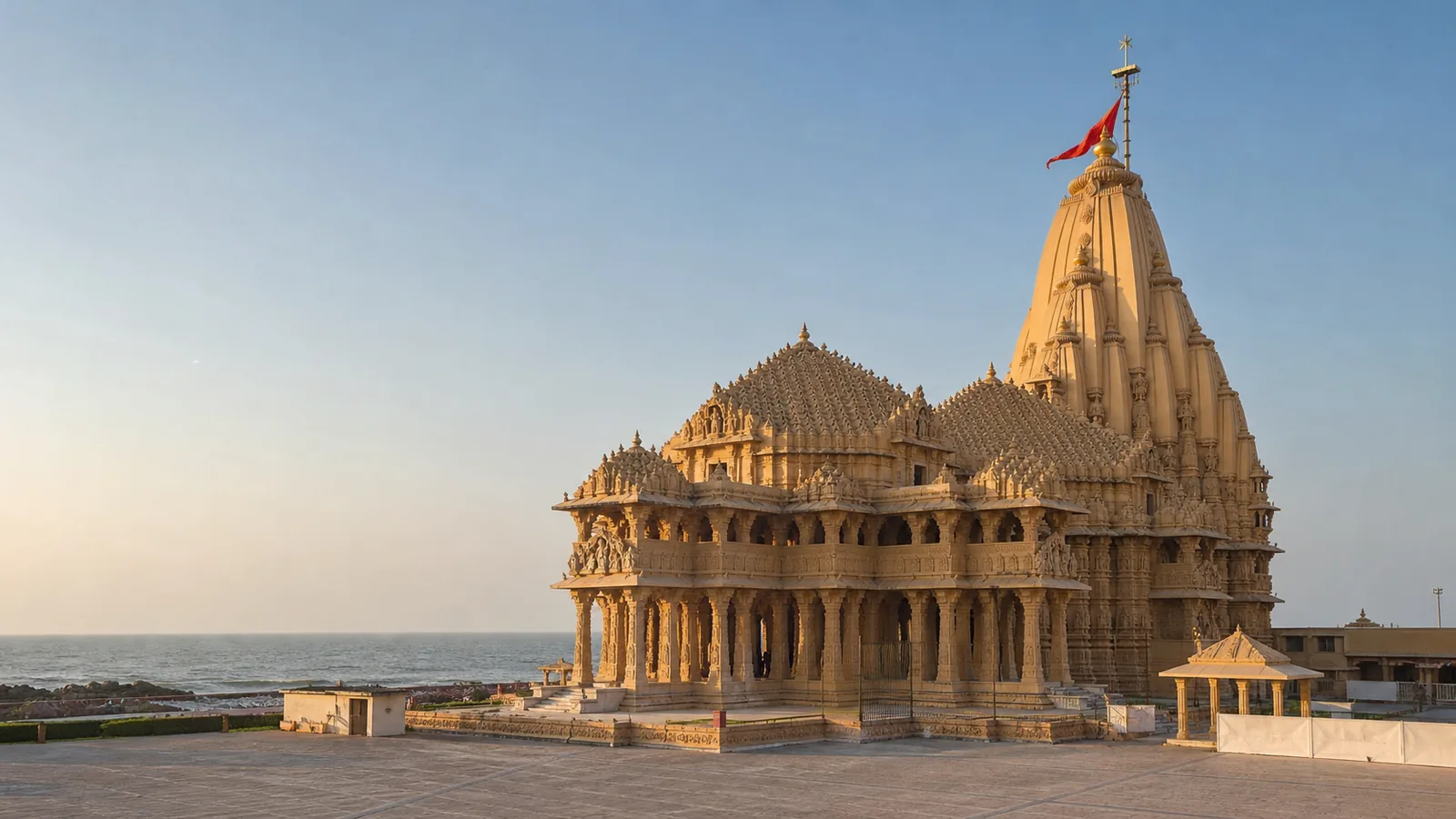
The crescent in his hair. Shiva is called Chandrashekhara, "the one who wears the moon as a crest". The Shiva Purana tells how the Moon married the twenty-seven daughters of Daksha but loved only Rohini. Daksha cursed him to waste away. The Moon worshipped Shiva at Prabhasa, and Shiva softened the curse so that he wanes for one fortnight and waxes in the next (Koti Rudra Samhita, chapter 14). Shiva stayed there as Someshvara, and the shrine is Somnath, the Lord of the Moon. The Purana tells this as the origin of Somnath, and devotion reads the crescent on Shiva's head through it: a sign of refuge, in which even what is waning is held up.
The blue throat. Shiva is Nilakantha, "the blue-throated one", and the story behind the name begins with a churning. The devas and the asuras churned the ocean of milk for the nectar of immortality, using the mountain Mandara as the churning rod and the serpent Vasuki as the rope. Before any nectar appeared, a deadly poison called halahala rose from the waters and began to burn the worlds. The gods turned to Shiva. Out of compassion, and with the assent of Bhavani, his consort, he took the poison in his palm and drank it. The poison stayed in his throat and turned it blue. The Bhagavata Purana tells this in 8.7.40-43 and adds that the blue mark became an ornament to him. A telling of the churning in the Mahabharata's Adi Parva (section 18 in Ganguli's translation) says that from that day he was called Nilakantha. Popular devotion adds that he held the poison in his throat so that it would reach neither the worlds outside nor the worlds within him.
The trishul. The trident stands beside him, hung with the small damaru drum. A trident is first of all a weapon, the one with which Shiva protects. Popular teaching reads its three points as the three qualities of nature (sattva, rajas and tamas), or as past, present and future, all held in one hand. Kashi has its own reading, and it is in the Shiva Purana: Kashi is supported by Shiva on his trident, and so the city does not perish when the worlds dissolve (Koti Rudra Samhita 22.15 and 23.23).
Meeting Shiva in Different Forms
The seated yogi of this portrait is one way Shiva is seen. Temples across India show many others. Three of them give a sense of the range.
Nataraja is the Lord of the dance: at Chidambaram he dances inside a ring of flame, one foot raised and the other planted on a small figure of ignorance, keeping the universe in rhythm.
Bhairava is the fierce one, who severed the fifth head of Brahma and wandered with the skull stuck to his hand until it fell away in Kashi, where Kashi honours him as its guardian, its kotwal.
Ardhanarishvara is the Lord who is half woman: the right half of one body is Shiva, the left half is Parvati, and the two cannot be told apart at the seam.
These three are forms. That word matters, and it is why this series is built in two parts.
The Vishnu chapter was about avatara, a descent in which the Lord comes into the world and lives a story within it. Shaiva traditions speak of Shiva differently. Shaiva Siddhanta teaches that Shiva is never born from a womb. He shows himself in forms (murti, rupa) for a purpose, while remaining what he is. Nataraja, Bhairava and Ardhanarishvara are forms in this sense: ways of seeing and worshipping one Lord.
Some texts do use the word avatara for Shiva. The Shatarudra Samhita of the Shiva Purana opens by promising to narrate "the incarnations of Shiva" and describes a long series of them, including Nandishvara (chapter 6), Sharabha (chapter 12), Hanuman (chapter 20) and the hunter Kirata who tested Arjuna (chapter 41). The same Samhita tells of Ardhanarishvara (chapter 3) and Bhairava (chapters 8 and 9). So the series keeps the two apart. The first part takes the forms of worship, each with its temple and tradition. The second takes the manifestations that particular texts call avataras, each in its source's own words. The full stories belong to their own chapters.
Hari and Hara in Kashi
There is a day in Kashi when the Vishnu chapter and this one meet.
On Vaikuntha Chaturdashi, the fourteenth day of the bright fortnight of Kartik, Kashi worships Vishnu and Shiva together. The story told for the day comes from the Shiva Purana (Koti Rudra Samhita, chapter 34). Vishnu vowed to worship Shiva with a thousand lotuses. One lotus was missing, so Vishnu, whose eyes are likened to lotuses, offered one of his own eyes to complete the count. Shiva gave him the Sudarshana chakra, the discus the Vishnu chapter saw balanced on his finger. The Purana sets the episode on Kailasa and gives it no date; Kashi's festival tradition remembers it on this day.
In 2026, Vaikuntha Chaturdashi falls on Monday 23 November. Drik Panchang for Varanasi gives the Chaturdashi tithi from 2:36 AM to 11:42 PM that day. The next day, Tuesday 24 November, is Kartik Purnima, when Kashi lights its ghats for Dev Deepawali.
What Comes Next
Shiva: Forms and Avatars takes these one chapter at a time. It begins with the forms of worship, Nataraja, Kaal Bhairav, Ardhanarishvara, Dakshinamurti and Lingodbhava, and then turns to the manifestations described in specific texts.
Each chapter will tell its story in full, name the text it comes from, and say where traditions tell it differently.