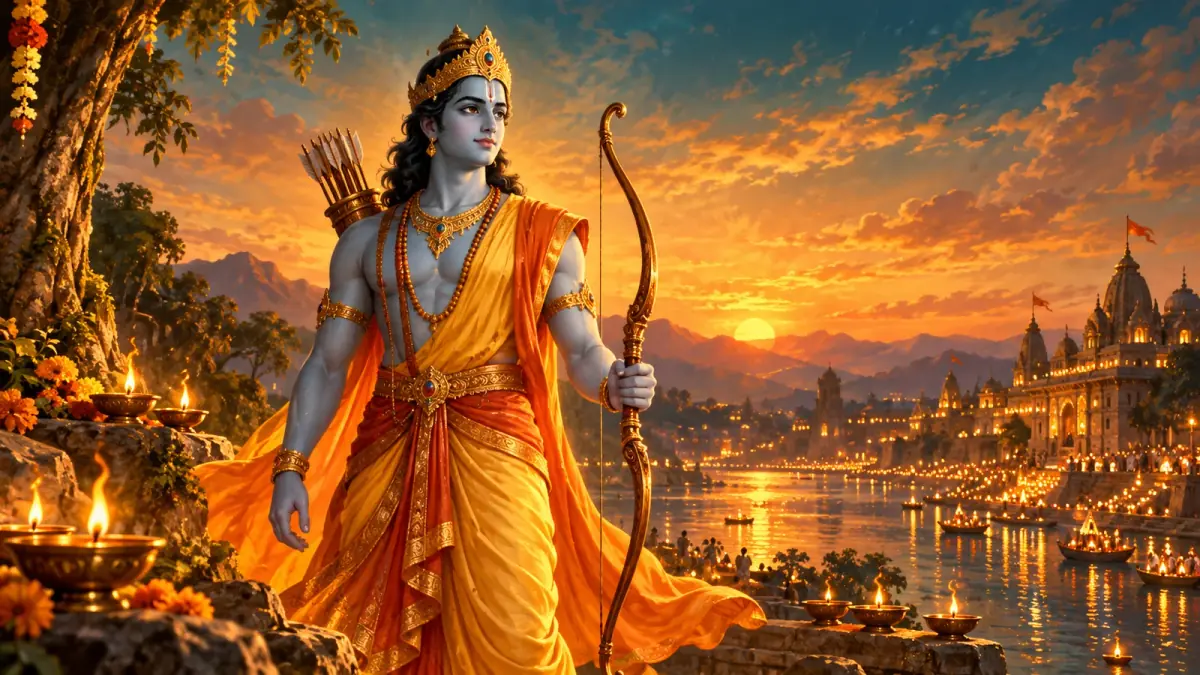
The Shore Facing Lanka
The search had reached the end of the land. Before the vanara army lay the southern ocean, a hundred yojanas of open water, and somewhere beyond it Sita was held captive. One by one the great warriors measured their strength against the sea and fell silent. Angada said he could reach Lanka, but was not sure he could make it back.
Through all of it, one of them sat apart and said nothing.
It was the old bear-king Jambavan who turned to him. He reminded Hanuman of who he was: the son of the wind, born to Anjana, the child who once leapt into the sky toward the rising sun. As Jambavan spoke, Hanuman rose and grew, until he stood on Mount Mahendra ready to cross the ocean in a single bound.
Story highlight. Hanuman's greatest strength is not his power but how lightly he holds it. He does not ask for the leap. He waits until he is needed.
The Child Who Reached for the Sun
Jambavan's reminder carried a story the Ramayana tells of Hanuman's birth. He was born to Anjana and Kesari, with Vayu, the wind, as his divine father. As an infant he saw the rising sun, took it for a ripe fruit, and leapt for it. Indra struck him down with the vajra, and the blow marked his jaw, his hanu. The name Hanuman stayed with him.
Grieving for his son, Vayu withdrew the wind from the worlds, and every living being began to suffer. The gods came to restore the child, and blessed him with strength and protection.
Later tellings add one more turn. As a restless child Hanuman troubled the sages of the forest, and they laid a curse on him: he would forget his own power until someone reminded him of it. That is why he sat silent on the shore. It also says something true about him. His strength was always meant for someone else.
A Voice That Won Rama
Long before the ocean, Hanuman had already met the prince he would serve for life. He was then the minister of Sugriva, the vanara king living in exile on the hill of Rishyamuka. When two armed strangers came walking through the forest, Sugriva feared they had been sent by his brother Vali. Hanuman went down to meet them, disguised as a wandering ascetic.
The strangers were Rama and Lakshmana, searching for Sita. Rama listened to Hanuman speak and was struck by it: the clarity, the poise, the courtesy. He told Lakshmana that no one could speak like this without deep learning. From that meeting came the friendship between Rama and Sugriva, and the beginning of a devotion that never wavered.
Across the Ocean
The leap is one of the great journeys of Indian literature, and the Sundara Kanda tells it in full. The ocean sends up the mountain Mainaka to offer him rest; Hanuman touches it in thanks and flies on. Surasa, mother of serpents, blocks his path and demands that he enter her mouth. He grows larger, and she opens wider. Then, in an instant, he shrinks to the size of a thumb, passes in and out, and she blesses him on his way. Simhika, a demoness who seizes creatures by their shadows, drags him down by his reflection on the water, and he destroys her.
He reaches Lanka at dusk and searches the golden city through the night, palace by palace, until he finds Sita in the Ashoka grove, worn with grief and surrounded by guards. He waits in the branches. He watches Ravana come to threaten her. Only when the grove falls quiet does he speak, softly telling the story of Rama so she will know he is a friend.
He gives her Rama's ring. He offers to carry her home on his back. She refuses: Rama himself must come for her. Instead she gives Hanuman her jewel, the chudamani, to take back as a sign.
Story highlight. Before leaving, Hanuman lets himself be captured so that he can stand before Ravana and warn him. When the court sets his tail on fire, he turns that fire on Lanka itself. Then, in the middle of the blaze, fear seizes him: what if the flames have reached Sita? He hurries back to the grove and finds her unharmed.
The Sundara Kanda, the book of this journey, is the part of the Ramayana many families read as a complete recitation, especially in difficult times.
The Mountain in His Hands
In the war that followed, Lakshmana fell in battle. The physician Sushena named healing herbs that grew only on a mountain far to the north, in the Himalaya. Hanuman flew there through the night. When he could not tell which plants were the right ones, he lifted the whole mountain and carried it back to the battlefield. Popular tradition calls it Dronagiri.
The image of Hanuman in flight, mace in one hand and a mountain on the other palm, became one of the best loved in Indian art. It is painted on temple walls, printed on calendars and carried in pocket shrines across the country.
The Old Monkey on the Road
Hanuman's story does not end with the Ramayana. In the Mahabharata, during the Pandavas' exile, Bhima goes in search of a fragrant flower for Draupadi and finds his way blocked by an old monkey lying across the path. Proud of his strength, Bhima tells it to move. The monkey says it is too old; Bhima may move its tail aside himself. Bhima tries with all his might, and cannot lift it.
The monkey is Hanuman, who like Bhima is a son of Vayu. He reveals himself to his younger brother and teaches him about humility and dharma. Tradition holds that he promised to be present in the coming war, and Arjuna's chariot flies a banner with the monkey emblem identified with him.
What Hanuman Teaches
Hanuman is the ideal of dasya bhakti, devotion expressed as service. Strength, speed, intelligence and eloquence are all his, and none of them are for himself. In every telling, he credits his victories to Rama.
He is also counted among the chiranjivis, those said to live through the ages. Many devotees believe that wherever the story of Rama is told, Hanuman is present to listen.
Worship, Festivals and Temples
Tuesday and Saturday are widely kept for Hanuman. Devotees recite the Hanuman Chalisa or the Sundara Kanda, offer sindoor and oil, and visit his shrines, which stand at the edge of countless villages and along many roads. His images are often coated in bright orange sindoor, and he appears in several forms: kneeling before Rama with folded hands, striding with his mace raised, or as the five-faced Panchamukhi Hanuman.
Hanuman Jayanti is celebrated on different dates in different regions, as the note on traditions below explains. Among his best known temples are Sankat Mochan in Varanasi, Hanuman Garhi in Ayodhya, Salasar Balaji in Rajasthan, Jakhu in Shimla and Namakkal Anjaneyar in Tamil Nadu. At Rameshwaram, the temple's own tradition honours the linga Hanuman is said to have brought.