Where Shri Rama Bowed to Bhagwan Shiva at the Edge of the Sea
Before first light the lane running east from the temple fills with people carrying nothing but a change of clothes. They walk to the water and step in. Behind them the great east tower stands against a sky that has not yet chosen a colour. The district administration describes that shore in one plain sentence — a calm, shallow spread of sea, barely a hundred metres in front of the temple gopuram. Pilgrims know it by another name. It is Agni Theertham, and the yatra begins in the water.
This is Rameshwaram Jyotirlinga, enshrined in the Arulmigu Ramanathaswamy Temple at Rameswaram, on Pamban Island in Ramanathapuram district, Tamil Nadu — the southernmost of all the twelve. It is also the Jyotirlinga where a Vaishnava story is told inside a Shaiva sanctum. The district administration writes that the temple marks the confluence of Shaivism and Vaishnavism and is revered by both; the temple's own administration calls Rameswaram a supreme sacred site not only for Shaivas but also for Vaishnavas, and an abode of India's unity.
This is article #11 in our weekly "12 Mondays, 12 Jyotirlingas" journey. After the sea at Somnath, the hills of Srisailam, the ghats of Ujjain, the island in the Narmada, the snows of Kedarnath, the forest of Bhimashankar, the lanes of Kashi, the river-source at Trimbakeshwar, the healer's courtyard at Baidyanath and the underground sanctum at Nageshwar, the yatra reaches the last land before Lanka. One abode remains after this — Grishneshwar, next Monday, where the journey ends.
Rameshwaram Jyotirlinga at a Glance
| Detail | Information |
|---|---|
| Temple | Arulmigu Ramanathaswamy Temple, Rameswaram – 623526, Ramanathapuram District |
| Deity | Bhagwan Shiva as Ramanathaswamy; the goddess as Parvathavardhini |
| Spiritual status | One of the 12 Jyotirlingas; named in the Dvadasha Jyotirlinga Stotra as Setubandhe tu Rāmeśam — seventh in the stotra's order, #11 in our series |
| Char Dham | Called one of the four Char Dham by Tamil Nadu Tourism and Incredible India's destination page; the temple lists Dwaraka, Puri, Badrinath and Rameswaram, the last being the only Shiva shrine among them |
| Location | Pamban Island, Ramanathapuram district, Tamil Nadu; Palk Bay north, Gulf of Mannar south |
| Temple form | Three prakarams, four gopurams; outer corridor 690 × 435 ft, height 22 ft 7½ in, 1,212 pillars (HR&CE) |
| Site area | About 15 acres (HR&CE) |
| Theerthams | 22 inside the temple; Agni Theertham is the sea outside, not one of the 22; 64 island-wide per Tamil Nadu Tourism |
| Great days | No festival calendar is published; the one dated record places the Theppa Utsavam and Theerthavari on the Ayilyam nakshatra |
| Nearest railhead | Rameswaram (RMM), Southern Railway — about 1.3 km from the temple |
| Nearest airports | Madurai (IXM), about 165–180 km on different official pages; Thoothukudi, about 195 km |
The Meaning of "Rameshwaram"
The temple administration gives the name its simplest reading: because Shri Rama worshipped Eeswaran — Shiva — this shrine received the name Ramesuram. In Sanskrit Rāma + Īśvara becomes Rāmeśvara, the Īśvara whom Rama worshipped; the deity's name, Ramanathaswamy, is Rāma-nātha, the Lord of Rama.
A second reading circulates widely in devotional writing — that the same sandhi permits Rāma eva Īśvaraḥ, Rama who is himself the Lord, and that Vaishnavas have long heard it that way. We could not trace it to any official page or named scholar, so we offer it as a much-loved gloss rather than a documented etymology. The harmony it is used to prove is on record independently, in the district's own words and in the Shaiva canon itself.
On spelling: across the HR&CE site, the Ministry of Tourism, Tamil Nadu Tourism and the district administration, the prevailing government spelling of the town is Rameswaram. Rameshwaram, the transliteration our series uses for the Jyotirlinga, appears even on one Tamil Nadu Tourism page. Neither is a declared official spelling; both are usage.
The Twelve Jyotirlingas and the Char Dham
Every Shiva bhakta who recites the Dvadasha Jyotirlinga Stotra has already spoken this tirtha's address:
सेतुबन्धे तु रामेशं नागेशं दारुकावने ।
Setubandhe tu Rāmeśam — Ramesha at Setubandha — paired in one line with Nagesha in the Daruka forest. Two clarifications. In the stotra's own recitation order Rameshwaram stands seventh of twelve; #11 is the order of our Monday journey, not a scriptural rank. And the stotra is traditionally attributed to Adi Shankaracharya, an attribution we could not verify against any critical edition. Follow all twelve abodes in our 12 Jyotirlingas series.
On the Char Dham, read the sources closely. Tamil Nadu Tourism calls Rameswaram one of the four Char Dham sites, as does Incredible India's destination page — though its own temple page does not mention the Char Dham, and nor does the district page. The temple administration states the fourfold scheme without using the term: of the four holy shrines of Bharat, three lie north — Dwaraka, Puri and Badrinath — and one south, Rameswaram; and of the four, Rameswaram alone is a Shiva shrine. That is the temple's own observation, and a quietly remarkable one: the single Shaiva station in a circuit otherwise held by Vishnu. No government source credits anyone with founding the circuit; the attribution to Adi Shankaracharya comes from the Advaita tradition itself rather than any dated record. Keep this Char Dham distinct from Uttarakhand's Chota Char Dham — Yamunotri, Gangotri, Kedarnath, Badrinath — which we travelled in our Kedarnath article.
The Katha: A Vow, a Sand Linga, and an Errand to Kailash
First, the temple's own hedge. Its Tamil page introduces this account with the phrase "so the Puranas say", and its English page opens with "The Puranas say that…". If the administration that owns the shrine reports its account as tradition, no article has licence to say more. Everything below is narrated as tradition.
After the war in Lanka, Shri Rama returned carrying the brahmahatya dosha — the sin of killing a brahmin, incurred by slaying Ravana. The temple names the sin and stops. The explanation comes from the Setu Mahatmya material, in the Kanchi Kamakoti Peetham's condensed rendering, which glosses it as the killing of brahmanas such as Ravana, Kumbhakarna and Indrajit.
On the advice of the sage Agastya — a detail unique to the temple's own telling — Rama came to this shore with Mata Sita and Lakshmana to consecrate a Shivalinga. An auspicious hour was fixed and Hanuman was sent for a linga. Where he was sent is itself disputed among official sources: the temple and Incredible India say Mount Kailash; Tamil Nadu Tourism says Kashi; the district names no origin. He was delayed — because Kailasa was far off, says the temple; because he had to meditate for days before obtaining Shiva's darshan, says the Setu Mahatmya material.
The hour, meanwhile, was running out. And so, in the temple's own phrasing, Sita playfully took sand in her hand and made a Shivalinga, and that linga was consecrated and worshipped before the muhurta lapsed. This is the Ramalingam, which the Ministry of Tourism's feature says is believed to be the lingam in the sanctum today.
Hanuman returned to find the rite completed, and was angry. The temple records only that he tried in vain to remove the consecrated sand linga. The famous detail that he used his tail is a popular retelling, on no government page — and in the Setu Mahatmya rendering there is no uprooting attempt at all: Hanuman returns disappointed and Rama consoles him.
What Rama did next is the heart of the katha. To pacify Hanuman he installed the linga Hanuman had brought — the Vishwalingam, also called Visvanathar or Kasi Viswanathar — beside the Ramalingam, and ordered that the first worship of every day go to it. The district adds the one spatial detail nobody else gives: the second linga was set a little north of the Ramanatha, with precedence in all honours. The rule is not a memory: the temple states in the present tense that the first pooja every day is performed to Visvanathar, and the Ministry of Tourism records the same.
Many Tellings of One Story
Four Government of India and Government of Tamil Nadu pages tell this katha, and they do not agree.
- Before the war, or after it? Tamil Nadu Tourism is the one government source that records both strands in a single paragraph: the linga built as part of Rama's prayer of repentance on his return, and another version in which it was built before his trip to Lanka. The temple and the district place the worship after the war. The Shiva Purana's Kotirudra Samhita, chapter 31, places it before — Rama camped on the southern shore, made an earthen parthiva linga and prayed for victory. Tulsidas stands in the same strand: in the Ramcharitmanas, Lanka Kand, the installation follows immediately after Nal and Nil build the bridge, before the crossing.
- Who shaped the sand linga? The temple, the district, Tamil Nadu Tourism and the Setu Mahatmya material all say Sita. Incredible India's temple page says the Ramalingam was built by Rama from sand — while the Ministry's own feature page attributes it to Sita. The same ministry stands on both sides across two of its pages; we record the split rather than resolve it.
- What does Valmiki say? Less than later retellings assume. In the Yuddha Kanda (6.123.19–21), flying home in the Pushpaka, Rama tells Sita that Mahadeva bestowed his grace on him there, calls the Setubandha a tirtha adored in the three worlds, and notes that Vibhishana first came to him at that spot. Those verses contain no word for linga, no muhurta, no errand, no sand linga. The consecration story belongs to the later texts — the Shiva Purana, the Skanda Purana's Setu Mahatmya, and Tulsidas.
What every telling shares is the shape that matters: a king who has won, coming to the water to be made clean; a wife who makes something out of nothing rather than let a sacred hour pass; and a servant whose devotion is honoured above his master's own offering.
The Kashi–Rameswaram Yatra
The temple administration describes a journey reckoned one of the most important religious duties of Hindus: the Kashi–Rameswaram yatra, which begins at Kashi and is completed only after worshipping Ramanathaswamy here. From the northern Jyotirlinga of Kashi Vishwanath to the southern one — the two ends of one thread.
Its signature custom is the Ganga-jal abhishekam, water carried from the Ganga at Kashi and poured over the linga. The textual warrant is Tulsidas, in the Ramcharitmanas, Lanka Kand, where Rama promises:
जो गंगाजलु आनि चढ़ाइहि। सो साजुज्य मुक्ति नर पाइहि॥
Whoever brings Ganga water and offers it attains sāyujya mukti. Note whose words these are — Tulsidas, in sixteenth-century Awadhi, not Valmiki. Both this and the Shiva Purana's parallel promise are promises of tradition, reported as promises, not outcomes.
As living practice it is real. The temple's official tariff lists Gangabishegam at ₹50 and Gangai Pooja Sangalpam at ₹10 (checked on the HR&CE page in September 2026). The administration never explains those lines or calls them a Kashi–Rameswaram rite, so we draw no link from the tariff alone. The other half of the custom — carrying Rameswaram's sand back to immerse in the Ganga — is widely described in devotional writing, but we could not trace it to any official source, and we say so rather than repeat it as documented.
What History Records: Ascetics, Sethupathis and a Tower That Waited
One caution shapes everything below: the temple's official site publishes no inscriptions — its inscriptions page is live but empty. Every date the administration gives is its own narrative, not an epigraphically dated record.
As the administration tells it: until about the 10th century the shrine stood as a thatched shed in the care of a single ascetic. In the 12th century the Sri Lankan king Parakramabahu rebuilt it in durable material. The district administration credits the same century to different builders, saying construction was begun by a Sethupathy Maravar and completed by his successor. Two Tamil Nadu government sources, one century, two founders; we give both.
Then the Sethupathis of Ramanathapuram, to whom, in one scholarly account's words, the pride of place in establishing the temple belongs. In the 15th century Udayan Sethupathi, with a Vaishya merchant of Nagore, built the 78-foot west gopuram and the compound walls. In the 16th century Chinna Udayan Sethupathi Kattathevar built the Nandi mandapam. The second prakaram is credited — and HR&CE hedges its own attribution with it is believed — to Thirumalai Sethupathi, whose record carries the reign 1645–1675.
The third and outer corridor is dated by the temple to 1740–1770, completed by Muthuramalinga Sethupathi; a scholarly account instead places it in the late eighteenth century. Both are printed here and neither averaged.
And then the fact that says most about how temples are actually built. In the 17th century Thalavai Sethupathi built only a part of the east Rajagopuram — a point on which the temple administration and an independent scholarly account agree exactly. It was finished between 1897 and 1904 by the A.L.A.R. family, Devakottai zamindars of the Nattukottai Nagarathar community, who raised the funds by thiruppani collection. Roughly 250 years separate that tower's beginning from its completion. Two further documented threads: the composite Virabhadra columns are additions of the Vijayanagara kings of the early 1500s, per a peer-reviewed study by Crispin Branfoot; and the Jaffna king Jeyaveera Cinkaiariyan (1380–1410) is recorded as having shipped stone blocks from Koneswaram temple, Trincomalee, to renovate the sanctum.
Two modern notes. The district administration records, with its own hedge, that it is said that Swami Vivekananda offered prayers at this temple in 1897. And the temple is administered by the Hindu Religious and Charitable Endowments Department of the Government of Tamil Nadu, its trustee page showing the board chaired by a serving HR&CE Joint Commissioner. The widely repeated claim that the Raja of Ramnad is the hereditary trustee is contradicted by the temple's own page. What is supportable is smaller: the Sethupathi of Ramnad retains a ceremonial role at certain festivals. Ritual honour is not legal trusteeship.
The Temple Today: Gopurams, Prakarams and the Long Corridors
The complex covers about 15 acres, on an island the temple's landing page describes — a Shaiva administration reaching for a Vaishnava image — as shaped like a conch in the hands of Thirumal.
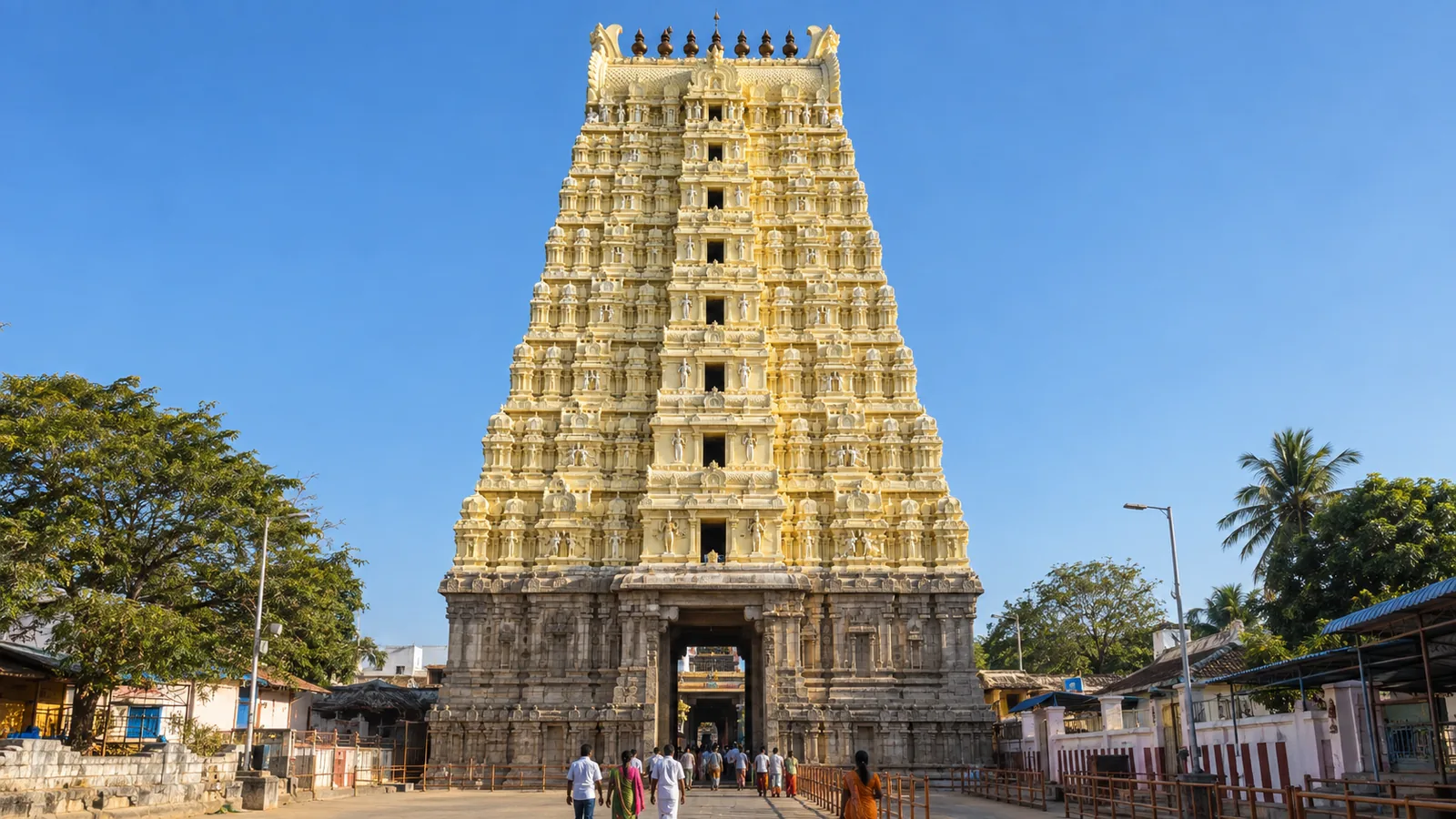
The gopurams. The east Rajagopuram is the one in every photograph: 126 feet, nine tiers, nine kalasams, 90 feet wide, built 1897–1904, per the temple's tower record; the district gives the same tower as 38 metres, which is that height converted. The west gopuram is 78 feet and five tiers, 15th century. The north and south gopurams are modern — HR&CE records each as 91 feet, each newly built in 2016. Any account implying all four towers are medieval is wrong.
The three prakarams. No dimensions are published for the first. The second, in its record's own metres, runs 115.80 m east–west and 94.20 m north–south; in it stand the temple kitchen, the treasury, a Bhairava shrine, portrait sculptures of Thirumalai Sethupathi and his son, a small shrine of Vinayaka with ten arms, and several theerthams.
The third prakaram the temple calls, in its record's title, world-famous. Its published dimensions in feet are outer 690 × 435, inner 649 × 395, height 22 feet 7½ inches, 1,212 pillars in total. The district administration and Incredible India's temple page give the corridor instead as 197 metres by 133 metres. The superlatives are irreconcilable and must always be attributed: the district calls the corridor the third largest in the world, Incredible India calls it Asia's longest corridor, and a scholarly source says it is reputed to be the longest in the world. The temple administration makes no length claim at all.
The temple's own closing remark on the third prakaram is the real story: Rameswaram is an island ringed by sea with no building stone of its own, and that such stone was carried from far away, in an age without transport, to raise so long a corridor, is offered as evidence of the builders' devotion.
Look up as you walk. The temple's murals register records painted work on the ceiling of the central bay of the third prakaram, and five murals at the east Rajagopuram entrance depicting the five tandavas of Shiva, each keyed to one of the Pancha Sabhai halls. The Nandi is given by the temple as 17 feet high, 22 feet long, 12 feet wide.
On the shrines, an honest gap: the temple's own shrines and sculptures pages are live but completely empty. What other sources support is separate shrines for Ramanathaswamy and his consort Parvathavardhini, separated by a corridor, and shrines for Vishalakshi, the utsava images, Vishnu and Ganesha. The Vishwalingam is the second lingam in the sanctum, not a separate building, and Sethumadhavar appears officially not as a shrine but as the temple's single registered tank, the Sethu Madhavar Theerthakulam in the third prakaram.
Finally, the dawn. The temple publishes that the first darshan of the day is of the Spatika linga, the crystal lingam, from 5.00 am to 6.00 am, before sanctum darshan begins. One caution the administration's silence requires: HR&CE nowhere says the crystal lingam is the Vishwalingam brought by Hanuman. Do not conflate them.
Agni Theertham and the 22 Theerthams
Agni Theertham is the sea. It lies on the eastern shore directly opposite the temple — barely a hundred metres in front of the gopuram, says the district — and it is not a well, not a tank, and not one of the 22 theerthams inside the temple. The proof is by absence across three official registers: it appears neither in the temple's fifty-name theertham list nor in its register of tanks, and it is not among the 22 the standard Tamil study counts inside the walls. Being open sea outside the compound, it is necessarily free and unticketed. Its legend is told three ways: Tamil Nadu Tourism connects it to Mata Sita's agni pariksha; Incredible India calls it the shore where Rama purified himself after the war; the district gives no legend, saying only that a dip there is considered to remove the sins of pilgrims.
Inside the walls are the 22 theerthams. The number appears three times on the temple's own site — which publishes no list of their names. That list comes from K. Seturaman's Irāmēsuvaram Kōyil (2001). Grouped by prakaram, and with the caveat that this is a reading order, not a ritual sequence: in the first, Sarva (also Manasa), Sandhyamirta and Siva; in the second, Ganga, Yamuna, Gaya, Chandra, Surya, Brahmahatti Vimochana, Chakra and Shankha; in the third, Madhava (Sethumadhava), Nala, Nila, Gavaya, Gavaksha, Gandhamadana, Gayatri, Savitri, Saraswati and Lakshmi; and last, Kodi or Koti. Three plus eight plus ten plus one closes the count exactly.
They are wells and tanks, not springs. The district calls them natural springs; no other source supports that, and the standard study describes theertha-wells cut in square, rectangular, polygonal, octagonal and circular plans.
The order of bathing has two fixed ends and nothing in between. The sea at Agni Theertham comes first, by universal practice. Kodi Theertham comes last, by scriptural rule — the Setu Purana and the Skanda Purana, as the study quotes them, require that all the others be bathed in before it. Between those endpoints no source prescribes a numbered sequence, so we print none; the route is set by the attendants leading the group.
How the snanam works is thinly documented, so treat it as reported practice. Pilgrims describe a single ticketed circuit led by temple staff, water drawn by bucket at each well and poured over them. HR&CE publishes bathing hours of 5.30 am to 12.30 pm and 3.00 pm to 7.00 pm (checked in September 2026) and publishes no tariff whatsoever for the bath — the figures circulating on commercial booking sites are not the temple's. Pilgrims commonly report a small per-head charge and tips to the attendants, so carry small change. Expect to be soaked: the facilities page lists no changing rooms, though it does list free footwear safekeeping. Visitor reports put the circuit at 45 minutes to two hours — not an official estimate. One documented bottleneck: the first six wells stand along a narrow path, which is exactly why, after a High Court petition, six further wells were consecrated and opened in late October 2018.
What the waters are held to do is belief, and the temple itself marks it as belief, hedging its Tamil descriptions repeatedly with it is believed. The administration calls bathing in the 22 a lifetime duty for Hindus; Incredible India says they are believed to possess spiritual and healing properties; a scholarly source records the tradition that the number 22 stands for the 22 arrows in Rama's quiver. Individual waters carry individual promises on the temple's own pages — release from debt, wisdom, prosperity, even the curing of disease. Not one of these is a physical or medical outcome, and we do not present any of them as one.
One last number, kept in its scope. Tamil Nadu Tourism states that Rameswaram contains sixty-four theerthams, with twenty-two located within the temple — the cleanest line in any source. The island totals themselves disagree: 64 on Tamil Nadu Tourism, 50 named on the temple's own speciality page, and about forty in the standard study. The 22 is stable; the island total is not.
Darshan at Ramanathaswamy Temple
Timings, with both official sources given. The temple's HR&CE page sets the hours at 4.00 am to 1.00 pm and 3.00 pm to 8.00 pm, its prose adding that devotees are admitted by 5.00 am, the Spatika linga darshan runs 5.00–6.00 am, sanctum darshan 6.00 am to 1.00 pm, the temple reopens at 3.00 pm with devotees admitted from 3.15 pm, and it is closed by 9.00 pm. Incredible India gives 5.00 am to 1.00 pm and 3.00 pm to 9.00 pm. Both are government sources and both are current. All of this was checked in September 2026 on pages carrying no revision date; confirm on the day with the temple office, 04573 221223.
The day's poojas, as the temple lists them, are six fifteen-minute slots: Thiruvanandal 6.00 am, Vilaa 7.00 am, Kalasandhi 10.00 am, Uchikkala 12 noon, Sayaraksha 6.00 pm, Ardhajama 8.30 pm. The first of them goes, as tradition says Rama ordered, to Visvanathar.
Tickets are paid at the counter and, as of September 2026, not bookable online — only donations can be paid online. The tariff, listed with no effective date, includes special entrance darshan ₹100 at the Swamy sannathi and ₹50 at the Ambal sannathi, quick darshan ₹200, Spatika linga darshan ₹50, archanai ₹10 and a locker at ₹10. One flag rather than a reconciliation: devotees protesting in 2023 alleged a ₹200 charge for Spatika linga darshan against the tariff's ₹50. Verify at the counter.
Dress. There is no official dress code — neither the HR&CE Department nor this temple publishes one, and in March 2022 the Madras High Court held that prescribing a dress code is for each temple to decide and cannot be judicially imposed, saying only that devotees are expected to enter in proper dress to maintain decorum. An earlier 2015 order prescribing dhotis and saris was stayed within about six weeks and never took effect, though travel guides still quote it. In practice modest traditional clothing is what almost everyone wears — and bring a spare set, since the theertham circuit leaves you drenched.
What the temple actually prohibits is short: bring in no umbrellas, sticks or articles made of animal hide — which covers leather belts, wallets, bags and camera straps.
Phones and cameras — new, and moving. From 1 September 2026 the Tamil Nadu HR&CE Department has prohibited camera-enabled mobile phones inside a list of 52 major temples, and press reports of that list name Rameswaram. Phones are deposited at counters at the entrance. A per-phone token fee introduced with the rule drew protests and has already been dropped at some temples; the position at Rameswaram specifically we could not confirm. Check on the day.
Festivals, and an Honest Word About Dates
The temple administration publishes no festival calendar and no festival dates. Its festivals page is a search form over a department-wide master list, not a calendar for this temple. That general list does name Mahasivaratri, Thirukalyanam, Ramalinga Prathishtai, Navaratri and the Amavasai observances among the festivals HR&CE recognises — but it does not say which fall here, or when. Rather than print a calendar we cannot source, we say plainly: ask the temple office before planning a journey around a festival.
Two festival facts are sourced. The temple's tank record states that the Theppa Utsavam (float festival) and the Theerthavari are both held on the Ayilyam nakshatra, with the month left blank. And a scholarly account records that at the Chokkattan Mandapam the utsava deities are kept during the Vasanthotsavam and the sixth-day festivals in Adi (July–August) and Masi (February–March), conducted by the Sethupathi of Ramnad.
How to Reach Rameswaram
By rail. Rameswaram (RMM), in Southern Railway's Madurai Division, is the railhead — about 1.3 km from the temple per the district administration. Every train now reaches the island across the new Pamban bridge, India's first vertical lift sea bridge, which PIB records as inaugurated by the Prime Minister on 6 April 2025, on Ram Navami. PIB gives its length as 2.07 km in one release and 2.08 km in another of the same day; it has a 72.5-metre vertical lift span, was built by Rail Vikas Nigam Limited at a cost PIB puts at over ₹700 crore, and stands 3 metres higher than the old bridge.
Daily trains link Rameswaram with Chennai, Madurai, Tiruchirappalli and Thiruvananthapuram, and weeklies run from cities as far off as Coimbatore, Tirupati, Okha, Bhubaneswar, Banaras and Ayodhya Cantt. We deliberately print no train numbers, days or timings — check IRCTC (irctc.co.in) or the National Train Enquiry System (139 / NTES). Be warned that one Ministry of Tourism page on the Pamban bridge is badly out of date, still saying services are suspended and all trains terminate at Mandapam. That was true between December 2022 and April 2025. It is not true now.
By road. The island is joined to the mainland by the Annai Indira Gandhi Road Bridge, built in 1988, running parallel to the rail bridge; Tamil Nadu Tourism gives its length as about 2.34 km and the district as 2.2 km. Tamil Nadu Tourism lists regular buses to Rameswaram bus stand — about 2 km from the temple — from Chennai, Madurai, Puducherry, Trichy and Coimbatore; book state services through tnstc.in. On road distances from Madurai, Chennai or Trichy we found no official figure at all, so we print none.
By air. The nearest airport is Madurai International (IXM), which Tamil Nadu Tourism's own pages place at anywhere from 163 to 180 km, while the district says about 175 km. That spread is the honest reason to say roughly 165–180 km by road and leave it there. Thoothukudi is given by the district as about 195 km. Agree taxi fares before you set out.
Sacred and Notable Places Near Rameswaram
Agni Theertham — The bathing shore east of the temple and, in the district's words, barely a hundred metres in front of the gopuram. Free, open, and busy from before dawn; pilgrims also perform tarpanam for their ancestors here.
Gandhamadhana Parvatham — About 3 km from the temple, on which Tamil Nadu Tourism and Incredible India agree, and the highest point on the island. A mandapam shelters what devotees believe to be the footprints of Shri Rama; the Ministry's feature adds it is believed to be the hillock from which Hanuman began his flight to Lanka.
Kothandaramaswamy Temple — On the Rameswaram–Dhanushkodi road, short of the ruins. No source we have gives a distance, so we give none. The district records that after the 1964 cyclone this temple remained intact; the Ministry's feature calls it where Vibhishan met Ram.
Dhanushkodi and Arichal Munai — 18 km from Rameswaram by road per the district, at the far tip, with sea on both sides. The town was destroyed on the night of 22–23 December 1964, when a cyclone sent storm surges across the spit; the Commission of Railway Safety's report on the loss of the Pamban–Dhanushkodi passenger train records 100 to 110 passengers and 18 railway staff, all dead, and notes the exact number was never known. The railway was dismantled and never rebuilt, so no train reaches Dhanushkodi. Arichal Munai, the land's end, lies a further 4.5 km on by secondary accounts. Read the safety notes below before you go.
Ram Setu / Adam's Bridge — Two registers, kept in two sentences. According to the Ramayana, as a PIB release carefully puts it, the construction of Ram Setu was begun from Dhanushkodi near Rameswaram. What lies in the sea today is a chain of shoals and sandbanks between Pamban Island and Mannar in Sri Lanka, called Ram Setu on Indian government pages and Adam's Bridge on nautical charts. We make no claim about its origin, age or composition.
The Pamban bridges — The 1914 bridge, opened on 24 February and long called India's first sea bridge, with its Scherzer rolling lift span, stands beside the 2025 vertical lift bridge and the 1988 road bridge.
Villoondi Theertham — About 6 km from the Rameswaram main bus stand, per Tamil Nadu Tourism; a freshwater spring in the sea reached by a walkway. Tradition says Rama, when Sita was thirsty, shot an arrow into the sea and a spring rose. Lakshmana and Jatayu Theerthams belong to a five-theertham set the Ananda Ramayana remembers, distinct from the 22; no official page gives their distances, so neither do we.
Panchamukhi Hanuman Temple — About 2 km away, per Incredible India's destination page, where stones believed to have been used for the Ram Setu are displayed.
Dr A. P. J. Abdul Kalam National Memorial — Built by DRDO at the burial site at Pei Karumbu, where India's eleventh President was laid to rest on 30 July 2015, and inaugurated in July 2017. The district calls it less than 1 km from Rameswaram; Tamil Nadu Tourism places it about 4 km from the bus stand.
Ariyaman Beach — About 21 km from Rameswaram town on the Gulf of Mannar, per Tamil Nadu Tourism; a long open beach with water sports in season.
Best Time to Visit Rameswaram
- October to March — Tamil Nadu Tourism's recommendation for Rameswaram, given because the temperature is at its best. Its district page says October to April and its Dhanushkodi page November to March; Incredible India offers no guidance at all. Attribute the window; do not treat it as settled.
- January to March — Generally the calmest and driest part of that window, and the easiest for both the theertham circuit and the run to Dhanushkodi.
- October to December — The same official window contains the north-east monsoon and the overlapping cyclone season; the 1964 cyclone struck in late December. Check IMD (mausam.imd.gov.in) and state disaster-management advisories if you travel then.
- April to June — Very hot on an exposed island. Plan darshan for early morning, and remember you will be walking barefoot on stone.
Safety and Official Guidance
- Verify before you travel. Timings, poojas, tickets and rules change here, and the pages carrying them show no revision dates. Confirm with the temple office on 04573 221223, and note that as of September 2026 no darshan or abhishekam ticket was bookable online — only donations. Distrust any third-party site that claims otherwise.
- At Agni Theertham, the district's only description is calm, shallow water, and no official source describes currents, depths, lifeguards or flags. Use ordinary sea sense: bathe within your depth and keep hold of children.
- At Dhanushkodi and Arichal Munai, access to the tip is controlled by a police check-post and the road is closed when the sea is rough. Drownings have been reported at Arichal Munai despite police warnings. No official page publishes hours, vehicle rules, permits or fees — follow the police on the day and do not plan on being at the tip after dark.
- Heat, sun and stone. Footwear is left outside and by mid-morning the paving is hot. Carry water, cover your head, and do the theerthams early.
- Crowds. The documented pinch-point is structural, not seasonal: the first six wells stand along a narrow path, which is why six more were added in 2018. On weekends and festival days, start early.
- Money and guides. The temple publishes no tariff for the theertham bath and no rate for guides. Carry small change, expect informal charges to vary, and pay no large sum in advance on a promise of quick darshan.
What Rameshwaram Teaches Us Today
The Shaiva canon here records a Vaishnava founder. The temple administration quotes a Tevaram verse of Appar calling this the temple Māl — Vishnu, Rama — built, and notes that Rameswaram was sung by Appar and Thirugnanasambandar and praised later by Arunagirinathar, Thayumanavar and Muthuswami Dikshitar. A Shiva temple whose oldest hymn credits Vishnu with building it; an island a Shaiva administration describes as a conch in Vishnu's hand. Sectarian argument does not survive long on this shore.
Then there is Rama himself, at the height of his victory — and what he does with that victory is bathe, and build, and bow. The Puranas say he came for expiation; Tulsidas has him come in joy; either way the shape is the same. The one who has just won kneels. That is not weakness in our tradition but the definition of dharma in a ruler: the greater the power, the lower the head.
And there is the small linga of sand that could not be moved. Hanuman's was fetched from Kailash — farther, costlier, more perfectly obtained. Sita's was a handful of wet sand, made in the time that was left. When the hour came it was the sand that was consecrated, because it was there. What is offered in time outranks what is perfect but late. Yet the katha does not stop there, and that is why it has lasted: Rama would not let his servant's devotion go unhonoured, and gave Hanuman's linga the first worship of every day, for ever. Justice here is not the correction of an outcome. It is the honouring of an effort.
Last, the setu that gives this Jyotirlinga its address in the stotra. Faith alone did not cross that water; neither did engineering alone. Stones were carried and laid by ordinary hands, day after day — the same lesson the corridors teach in a quieter voice, on an island with no stone of its own. The east tower waited two and a half centuries for its final tier.
Swami Vivekananda, standing in this temple in 1897, told the pilgrims gathered there that external worship is only a symbol of internal worship, and that the one who sees Shiva in the poor, the weak and the diseased truly worships Shiva. Tradition promises great fruit here — and tradition's own greatest modern voice, in this courtyard, said the fruit is in the heart. Bathe in the sea before light. Walk the corridor slowly. Then go home and be gentler than you were.
Om Namah Shivaya.
Sources and Official References
- Arulmigu Ramanathaswamy Temple, HR&CE, Government of Tamil Nadu
- HR&CE — temple history and sthala purana
- HR&CE — timings, poojas and service tariff
- HR&CE — temple rules
- Ramanathapuram District Administration — Ramanathaswamy Temple
- Ramanathapuram District Administration — Places of Interest
- Ramanathapuram District Administration — Dhanushkodi
- Incredible India, Ministry of Tourism — Sri Ramanathaswamy Temple
- Incredible India — Rameswaram destination
- Tamil Nadu Tourism — Rameswaram
- Tamil Nadu Tourism — Agni Theertham Beach
- PIB / PMO — New Pamban Rail Bridge inauguration
- PIB, Ministry of Railways — Bridging Progress: The Rise of the New Pamban Bridge
Frequently Asked Questions
Where is Rameshwaram Jyotirlinga, and how do I reach Rameswaram?
It is enshrined in the Arulmigu Ramanathaswamy Temple at Rameswaram, on Pamban Island in Ramanathapuram district, Tamil Nadu. Trains reach Rameswaram station (RMM) — about 1.3 km from the temple, says the district administration — across the new Pamban vertical lift sea bridge, inaugurated on 6 April 2025 according to PIB. By road the Annai Indira Gandhi Road Bridge of 1988 joins the island to the mainland. Madurai (IXM) is the nearest airport, given as roughly 165–180 km on different official pages.
Is Rameshwaram one of the 12 Jyotirlingas, and is it also one of the Char Dham?
Yes to both, though the Char Dham status is stated by some government pages and not others. The Dvadasha Jyotirlinga Stotra names it in the line Setubandhe tu Ramesham — seventh in that hymn's order, though article #11 in our travelling series. Tamil Nadu Tourism and Incredible India's destination page call it one of the four Char Dham; the temple administration lists Dwaraka, Puri, Badrinath and Rameswaram as the four holy shrines of Bharat, adding that Rameswaram alone among them is a Shiva shrine.
What is the story of Shri Rama, Mata Sita and Hanuman here?
The temple introduces its own account with the words that the Puranas say, and so do we. Tradition holds that after slaying Ravana, Shri Rama came to this shore on sage Agastya's advice to expiate the sin of brahmahatya, and fixed an auspicious hour to consecrate a Shivalinga. Hanuman, sent to fetch one, was delayed; Mata Sita shaped a linga from sand, and that linga — the Ramalingam — was consecrated before the hour lapsed. Hanuman returned with his linga, the Vishwalingam, which Shri Rama installed beside the first.
Why is the Vishwalingam worshipped before the Ramalingam?
Because tradition says Shri Rama ordered it, to console Hanuman whose errand had been overtaken by the hour. The district administration records that Hanuman's linga was installed a little north of the Ramanatha linga and given precedence in all honours, and the Ministry of Tourism states that the Vishvalingam receives worship first, per Rama's instruction. The temple's own page says in the present tense that the first pooja every day is performed to Visvanathar.
What are the 22 theerthams, and is Agni Theertham one of them?
The 22 are sacred waters inside the temple premises — built wells and tanks cut in square, rectangular, polygonal, octagonal and circular plans, according to K. Seturaman's standard Tamil study. Agni Theertham is emphatically not one of them: it is the open sea on the shore east of the temple, which the district places barely 100 metres in front of the gopuram. The administration states the number 22 but publishes no list of names. Tamil Nadu Tourism counts 64 across the island, of which 22 lie within the temple.
How does the theertham snanam work?
Two endpoints are fixed and nothing between them is. Pilgrims bathe first in the sea at Agni Theertham, which is free and unticketed, and the Kodi Theertham is bathed last by a rule the Setu and Skanda Puranas lay down; in between, attendants draw water at each well and pour it over the bather. HR&CE publishes bathing hours of 5.30 am to 12.30 pm and 3 pm to 7 pm, checked in September 2026, but publishes no tariff for the bath — carry small change. Expect to be soaked, with no changing rooms listed.
What are the darshan timings and dress rules?
Two government sources differ, so here are both. The temple's HR&CE page gives 4.00 am to 1.00 pm and 3.00 pm to 8.00 pm, with devotees admitted from 5.00 am, Spatika linga darshan 5.00–6.00 am, and the temple closed by 9.00 pm; Incredible India gives 5.00 am to 1.00 pm and 3.00 pm to 9.00 pm. Neither HR&CE nor this temple publishes a dress code, and in March 2022 the Madras High Court held that prescribing one is for each temple to decide. The rules page bars only umbrellas, sticks and leather articles.
What is special about the temple corridors and gopurams?
The third or outer prakaram is the celebrated feature. The temple gives its outer measurements as 690 by 435 feet, a height of 22 feet 7½ inches and 1,212 pillars; the district and Incredible India instead give 197 metres by 133 metres. The superlatives must be attributed — the district calls it the third largest in the world, Incredible India calls it Asia's longest, and the temple makes no length claim at all. Of the four gopurams, the east Rajagopuram is 126 feet and nine tiers, completed 1897–1904.
How do I visit Dhanushkodi, Arichal Munai and the Pamban Bridge?
The district administration puts Dhanushkodi 18 km from Rameswaram by road, with Arichal Munai a further 4.5 km beyond by secondary accounts. Access to the tip is controlled by a police check-post and closed when the sea is rough; no official page publishes hours, vehicle rules or permits, so check locally, follow the police, and do not plan on being there after dark. Drownings have been reported at Arichal Munai. The new vertical lift railway bridge stands beside the 1914 Scherzer bridge and the 1988 road bridge.
What is the best time to visit, and which festivals draw the biggest crowds?
Tamil Nadu Tourism recommends October to March for Rameswaram, October to April on its district page and November to March on its Dhanushkodi page. Within that window January to March is generally calmest, October to December brings the north-east monsoon and cyclone risk, and April to June is very hot. On festivals the honest answer is that the temple publishes no calendar and no dates — the HR&CE department's general list names Mahasivaratri, Thirukalyanam, Ramalinga Prathishtai and Navaratri without saying which fall here or when.


