The Date, First
Dussehra / Vijayadashami 2026 falls on Tuesday, October 20 for most of India. Bengal observes Bijoya Dashami on Wednesday, October 21. Both dates come from the same Dashami tithi; the difference is only in how each tradition decides which civil day carries the festival, and it is explained just below.
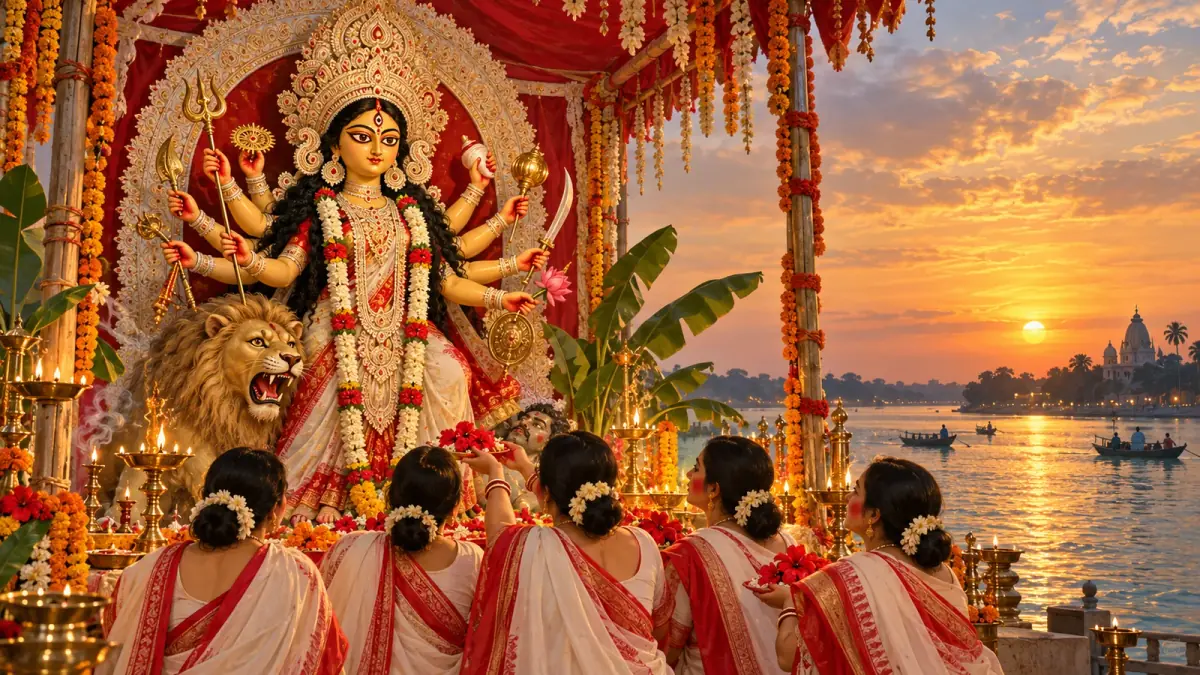
Vijayadashami, "the tenth day of victory", closes the nine nights of Navratri. It is the day tradition remembers two victories at once: Bhagwan Rama's over Ravana, and Maa Durga's over Mahishasura. Across the country it is a gazetted holiday, the evening of Ravana Dahan in the north, the last day of Durga Puja in the east, and the day of Shami and Aparajita puja wherever the older muhurta customs survive.
Dussehra 2026: City-wise Timing Table
All timings below are in Indian Standard Time (IST), and each row names its city. Tithi and nakshatra moments are the same instant everywhere in India; muhurta windows follow local sunrise and sunset, so they shift from city to city.
| Observance | Timing (city-labelled, IST) |
|---|---|
| Vijayadashami (most of India) | Tuesday, October 20, 2026 |
| Bengal Vijayadashami (Bijoya Dashami) | Wednesday, October 21, 2026 |
| Dashami tithi begins | 12:50 PM, Tuesday, October 20 |
| Dashami tithi ends | 2:11 PM, Wednesday, October 21 |
| Shravana nakshatra | 3:38 PM, October 19 to 6:02 PM, October 20 |
| Vijay Muhurat, Delhi | 1:59 PM to 2:45 PM, October 20 |
| Aparahna puja time, Delhi | 1:14 PM to 3:30 PM, October 20 |
| Vijay Muhurat, Kolkata | 1:17 PM to 2:03 PM, October 20 |
| Aparahna puja time, Kolkata | 12:30 PM to 2:49 PM, October 20 |
For any other city, open the Drik Panchang Vijayadashami page and set it to your location before fixing your puja hour.
Why October 20 in Most of India, but October 21 in Bengal
The two dates are not a controversy; they are two old conventions reading the same sky.
- The muhurta rule (most of India). Vijayadashami is kept on the day when Dashami tithi prevails in the Aparahna (afternoon) hours, and the day is held especially complete when Shravana nakshatra joins it. In 2026, Dashami begins at 12:50 PM on October 20 and runs through that afternoon while Shravana lasts until 6:02 PM, so the festival, with Vijay Muhurat, Shami Puja and Aparajita Puja, belongs to October 20.
- The Bengal panjika rule. Bengali panjikas count the festival on the day Dashami prevails at sunrise. At dawn on October 21 Dashami is running (it ends at 2:11 PM), so Bijoya Dashami is October 21, which is also the regional holiday in West Bengal. Our Bijoya Dashami guide covers that day, Sindoor Khela and Durga Visarjan in detail.
If your family follows a particular panchang or panjika, its reading comes first.
Two Victories, One Day
Vijayadashami carries two great narratives. They are told side by side, but they are distinct traditions from distinct scriptures, and the festival is richer when they are not blended into one.
Rama's Victory: the End of the War in Lanka
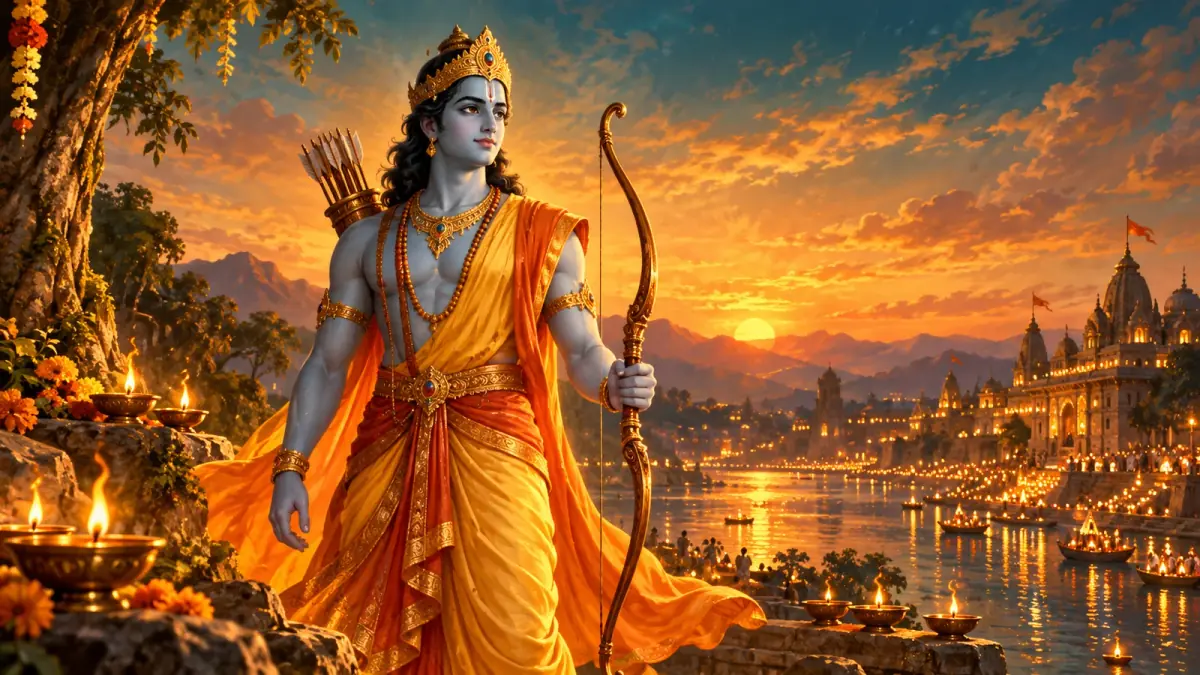
The Valmiki Ramayana tells the story at full length: Sita is carried away by Ravana, the king of Lanka; Rama and Lakshmana search for her; Hanuman leaps the sea and finds her; a bridge is built; and a long, terrible war follows. In the war's final duel, as the Yuddha Kanda (sarga 108) narrates it, Rama's charioteer Matali reminds him of the missile presided over by Brahma, an arrow Brahma had once fashioned for Indra and that the sage Agastya had given Rama on the battlefield. Rama invokes it, the arrow pierces Ravana's chest, and the ten-headed king falls from his chariot. In the next sarga his brother Vibhishana, who had taken refuge with Rama, grieves for him, and Rama himself directs that the fallen king receive proper funeral rites: even in victory, the epic insists on dignity.
Two honest notes belong here. The Valmiki Ramayana itself does not date the battle to this tithi; it is the living festival tradition that remembers Ravana's fall on Vijayadashami. And Ravana's ten heads, in the epic, mark his name Dashagriva and his formidable power and learning; the popular teaching that they stand for a fixed list of ten vices is a later, modern reading, loved in sermons but not a scriptural list.
Durga's Victory: the Devi and Mahishasura
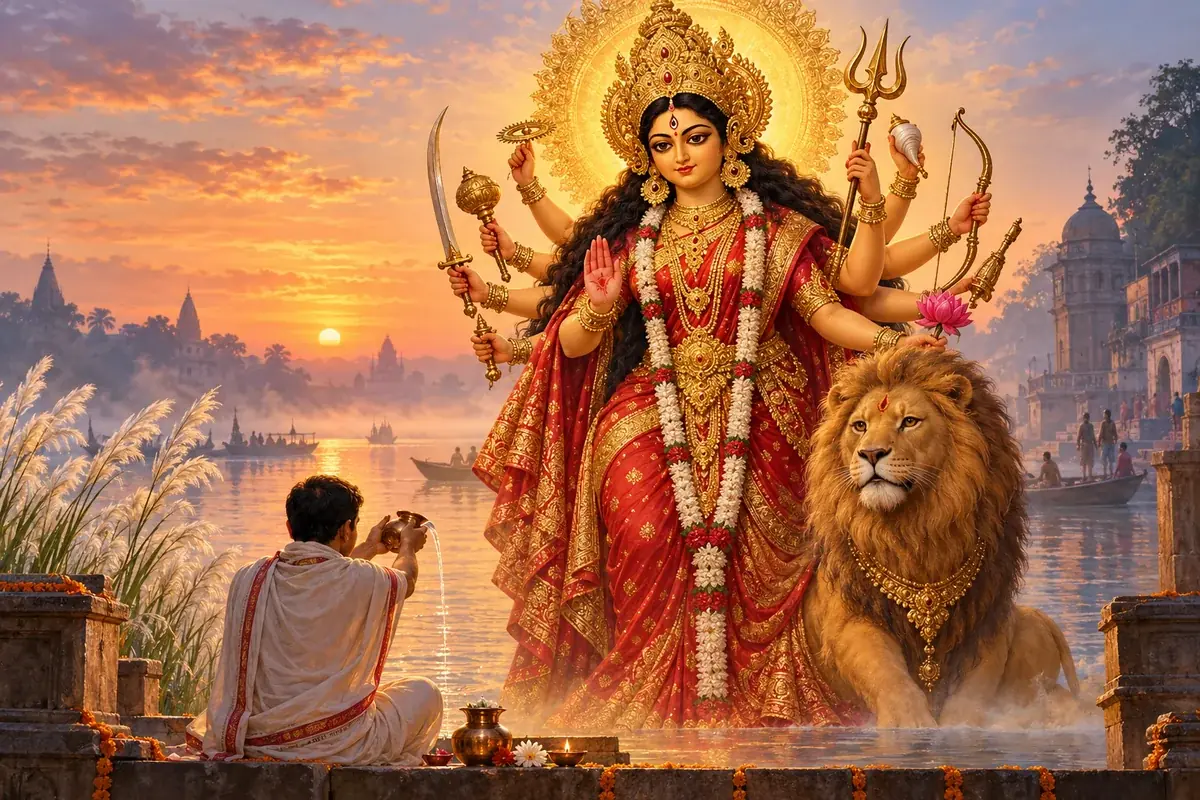
The eastern face of the day comes from the Devi Mahatmya (Durga Saptashati), the seven hundred verses within the Markandeya Purana that Bengal reads through the puja. Its second and third chapters tell how the gods, overthrown by the buffalo-demon Mahishasura, pour their combined radiance into one blazing form: the Devi, armed by every god, riding her lion. Mahishasura shifts shape as she fights him, buffalo to lion to swordsman to elephant and back, until, as chapter 3 describes, she pins him under her foot and slays him as he struggles half-emerged from the buffalo's mouth. For Durga Puja, Dashami is the morning after that victory: the work is done, and the Mother departs. The nine preceding nights honour her nine forms, the Navdurga, culminating in Maa Siddhidatri.
One story is of the ideal man walking dharma through exile and war; the other is of the Shakti who acts when the order of the worlds fails. The festival holds both without needing them to be the same story.
Ramlila and Ravana Dahan
Through the Navratri nights, towns across North India stage Ramlila, the cycle of plays based on Tulsidas's Ramcharitmanas. UNESCO inscribed Ramlila, the traditional performance of the Ramayana on its Representative List of the Intangible Cultural Heritage of Humanity in 2008, naming the traditions of Ayodhya, Ramnagar, Varanasi, Vrindavan, Almora, Satna and Madhubani among the most representative. The performances usually run ten to twelve days and close on Dussehra evening with Ravana Dahan: effigies of Ravana, often with Kumbhakarna and Meghnad beside him, packed with fireworks and set alight before the crowd.
A practical caution: Ravana Dahan has no muhurta of its own. The Vijay Muhurat (early afternoon) governs puja, not the burning of effigies. Each committee lights its effigy after its own evening programme, commonly between sunset and late evening, and the hour differs from ground to ground even within one city. For the event time, rely on your local Ramlila committee or city listings, not on a panchang table.
A Simple Dussehra Puja at Home
Vijayadashami needs no elaborate ritual at home. Customs vary from family to family; take what fits yours, and let your own elders' practice overrule anything written here.
- Clean and prepare. Tidy the puja space in the morning. Many households also clean the tools of their work this day, a custom related to the southern Ayudha Puja.
- Choose the hour. The Aparahna window (1:14 to 3:30 PM in Delhi; 12:30 to 2:49 PM in Kolkata, October 20) is the traditional time, with the Vijay Muhurat inside it as the choicest moment.
- Offer worship. Light a lamp and incense before Bhagwan Rama, Maa Durga, or your family deity. Offer flowers, roli-akshat and something sweet. A short aarti closes it.
- Read the story. A chapter of the Ramayana or the Devi Mahatmya, or simply the story of the day retold to children, keeps the heart of the festival alive better than anything bought from a market.
- Honour your instruments. Books, tools, instruments and vehicles are respectfully cleaned, marked with tilak, and thanked, options rooted in regional custom, not obligations.
- Give something. Sweets to neighbours' children, food to someone in need: victory in this tradition is shared, never hoarded.
There is no universal fast on Vijayadashami. Many families feast on this day; those who fasted through Navratri have usually completed their Parana on the morning of October 20. Follow your own family's custom without anxiety.
Shami, Aparajita and the Regional Map of the Day
The old muhurta texts attach three observances to the Aparahna of Vijayadashami, and the Drik Panchang notes list all three: Shami Puja, Aparajita Puja and Seema Avalanghan, the symbolic crossing of the boundary of one's village or town, a remnant of the day kings began their campaigns.
- Shami Puja honours the Shami tree in which, the Mahabharata tradition says, the Pandavas hid their weapons during their year in disguise and from which they took them back on the eve of their victory. In Karnataka, Telangana and Andhra Pradesh the same worship is Banni or Jammi Puja.
- Sona exchange. In Maharashtra and parts of the Deccan, Shami or apta leaves are exchanged as "sona", gold, with greetings of victory, a gesture of wishing prosperity on every house.
- Aparajita Puja worships the Devi as Aparajita, "the unconquered", traditionally with the aparajita vine or its flowers, asking that one's undertakings not fail.
- Regional celebration takes grand public forms too: the Dasara of Mysuru with its royal procession, the week of Kullu Dussehra that begins on this day, and the farewell processions of Bengal. Each region's custom is its own; none is a rule for the others.
What the Victory Asks of Us
It is easy to let Dussehra become a spectacle: the arrow flies, the effigy burns, the crowd cheers. The tradition's own reading is quieter. Rama's war ends not with triumphalism but with funeral rites for the defeated; the Devi's battle ends and she withdraws, work done, without a kingdom claimed. Victory, in both stories, is the restoration of order, not the humiliation of an enemy.
So the day's real question is small and personal: what, this year, is the one untruth, the one cruelty, the one laziness in me that can fall with the effigy? Light the lamp in the afternoon, answer it honestly, and the festival has done its work. And if your family's festival continues into Bijoya Dashami on October 21, the farewell to the Mother carries the same teaching home.
Vijayadashami ki shubhkamnayen.
References
- Drik Panchang: Vijayadashami 2026, Delhi: October 20 date, Vijay Muhurat 1:59 to 2:45 PM, Aparahna 1:14 to 3:30 PM, Dashami tithi and Shravana nakshatra timings, Shami / Aparajita / Seema Avalanghan in Aparahna. Kolkata timings from the same page set to Kolkata.
- Drik Panchang: Bengal Vijayadashami 2026: October 21 by the Bengal rule, and the explanation of the tithi-versus-muhurta conventions.
- timeanddate.com: Dussehra 2026 in India: gazetted holiday on Tuesday, October 20, 2026.
- Valmiki Ramayana, Yuddha Kanda, sarga 108 (English rendering at valmikiramayan.net, K. M. K. Murthy): Matali's counsel, the Brahma-missile given by Agastya, and the fall of Ravana; sarga 109 for the funeral rites.
- Devi Mahatmya (Durga Saptashati), chapters 2 and 3, AuroBharati edition, Sri Aurobindo Society: the Devi's manifestation and the slaying of Mahishasura.
- UNESCO Intangible Cultural Heritage: Ramlila: inscription of 2008 and the character of the performances.
Frequently Asked Questions
Is Dussehra on October 20 or October 21 in 2026?
For most of India, Dussehra / Vijayadashami falls on Tuesday, October 20, 2026: Dashami tithi begins at 12:50 PM that day (IST) and prevails through the afternoon together with Shravana nakshatra, which is the combination the muhurta rule prefers. Bengal's panjika convention counts the day on which Dashami prevails at sunrise, so Bengal Vijayadashami (Bijoya Dashami) is Wednesday, October 21. Both dates are correct within their own traditions.
What is the difference between Dussehra and Vijayadashami?
They are two names for the same festival, the tenth day (Dashami) of the bright fortnight of Ashwin. Vijayadashami, 'the tenth day of victory', is the older pan-Indian name. Dussehra, used mostly in North India, is popularly linked to Rama's victory over the ten-headed Ravana. In Karnataka the festival is Dasara, and in Nepal the same days are celebrated as Dashain.
What is the Vijay Muhurat on Dussehra 2026?
Vijay Muhurat is the short mid-afternoon window considered auspicious for beginning new ventures and for Shami and Aparajita puja. On October 20, 2026 it is 1:59 to 2:45 PM in Delhi and 1:17 to 2:03 PM in Kolkata (both IST). The window follows local sunrise and sunset, so it shifts by several minutes from city to city; check a panchang set to your own location.
Is Ravana Dahan at the same time everywhere?
No. Ravana Dahan is a public event, not a muhurta-bound rite: each Ramlila committee lights its effigy after its own evening programme, usually between sunset and late evening. The Vijay Muhurat (early afternoon) is for puja, not for the effigy burning, so do not treat it as an event time. Check your local committee or city listings for the hour.
What can a family do at home on Dussehra?
A simple observance works well: clean the puja space, light a lamp in the Aparahna hours (1:14 to 3:30 PM in Delhi on October 20, 2026), offer flowers and something sweet to Bhagwan Rama or Maa Durga, read or retell a part of the Rama story with children, and if your tradition keeps it, offer respect to a Shami tree or exchange its leaves. Honouring the tools of your daily work is also a widely loved custom. None of this requires a priest.
Why is the Shami tree worshipped on Dussehra?
Tradition holds that the Pandavas hid their weapons in a Shami tree during their year in disguise and retrieved them on Vijayadashami before their victory. Shami Puja, also called Banni or Jammi Puja in the south, is done in the Aparahna / Vijay Muhurat window, and in Maharashtra and parts of the Deccan people exchange Shami or apta leaves as 'sona', symbolic gold, with the greeting of victory.