THESANATANWAY

Chandra and His 27 Wives: The Vedic Story That Maps the Real Lunar Sky

The Hindu story of Chandra's 27 wives is more than mythology — it encodes the Moon's real 27.3-day journey through the 27 Nakshatras. Discover how ancient India

The Sanatan Way

Where Myth Meets the Night Sky Long before telescopes scanned the heavens and satellites mapped the lunar surface, the ancient sages of India looked up at the night sky and saw a story unfolding. The Moon, they said, was not just a celestial body — he was Chandra, a luminous god, a wandering lover, and a husband to twenty-seven wives. He visited each one in turn, lingered too long with his favorite, and was cursed for it. His waxing and waning, his glow and his decay, were said to be the visible footprints of that ancient drama playing out in the sky. It sounds like pure mythology. A poetic flight of imagination. And yet — when you trace the story carefully, something extraordinary emerges. Those twenty-seven wives are not arbitrary. They map, almost perfectly, onto the twenty-seven Nakshatras, the lunar constellations that the Moon actually passes through during its 27.3-day journey around the Earth. This is the story of how an ancient civilization may have encoded one of the most precise astronomical observations of the natural world inside a love story. And it is a story worth telling slowly.

Chandra: The Moon as a God, Not Just a Light In Hindu mythology, Chandra (also called Soma) is far more than the silvery disc that floats above us. He is a deva — a luminous being — born, in one tradition, from the churning of the cosmic ocean, and in another, from the sage Atri's meditative gaze. He rides a chariot drawn by white antelopes or horses across the sky, scattering coolness, dew, and dreams as he passes. Chandra rules the mind, emotions, intuition, and the tides of feeling that rise and fall within us, just as the ocean tides rise and fall under his pull. He is the patron of poets, lovers, mystics, and night-wanderers. In Vedic astrology, the Moon's position at one's birth is considered as significant as — sometimes more significant than — the Sun's, because it governs the inner emotional landscape. Crucially, Chandra is described as restless. He never stays in one place. He moves, always moves, across the sky. And this restlessness is the seed of our story.

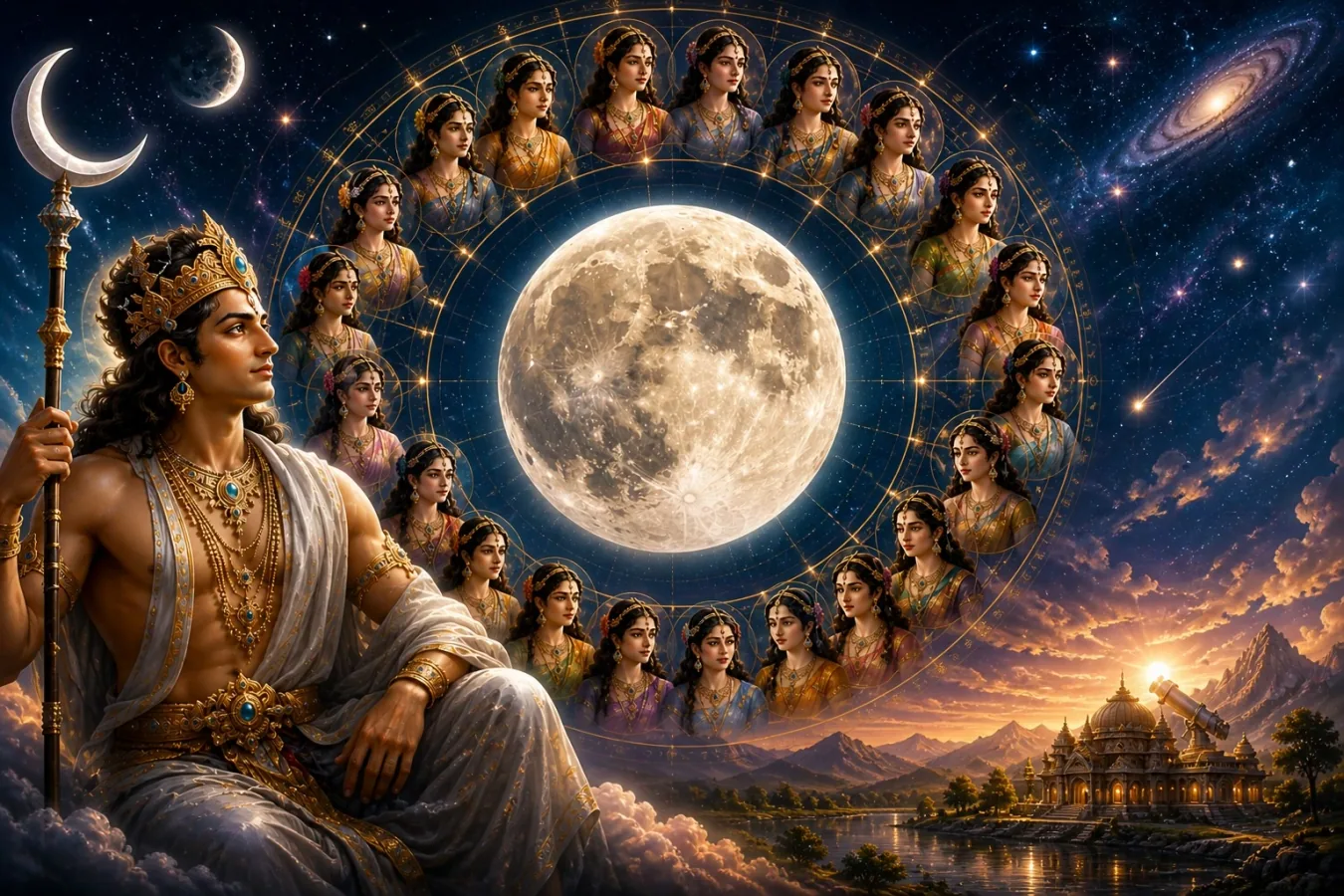
Daksha's Twenty-Seven Daughters The Prajapati Daksha was one of the great progenitors of creation, a son of Brahma himself, and the father of many daughters who became the mothers of gods, sages, and stars. Among his children were twenty-seven beautiful daughters, each radiant in her own way, each presiding over a portion of the night sky. Their names — Ashwini, Bharani, Krittika, Rohini, Mrigashira, Ardra, Punarvasu, Pushya, Ashlesha, Magha, Purva Phalguni, Uttara Phalguni, Hasta, Chitra, Swati, Vishakha, Anuradha, Jyeshtha, Mula, Purva Ashadha, Uttara Ashadha, Shravana, Dhanishtha, Shatabhisha, Purva Bhadrapada, Uttara Bhadrapada, and Revati — read like a litany of stars. Which, of course, is exactly what they are. Daksha gave all twenty-seven of these daughters in marriage to Chandra, the Moon. It was a celestial wedding of unimaginable scale: one luminous bridegroom, twenty-seven luminous brides, and a promise that he would honor each of them equally as he made his eternal journey across the heavens. For a while, he did.

The Trouble with Rohini But Chandra, like many figures in mythology, had a heart that refused to be evenly distributed. Among all twenty-seven sisters, one captivated him completely — Rohini. She was, by most accounts, the most beautiful, the most graceful, the one whose presence made him forget his duties and his promises. Chandra began to linger. When his orbit brought him to Rohini, he stayed longer than he should have. When it was time to move on, he resisted. The other twenty-six wives — sisters all — watched as their husband visited them briefly, distractedly, and rushed back to Rohini. The neglected sisters complained to their father. Daksha, ever the patriarch, summoned Chandra and warned him gently at first, then sternly. Treat all my daughters equally, he said. Honor your vows. But Chandra, helplessly in love, could not. He returned again and again to Rohini's side. And so Daksha, in fury, pronounced a terrible curse: Kshaya — let Chandra wither away. Let his light fade. Let him diminish until he is nothing.

The Curse and the Compromise The curse took hold immediately. Chandra began to lose his radiance, night by night, growing thinner and paler, until the heavens themselves grew dim and the rhythms of life on Earth — the tides, the cycles, the dreams — began to falter. The gods grew alarmed. A dying Moon meant a dying world. They appealed to Lord Shiva, who took pity on Chandra and offered a partial remedy. The curse could not be undone — Daksha's word was binding — but it could be modified. And so a compromise was struck: Chandra would wane for half of each cycle, growing thinner and dimmer until he nearly vanished, and then he would wax again, recovering his light over the other half. This, the ancients said, is why the Moon grows and shrinks every month. It is the living echo of an old curse and a merciful compromise — a god who diminishes and is reborn, again and again, forever. Shiva himself wears the crescent Moon on his forehead — a permanent reminder of the rescue, and a permanent honor bestowed on Chandra.

What the Story Symbolizes Read as pure myth, the tale is a meditation on devotion, fairness, and consequence. It speaks to the cost of unequal love, the danger of broken promises, and the cyclical nature of grief and recovery. The Moon's monthly death and rebirth becomes a metaphor for every diminishment we suffer and every renewal we earn. But the story has another layer — one that becomes visible only when you stop reading it as theology and start reading it as astronomy.

The 27 Wives Are the 27 Nakshatras Here is the moment where mythology and science meet — and where the ancient Indian imagination reveals something genuinely remarkable. The twenty-seven daughters of Daksha are not metaphorical wives. They are the twenty-seven Nakshatras — the lunar mansions, or constellations, that the Moon passes through during its orbit around the Earth. Each Nakshatra is a specific cluster of stars, occupying roughly 13 degrees and 20 minutes of the ecliptic. Together, the twenty-seven of them tile the entire 360-degree path that the Moon traces across the sky. When the Vedic astronomers said Chandra "visits" each of his wives, they meant something almost technically literal: the Moon passes through, and appears to dwell briefly in front of, each of these twenty-seven star groups in sequence. Rohini — the favorite wife — corresponds to a real Nakshatra, dominated by the bright reddish star we now call Aldebaran in the constellation Taurus. It is one of the brightest, most striking star fields along the Moon's path. It is, quite literally, the most beautiful "wife" in the sky. The Moon does linger near Rohini in a sense — Aldebaran is brilliant enough that the Moon's proximity to it is a particularly luminous event in the night sky, easily noticed by ancient skywatchers night after night, year after year. The myth, in other words, is not just a story. It is an observation.

The 27.3-Day Sidereal Cycle Modern astronomy tells us that the Moon completes one full orbit around the Earth — measured against the fixed background stars — in approximately 27.32 days. This is called the sidereal month, distinct from the synodic month of about 29.5 days, which measures the time from one new moon to the next. The Vedic system of twenty-seven Nakshatras is built almost exactly on this 27.3-day cycle. Divide the Moon's orbit into twenty-seven equal segments, and the Moon spends roughly one day — one night, really — in each segment. One night with each "wife." A perfect match. This is not coincidence. It is the result of careful, sustained, generation-spanning observation of the night sky by people who had no telescopes, no clocks, and no written formulas — only their eyes, their memory, and their devotion to pattern. Some traditions also include a twenty-eighth Nakshatra called Abhijit, accounting for the slight imperfection of the 27-segment division. But the core system — twenty-seven divisions for a roughly 27.3-day cycle — is astonishingly accurate.

How the Ancient Indians Tracked the Moon The Nakshatra system appears in some of the oldest layers of Indian thought, including the Rigveda and the Atharvaveda, and was elaborated in works like the Vedanga Jyotisha, one of the earliest known astronomical treatises in the world. By the time of Aryabhata in the 5th century CE and Brahmagupta in the 7th, Indian astronomy had developed sophisticated mathematical models of planetary motion, eclipses, and the lunar cycle. But the Nakshatras predate all of that formal astronomy. They were a folk-science, embedded in ritual, agriculture, and timekeeping long before they were systematized. Farmers used Nakshatras to time their planting. Priests used them to time their rituals. Astrologers used them to read character. And ordinary people used them to tell the time of year by glancing at the sky. The Moon, moving through one Nakshatra each night, became a kind of cosmic clock — a hand sweeping across a dial of stars. To know which Nakshatra hosted the Moon tonight was to know, with reasonable precision, where you stood in the great wheel of time.

Mythology as the Poetry of Observation It is tempting, in our modern moment, to draw a hard line between myth and science — to treat one as imagination and the other as truth. But the story of Chandra and his twenty-seven wives suggests a more interesting possibility: that mythology, in its best moments, is a form of science. A way of encoding observation into narrative so that it can be remembered, transmitted, sung, and felt across generations. A formula can be forgotten. A table of numbers can be lost. But a story — a story about a Moon-god, his many beautiful wives, his favorite Rohini, his angry father-in-law, his diminishing light, and his monthly rebirth — that story will be told around fires, repeated to children, set to music, painted on temple walls, and carried forward through millennia. Inside that story, almost like a fossil, sits a precise astronomical fact: the Moon takes 27.3 days to complete its sidereal orbit, passing through 27 distinct regions of the sky. The ancients knew this. They simply chose to remember it as a love story. This is not mysticism. It is not magic. It is something more interesting — it is a strategy for keeping knowledge alive.

What This Tells Us About Ancient Civilizations Across the world, similar patterns emerge. The Babylonians encoded their planetary observations in tales of gods. The Greeks turned the sky into a gallery of heroes and monsters. The Polynesians navigated thousands of miles of ocean using star-stories passed down through chants. The Maya built their entire civic life around astronomical cycles disguised as the doings of gods. The Indian Nakshatra tradition is one of the most elegant examples of this universal human impulse: to look at the cosmos, find a pattern, and turn it into a story so beautiful that no one will ever forget it. When we stand under the night sky today, with all our satellites and equations, we are still standing where those ancient sages stood. We see the same Moon they saw, traveling the same path through the same constellations. The names we use are different. The framework we use is different. But the pattern — the 27.3-day journey through 27 regions of the sky — is identical. The wives are still there. Rohini still shines brightest. And Chandra, cursed and blessed, still wanes and waxes above us, every single month, just as the story said he would.

A Final Reflection Perhaps the deepest gift of this myth is the reminder that knowledge and wonder need not be opposites. The astronomers who first divided the sky into twenty-seven Nakshatras were not less rigorous because they told stories about it. They were more human. They understood that to embed truth inside beauty is to give it the best possible chance of surviving. The next time you see a full Moon, or a thin crescent fading into the dawn, you might pause. You are watching, in real time, the unfolding of one of humanity's oldest and most accurate astronomical observations — dressed up, lovingly, as a tale of love, jealousy, curse, and renewal. The Moon has twenty-seven wives. The Moon also has a 27.3-day sidereal orbit through 27 lunar constellations. Both statements are, in their own way, true. And the civilization that gave us both is worth remembering with wonder.

Share this Article

🙏

Stay on the Path

Get notified when we publish new articles. No spam — just pure Sanatan Dharma knowledge.

Subscribe
Continue reading

You May Also Like

🙏

Stay on the Path

Get notified when we publish new articles. No spam — just pure Sanatan Dharma knowledge.

Subscribe