The Day the Tools Rest
Walk through an industrial town in eastern India on Kanya Sankranti and you will notice something unusual: the machines are silent. Lathes are garlanded with marigold, trucks wear vermilion swastikas on their bonnets, and a painted clay image of a serene, moustached figure seated on an elephant presides over the workshop floor. By afternoon, the sky fills with kites.
This is Vishwakarma Puja, the festival of Lord Vishwakarma, the divine architect and craftsman of Sanatan Dharma. It is one of the few Hindu festivals in which the objects of daily labour themselves become objects of worship. This guide covers who Vishwakarma is in the Vedas and Puranas, the stories behind his creations, the festival's date, how to perform the puja, and what the day teaches about work.
Who Is Lord Vishwakarma?
The name Vishwakarma (Sanskrit Viśvakarman) joins vishva, "all" or "the universe", with karman, "making" or "work". It means "the maker of all", the one whose work is the entire cosmos. Over the long history of the tradition the name has carried two related meanings: in the Vedas it describes the supreme creator himself; in the Puranas and epics it becomes the name of the architect of the devas, the master craftsman who builds what the gods require.
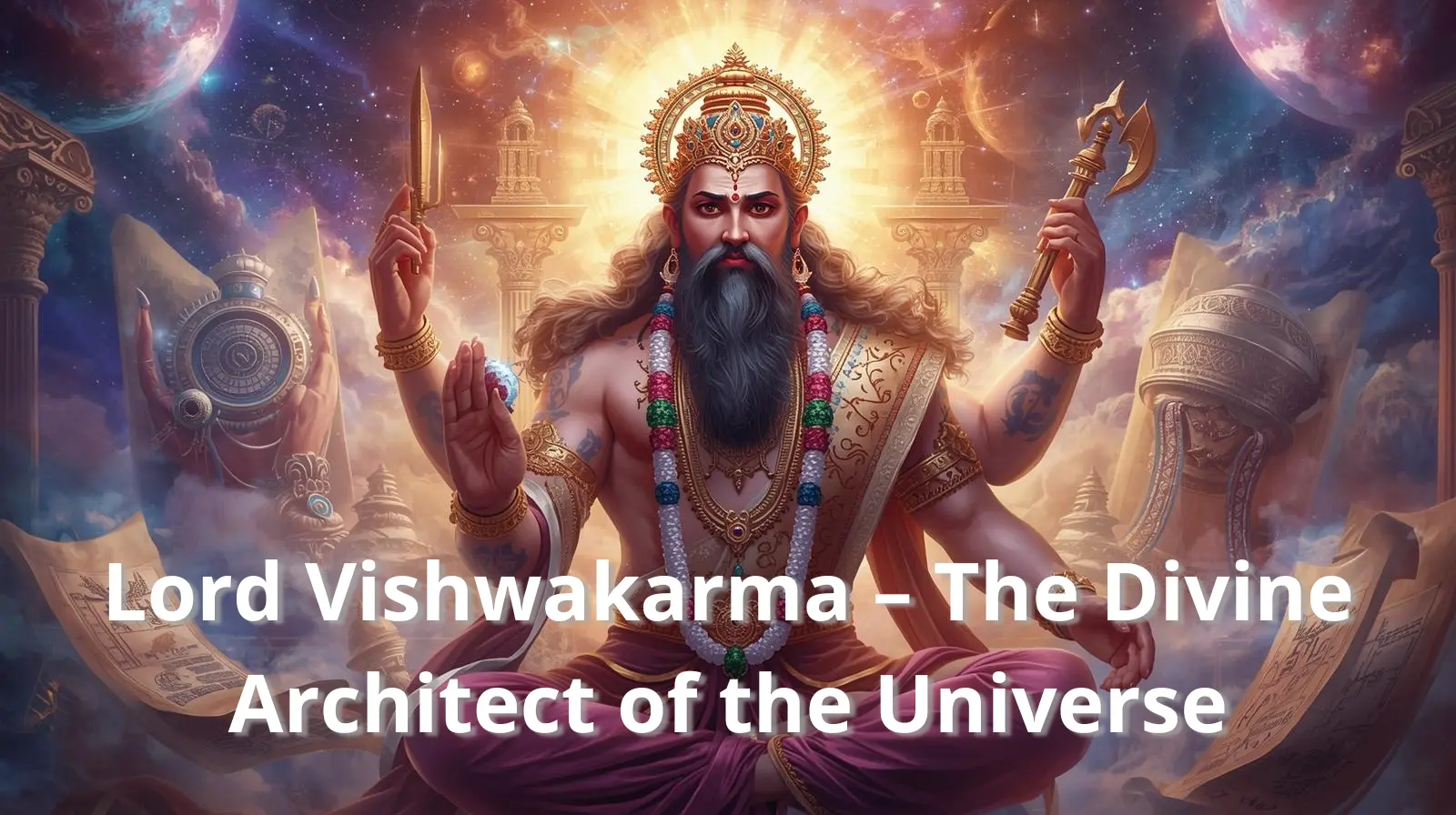
Iconography reflects this range. In much of India, Vishwakarma is shown as an elderly, bearded sage with four arms, holding tools such as a measuring rod or thread, a water pot, a book and a noose, often with a swan as his vahana. In Bengal and neighbouring regions he is more often shown as a youthful, moustached figure riding an elephant, with tools in hand. Both reflect regional artistic traditions, not competing theologies.
Vishwakarma in the Vedas: The Maker of All
The oldest portrait of Vishwakarma is found in two hymns of the Rigveda, 10.81 and 10.82, known as the Vishwakarma Suktas. Their seer is traditionally named Vishvakarma Bhauvana. These are not hymns about a carpenter-god; they are among the Rigveda's great meditations on how the universe came to be.
In 10.81, the poet imagines the creator as a cosmic smith. Its third verse is one of the most quoted lines on the omnipresence of the divine:
viśvataścakṣur uta viśvatomukho viśvatobāhur uta viśvataspāt | saṃ bāhubhyāṃ dhamati saṃ patatrair dyāvābhūmī janayan deva ekaḥ ||
"With eyes on every side, faces on every side, arms on every side and feet on every side, the One God, bringing forth heaven and earth, forges them together with his arms and with wings."
The image is of a smith working the bellows: creation as a craft. The same hymn then asks, with disarming honesty, what the wood was and what the tree from which heaven and earth were fashioned.
Hymn 10.82 continues in this vein, calling Vishwakarma wise in mind and all-pervading, the father of the eye, and speaking of the first germ held by the primeval waters, in which all the gods came together. In later Vedic literature, Vishwakarma is identified with Prajapati, the lord of creatures, and the name is also used as an epithet of Indra and Surya.
The Puranic Vishwakarma and His Lineage
In the Puranas and epics, Vishwakarma takes a more personal form: the architect of the devas, called in the texts the master of a thousand crafts. The Vishnu Purana, in its account of the eight Vasus, names him the son of the Vasu Prabhasa and of the sister of Brihaspati, a yogini named in different readings as Varastri or Yogasiddha, and describes him as the builder of the gods' celestial chariots and the maker of their ornaments, by whose art humans also live.
Sanjna and the Radiance of Surya
The most beloved family story concerns his daughter Sanjna (also Saranyu or Samjna), who married Surya, the Sun. Unable to bear her husband's blazing radiance, Sanjna left behind her shadow-double, Chhaya, and withdrew to the forest in the form of a mare. When Surya discovered this and followed her, Vishwakarma placed the Sun on his lathe and trimmed away part of his brilliance so that Sanjna could live with him.
According to the Vishnu Purana, from the shavings of that divine light Vishwakarma fashioned the Sudarshana Chakra of Vishnu, the trishula of Shiva, the weapon of Kubera, the spear of Kartikeya and weapons of the other gods. Through Sanjna, Vishwakarma is grandfather to Yama, Yamuna (Yami), Vaivasvata Manu and the Ashvini Kumaras.
Tvashtr, Vishwarupa and Nala
The Rigveda also knows Tvashtr, the divine artisan who fashions Indra's thunderbolt and shapes forms in the womb. Tvashtr's son Vishwarupa, the three-headed priest of the gods, was slain by Indra, and in grief Tvashtr brought forth the serpent-demon Vritra. Many later texts identify Tvashtr with Vishwakarma, while others keep them as separate figures; traditions genuinely differ here, and both readings have long pedigrees.
The Valmiki Ramayana adds one more descendant: Nala, the vanara who engineered the bridge to Lanka for Shri Rama, is described as the son of Vishwakarma, inheriting his father's gift.
The Great Creations and the Stories Behind Them
The Vajra and the Sacrifice of Dadhichi
When the demon Vritra seized the waters of the world, no weapon of the devas could harm him. They were told that only a weapon made from the bones of the sage Dadhichi, whose body was charged with the power of his austerities, could prevail. The devas approached the sage and made their request, and Dadhichi gladly gave up his life for the welfare of the worlds. From his bones the Vajra, Indra's thunderbolt, was fashioned: by Tvashtr in some tellings, by Vishwakarma in others such as the Bhagavata Purana. The story is told less as a tale of weaponry than of dana in its highest form: a sage giving his very body so that the world might be freed.
Lanka, the Golden City
The Uttara Kanda of the Valmiki Ramayana recounts that Vishwakarma built the city of Lanka on Mount Trikuta for the rakshasa brothers Malyavan, Sumali and Mali. When they were driven out, it became the city of Kubera, and later Ravana took it from his half-brother, along with the Pushpaka Vimana, the flying chariot also made by Vishwakarma. A popular later tradition tells a different story: that Vishwakarma built a golden palace for Shiva and Parvati, which Ravana requested as dakshina; but this is a folk account and not the Valmiki version.
Dwarka, the City in the Sea
When the repeated attacks of Jarasandha made Mathura unsafe, Shri Krishna resolved to move the Yadavas to a fortress no army could reach. The Bhagavata Purana describes how he had a city built in the midst of the sea, laid out with palaces, gardens and broad roads, by the divine architect. This was Dwarka, and popular tradition adds that it was raised in a single night.
Indraprastha and the Maya Sabha: A Common Confusion
Many retellings credit Vishwakarma with the city of Indraprastha, the Pandavas' capital. But the famous assembly hall that made Duryodhana stumble in envy, the Maya Sabha, was not his work. The Sabha Parva of the Mahabharata is explicit that it was built by Maya Danava, the great architect of the asuras, in gratitude to Arjuna for sparing his life during the burning of the Khandava forest. Maya and Vishwakarma are two different master builders: one of the asuras, one of the devas.
Jagannath of Puri
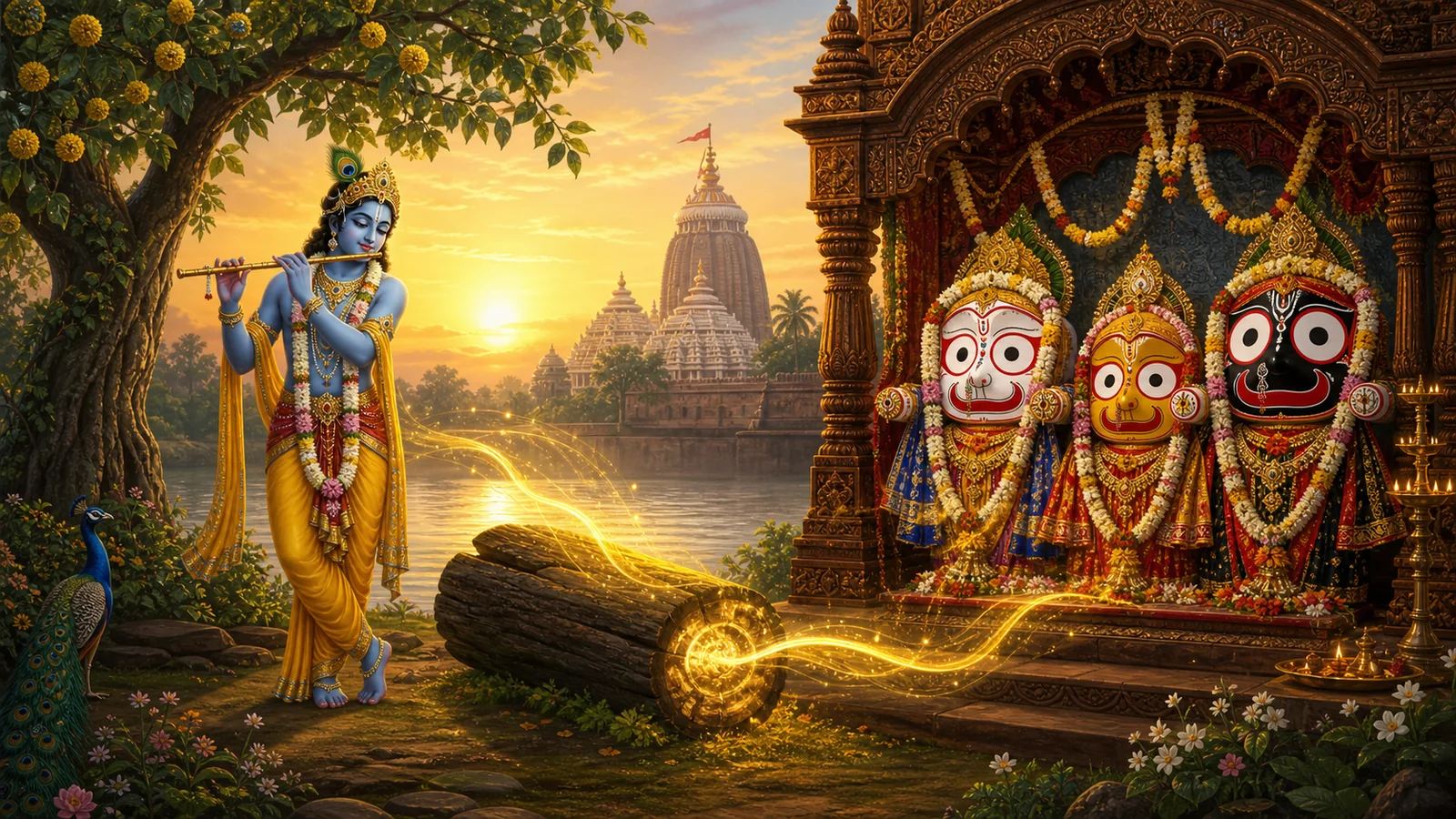
In Odisha, the tradition of Puri holds that Vishwakarma came in the guise of an old carpenter to carve the wooden forms of Jagannath, Balabhadra and Subhadra behind closed doors, on the condition that no one disturb him. When King Indradyumna opened the doors too soon, the carpenter vanished, leaving the forms as we see them today. The story is told in full in From Krishna to Jagannath: The Sacred Journey to the Lord of Puri, and its spirit lives on in the hereditary carpenters who build the chariots each year for the Jagannath Rath Yatra.
Vishwakarma is also regarded as the patron of Vastu and Shilpa Shastra, the traditional sciences of architecture and sculpture, and texts such as the Vishvakarma Prakasha carry his name.
When Is Vishwakarma Puja? The Kanya Sankranti Logic
Most Hindu festivals follow lunar tithis, which is why their Gregorian dates move from year to year. Vishwakarma Puja is different: in eastern India and much of the country it is observed on Kanya Sankranti, the moment the Sun enters the sidereal sign of Kanya (Virgo). In the Bengali solar calendar this is Bhadra Sankranti, the last day of the month of Bhadra.
Because it follows the Sun, the date is remarkably stable, usually falling between 16 and 18 September, most often on the 17th. In 2027 it falls on Friday, 17 September, with Kanya Sankranti at 2:14 PM per Drik Panchang for Kolkata (Bisuddhasiddhanta method); in 2026 it fell around 17 September. Where the Sankranti occurs late in the day, local panchangs may fix the puja on the following day, so always check a regional calendar.
Not everyone honours Vishwakarma on this date. In parts of Punjab, Haryana, Himachal Pradesh and Delhi, Vishwakarma Day is observed on the day after Diwali, when workshops and factories close for tool worship. Some Vishwakarma communities keep other dates in the lunar calendar as Vishwakarma Jayanti. All are sincere expressions of the same reverence.
Vishwakarma Puja Samagri
A simple list for a workplace or home puja:
- An image or idol of Lord Vishwakarma, and a small image of Ganesha
- A low wooden seat (chowki) and a clean red or yellow cloth
- A kalash with water, mango leaves and a coconut
- Roli or kumkum, haldi, sandalwood paste and akshat (unbroken rice)
- Fresh flowers and marigold garlands
- Incense sticks, a ghee or oil lamp and camphor for aarti
- Sacred red thread (mauli or kalava) and janeu
- Betel leaves, betel nuts and a few coins
- Fruits, sweets and panchamrit for naivedya
- Clean cloths for wiping tools, and your tools, machines, vehicles or instruments themselves
Step-by-Step Puja Vidhi
Families and workplaces follow many variations; what follows is a widely practised outline, not the only correct form.
- Prepare the space the day before. Clean the workshop, office or home workspace thoroughly. Service and wipe down machines and tools. Cleaning is itself the first offering.
- Purify yourself. On the morning of the puja, bathe and wear clean clothes. Many observe a light fast until the puja is complete.
- Set up the altar. Place the chowki facing east or north if possible, spread the cloth and place the images of Ganesha and Vishwakarma on it. Set the kalash beside them.
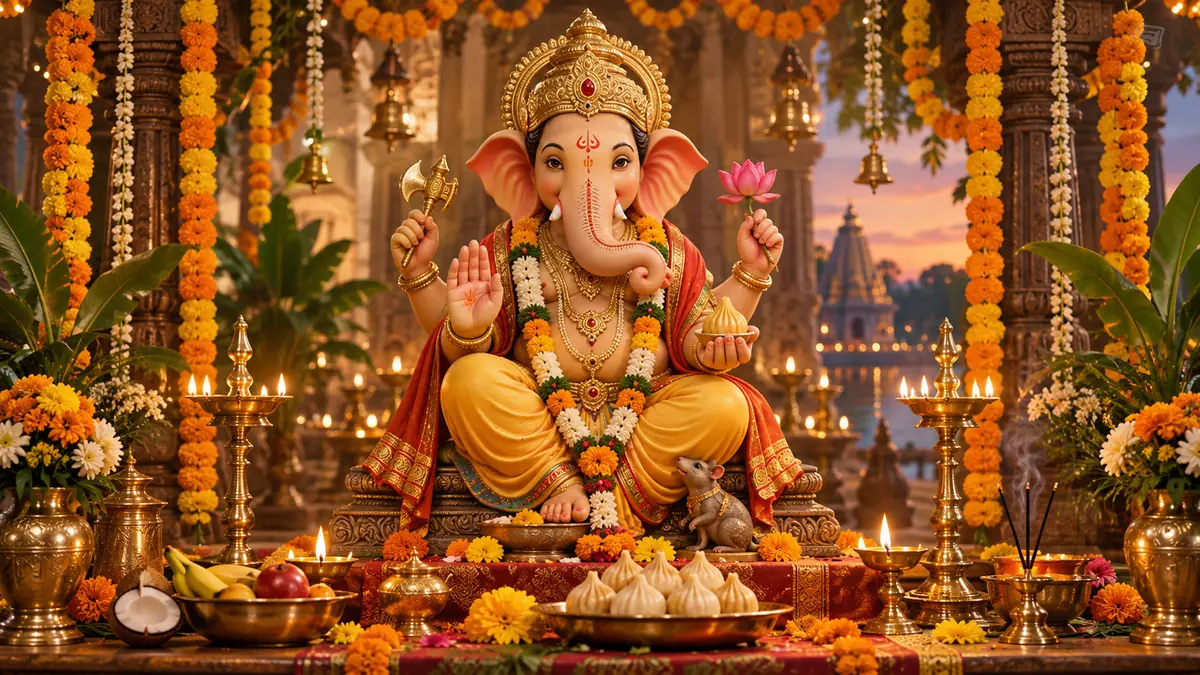
- Worship Ganesha first. As in every Hindu rite, begin by honouring Ganesha, the remover of obstacles; the reasons are explored in our guide to Ganesh Chaturthi.
- Take the sankalpa. Holding water, rice and a flower, state your name, place and the purpose of the puja: gratitude for your livelihood and a prayer for safe, honest and skilful work in the year ahead.
- Invoke and honour Vishwakarma. Offer water, tilak, akshat, flowers, a garland, incense and the lamp, chanting "Om Vishwakarmane Namah" with each offering.
- Honour the tools. Wipe each tool, machine or vehicle, apply a tilak of roli or haldi, tie mauli where possible and offer a flower. Switch off and unplug machines first, and never sprinkle water on electrical equipment.
- Offer naivedya. Place fruits, sweets and panchamrit before the deity.
- Perform aarti. Wave the lamp or camphor before Vishwakarma and the tools, often singing a Vishwakarma aarti, while everyone present joins in.
- Share prasad. Distribute prasad to all: owners, staff, apprentices and helpers alike. In many workplaces a community meal follows.
In many workshops the tools are not used for the rest of the day; they rest as honoured guests and are taken up again the next morning.
Regional Customs Across India
- West Bengal: Bishwakarma Puja is celebrated with community pandals in factories, garages, printing presses and taxi stands. The elephant-riding image is characteristic of Bengal, and kite flying fills the afternoon sky. In parts of rural Bengal the day also coincides with Ranna Puja.
- Odisha: Artisans, mechanics, weavers and industrial workers worship their tools, and the living carpentry of Puri's chariot-builders gives the day special resonance.
- Bihar and Jharkhand: The industrial and mining belts, including Jamshedpur and Dhanbad, celebrate on a large scale, with idols in plants, workshops and transport depots.
- Karnataka and South India: The Vishwakarma community, also known as Vishwabrahmins, Acharis or Panchalas, traces its descent from Vishwakarma. Tradition speaks of five sons of Vishwakarma, associated with five crafts: ironwork, carpentry, copper and bronze casting, stone sculpture and goldsmithing. These families hold Vishwakarma Jayanti celebrations, while tool worship for the wider public is more commonly observed at Ayudha Puja during Navaratri.
Kite Flying on Vishwakarma Puja
In Bengal, Bihar, Jharkhand and Odisha, rooftops fill with colourful kites and friendly contests of cut-and-chase on Vishwakarma Puja. This is a regional festive custom, not a scriptural rite, and its origins are not documented in any sacred text. Many see it as a fitting celebration of craft: a kite is a hand-built object of balance and design.
Why Honour Tools? The Spirit of Ayudha Puja
Vishwakarma Puja belongs to a wider Indian instinct to honour the instruments of our work. At Ayudha Puja on Mahanavami, South Indian homes and shops garland vehicles and machines; students place books before Saraswati; musicians bow to their instruments before playing; farmers honour their ploughs and bullocks. The idea is simple: the things that sustain our lives carry the effort of those who made them and the livelihood of those who use them.
To honour a tool is also to take responsibility for it: to keep it clean, maintained and safe. In a factory, the day of Vishwakarma Puja often doubles as a day of servicing and safety checks, where devotion and good practice meet.
Vishwakarma and Karma Yoga
The Bhagavad Gita offers the philosophy that gives this festival its depth. Krishna tells Arjuna that "yoga is skill in action" (yogaḥ karmasu kauśalam, Gita 2.50), a line that could stand as Vishwakarma's own motto. He also teaches that "you have a right to your work alone, never to its fruits" (Gita 2.47), and urges, "perform your prescribed work, for action is better than inaction" (Gita 3.8).
Most directly, Krishna declares that a person attains perfection by worshipping the Lord through their own work (svakarmaṇā tam abhyarcya siddhiṃ vindati mānavaḥ, Gita 18.46). Vishwakarma Puja is this teaching made visible: the lathe, the loom, the keyboard and the stethoscope become the altar, and the day's labour becomes the offering. To understand how creation, preservation and dissolution unfold in the Hindu vision, see The Eternal Trinity of Hinduism: Brahma, Vishnu, Mahesh.
Vishwakarma Today
The spirit of Vishwakarma now extends far beyond the traditional workshop. Engineers, architects, software developers, mechanics, designers, surgeons and makers of every kind carry forward the recognition that skilled creation is a form of worship. The festival is also a reminder of the dignity of labour: on this day, the owner and the apprentice stand before the same image and receive the same prasad.
For modern workers, a meaningful observance might be as simple as cleaning your workspace, repairing a neglected tool, thanking the people whose labour your own work depends on, and resolving to do your work with care and honesty. Just as Akshaya Tritiya teaches that good actions done in the right spirit never diminish, Vishwakarma Puja teaches that good work done in the right spirit is itself sacred.
Conclusion: Work as Offering
From the Rigvedic smith who forges heaven and earth to the old carpenter who shaped Jagannath behind closed doors, Vishwakarma reminds us that the universe itself is a work of craft, and that our small crafts are part of that great work. When the machines fall silent on Kanya Sankranti and the kites rise over the rooftops, the message is clear: gratitude for our tools, excellence in our work and respect for every worker are not separate from dharma. They are dharma.
Om Vishwakarmane Namah.
Frequently Asked Questions
Who is Lord Vishwakarma?
Vishwakarma is the divine architect and craftsman of Sanatan Dharma. In the Rigveda he is the maker of all, who fashioned heaven and earth; in the Puranas he is the architect of the devas, son of the Vasu Prabhasa, and the builder of celestial cities, chariots and weapons.
When is Vishwakarma Puja celebrated?
In eastern India and much of the country, Vishwakarma Puja falls on Kanya Sankranti, the day the Sun enters the sidereal sign of Virgo (Kanya). Because it follows the solar calendar, it usually lands between 16 and 18 September, most often on the 17th. In 2027 it falls on Friday, 17 September, with Kanya Sankranti at 2:14 PM per Drik Panchang for Kolkata; in 2026 it fell around 17 September. Some regions honour Vishwakarma on other days, such as the day after Diwali in parts of North India.
Why is Vishwakarma Puja celebrated on Kanya Sankranti?
Unlike most Hindu festivals, which follow lunar tithis, Vishwakarma Puja is tied to a solar transit. In the Bengali calendar the day is Bhadra Sankranti, the last day of the month of Bhadra. Tradition holds this transit as the fitting day to honour the divine craftsman, which is why the date stays almost fixed on the Gregorian calendar.
How is Vishwakarma Puja performed at a workplace?
The workshop is cleaned and machines switched off; an image of Vishwakarma is placed on a clean seat after first worshipping Ganesha; a sankalpa is made; tools and machines are cleaned and marked with tilak, tied with sacred thread and offered flowers; naivedya is offered, the mantra 'Om Vishwakarmane Namah' is chanted, aarti is performed and prasad is shared with all workers. In many places tools are rested for the day.
Which things were created by Vishwakarma?
Tradition credits him with Indra's Vajra, the golden city of Lanka, Krishna's Dwarka, the Pushpaka Vimana and many divine weapons, including (in the Vishnu Purana's account) the Sudarshana Chakra and Shiva's trishula fashioned from the trimmed radiance of Surya. The Maya Sabha of the Pandavas, however, was built by Maya Danava, not Vishwakarma.
Why do people fly kites on Vishwakarma Puja?
Kite flying on Vishwakarma Puja is a popular custom, especially in West Bengal, Bihar, Jharkhand and Odisha. It is a regional festive tradition rather than a scriptural rite; many see it as a joyful celebration of the craftsman's skill, since kites are hand-made objects of balance and design.
Is Vishwakarma Puja the same as Ayudha Puja?
They are different festivals with the same spirit. Ayudha Puja falls on Mahanavami during Navaratri and is especially popular in South India, where tools, vehicles and instruments are worshipped. Vishwakarma Puja falls on Kanya Sankranti and centres on Vishwakarma as the deity of craft. Both express reverence for the tools through which we earn our livelihood.
Can Vishwakarma Puja be done at home or by office workers?
Yes. Anyone who works with tools of any kind (a laptop, a sewing machine, a kitchen, a vehicle, books or instruments) can honour Vishwakarma. A simple puja at home with a lamp, flowers, a clean workspace and heartfelt gratitude is fully in keeping with the tradition.