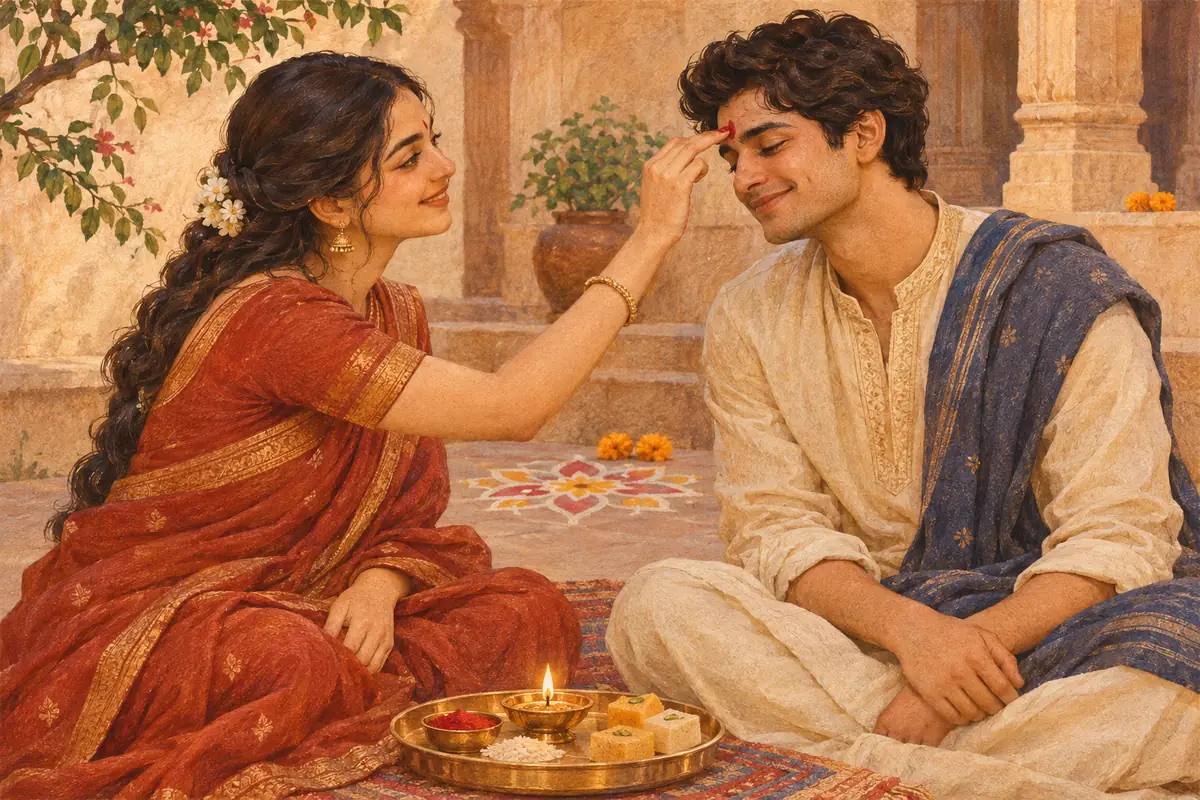
The five days of Diwali do not end with a bang but with a knock on a door. Somewhere a sister is arranging a thali she has arranged in her head for a week, diya, roli, rice, the sweets her brother liked before either of them could pronounce the word, and somewhere a brother is on a train or a two-wheeler or a flight, going where he is expected. Bhai Dooj, also called Bhaiya Dooj and Yama Dwitiya, falls on Wednesday, November 11, 2026, the festival's closing note, when the lamps hand the stage back to the people they were lit for.
Bhai Dooj 2026: Date and Tilak Muhurat, City by City
All timings below are in Indian Standard Time (IST), and each row names its source. The tithi moments are the same instant everywhere in India; the tilak window follows the local sun, so it shifts from city to city.
| Observance | Timing (IST) | Source |
|---|---|---|
| Bhai Dooj / Yama Dwitiya | Wednesday, November 11, 2026 | Drik Panchang, Gurugram |
| Dwitiya tithi begins | 2:00 PM, Tuesday, November 10 | Drik Panchang, Gurugram (same moment across India) |
| Dwitiya tithi ends | 3:53 PM, Wednesday, November 11 | Drik Panchang, Gurugram (same moment across India) |
| Tilak (aparahna) muhurat, Gurugram | 1:11 to 3:21 PM, November 11 | Drik Panchang, Gurugram |
| Tilak (aparahna) muhurat, Delhi | 1:10 to 3:20 PM, November 11 | Drik Panchang, Delhi |
| Tilak (aparahna) muhurat, Mumbai | 1:30 to 3:46 PM, November 11 | Drik Panchang, Mumbai |
| Tilak (aparahna) muhurat, Kolkata | 12:27 to 2:41 PM, November 11 | Drik Panchang, Kolkata |
The Tithi and the Tilak Window Are Not the Same Thing
Two different clocks run through every panchang entry, and Bhai Dooj is the clearest place to see them apart. The tithi is lunar and all-India: Kartik Shukla Dwitiya begins at 2:00 PM on Tuesday and ends at 3:53 PM on Wednesday, the same instant in every city. The tilak window is solar and local: the classical hour for this festival is aparahna, the stretch of early afternoon reckoned from local sunrise and sunset, which is why Kolkata's window opens three quarters of an hour before Mumbai's.
Put the two clocks together and the date settles itself. On Tuesday the 10th, the afternoon window belongs mostly to Pratipada, the tithi of Govardhan Puja; Dwitiya only enters partway through. On Wednesday the 11th, Dwitiya holds the entire aparahna and runs on until 3:53 PM. A festival whose rite lives in the afternoon goes to the day whose afternoon its tithi fills, so Bhai Dooj is Wednesday. That afternoon window is a preference, not a gate: families across India do the tilak in the morning or whenever the brother's train actually arrives, and the tithi accommodates them all the way to 3:53 PM. Where your family keeps the muhurat, the early afternoon is the hour; where it keeps its own order, that order is the vidhi.
The Katha: Yama at His Sister's Door
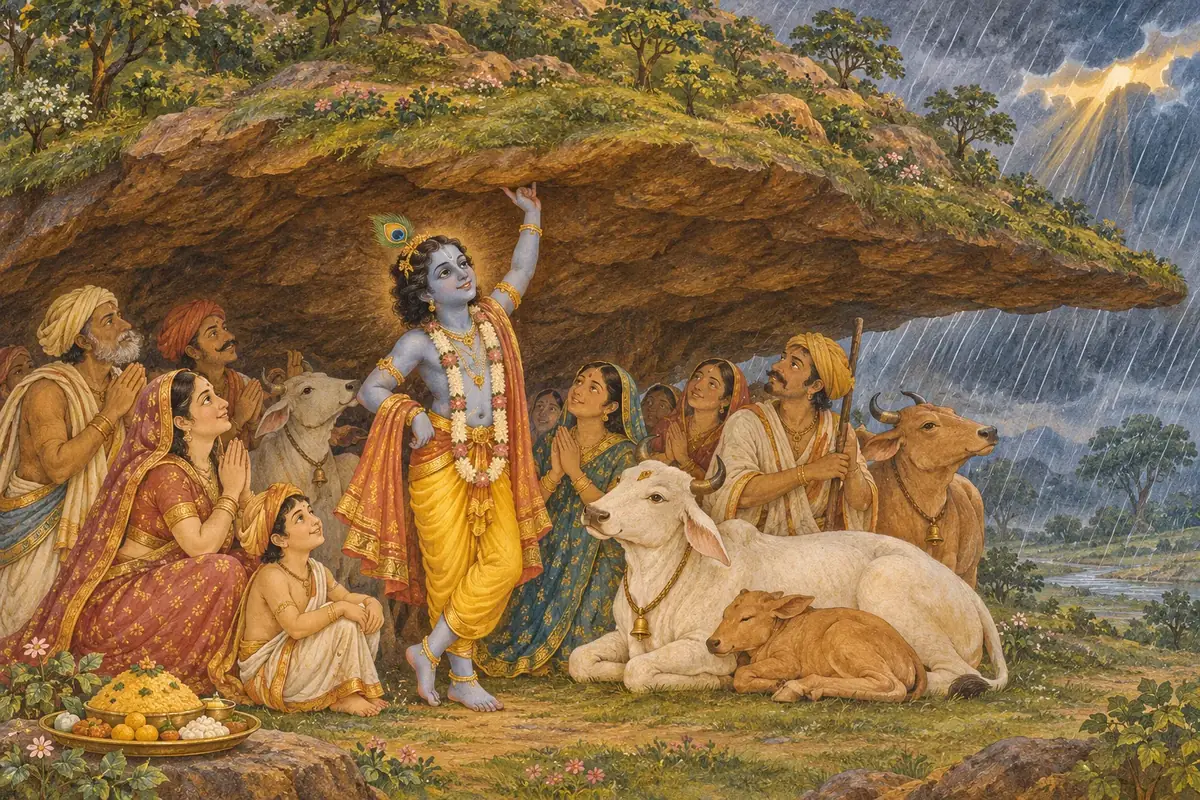
The story the day rests on is a traditional one, told and retold rather than pinned to one chapter, and it is best heard the way it is told at home. Yamuna, the river-goddess, and Yama, the lord of death, are twins, children of Surya. The sister kept inviting the brother: come, eat at my house, let me see you. And the brother kept not coming, in the way of brothers with demanding jobs; his, after all, never pauses. The katha says that on the Dwitiya after Diwali he finally came. Yamuna bathed, lit the lamps, put the tilak of welcome on his forehead, did his aarti, and fed him a meal she had cooked herself, every dish an argument that he should have come sooner.
Moved in a way his office rarely permits, Yama offered her a boon. Yamuna did not ask for herself. She asked that this day belong to brothers and sisters everywhere: that a brother who receives the tilak at his sister's hands and eats in her home on Kartik Shukla Dwitiya be blessed with long life, free of the fear of an untimely end. Yama granted it, and the day has carried his name since, Yama Dwitiya. In Braj, tradition extends the welcome to the river herself: bathing in the Yamuna with one's brother or sister on this day, most famously at Mathura's Vishram Ghat, is held specially meritorious, the goddess standing in for every sister whose brother lives too far to come.
It is a katha with unusual tenderness at its centre: the one being in the universe nobody wants at the door is welcomed, fed and loved, because to his sister he is not death, he is a brother. The festival asks everyone else to do the easier version of the same thing.
The Puja Thali: A Short Checklist
- A small diya with ghee or oil, and wicks
- Roli or kumkum for the tilak, and akshat (unbroken rice) to fix it
- A few flowers
- Sweets, bought or homemade
- A kalawa or raksha thread, if your family ties one at the wrist
- By regional custom: a dry coconut, batasha, or dry fruits to place in the brother's hands
A Simple Tilak Vidhi at Home
Families differ in sequence and detail, and the house's own elders outrank any written vidhi, this one included. A simple, common form:
- Seat the brother facing east or north on a clean seat or chowki once the thali is ready; in many homes the sister has bathed early and, by her own family's custom, fasts until the tilak is done.
- Apply the tilak of roli with the ring finger, press a few grains of akshat onto it, and if your family does, tie the kalawa on his right wrist.
- Do the aarti, circling the diya before him, and pray in your own words for his long life; the formal prayer of the day asks exactly what Yamuna asked.
- Sweeten his mouth and, where the custom lives, place the dry coconut or dry fruits in his hands.
- Eat together. The meal at the sister's home is the heart of the festival; the brother's gift to his sister afterwards, in whatever form, is his side of Yamuna's bargain. Fasting, the order of steps, and what is given are all family customs, not fixed law; the tilak, the blessing and the shared meal are the constants.
Bhau Beej, Bhai Phonta, Bhai Tika
The same Dwitiya wears different names across the subcontinent, and the variations are worth knowing on their own terms.
In Maharashtra and Goa, the day is Bhau Beej. The sister performs aukshan, waving the lit thali before her brother, and in traditional homes seats him within a square drawn on the floor before the tilak; the festive table leans to basundi, the slow-reduced sweetened milk, often with puri. In Bengal, it is Bhai Phonta, the phonta being the mark itself, classically of chandan, applied while the sister recites a traditional blessing rhyme, many sisters fasting until the phonta is given; per Drik Panchang's Bengali calendar it falls on the same Wednesday, November 11 in 2026, though Bengali panjikas occasionally differ by a day, and a family's own panjika decides. In Nepal, the day is Bhai Tika, the fifth and final day of Tihar, the festival of lights that honours Yama throughout: the Nepal Tourism Board describes its sequence of Kaag Tihar for the crow, Yama's informant, Kukur Tihar for the dog, his agent, Gai Tihar with Lakshmi Puja, the day of the ox with the Newari Mha Puja of the self, and then Bhai Tika, when sisters put tika on their brothers' foreheads and pray to Yama for their long life, in some communities brothers and sisters marking each other, with gifts, feasting and Tihar songs sung from house to house. Nepal reckons the day by its own calendar and announced hours, so travellers should check locally.
The accent shifts, the sweets change, the mark on the forehead goes from roli to chandan to tika; the grammar underneath, a sister's blessing against death itself, does not.
Where the Five Days End
Dhanteras opens Diwali with health, Lakshmi Puja fills it with fortune, Govardhan Puja grounds it in gratitude, and Bhai Dooj closes it with the one wealth the other days assume: the people. It is the quietest of the five and the one that travels best, needing no courtyard, no hill, no new purchase, only a thali and an afternoon. This Wednesday, let the tilak be unhurried. The boon of the day was never the long life alone; it was the visit.
Shubh Bhai Dooj.
References
- Drik Panchang: Bhai Dooj 2026, Gurugram: the date, aparahna tilak time (1:11 to 3:21 PM) and Dwitiya timings (2:00 PM November 10 to 3:53 PM November 11, IST). The Delhi, Mumbai and Kolkata pages were checked separately for the city rows above; set the page to your own location before fixing the hour.
- Drik Panchang: Bengali calendar 2026: Bhai Phonta on Kartik Shukla Dwitiya, November 11, 2026, by Bengali reckoning.
- Nepal Tourism Board: Tihar: the five days of Tihar and the Bhai Tika observance as described above.
- Wikipedia: Bhai Dooj: regional names and customs, including Bhau Beej in Maharashtra and Goa and the square drawn for the brother.
- The Yama and Yamuna katha is a traditional Puranic and oral narrative, retold here as tradition; tellings vary by region, and Drik Panchang's own vrat katha page carries a fuller version.
Frequently Asked Questions
When is Bhai Dooj in 2026?
Bhai Dooj, also called Bhaiya Dooj and Yama Dwitiya, falls on Wednesday, November 11, 2026. Kartik Shukla Dwitiya begins at 2:00 PM on Tuesday, November 10 and ends at 3:53 PM on Wednesday, November 11 (IST). The tilak belongs to the aparahna, the early afternoon, and Dwitiya holds that whole window only on Wednesday, so the festival is kept on the 11th.
What is the Bhai Dooj tilak muhurat in 2026?
The aparahna window on Wednesday, November 11, 2026 runs 1:11 to 3:21 PM in Gurugram, 1:10 to 3:20 PM in Delhi, 1:30 to 3:46 PM in Mumbai and 12:27 to 2:41 PM in Kolkata, all IST, per Drik Panchang. The window follows the local sun, so it shifts from city to city; check a panchang set to your own location.
Why is Bhai Dooj called Yama Dwitiya?
Tradition tells that on this Dwitiya, Yama, the lord of death, finally visited his sister Yamuna, who welcomed him with a tilak, aarti and a meal cooked with her own hands. Pleased, Yama declared that a brother who receives his sister's tilak and eats at her home on this day need not fear untimely death. The day has been Yama Dwitiya ever since, the second lunar day that belongs to Yama.
Can the tilak be done outside the muhurat?
Many families do. The aparahna window is the classical preference, but Dwitiya itself prevails until 3:53 PM on November 11, 2026, and households across India keep the tilak in the morning, after the brother arrives, or whenever the family gathers. Where a muhurat is kept, the early afternoon window is the one to use; where family custom says otherwise, custom rules.
What goes on the Bhai Dooj puja thali?
A small diya with ghee or oil, roli or kumkum for the tilak, akshat (unbroken rice), a few flowers, sweets, and a kalawa or raksha thread if your family ties one. Many households add a dry coconut, batasha or dry fruits by regional custom. Nothing on the thali needs to be expensive; the tilak and the meal are the festival.