In Braj they say the real feast begins when Diwali's lamps go out. In home kitchens from Mathura to wherever Braj's children have settled, the stoves barely rest: kadhi thickening in one pot, puris waiting by another, sweets set aside since morning, all of it meant not for the family but for a hill. In the courtyard, someone shapes a small mound of cow dung, crowns it with tufts of grass, and the house has built itself a mountain. Govardhan Puja, also called Annakut, falls on Tuesday, November 10, 2026, and if you have seen calendars naming Monday the 9th, the muhurat section below settles that question first.
Govardhan Puja 2026: Date and Muhurat, City by City
All timings below are in Indian Standard Time (IST), and each row names its source. The tithi moments are the same instant everywhere in India; the puja window follows local sunrise, so it shifts by a few minutes from city to city.
| Observance | Timing (IST) | Source |
|---|---|---|
| Govardhan Puja / Annakut | Tuesday, November 10, 2026 | Drik Panchang, Gurugram |
| Pratipada tithi begins | 12:31 PM, Monday, November 9 | Drik Panchang, Gurugram (same moment across India) |
| Pratipada tithi ends | 2:00 PM, Tuesday, November 10 | Drik Panchang, Gurugram (same moment across India) |
| Pratahkala muhurat, Gurugram | 6:40 to 8:50 AM, November 10 | Drik Panchang, Gurugram |
| Pratahkala muhurat, New Delhi | 6:40 to 8:50 AM, November 10 | Drik Panchang, New Delhi |
| Pratahkala muhurat, Mathura | 6:36 to 8:47 AM, November 10 | Drik Panchang, Mathura |
Govardhan Puja is a morning festival: its classic window is pratahkala, the first stretch after sunrise, which is why the timings above sit so early. Temples repeat the offerings through the day, and a family that misses the window has not missed the festival; but the muhurat, where one is kept, belongs to the morning.
Why November 10 and Not November 9
Most years Govardhan Puja simply follows Diwali the next day, and many printed calendars assume it always does. In 2026 the tithis leave a gap. Diwali falls on Sunday, November 8, on the Amavasya of Kartik. That Amavasya does not end with the night: it runs on through Monday morning and past noon, and Kartik Shukla Pratipada, the tithi of Govardhan Puja, begins only at 12:31 PM on Monday, November 9. A tithi that arrives after midday cannot claim that morning, and a morning festival goes to the first sunrise its tithi touches. Pratipada is present at sunrise on Tuesday and lasts until 2:00 PM that day, so Tuesday, November 10 is Govardhan Puja, and Monday stands empty between the two festivals, a quiet day the panchang leaves for sweeping up after the lights.
Some calendars and local lists do print Monday the 9th, usually by counting the day the tithi begins rather than the morning it rules; the same divergence gives Gujarat two possible New Year mornings in such years, since Bestu Varas follows the same Pratipada. The pratahkala rule that Drik Panchang and most North Indian panchangs follow points firmly to the 10th. As always, a family that follows its own temple or regional panchang should follow it without anxiety; the hill does not check the date on the invitation.
The Katha: The Week Braj Lived Under a Hill
The story belongs to the cowherd community of Braj, and the Srimad Bhagavatam tells it from inside that community, in Skandha 10, chapters 24 and 25.
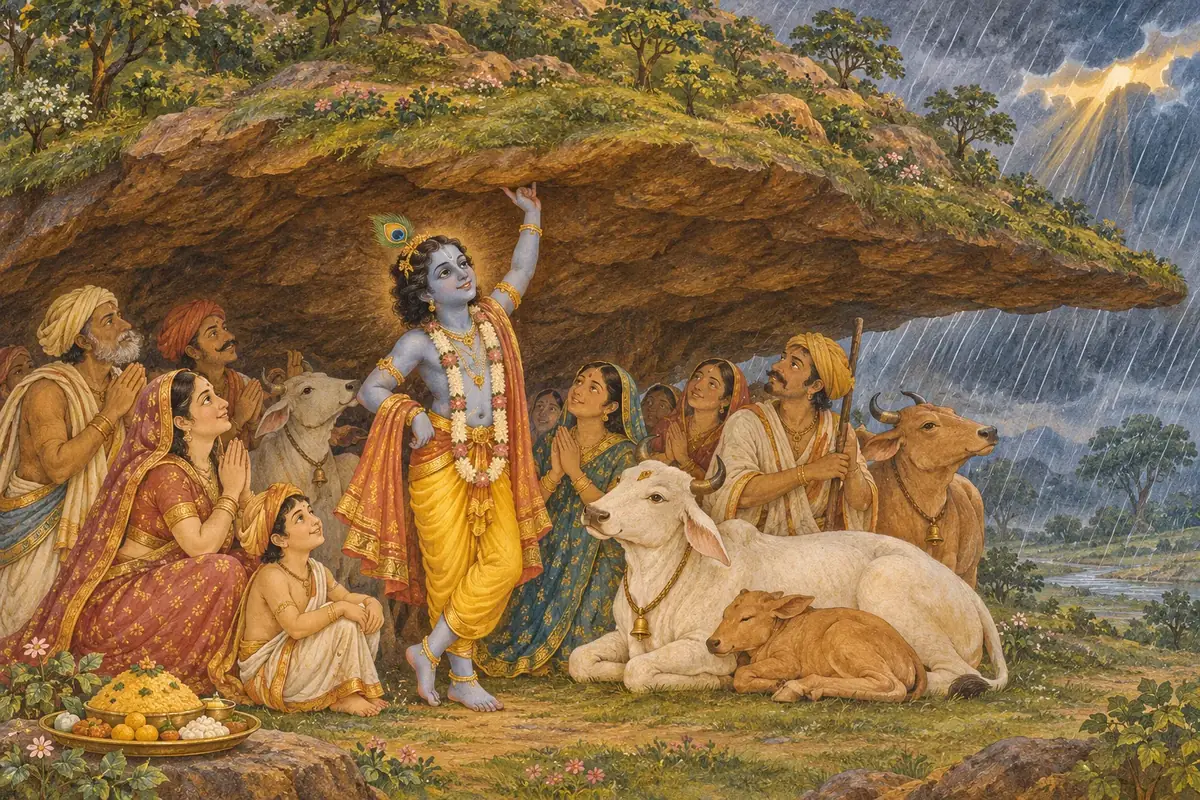
It begins with preparations. Nanda and the elders of Gokul are readying their annual sacrifice to Indra, lord of rain, as their fathers had before them, when the young Krishna starts asking questions a child is not supposed to ask. What is this yajna for? Who is Indra to us? His argument, laid out at length in chapter 24, is startlingly down-to-earth: we are not courtiers of heaven, we are cowherds. Our life is here, in the cows, in the brahmanas, and in this hill, Govardhan, whose grass feeds the herds, whose streams water them, whose forests shelter them. Worship what sustains you, he says; let the offerings go to the hill, the cows and the learned, and let Indra keep his thunder. The elders, half persuaded and wholly fond of him, agree. The village cooks everything it has, carries the food around the hill, feeds the brahmanas and the cows, and circumambulates Govardhan. And the Bhagavatam adds a scene the painters have loved ever since: Krishna himself assumes a vast form upon the hill, declares that he is the mountain, and eats the offerings, while the boy Krishna stands below among the villagers, bowing to the form above.
Indra's reply opens chapter 25. Stung in his pride, he sends the Samvartaka clouds, the clouds kept for the dissolution of worlds, against a village of herders. Rain comes down in ropes, then in sheets of hail; the cattle begin to freeze; the people of Braj, carrying their children and driving their cows, come to Krishna, and the seven-year-old walks to the hill and lifts it with one hand, holding it up like a great umbrella. Beneath it the whole community gathers, every family, every calf, the week's strange houseguests of a mountain. For seven days Krishna stands there, unmoving, while the storm spends itself against stone. Indra, his clouds exhausted and his pride with them, calls off the rain and later comes down to beg pardon. When the families walk out into the washed sunlight and Krishna sets the hill back in its place, the people of Braj have learned what the festival has taught ever since: the powers that feed you daily, land, cattle, grain, rain in its season, deserve your gratitude before any distant throne does.
One Hand, or the Little Finger?
Look at any Govardhan picture, including the one above this article, and Krishna holds the mountain on a single raised finger, usually the little finger of his left hand. It is worth being precise about where that beloved detail comes from. The Bhagavatam's own chapter says one hand, and elsewhere compares the ease of it to a child holding up a mushroom. The little finger is the language of later devotion: the retellings of Braj and the Vaishnava traditions, temple murals, pichhwai paintings and bhajans, where the smallest finger carries the largest load precisely to show how light the world sits in God's grip. ISKCON's own telling uses it naturally. It is familiar devotional imagery, cherished and correct in its own register, and a reader should simply know that the scripture gives the hand and the tradition gives the finger.
What Annakut Means
Annakut is a plain compound with an extravagant meaning: anna, food or grain, and kuta, a heap or mountain. The offering re-enacts the katha. Braj fed a hill; so on this day the food itself is built into a hill, rice heaped high, curries and breads and sweets banked around it like slopes, and offered to Krishna as Govardhan-dhari, the lifter of the mountain. In many homes the hill is present twice: once as the cow-dung Govardhan in the courtyard, and once as the food on the thali.
Practical bhog, for a household, means fresh vegetarian food cooked that morning: kadhi and plain rice is the classic pair in much of North India, with puris, a seasonal sabzi, something of leafy greens or gram flour, and a sweet, kheer or halwa or whatever the kitchen does well. Milk, makhan and mishri honour the cowherd himself. None of it need be elaborate. A temple builds a mountain because a town eats from it; a family's Annakut is however much its own table can offer and finish with respect, and one dish offered warm counts fully. Cows are honoured the same day wherever the custom lives, fed and garlanded, for the festival has never separated the hill from the herds it feeds.
A Simple Govardhan Puja at Home
Family and regional practice vary widely, and your own elders' way should overrule anything written here. What follows is a simple, common form.
Samagri checklist: a representation of Govardhan according to your family's custom (a small cow-dung hillock in the courtyard, decorated with grass and flowers, or where that is impractical, a picture of Govardhan-dhari Krishna or a small heap of grain on a clean plate); a diya with ghee or oil and wicks; roli and akshat; flowers; incense; the morning's bhog; a kalash or lota of water; and a little prasad to share.
- Prepare the Govardhan by morning. Shape the hillock or set the image after bathing, in a clean spot; children traditionally help, and should.
- Begin within the pratahkala window where you keep it (6:40 to 8:50 AM in Gurugram and Delhi this year). Light the diya.
- Offer roli, akshat and flowers, then lay the bhog before the Govardhan, simple or abundant as your kitchen allows. A short mantra if you wish: Om Shri Govardhanaya Namah, or simply the jaikara, Govardhan Maharaj ki jai. A sankalpa in your own words carries the same intent.
- Do the aarti, the traditional Govardhan aarti if your family sings it, any Krishna aarti otherwise, and walk around the Govardhan four times or seven, as your custom keeps, the household's own little parikrama.
- Share the prasad with everyone present, and set aside the cows' portion where that custom lives. Annakut ends in distribution; food offered to the hill has always been food eaten together.
Chhappan Bhog, Parikrama and the Wider Day
Two grand customs frame the home festival, and both belong to traditions that keep them rather than to every household. Chhappan Bhog, the offering of fifty-six dishes, is the glory of temple Annakuts, at Nathdwara, in the Pushtimarg havelis, at ISKCON temples and across Braj; a popular explanation counts seven days under the hill times the eight watches of each day, fifty-six meals the boy who held the mountain was owed. Govardhan Parikrama is the circumambulation of the hill itself at Govardhan town near Mathura, about 21 kilometres on foot through Radha Kund, Mansi Ganga and Dan Ghati, walked by lakhs on this day, some measuring it full-length in dandavat. Neither is required of a family courtyard; both are worth seeing once in a lifetime.
The day carries other names in other regions. In Maharashtra it is Bali Pratipada, honouring King Bali's annual return from the netherworld under Vamana's boon; in Gujarat the same Pratipada is Bestu Varas, the New Year, when shops open fresh account books. That one tithi can be a mountain festival, a king's homecoming and a new year at once is the usual, happy arithmetic of the Hindu calendar.
The Day After the Lights
Diwali worships Lakshmi, wealth in its shining, portable form. Govardhan Puja, hard on its heels, worships wealth in its original form: land that grows grass, cattle that turn grass into milk, grain heaped high enough to feed everyone who comes. It is the harvest thanksgiving of a herding people, kept alive in courtyards by a mound of dung and a plate of kadhi-chawal. Build your small mountain this Tuesday, feed it first and your family after, and let the festival make its old point once more: what holds your world up is nearer than you think, and gratitude, like the hill, is best kept close.
Shubh Govardhan Puja. Annakut ki shubhkamnayein.
References
- Drik Panchang: Govardhan Puja 2026, Gurugram: the date, pratahkala muhurat (6:40 to 8:50 AM) and Pratipada timings (12:31 PM November 9 to 2:00 PM November 10, IST). The New Delhi and Mathura pages were checked separately for the city rows above; set the page to your own location before fixing the hour.
- Srimad Bhagavatam, Skandha 10, chapter 24 (Vedabase): Krishna's conversation with Nanda and the first worship of Govardhan; chapter 25: Indra's Samvartaka clouds, the hill lifted with one hand, and the seven days of shelter.
- ISKCON Bengaluru: Govardhan Puja: the Annakut custom, temple practice and prasadam distribution, and the popular retelling in which the hill rests on the little finger of Krishna's left hand.
- Our own Diwali 2026 and Dhanteras 2026 articles cover the rest of the five-day festival, with the same timing conventions.
Frequently Asked Questions
When is Govardhan Puja in 2026?
Govardhan Puja, also called Annakut, falls on Tuesday, November 10, 2026. Kartik Shukla Pratipada begins at 12:31 PM on Monday, November 9 and ends at 2:00 PM on Tuesday, November 10 (IST). The puja belongs to the morning, and Pratipada is present at sunrise only on Tuesday, so the festival is kept on the 10th.
Is Govardhan Puja on 9 or 10 November 2026?
On Tuesday, November 10, by the common pratahkala rule. Pratipada begins only at 12:31 PM on November 9, so that morning still belongs to Amavasya; the first morning Pratipada touches is the 10th. Some calendars list Monday the 9th, usually by counting the day the tithi begins. A household that follows a family panchang or its temple should keep that date.
What is the Govardhan Puja muhurat in 2026?
The pratahkala (early morning) window on Tuesday, November 10, 2026 runs 6:40 to 8:50 AM in Gurugram and New Delhi, and 6:36 to 8:47 AM in Mathura, all IST, per Drik Panchang. The window follows local sunrise, so it shifts by minutes from city to city; check a panchang set to your own location.
What is Annakut, and does a home offering have to be large?
Annakut means a mountain of food: anna, grain or food, and kuta, a heap. It recalls the offerings Braj carried to Govardhan hill, and temples still build it into dozens of dishes, sometimes the famous Chhappan Bhog of fifty-six. At home it can be one fresh vegetarian dish offered with love: kadhi and rice, puri and sabzi, or simply milk, makhan and mishri. The heap stands for gratitude, not expense.
Why is there a gap day between Diwali and Govardhan Puja in 2026?
Usually Govardhan Puja follows Diwali the very next day, but in 2026 Diwali is Sunday, November 8 and Govardhan Puja is Tuesday, November 10. Monday, November 9 belongs to Amavasya until just past noon, and Pratipada begins only at 12:31 PM, too late to claim that morning. The first Pratipada morning is Tuesday, so the festival waits a day.