The Tenth Day, a Day Later
In Bengal, the calendar of farewell runs on its own quiet logic. Bijoya Dashami 2026 falls on Wednesday, October 21, one day after most of India celebrates Dussehra on October 20.
There is no quarrel in that gap, only two old conventions. Most of India keeps Vijayadashami on the day Dashami tithi fills the afternoon, joined when possible by Shravana nakshatra: in 2026 that is October 20, since the tithi begins at 12:50 PM that day. Bengali panjikas instead ask whose sunrise the tithi touches: Dashami is still running at dawn on October 21 (it ends at 2:11 PM), so that is Bengal's Dashami, and West Bengal's regional holiday falls on it. The Drik Panchang Bengal Vijayadashami page states both dates side by side; if your para or family panjika says otherwise, follow it.
For Bengal this is not primarily a day about Rama or effigies. It is the last morning of Durga Puja: the Mother, who arrived with her four children for five brief days, is going home.
Boron: the Farewell of the Married Daughter
Bengal's genius has always been to worship Durga not only as the slayer of Mahishasura but as the daughter come home for the holidays. On Dashami that homecoming ends, and the farewell is domestic, intimate and entirely led by women.
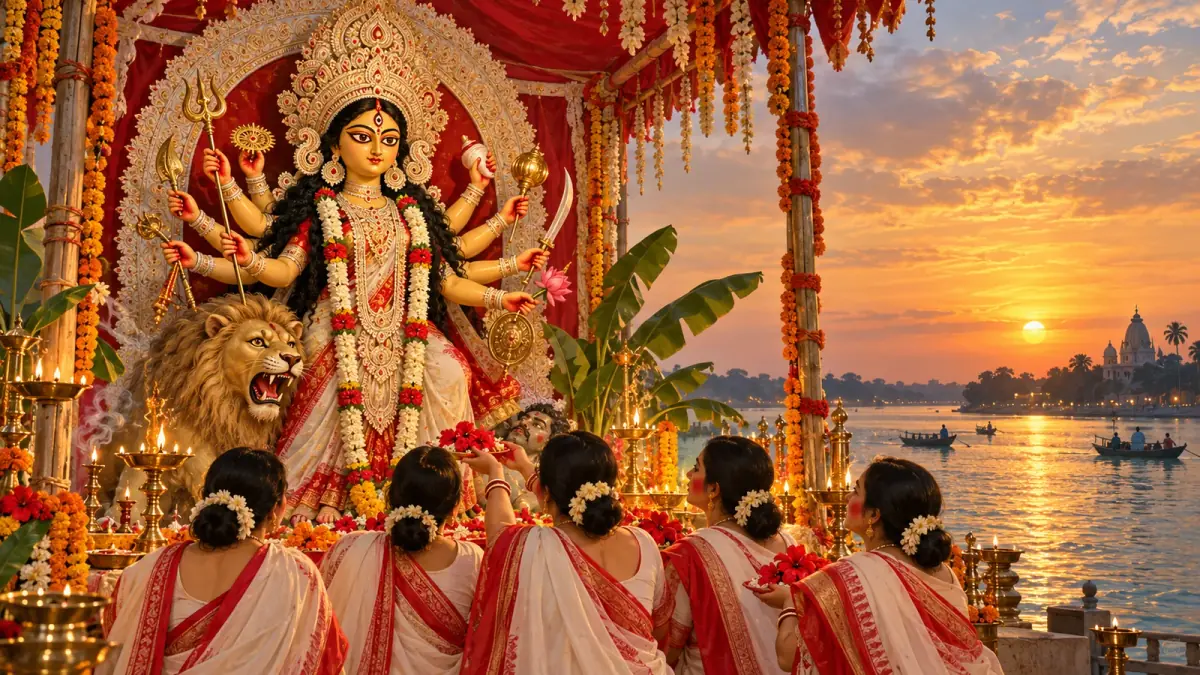
In the boron (also called Devi boron, the ceremonial send-off), women approach the murti in turn with a plate of sweets, betel leaves and sindoor. They touch the Devi's feet, feed her a last morsel of mishti, wipe her face as one would a departing daughter's, and whisper into her ear the invitation to come again next year. Many weep without embarrassment. The mood of the morning is the mood of every Bengali courtyard that has ever sent a married daughter back to her in-laws' house: love, pride and ache in one breath.
Sindoor Khela: Vermilion for the Journey
Out of the boron grows Sindoor Khela, the "vermilion play". After offering sindoor to the Devi, women apply it to one another, on the parting of the hair, on cheeks, on bangles, until the pandal is a blur of red and white. The sindoor offered to the Mother is carried home as a blessing on the household.
Participation has its history, and honesty about it matters. Sindoor Khela has traditionally been a custom of married women, tied to prayers for a long married life, and the older practice excluded widows and unmarried women. In recent years many community pujas, beginning with well-publicised efforts in Kolkata, have deliberately opened the ritual to all women, widowed, unmarried, divorced or transgender, and at large pandals today the crowd is far more mixed than it once was. Practice still varies from pandal to pandal and family to family; this article describes the variation rather than prescribing any single rule. If you are a guest, the safest courtesy is simply to follow the lead of the women hosting the ritual.
Visarjan: the Clay Returns to the River
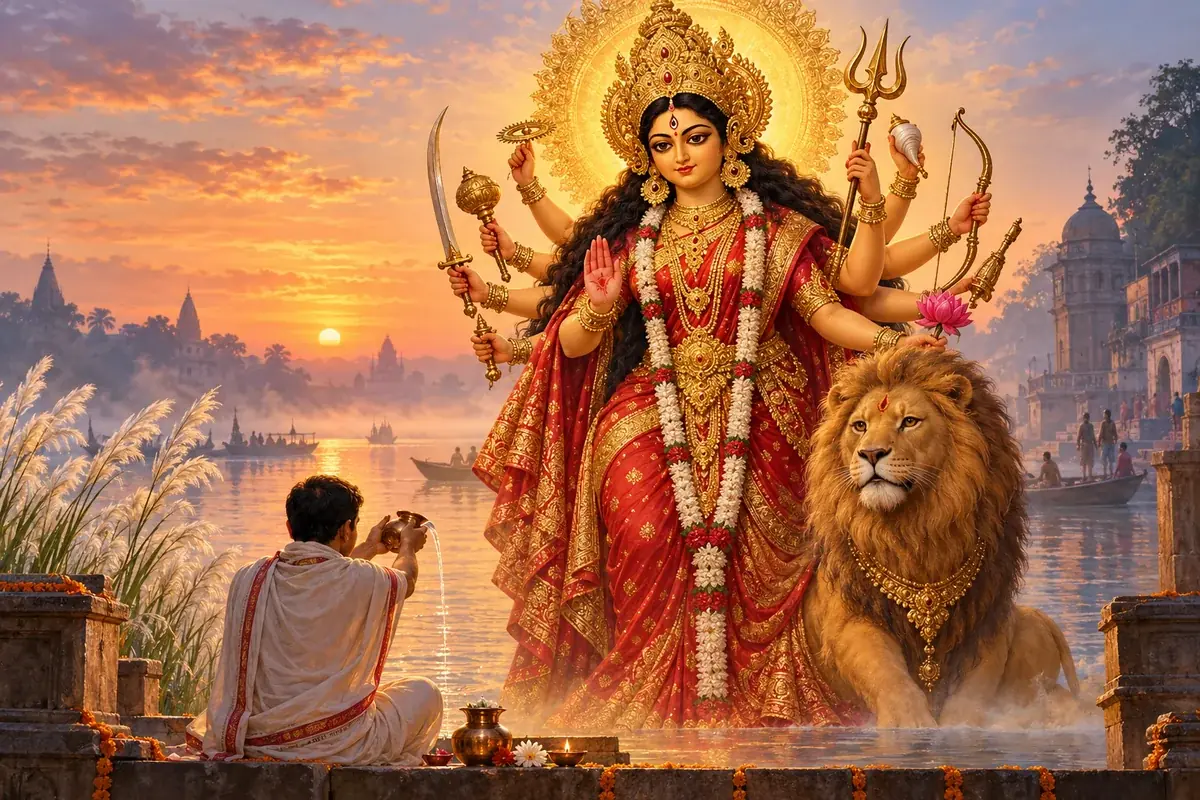
By afternoon the murti leaves the pandal. Drummers lead; the procession dances its way to the ghat; and the image that was the centre of five days of worship is carried into the water. UNESCO, inscribing Durga Puja in Kolkata on the Representative List of the Intangible Cultural Heritage of Humanity in 2021, noted the festival's full arc: the images are sculpted from unfired clay taken from the Ganga, and on the tenth day they are returned to the same river.
That circle is the theology of the day in miniature. The Devi was invoked into the clay; with the Dashami rites she withdraws from it; what goes into the river is earth going back to earth, while the Mother departs for Kailash. The crowd's own refrain keeps the farewell from becoming grief: "asche bochhor abar hobe", it will happen again next year.
Three practical cautions, because dates and times here are often muddled:
- Visarjan is not one all-India date. Each region and committee follows its own convention and schedule. Drik Panchang's Visarjan page set to Kolkata lists the muhurta-rule window on October 20, 2026 (12:50 to 2:49 PM IST), while Bengal's panjika Dashami, when the boron and Sindoor Khela happen, is October 21.
- Kolkata's immersions are staggered. In practice, the city's thousands of pujas immerse across Dashami and the following days under police and municipal arrangements at the ghats; a famous pandal's murti may enter the Hooghly days after a household one. Your local committee's announcement is the only schedule that matters.
- Delhi's Vijay Muhurat has nothing to do with immersion in Bengal. Muhurta windows published for one city and one ritual should never be reused for another city's processions.
Considerate observance is part of the tradition's own spirit: many committees now favour natural clay and colours and remove flowers and decorations before immersion, and families who cannot reach a ghat immerse a symbolic ghat-kalash or let the boron itself be their farewell. None of this is a rule; all of it is in keeping with a festival that returns clay to a living river.
Shubho Bijoya: the Festival After the Festival
The moment the murti goes under, Dashami changes key. The days that follow are Bijoya: the season of greetings. Juniors bend to touch the feet of elders and receive blessings; friends and cousins embrace, the famous kolakuli; and no visit survives without sweets, narkel naru (coconut laddoos), kucho nimki, ghugni and whatever else the house is proud of. "Shubho Bijoya" is said in person, over the phone and now in a thousand messages, and in many families the greetings run for days, often until Kali Puja and Bhai Phonta close the season.
It is worth noticing what Bengal has done here: the day of victory is celebrated almost entirely as a day of relationships, blessings sought, quarrels set aside, sweets shared. The Devi's triumph over the asura becomes, at home, the small renewing of bonds for the year ahead.
One Festival, Many Calendars
Keep the two halves of the season distinct and the whole picture stays clear. The Navratri of the nine forms, observed across India, closed with Maa Siddhidatri and the Parana of October 20. The same Dashami tithi gives most of India its Dussehra on October 20, with Vijay Muhurat, Shami Puja and Ravana Dahan, and gives Bengal its Bijoya on October 21, with boron, Sindoor Khela and Visarjan. Different doors into the same tenth day.
Shubho Bijoya. May the Mother's year-long absence be short in the heart.
References
- Drik Panchang: Bengal Vijayadashami 2026, Kolkata: Bijoya Dashami on Wednesday, October 21, 2026; Dashami tithi timings; the explanation of Bengal's sunrise-tithi convention versus the muhurta rule.
- Drik Panchang: Durga Visarjan 2026, Kolkata: the muhurta-rule Visarjan window of October 20, 2026, 12:50 to 2:49 PM IST, during Shravana nakshatra.
- Office Holidays: Vijaya Dashami in West Bengal 2026: regional holiday on Wednesday, October 21, 2026.
- UNESCO Intangible Cultural Heritage: Durga Puja in Kolkata: 2021 inscription; clay taken from the Ganga and returned to it on the tenth day.
- Wikipedia: Sindur Khela: the ritual's form and its traditional restriction to married women.
- Scroll.in: This ad asks for inclusion of all women in a Durga Puja ritual: the inclusivity campaigns and the opening of Sindoor Khela at community pujas.
Frequently Asked Questions
When is Bijoya Dashami in 2026?
Bijoya Dashami falls on Wednesday, October 21, 2026 in Bengal. Bengali panjikas count the festival on the day Dashami tithi prevails at sunrise: the tithi begins at 12:50 PM on October 20 and ends at 2:11 PM on October 21 (IST), so it is running at dawn on the 21st. Most of the rest of India observes Vijayadashami / Dussehra a day earlier, on Tuesday, October 20.
Why is Bengal's Vijayadashami a day after Dussehra in 2026?
Two calendar conventions read the same Dashami tithi differently. Most regions keep Vijayadashami on the day the tithi prevails in the afternoon, ideally joined by Shravana nakshatra, which points to October 20 in 2026. Bengal's panjika tradition follows the sunrise tithi, which points to October 21. In some years the two rules agree on one date; in 2026 they differ by a day, and each is correct within its own tradition.
What is Sindoor Khela and who takes part?
On Dashami, after the final rites, women offer sindoor (vermilion) to Maa Durga's image, along with sweets and betel leaves, and then apply sindoor to one another: this affectionate farewell is Sindoor Khela. It has traditionally been a custom of married women, and participation still varies by family and pandal, but many community pujas in recent years have opened it to all women, including widows, who were once kept out. Follow the custom of your own puja; there is no single all-India rule.
Does all Durga Visarjan in India happen on one date?
No. Immersion follows each region's own convention and each committee's schedule. By the pan-Indian muhurta rule, Drik Panchang lists the Visarjan muhurat for Kolkata on October 20, 2026 (12:50 to 2:49 PM IST), while Bengal's panjika observance of Dashami is October 21, and in practice Kolkata's ghat immersions are staggered across the following days under civic arrangements. North Indian Navratri murtis are commonly immersed on October 20. Your local committee's announcement is the only reliable schedule.
How do Bengalis greet each other after Dashami?
The greeting is 'Shubho Bijoya'. Juniors touch the feet of elders and seek blessings (pranam), people of the same age embrace (kolakuli), and plates of sweets and savouries, narkel naru, nimki and more, do the rounds of homes. In many families Bijoya greetings continue for days after Dashami, often until Kali Puja and Bhai Phonta.
What does the immersion of the idol actually mean?
The clay image is consecrated for the days of the puja; with the final Dashami rites, the Devi is understood to withdraw from it, and the clay returns to the river it came from. Devotees see the Mother departing for Kailash, her husband Shiva's abode, with the promise of return next autumn. The farewell is deliberately tender rather than mournful: 'asche bochhor abar hobe', it will happen again next year.