The week before Diwali announces itself without a calendar. The house smells of fresh paint and washed curtains, the utensil shops stay open late with their steel stacked to the ceiling, and someone in the family starts counting diyas and finds, as every year, that half of last year's are missing. All of that preparation points to one evening. Dhanteras, also called Dhantrayodashi, falls on Friday, November 6, 2026, and it opens the five days of Diwali: the evening the first lamp of the festival is lit, Lakshmi, Kubera and Dhanvantari are worshipped, and households bring something new across the threshold.
Dhanteras 2026: Date and Puja Muhurat, City by City
All timings below are in Indian Standard Time (IST), and each row names its city. The tithi moments are the same instant everywhere in India; the puja windows follow local sunset, so they shift from city to city.
| Observance | Timing (city-labelled, IST) |
|---|---|
| Dhanteras / Dhantrayodashi | Friday, November 6, 2026 |
| Trayodashi tithi begins | 10:30 AM, Friday, November 6 |
| Trayodashi tithi ends | 10:47 AM, Saturday, November 7 |
| Puja muhurat, New Delhi | 6:02 PM to 7:57 PM, November 6 |
| Puja muhurat, Gurugram | 6:03 PM to 7:59 PM, November 6 |
| Puja muhurat, Mumbai | 6:35 PM to 8:35 PM, November 6 |
| Puja muhurat, Kolkata | 5:28 PM to 7:26 PM, November 6 |
| Puja muhurat, Bengaluru | 6:25 PM to 8:20 PM, November 6 |
| Puja muhurat, Chennai | 6:14 PM to 8:10 PM, November 6 |
| Yama Deepam, New Delhi | around sunset, about 5:33 PM to 6:51 PM, November 6 |
Why the evening, when the tithi begins in the morning? Dhanteras puja belongs to Pradosh Kaal, the hours just after sunset, and within it the window when the fixed (sthir) Vrishabha lagna rises, in the belief that what is begun under a fixed ascendant stays in the house. Trayodashi begins at 10:30 AM on Friday and prevails through that whole evening, so Friday is the festival; by Saturday sunset the tithi has already ended. The same logic places Diwali itself on Sunday, November 8.
One distinction saves confusion every year: the puja muhurat is not the shopping muhurat. The puja keeps to its short evening window. Purchases are traditionally fine through the whole span in which Trayodashi prevails: for Delhi, from 10:30 AM on Friday right through to 6:37 AM on Saturday, and again from 6:37 to 10:47 AM that morning, per Drik Panchang's purchase timings. You do not need to crowd the jeweller at 6 PM; the evening belongs to the lamp and the puja.
What Dhanteras Means
The name is a compression of Dhantrayodashi: dhana, wealth, and trayodashi, the thirteenth tithi of the dark fortnight of Kartik. It is the opening note of the Diwali sequence, two evenings before the Lakshmi Puja night, and it sets the festival's real theme more honestly than its shopping-day reputation suggests.
Because the day's own deities say so. The devata whose appearance the tithi marks is not a god of money at all but Dhanvantari, the physician. Wealth as this day frames it begins with a body that is well, a household that eats from clean vessels, and gratitude for both. The old ordering survives in a proverb every Indian grandmother owns in some version: health first, then wealth. A festival that puts the doctor of the gods before the goddess of fortune is making exactly that point. What the day asks is not expenditure but stewardship: clean what you have, repair what you can, waste less, and let what enters the house enter it with intention.
Dhanvantari, Lakshmi and Kubera: Three Deities, Three Gifts
The evening's worship braids three distinct associations, and they are worth keeping distinct.
Dhanvantari is the physician of the devas and the traditional fountainhead of Ayurveda. The Bhagavata Purana (canto 8, chapter 8) describes the devas and asuras churning the ocean of milk, and among the last to emerge is a radiant figure carrying the pot of amrita: Dhanvantari. His appearance day is kept on this Trayodashi as Dhanvantari Jayanti. India's National Ayurveda Day was long observed on Dhanteras too, until a Gazette Notification of March 2025 fixed it on September 23 each year. The association is devotional and cultural; Ayurveda itself is a living tradition of medicine, and honouring its presiding deity is not a substitute for anyone's treatment.
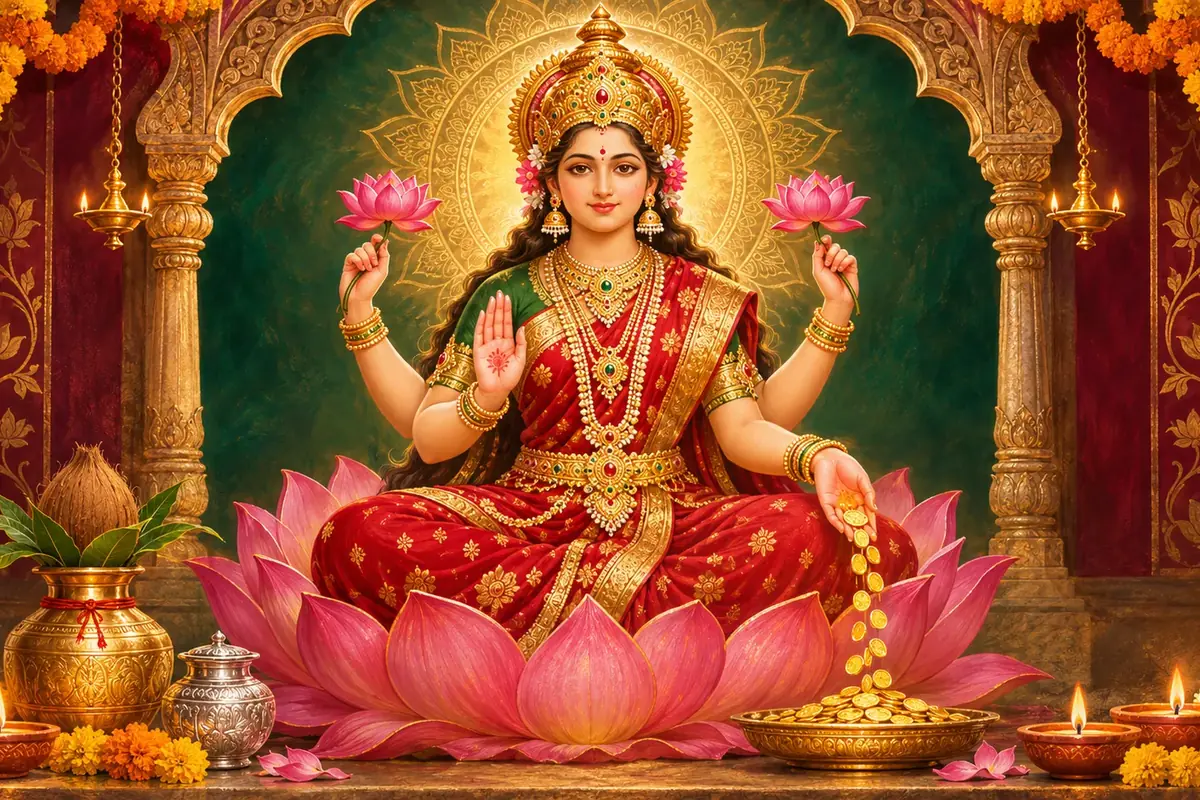
Lakshmi emerges in the same churning narrative, seated on a lotus, choosing Vishnu as her own. Puranic tellings of the Samudra Manthan vary in their lists and order of treasures from text to text, Bhagavata, Vishnu Purana and Mahabharata among them, and the tradition has never needed them to agree. On Dhanteras she is welcomed into a cleaned and lit house two evenings before her great night.
Kubera comes from a different stream altogether: the yaksha king of Puranic cosmology, treasurer of the gods, guardian of the north. He is not born of the churning; he is the keeper of wealth already won. Worshipping Lakshmi and Kubera together is the tradition's way of saying that fortune must both arrive and be kept well, and keeping well is a discipline, not a windfall.
The Story of King Hima's Son
A story told across North India, and worth telling as what it is, a popular traditional narrative, not a scriptural citation, explains the day's lamps. A king named Hima had a son fated to die of snakebite on the fourth night after his wedding. His new bride refused the fate. On the appointed night she heaped her ornaments and gold coins in a glittering mound at the door, lit lamps everywhere, and sang and told stories so that her husband never slept. When Yama arrived in the form of a serpent, the blaze of the lamps and the shine of the gold dazzled him; he sat on the heap all night listening, and at dawn went away, the hour of death having passed. The night, the katha says, was Dhantrayodashi, and the lamps of Dhanteras, above all the Yama Deepam, remember her vigil. Folk tellings differ in detail from region to region; what they share is the conviction that light, wakefulness and love can stand between a household and misfortune.
A Simple Dhanteras Puja at Home
Family and regional practice vary widely, and your own elders' way should overrule anything written here. What follows is a simple, common form.
Samagri checklist: a small chowki or clean shelf; images or murtis of Lakshmi and Ganesha (Dhanvantari and Kubera if your family keeps them); a diya with oil or ghee and wicks; roli and akshat (kumkum and unbroken rice); flowers; incense; something sweet as naivedya; a kalash or lota of water; and whatever new item was bought, placed before the deities.
- Clean the puja corner by evening. The cleaning is itself the first offering of the week.
- Set the chowki with Ganesha and Lakshmi; place the day's new purchase before them.
- Begin within the muhurat (6:02 to 7:57 PM in Delhi). Light the diya, offer roli, akshat, flowers and the sweet, first to Ganesha, then to Lakshmi, Dhanvantari and Kubera as your family keeps them.
- A mantra, if you wish. The simplest and most common is Om Dhanvantaraye Namah, salutations to Dhanvantari, a prayer for the health of everyone in the house. It is optional; a quiet sankalpa in your own words carries the same intent.
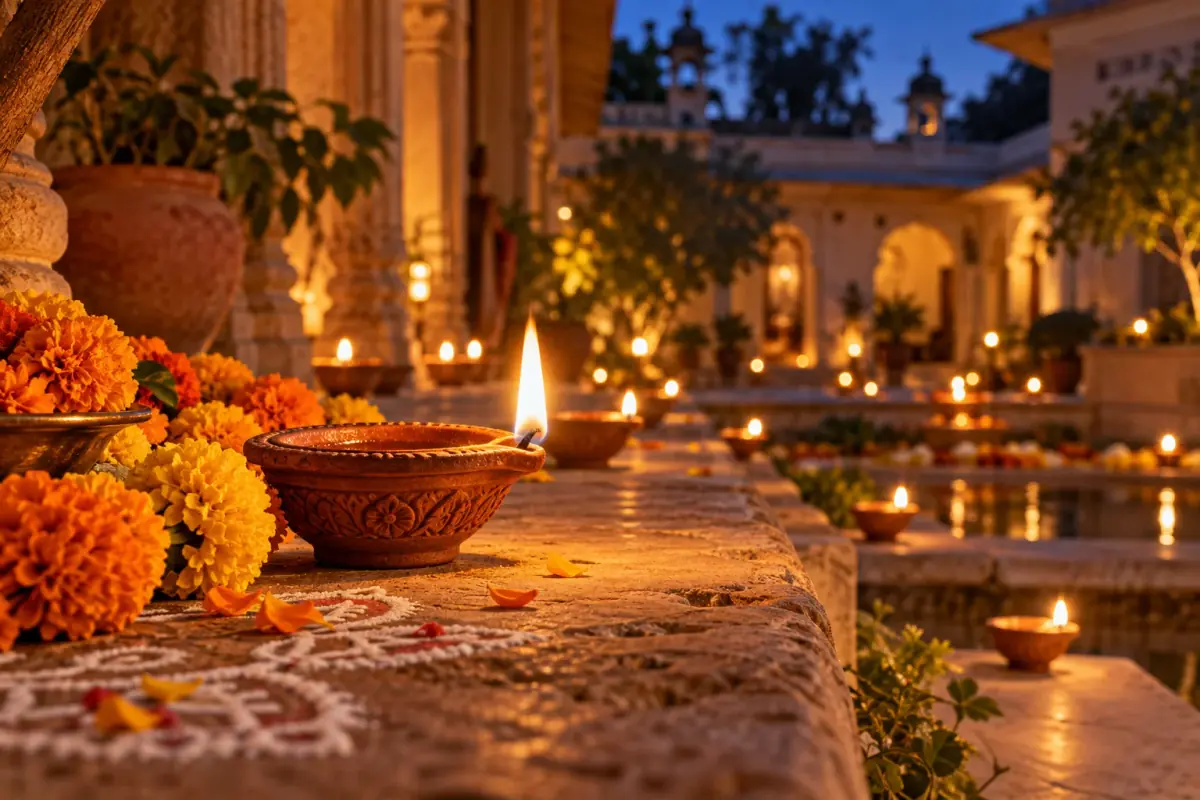
- Light the Yama Deepam outside the door after sunset (see below), and a few diyas at the threshold and windows: the festival's first row of lights.
What to Buy on Dhanteras, and What It Means
The custom of bringing something new into the house is a gesture of welcome: the household readying itself, visibly, for Lakshmi. Each traditional purchase carries its own symbolism.
- Utensils, the classic Dhanteras purchase, stand for the kitchen, which is to say for nourishment: a new vessel is a promise that the house will go on feeding its people and its guests.
- Gold or silver, where the budget allows it, stands for Lakshmi herself in her most compact form; on Dhanteras, silver, from a coin to a small bowl, has long been as traditional as gold.
- Diyas and their oil are the purchase the festival cannot do without, and the cheapest one.
- Whole coriander (dhaniya) is bought in many northern households and sown after Diwali: wealth that grows, the most literal stewardship of all.
- A new broom is a popular custom in many regions, honoured as the instrument that keeps Lakshmi's house clean.
Two honest notes. Buying gold is not compulsory, and no misfortune attends a Dhanteras without it; the day's own texts ask for lamps and worship, not invoices. And nothing here is investment advice: buy what gladdens the house and fits the month's budget, not what a festival discount insists is destiny. A five-rupee clay diya lit in the right hour fulfils the day completely.
Yama Deepam: The Quieter Lamp
After the shopping and before the feast comes the evening's most moving ritual. The Yama Deepam is a single oil lamp lit for Yama, the lord of death, traditionally placed outside the main door, facing south, Yama's direction, with the prayer that untimely death keep away from the family through the year. Drik Panchang confirms the observance for Friday, November 6, 2026, with the traditional sandhya window in Delhi at about 5:33 to 6:51 PM, around local sunset.
Regional practice differs: some households keep the lamp by the threshold rather than facing south, some use a four-wick lamp, and in parts of the country the deepdan for Yama is offered on Chaturdashi evening instead. Follow your family's way. And a practical word the tradition would approve of: a lamp left alone outside a door deserves a stable base away from anything that can catch, out of the path of children, pets and gusts. The prayer is for protection; let the lamp itself be kept safely.
How Regions Keep the Day
A few well-supported variations show the day's range without pretending any custom is universal. In Maharashtra, the festive sequence begins a day earlier with Govatsa Dwadashi, when cows and calves are honoured, and Dhantrayodashi is kept with particular devotion by trading families. Business households across the country traditionally clean and worship their account books, safes and instruments of trade this evening, the working form of Kubera's worship. Ayurveda institutions and practitioners observe the day as Dhanvantari Jayanti with formal worship of the physician of the gods. And in much of South India, this tithi passes quietly: the Deepavali emphasis there falls on the Naraka Chaturdashi oil bath two mornings later, a reminder that the festival is a family of traditions rather than one rulebook.
Health, Gratitude, Prosperity
Strip the discounts away and Dhanteras makes a quiet, almost medical argument: prosperity begins in a body that is well and a house that is cared for. Its presiding deity carries medicine, not money. Its most tender ritual is a lamp lit so that death passes by. Its purchases, read properly, are promises, to feed people, to keep things clean, to let wealth grow slowly like coriander in a pot. This Dhanteras, buy what you like, but light the two lamps that matter: one at the door for protection, and one inside, of plain gratitude, that everyone you love is here to celebrate with you.
Shubh Dhanteras.
References
- Drik Panchang: Dhanteras Puja 2026: the date, Trayodashi timings (10:30 AM November 6 to 10:47 AM November 7, IST) and city puja muhurats; set the page to your own location before fixing the hour. The Yama Deepam page and gold purchase timings page follow the same conventions.
- Panchang cross-check: the tithi moments above were independently verified against NASA JPL planetary data (DE421), the same method as our Diwali and Mahalaya articles; the results agree within a minute.
- Bhagavata Purana, canto 8, chapter 8 (Vedabase): the churning of the ocean, the emergence of Lakshmi and of Dhanvantari with the pot of amrita.
- Wikipedia: Samudra Manthana: overview of the churning narrative and its textual variations.
- Ministry of AYUSH / PIB: Ayurveda Day fixed on 23 September: Dhanvantari Jayanti remains on Dhanteras, while National Ayurveda Day has been observed on 23 September every year since 2025.
- The story of King Hima's son is a popular oral and devotional narrative associated with Dhanteras and the Yama Deepam; it is retold here as tradition, without a scriptural citation, and tellings vary by region.
Frequently Asked Questions
When is Dhanteras in 2026?
Dhanteras, also called Dhantrayodashi, falls on Friday, November 6, 2026. The Kartik Krishna Trayodashi tithi begins at 10:30 AM that day and ends at 10:47 AM on Saturday, November 7 (IST). Because Trayodashi prevails through Friday evening, the Pradosh hours that the puja needs, the festival belongs to Friday.
Why is Dhanteras celebrated?
Dhanteras opens the five days of Diwali. Tradition holds that Lord Dhanvantari, the physician of the gods, emerged from the churning of the ocean bearing the pot of amrita on this tithi, and Lakshmi and Kubera are worshipped the same evening for prosperity. The day honours health and wealth together and is also kept as Dhanvantari Jayanti, the appearance day of the physician of the gods.
What is the Dhanteras puja muhurat in 2026?
The puja is done after sunset, while Trayodashi and the fixed Vrishabha lagna prevail. On November 6, 2026 the window is about 6:02 to 7:57 PM in Delhi, 6:03 to 7:59 PM in Gurugram, 6:35 to 8:35 PM in Mumbai, 5:28 to 7:26 PM in Kolkata, 6:25 to 8:20 PM in Bengaluru and 6:14 to 8:10 PM in Chennai (all IST). The window follows local sunset, so check a panchang set to your own city.
Is buying gold on Dhanteras compulsory?
No. Buying gold is a popular custom, not a requirement of the day. Bringing something new into the house, often a metal, is itself an optional custom of welcome to Lakshmi, and a steel utensil, a brass diya or a few coriander seeds serve it as fully as jewellery does. The puja, the lamps and the Yama Deepam need no purchase at all.
What can we buy on Dhanteras on a small budget?
A steel or brass utensil, a clay diya or two, a small idol or image of Lakshmi-Ganesha, whole coriander seeds (dhaniya), a new broom in regions that keep that custom, or simply the oil and wicks for the week of lamps. The custom values the gesture of bringing something home, not its price.
Can existing utensils be used for the Dhanteras puja?
Yes. New purchases are placed before the deities as a mark of the day, but the puja itself is done with whatever clean lamps, plates and vessels the house already has. A household that buys nothing loses nothing of the ritual.
Who is Lord Dhanvantari?
Dhanvantari is the physician of the devas and the traditional originator of Ayurveda. The Bhagavata Purana describes him rising from the churned ocean carrying the pot of amrita, the nectar of immortality. His appearance day is kept on Dhanteras, which is why the day is also Dhanvantari Jayanti. India's National Ayurveda Day, once observed on Dhanteras, has been fixed on September 23 every year since 2025.
What is Yama Deepam?
Yama Deepam is a single oil lamp lit for Yama, the lord of death, on Dhanteras evening, traditionally placed outside the main door facing south, asking that untimely death stay away from the family. In 2026 it is lit on Friday, November 6; in Delhi the traditional window is about 5:33 to 6:51 PM, around local sunset.
Are the puja and shopping muhurats the same on Dhanteras?
No. The puja muhurat is the short evening window after sunset while Trayodashi and a fixed lagna prevail, about two hours. The shopping muhurat is far wider: for Delhi in 2026, from 10:30 AM on November 6 to 6:37 AM on November 7, and again from 6:37 to 10:47 AM that Saturday. Purchases can be made through the day; the puja keeps to its evening hour.
Do Dhanteras customs and timings differ by location?
Yes, on both counts. The tithi moments are the same across India, but the puja window follows local sunset, so every city differs by minutes. Customs differ more: traders worship account books, Maharashtra honours cows on Govatsa Dwadashi the day before, Ayurveda institutions keep Dhanvantari Jayanti, and in much of the south the Deepavali emphasis falls elsewhere entirely.