
The Date, First
Diwali 2026, the night of Lakshmi Puja, falls on Sunday, November 8. The Kartik Amavasya tithi begins at 11:28 AM on Sunday and ends at 12:32 PM on Monday, November 9 (IST). Lakshmi Puja belongs to the day on which Amavasya prevails after sunset, and in 2026 that is unambiguously the Sunday evening. November 8 is also the gazetted central government holiday for Deepavali.
Diwali closes the festive arc that began with Navratri and Vijayadashami: the darkest night of the darkest fortnight of Kartik, answered with more lamps than any other night of the year. One evening carries many traditions at once: Lakshmi Puja in most of the country, Kali Puja in Bengal, the dawn oil bath of the southern Deepavali, the Sikh Bandi Chhor Divas and the Jain remembrance of Mahavira's nirvana.
Diwali 2026: Lakshmi Puja Muhurat, City by City
All timings below are in Indian Standard Time (IST), and each row names its city. Tithi moments are the same instant across India; the puja windows follow local sunset, so they shift from city to city.
| Observance | Timing (city-labelled, IST) |
|---|---|
| Diwali / Lakshmi Puja | Sunday, November 8, 2026 |
| Amavasya tithi begins | 11:28 AM, Sunday, November 8 |
| Amavasya tithi ends | 12:32 PM, Monday, November 9 |
| Lakshmi Puja muhurat, Delhi | 5:55 PM to 7:51 PM, November 8 |
| Pradosh Kaal, Delhi | 5:32 PM to 7:56 PM (sunset 5:32 PM) |
| Vrishabha Kaal, Delhi | 5:55 PM to 7:51 PM |
| Lakshmi Puja muhurat, Mumbai | 6:28 PM to 8:27 PM, November 8 |
| Pradosh Kaal, Mumbai | 6:03 PM to 8:27 PM (sunset 6:03 PM) |
| Lakshmi Puja muhurat, Kolkata | 5:21 PM to 7:20 PM, November 8 |
| Pradosh Kaal, Kolkata | 4:56 PM to 7:20 PM (sunset 4:56 PM) |
The muhurat is the overlap of two things: Pradosh Kaal, the roughly two and a half festive hours after sunset while Amavasya prevails, and Vrishabha Kaal, the window in which the fixed (sthir) lagna of Vrishabha rises. A fixed lagna is preferred for Lakshmi Puja in the belief that what is begun in a stable ascendant stays: the household invites the Devi of prosperity to remain, not to visit. If the whole window is impractical for your family, the Pradosh hours after local sunset are the essential frame.
For any other city, open the Drik Panchang Lakshmi Puja page and set it to your location before fixing the hour.
The Five Days of Diwali 2026
| Day | Date | What is observed |
|---|---|---|
| Dhanteras | Friday, November 6 | Dhanvantari and Lakshmi puja in Pradosh (about 6:03 to 7:57 PM in Delhi); new purchases; Yama Deepam at the door |
| Choti Diwali (Naraka Chaturdashi) | Saturday evening, November 7, and the Abhyang Snan at dawn on Sunday, November 8 (5:36 to 6:36 AM in Delhi) | Lamps of the fourteenth; the oil bath that is the southern Deepavali morning |
| Diwali / Lakshmi Puja / Kali Puja | Sunday, November 8 | Lakshmi Puja in Pradosh; Kali Puja in Bengal the same night |
| Govardhan Puja / Annakut | Tuesday, November 10 | Pratipada morning puja (Pratahkal about 6:38 to 8:48 AM in Delhi); Annakut offerings |
| Bhai Dooj (Yama Dwitiya) | Wednesday, November 11 | Sisters' tilak to brothers in the afternoon (Aparahna about 1:10 to 3:20 PM in Delhi) |
The tithi clock explains each placement. Trayodashi begins at 10:31 AM on Friday, November 6 and prevails that evening, which makes it Dhanteras. Chaturdashi runs from 10:48 AM on Saturday to 11:28 AM on Sunday: its lamps belong to Saturday evening, while the Abhyang Snan, which needs Chaturdashi at dawn, falls to Sunday morning. Amavasya owns Sunday evening. Pratipada begins only at 12:32 PM on Monday and rules Tuesday morning, so Monday, November 9 is a quiet gap day with no festival of its own, a feature of the tithi calendar in 2026, not a mistake in your calendar. Dwitiya then prevails through Wednesday afternoon, the Bhai Dooj hour.
Why Lamps on the Darkest Night
Diwali is the one great festival deliberately set on Amavasya, the no-moon night. The name itself says the rest: dipavali, a row of lamps. Where Karwa Chauth waits for the moon, Diwali answers its complete absence with human light. The tradition's instinct is the old prayer tamaso ma jyotir gamaya, lead me from darkness to light: when the sky gives nothing, the household itself becomes the constellation.
The Stories of Diwali
Several great narratives share this night. They come from different scriptures and regions, and the festival is richer when each is allowed to be itself.
Rama Returns to Ayodhya
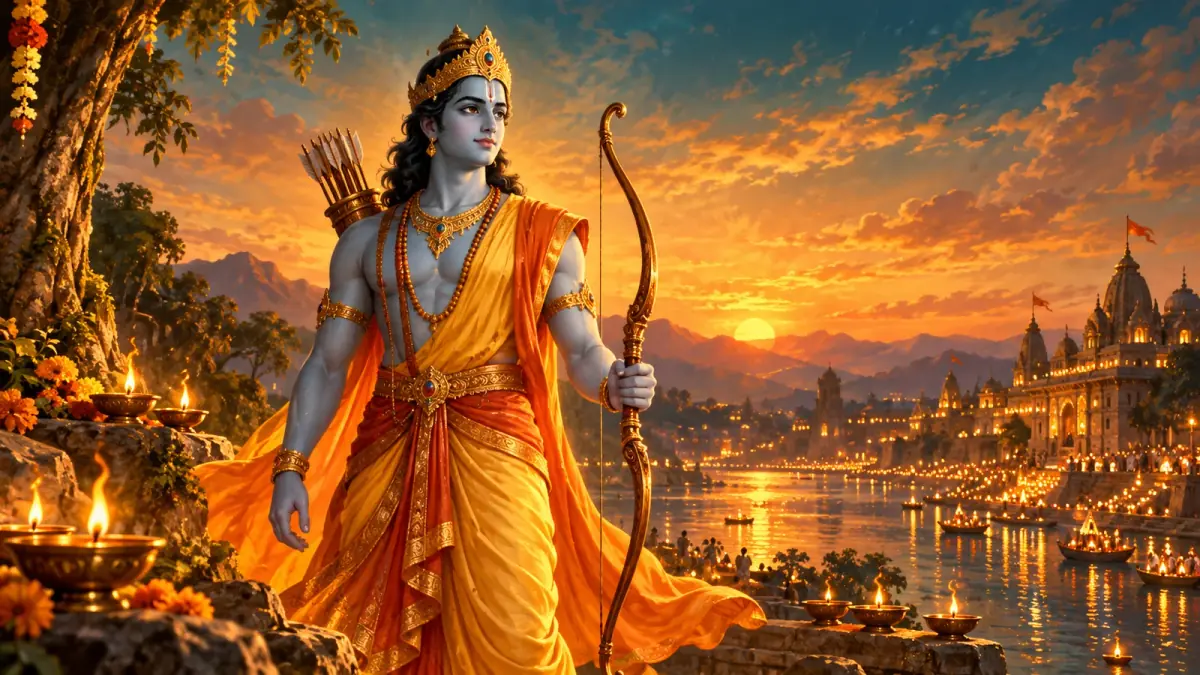
The most widely told story is the homecoming. After the fourteen years of exile and the war told in the Valmiki Ramayana, Rama returns to Ayodhya with Sita and Lakshmana, and the living tradition remembers the city welcoming them with rows of lamps on the Amavasya of Kartik. The epic itself narrates the return and the joy of the city; the lamp rows are the festival tradition's memory grafted onto it, and it is honest to keep the two apart. The arc that began on Vijayadashami with Ravana's fall completes here, twenty days later, with the throne restored: Dussehra is the victory, Diwali the homecoming.
Lakshmi, Born of the Churning Ocean
The puja of the night itself belongs to Maa Lakshmi. The Puranic story of the Samudra Manthan tells how the devas and asuras churned the ocean of milk, and among the treasures that rose from it came the Devi of fortune, choosing Vishnu as her own. Tradition holds that she emerged, and that she walks the earth, on this Amavasya, which is why houses are cleaned, lit and opened for her. The belief that Lakshmi visits the lit and welcoming home and passes the dark one is the engine of every Diwali custom, from the whitewash to the rangoli at the threshold.
Krishna and Narakasura
The fourteenth, Naraka Chaturdashi, remembers Krishna's defeat of Narakasura, the asura king of Pragjyotisha who had imprisoned sixteen thousand women. The Bhagavata Purana (10.59) tells the battle and the release of the captives. The pre-dawn oil bath of the southern Deepavali, the Abhyang Snan, marks the washing away of that night's darkness; in 2026 its window is dawn on Sunday, November 8, while Chaturdashi still prevails.
Kali in Bengal, and the Others
On the same Amavasya night Bengal worships Maa Kali, the fierce mother who ends what must end; Kali Puja is done at Nishita, around local solar midnight. The Sikh tradition keeps Bandi Chhor Divas, the day Guru Hargobind returned to Amritsar from Gwalior fort, freeing fifty two princes with him, and the Golden Temple glows with lamps. For Jains, this is the night of Mahavira's nirvana at Pavapuri. One dark sky, many lights.
Lakshmi Puja Vidhi at Home
The puja needs no priest and no elaborate samagri. Customs vary from family to family; let your own elders' practice overrule anything written here.
- Clean and ready the house by evening. The cleaning is itself part of the vrata: Lakshmi is welcomed into order, not clutter. Draw a rangoli at the threshold and set small footprints walking inward if your tradition keeps them.
- Set the chowki. On a clean platform place Maa Lakshmi with Ganesha to her left side as you face them, since every puja begins with him. Many households add Saraswati, the account books, or the tools of their trade.
- Begin in the muhurat. Within the Pradosh window (5:55 to 7:51 PM in Delhi on November 8), light the main lamp, offer a short Ganesha vandana, then invoke Lakshmi with flowers, roli-akshat, and something sweet. Kheel and batashe are the classic northern offering.
- Aarti, then light the house. After the aarti, carry flame to every diya: the threshold, windows, the tulsi, the darkest corner of the house. Traditionally one lamp is kept burning through the night.
- Share before you celebrate. Sweets to neighbours, something real to someone in need. The Devi of prosperity is honoured by circulation, not hoarding.
There is no universal fast on Diwali; most families feast. If firecrackers are part of your celebration, keep them away from the puja hours and mind your elders, your animals and your air; the lamp, not the bang, is the ritual.
Dhanteras, Govardhan and Bhai Dooj in Brief
Dhanteras (Friday, November 6) opens the festival. It honours Dhanvantari, the physician of the gods who rose from the same churned ocean bearing the pot of amrita, which is why the day is as much about health as wealth; the government of India marks it as National Ayurveda Day. Buying a metal, from a steel spoon to gold, is the popular custom; the evening's quieter duty is the Yama Deepam, a single lamp for Yama set facing south outside the door, asking that untimely death keep away from the house.
Govardhan Puja (Tuesday, November 10) remembers Krishna lifting Govardhan hill to shelter Braj from Indra's rains, the Bhagavata's lesson that the near and nourishing earth deserves worship before distant powers. Households build a small Govardhan of cow dung or arrange the Annakut, the mountain of food offered and then shared. In 2026 it falls two days after Diwali because of the gap Monday explained above.
Bhai Dooj (Wednesday, November 11) closes the five days. On Yama Dwitiya, tradition says, Yama dined at the home of his sister Yamuna and granted the day its promise: the brother who receives his sister's tilak this afternoon is guarded from untimely death. Sisters apply the tilak in the Aparahna hours (about 1:10 to 3:20 PM in Delhi), brothers bring gifts, and the festival ends where dharma likes to end, inside the family.
What the Light Asks of Us
It is easy to let Diwali become expenditure: the loudest crackers, the largest hamper. The tradition's own reading is smaller and harder. Every story of the night is about something dark being ended, Ravana's city, Naraka's prison, the unlit house, and in every one the light is kindled for someone else: a city for its king, captives for their freedom, a lamp at the door for the stranger and one for Yama himself. The row of lamps is a promise that the household will be a source of light and not only a container of it.
So the real question of the night is personal: which one lamp, this year, are you lighting for someone outside your own door? Light it in the Pradosh hour, and the festival has done its work.
Shubh Deepavali.
References
- Drik Panchang: Diwali Lakshmi Puja 2026: the Lakshmi Puja date, Pradosh and Vrishabha Kaal convention; set the page to your city for local timings. The five-day pages for Dhanteras, Naraka Chaturdashi, Govardhan Puja and Bhai Dooj follow the same conventions.
- Panchang timings in this article: tithi times were calculated from NASA JPL planetary data (DE421), the same method as our Mahalaya article; Pradosh Kaal is taken as the roughly 2 hour 24 minute span after local sunset, Vrishabha Kaal from the rising of the sidereal fixed lagna, Pratahkal and Aparahna as the standard divisions of the day from local sunrise to sunset. City windows are stated for Delhi, Mumbai and Kolkata.
- Government of Puducherry: List of public holidays 2026: Deepavali on Sunday, November 8, 2026, consistent with the central list under DoPT O.M. No. 12/2/2023-JCA dated 3 July 2025.
- Bhagavata Purana 10.59 (Vedabase): the Narakasura episode and the release of the captive princesses.
- Wikipedia: Samudra Manthana: the churning of the ocean and the emergence of Lakshmi and Dhanvantari.
- Ministry of AYUSH / PIB: National Ayurveda Day on Dhanteras: Dhanvantari Jayanti and the day's association with Ayurveda.
- Wikipedia: Bandi Chhor Divas: Guru Hargobind's release from Gwalior and the Amritsar illumination.
Frequently Asked Questions
When is Diwali in 2026?
Diwali, the night of Lakshmi Puja, falls on Sunday, November 8, 2026. The Kartik Amavasya tithi begins at 11:28 AM that day and ends at 12:32 PM on Monday, November 9 (IST), so the Amavasya evening, the time that matters for Lakshmi Puja, belongs to Sunday. November 8 is also the gazetted central government holiday for Deepavali.
What is the Lakshmi Puja muhurat on Diwali 2026?
Lakshmi Puja is done in the Pradosh Kaal after sunset, ideally while the fixed Vrishabha lagna rises. On November 8, 2026 that window is about 5:55 to 7:51 PM in Delhi, 6:28 to 8:27 PM in Mumbai and 5:21 to 7:20 PM in Kolkata (all IST). The window follows local sunset, so it shifts from city to city; check a panchang set to your own location.
Why is Diwali on November 8 and not November 9, when Amavasya ends?
Lakshmi Puja is kept on the day Amavasya prevails during Pradosh Kaal, the hours just after sunset. In 2026 Amavasya begins at 11:28 AM on November 8 and covers that whole evening, while on November 9 it ends at 12:32 PM, well before sunset. So the festival evening is Sunday, November 8, even though the tithi spills into Monday afternoon.
When is Dhanteras in 2026?
Dhanteras falls on Friday, November 6, 2026. Trayodashi tithi begins at 10:31 AM that day and prevails through the evening, so the Dhanteras puja is done in the Pradosh window after sunset, about 6:03 to 7:57 PM in Delhi. The Yama Deepam, the single lamp kept for Yama outside the door, is also lit this evening.
When are Govardhan Puja and Bhai Dooj in 2026?
Govardhan Puja is on Tuesday, November 10 and Bhai Dooj on Wednesday, November 11, 2026. Monday, November 9 carries neither festival: Amavasya runs till 12:32 PM and Pratipada begins only after that, so Pratipada rules the following morning, which is when Govardhan Puja is done. Dwitiya then prevails through Wednesday afternoon, the Bhai Dooj time.
Is Diwali on the same day everywhere in India?
In 2026, yes, the main day is Sunday, November 8 across traditions. North India does Lakshmi Puja that evening; in the south, Deepavali is kept with the Abhyang Snan oil bath at dawn the same Sunday, while Chaturdashi still prevails; Bengal worships Maa Kali the same Amavasya night; and the Sikh Bandi Chhor Divas and the Jain observance of Mahavira's nirvana fall on the same day.