Dawn on Mahalaya
In Bengal, Mahalaya begins in the dark. Long before sunrise, radios crackle to life in homes across Kolkata, and a deep, unhurried voice begins the Chandi Path. Grandparents who have heard it for seventy years sit up in bed. Children who will grow up to miss it are woken to listen.
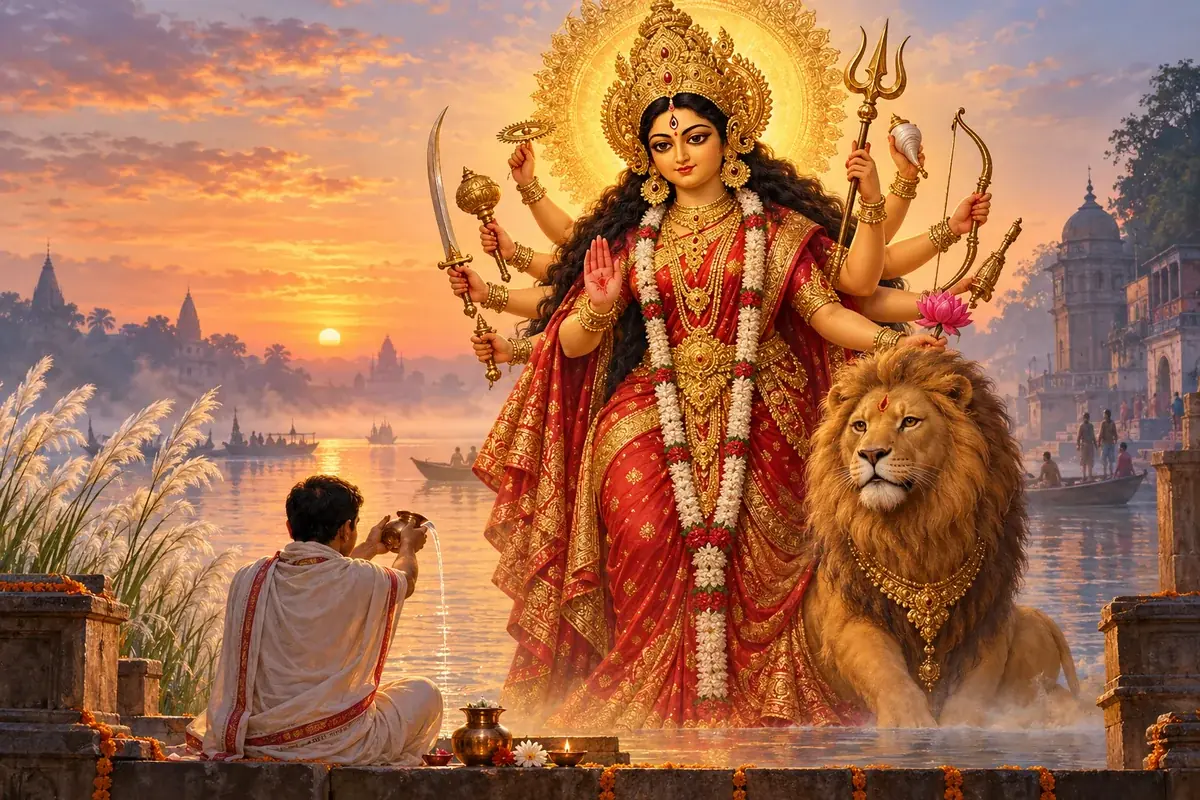
By first light, the river ghats are full. Men and women stand in the water with folded palms, letting water and black sesame trickle through their fingers while they say the names of fathers, grandmothers and great-grandparents. The ancestors are being thanked and given leave. And across the city, in workshops still smelling of wet clay, the image of Maa Durga waits for the festival that is now only days away.
That is Mahalaya: the day the tradition turns from remembering those who came before us to welcoming the Divine Mother. In 2026 it falls on Saturday, October 10.
Mahalaya 2026 at a Glance
Panchang timings below are for Kolkata, in Indian Standard Time (IST). Tithi start and end times are the same instant everywhere in India; sunrise-based windows shift by a few minutes from city to city.
| Observance | Date and time (Kolkata, IST) |
|---|---|
| Amavasya tithi begins | 9:36 PM, Friday, October 9 |
| Mahalaya / Sarva Pitru Amavasya | Saturday, October 10 |
| Sunrise (dawn tarpan) | about 5:30 AM |
| Kutup muhurta | 11:00 AM to 11:47 AM |
| Rohina muhurta | 11:47 AM to 12:34 PM |
| Aparahna kaal | 12:34 PM to 2:56 PM |
| Amavasya tithi ends | 9:20 PM, Saturday, October 10 |
| Navratri Day 1 (Ghatasthapana) | Sunday, October 11 |
| Maha Shashthi in Bengal | Saturday, October 17 (state holiday list) |
Panchangs can differ by a minute or two, and traditional Bengali panjikas sometimes follow their own calculations. If your family follows a particular panjika, its timings come first. To check another city, set the Drik Panchang Amavasya Shraddha page to your location.
Mahalaya, Sarva Pitru Amavasya and Devi Paksha: What Each Means
These names are often used as if they were one thing. They overlap, but each points to something different:
- Sarva Pitru Amavasya is the new-moon day that closes Pitru Paksha, the fortnight of the ancestors. Shraddha on this day is meant for all ancestors, irrespective of the lunar day they died, which is why families who do not know a death tithi observe it.
- Mahalaya is the name the same day carries in Bengal and much of eastern India. In parts of western and southern India the word is also used for the whole fortnight of ancestral rites.
- Devi Paksha is the bright fortnight that begins the next day. In Bengal, as a study of Kumartuli's artisans puts it, the dawn of Mahalaya announces the Devipaksha, which ends at the full moon with the worship of Lakshmi.
- Navratri Day 1 is Shukla Pratipada. Pratipada tithi begins at 9:20 PM on October 10, so Ghatasthapana and the worship of Maa Shailputri fall on the morning of Sunday, October 11.
- Shashthi, Kalparambha and Bodhan open Bengal's main Durga Puja days. Kalparambha (the formal start of the puja vow) is done in the morning, and Bodhan (the awakening of the Devi), with Amantran and Adhivas, follows in the evening. The West Bengal government's 2026 holiday list marks Maha Shashthi on Saturday, October 17. North Indian Navratri calendars count Shashthi on October 16 (see our Maa Katyayani article), because Shashthi tithi runs from 3:26 AM on October 16 to 5:55 AM on October 17 and touches both sunrises in Kolkata. Your local panjika or puja committee will fix the exact Bodhan day.
Bengal's Mahalaya: Tarpan at the Ghats
For Bengali families, Mahalaya morning has two halves. The first belongs to the ancestors. Officials in past years have arranged security at 18 ghats in Kolkata where devotees offer tarpan, and lakhs gather on the banks of the Hooghly and other rivers and ponds across the state.
The second half belongs to the Devi. In Kumartuli, Kolkata's potters' quarter, many artisans mark the day with chokkhudaan, the bestowing of the eyes, painting the eyes onto Durga's image. In tradition, the clay figure now looks out at the world, and the countdown to the puja has truly begun.
One Day, Many Observances Across India
Elsewhere, the same Amavasya takes other forms:
- North India: Sarva Pitru Amavasya is the great catch-all Shraddha day. Families cook a simple meal, set aside portions traditionally given to a cow, crow, dog and ants, feed Brahmins or the needy, and in many homes the crow's arrival is read as a sign the offering was accepted.
- Tamil Nadu: Mahalaya Amavasya draws pilgrims to the seashore and sacred waters. At Rameswaram's Agni Theertham, devotees offer tharpanam in thanksgiving to their forefathers.
- Telangana: the first day of the nine-day Bathukamma flower festival, Engili Pula Bathukamma, falls on Mahalaya Amavasya, known locally as Pethara Amavasya.
The forms differ, but every one of them begins with gratitude.
Tarpan and Shraddha on Mahalaya
Tarpan means "satisfying": an offering of water, usually with black sesame and kusha grass, made while remembering the ancestors by name. Shraddha is the fuller rite performed with shraddha (faith), and can include tarpan, pinda offerings and the feeding of guests. Our Pitru Paksha guide walks through tarpan step by step.
Preparation is simple. Bathe, wear clean clothes and keep ready a vessel of water, black sesame, a few blades of kusha if available, and the names of the ancestors you will remember. Many families write the names down the night before.
When to offer is where customs genuinely differ:
- In Bengal, dawn tarpan at the river is the beloved custom of Mahalaya morning.
- Formal Shraddha, by Dharmashastra convention, belongs to the middle of the day: the Kutup, Rohina and Aparahna windows given above. Wikipedia's summary of the tradition notes that Shraddha is performed at noon, on a riverbank or at home.
Neither custom is "wrong". Region and family lineage shape the practice, so ask your family priest and use a panchang set to your own city.
Mahishasuramardini: The Voice Before Dawn
The radio programme that wakes Bengal on Mahalaya is Mahishasuramardini. It is about an hour and a half long and weaves together Chandi Path verses from the Sri Sri Chandi (Durga Saptashati), Bengali narration, devotional songs and orchestral music. It tells how the gods' combined power took form as the Devi to defeat the buffalo-demon Mahishasura.
Its credits are part of the legend:
- Birendra Krishna Bhadra: narration and Sanskrit recitation, the voice most Bengalis associate with Mahalaya.
- Bani Kumar: the script.
- Pankaj Kumar Mullick: the music.
Songs such as "Bajlo Tomar Alor Benu", sung by Supriti Ghosh, have become inseparable from the season. Akashvani has aired the programme since the early 1930s (accounts differ on the exact first year), and it has long been played from a recording. In 1976, Akashvani tried a new programme narrated by the film star Uttam Kumar. Listeners responded so poorly that Bhadra's version returned, and it has stayed.
A Hindi version also exists. In 2021, for example, Prasar Bharati scheduled the Hindi/Sanskrit programme from 4 to 5:30 AM on its national channels and the Bangla version on FM Rainbow. That document describes a past year, not 2026, so check Akashvani's announcements for this year's broadcast times.
Mahishasuramardini Is Not "Aigiri Nandini"
The two are often confused online. "Aigiri Nandini" is the opening of a separate Sanskrit hymn, the Mahishasura Mardini Stotram, sung in temples and homes across India. Mahishasuramardini is Akashvani's radio programme built around the Chandi. Both praise the Devi as the slayer of Mahishasura, and both are lovely to hear on Mahalaya, but they are different works.
A Simple Mahalaya at Home
You do not need a ghat or a priest to keep Mahalaya well. A simple observance might look like this:
- Wake early and listen. Play Mahishasuramardini, or read a chapter of the Devi Mahatmya if that is your custom.
- Remember. Sit quietly with photographs or the written names of your ancestors. Say their names aloud.
- Offer tarpan. Pour water mixed with black sesame from your cupped hands into a clean vessel or onto a plant's soil, facing south as tradition prefers.
- Give. Feed someone in need, donate grain, or support a cause your grandparents cared about, in their name.
- Pray for the coming days. Clean the home altar and prepare for Ghatasthapana tomorrow.
Is Fasting Compulsory on Mahalaya?
No. There is no universal fasting rule for Mahalaya. In many families, the person offering Shraddha does not eat until the rites are complete, and the household keeps the day's food simple and sattvic. Many devotees begin their Navratri fast the next morning instead. If health or work make a fast difficult, tradition asks you to remember with a full heart, not to strain yourself.
When formal rites cannot be arranged, simple tarpan at home, the ancestors' names spoken aloud and food given in their memory are tradition's own answer. A family priest can guide a shorter form of the rite. Doing something small with sincerity is better than doing nothing out of fear of imperfection.
From Gratitude to Celebration
The order of these days is itself a teaching: first we thank the roots, then we celebrate the One who sustains all life. As Mahalaya's Amavasya slips into Pratipada on the night of October 10, the house that remembered its ancestors in the morning prepares the kalash for the Devi.
Tomorrow begins the nine forms of Maa Durga, opening with Maa Shailputri on Navratri Day 1. Shubho Mahalaya.
References
- Drik Panchang — Amavasya Shraddha 2026: Kutup, Rohina and Aparahna Shraddha windows; set the page to your city.
- Drik Panchang — Kalparambha 2026: Kalparambha and Bengal Durga Puja ritual timings by city.
- Panchang timings in this article are for Kolkata (IST). Tithi times were calculated from NASA JPL planetary data (DE421), and the muhurta windows use the standard Shraddha divisions of the day from local sunrise to sunset.
- Government of West Bengal, Finance (Audit) Department — Holiday notification No. 4188-F(P2), 27 November 2025: Mahalaya on Saturday, October 10 and Maha Shashthi on Saturday, October 17, 2026.
- Wikipedia — Mahisasuramardini (radio programme): content, credits, Hindi version and the 1976 episode.
- Prasar Bharati / PIB — Celebrate Navratri with Prasar Bharati (2021): past Mahalaya programming on Akashvani and Doordarshan.
- PTI via EastMojo — People offer tarpan on Mahalaya (2021): tarpan at Kolkata's ghats.
- Lopamudra Maitra — Artisans of Kumartuli, Chitrolekha Journal (2013): Devipaksha and chokkhudaan.
- Wikipedia — Pitru Paksha: Sarvapitri Amavasya, Shraddha timing and customs.
- Deccan Chronicle — Thousands take holy dip at Rameswaram (2019): Mahalaya Amavasya tharpanam at Agni Theertham.
- Wikipedia — Bathukamma: Engili Pula Bathukamma on Mahalaya Amavasya.
Frequently Asked Questions
When is Mahalaya in 2026?
Mahalaya falls on Saturday, October 10, 2026. It is the same day as Sarva Pitru Amavasya, the last day of Pitru Paksha. The Amavasya tithi runs from 9:36 PM on Friday, October 9 to 9:20 PM on Saturday, October 10 (IST), and Shardiya Navratri begins the next morning, Sunday, October 11.
Are Mahalaya and Sarva Pitru Amavasya the same?
They fall on the same day but are remembered in different ways. Sarva Pitru Amavasya is the name that stresses the Shraddha for all ancestors. Mahalaya is the name most used in Bengal and eastern India, where the day also marks the turn from Pitru Paksha to Devi Paksha and the awaited arrival of Maa Durga.
What is the right time for Mahalaya tarpan in Kolkata in 2026?
Many Bengali families offer tarpan at dawn on river ghats; sunrise in Kolkata on October 10 is at about 5:30 AM IST. Formal Shraddha follows the midday windows: Kutup 11:00 to 11:47 AM, Rohina 11:47 AM to 12:34 PM and Aparahna 12:34 to 2:56 PM (Kolkata, IST). Family custom and your priest decide which applies to you.
Who recited Mahishasuramardini?
The Bengali narration and Sanskrit recitation are by Birendra Krishna Bhadra. The script was written by Bani Kumar and the music composed by Pankaj Kumar Mullick. Akashvani (All India Radio) has broadcast the programme at dawn on Mahalaya for generations, traditionally from around 4 AM.
Is Mahishasuramardini the same as Aigiri Nandini?
No. Mahishasuramardini is a radio programme, about an hour and a half long, combining Chandi Path verses, Bengali narration, songs and music. 'Aigiri Nandini' is the opening of a separate Sanskrit hymn, the Mahishasura Mardini Stotram. Both praise the Devi who defeated Mahishasura, but they are different works.
Is fasting compulsory on Mahalaya?
No single rule applies everywhere. In many families the person offering Shraddha eats only after the rites, and the household keeps the day's food simple and sattvic. Others do not fast at all. Follow your family custom; sincerity matters more than strictness.
What can I do if I cannot arrange a formal Shraddha on Mahalaya?
Offer what you can. Tarpan with clean water and black sesame, remembering your ancestors by name, feeding someone in need, a donation in their memory or a quiet prayer are all part of tradition's own answer. Your family priest can also guide a simpler observance.
When does Durga Puja begin after Mahalaya 2026?
Shardiya Navratri begins on Sunday, October 11 with Ghatasthapana. In Bengal, the main Durga Puja days begin with Maha Shashthi, which the West Bengal government's 2026 holiday list marks on Saturday, October 17. Shashthi tithi touches two sunrises in Kolkata this year, so follow your local panjika or puja committee for Kalparambha and Bodhan.