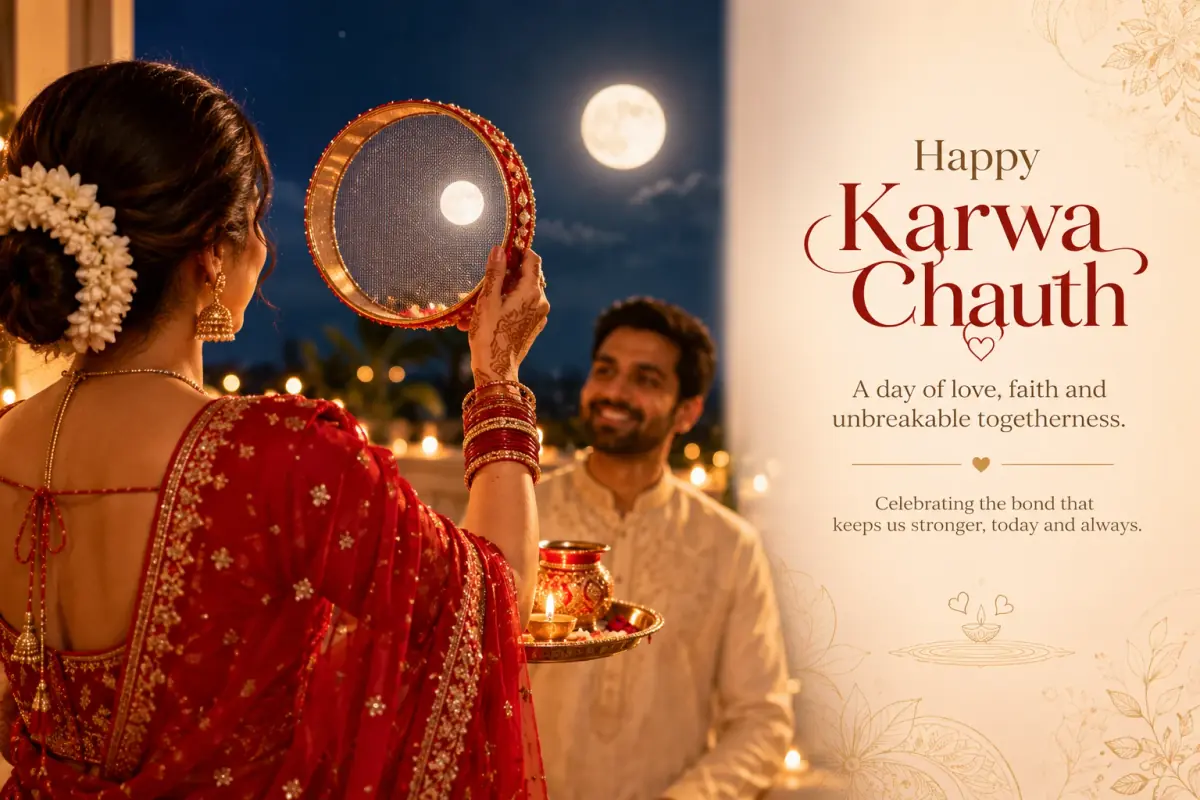
The Longest Wait for the Moon
The mehendi went on last night and has darkened by morning. Before sunrise, a plate of sargi — sweet pheniyan in warm milk, a handful of almonds, a few pieces of fruit — has been eaten in a half-lit kitchen. By afternoon the puja thali has been polished twice, someone has confirmed the katha time with the neighbours, and on rooftops across North India people have begun glancing east, though the moon is still hours away.
Karwa Chauth is a one-day fast, but it is rarely about hunger. It is a day of prayer for a spouse's long life and well-being, kept from sunrise until moonrise — traditionally by married women, and today often by couples together. It is also one of the most companionable days in the Hindu calendar: women gather in circles, pass decorated thalis from hand to hand, retell an old story and wait for the moon together. In 2026, Karwa Chauth falls on Thursday, October 29, nine days after Vijayadashami closes Navratri.
This guide brings together everything you need for the day: the verified 2026 timings and moonrise for 24 cities, what the name means, what history can and cannot tell us, the Veeravati katha, sargi, a samagri checklist, a step-by-step vrat and puja vidhi, fasting rules with an honest health note, regional customs, and wishes to share.
Karwa Chauth 2026: Date, Puja Muhurat and Moonrise Time
Karwa Chauth 2026 is on Thursday, October 29. The Chaturthi tithi runs from 1:06 AM to 10:09 PM that day, and in New Delhi the moon rises at 8:17 PM, according to Drik Panchang.
| Karwa Chauth 2026 | New Delhi |
|---|---|
| Date | Thursday, October 29, 2026 |
| Tithi | Kartik Krishna Chaturthi |
| Chaturthi begins | 1:06 AM, October 29 |
| Chaturthi ends | 10:09 PM, October 29 |
| Fasting time | 6:31 AM to 8:17 PM (13 hrs 46 min) |
| Puja muhurat | 5:38 PM to 6:56 PM |
| Moonrise | 8:17 PM |
| Same day | Vakratunda Sankashti Chaturthi |
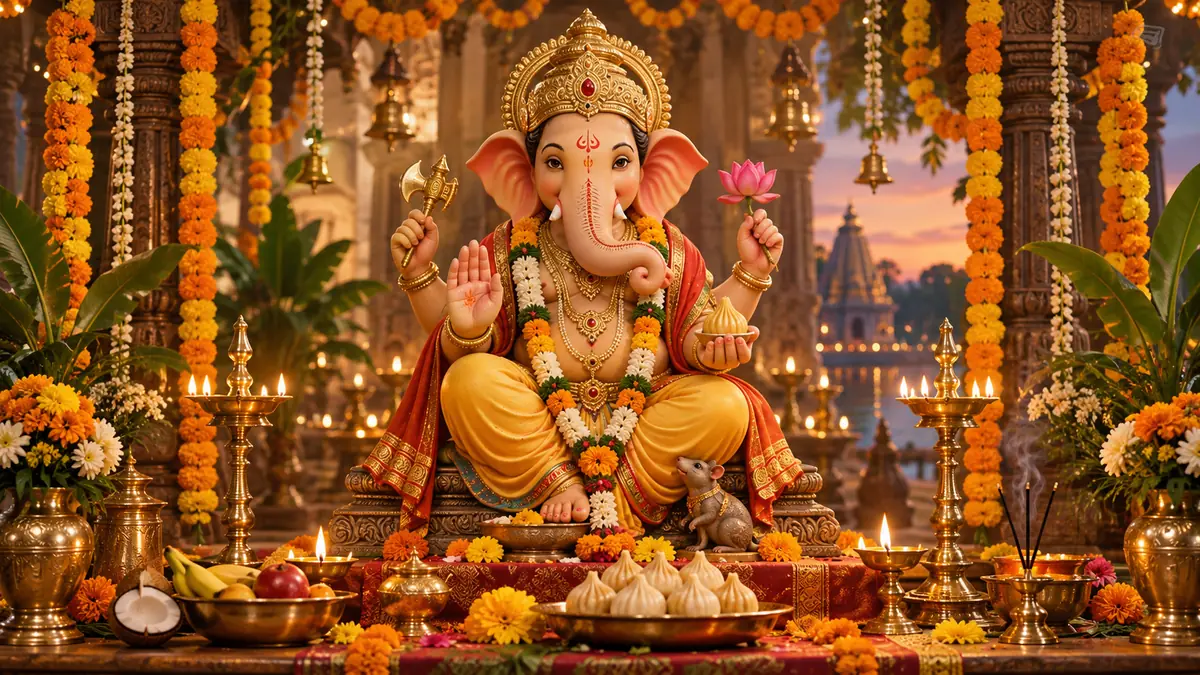
Two notes on the calendar. In the purnimanta calendar followed across North India, the day is Krishna Chaturthi of Kartik; in the amanta calendar of western and southern India the same day falls in Ashwin. The date does not change — only the month's name. And because Karwa Chauth is a Chaturthi, it coincides with Sankashti Chaturthi, the monthly fast for Bhagwan Ganesha that is also broken after moonrise. That is one reason Ganesha is worshipped in the evening puja (see our Ganesh Chaturthi guide).
Karwa Chauth Moonrise Time in Your City
Moonrise depends on where you are: families in Kolkata will see the moon more than an hour before families in Mumbai.
| City | Moonrise on October 29, 2026 |
|---|---|
| New Delhi | 8:17 PM |
| Gurugram | 8:18 PM |
| Noida | 8:16 PM |
| Chandigarh | 8:12 PM |
| Amritsar | 8:18 PM |
| Ludhiana | 8:16 PM |
| Jammu | 8:14 PM |
| Shimla | 8:10 PM |
| Dehradun | 8:08 PM |
| Jaipur | 8:28 PM |
| Jodhpur | 8:41 PM |
| Lucknow | 8:06 PM |
| Kanpur | 8:10 PM |
| Prayagraj | 8:06 PM |
| Varanasi | 8:02 PM |
| Patna | 7:52 PM |
| Bhopal | 8:31 PM |
| Indore | 8:39 PM |
| Ahmedabad | 8:52 PM |
| Mumbai | 9:00 PM |
| Pune | 8:58 PM |
| Kolkata | 7:47 PM |
| Hyderabad | 8:41 PM |
| Bengaluru | 8:55 PM |
These times mark the moment the moon's centre crosses a flat horizon — the convention Drik Panchang uses. We calculated them for each city and cross-checked New Delhi, Jaipur and Mumbai against Drik Panchang's published times. In practice you will usually see the moon 10–30 minutes later, once it clears buildings, trees and haze, so don't worry if the sky is still empty at the exact minute. Outside India, use a panchang set to your own city.
What Is Karwa Chauth?
Karwa Chauth is a Hindu vrat observed on the fourth day of the waning moon in Kartik, in which the observer fasts from sunrise to moonrise and prays for a spouse's long life and well-being. The fast ends only after an offering of water (arghya) is made to the rising moon.
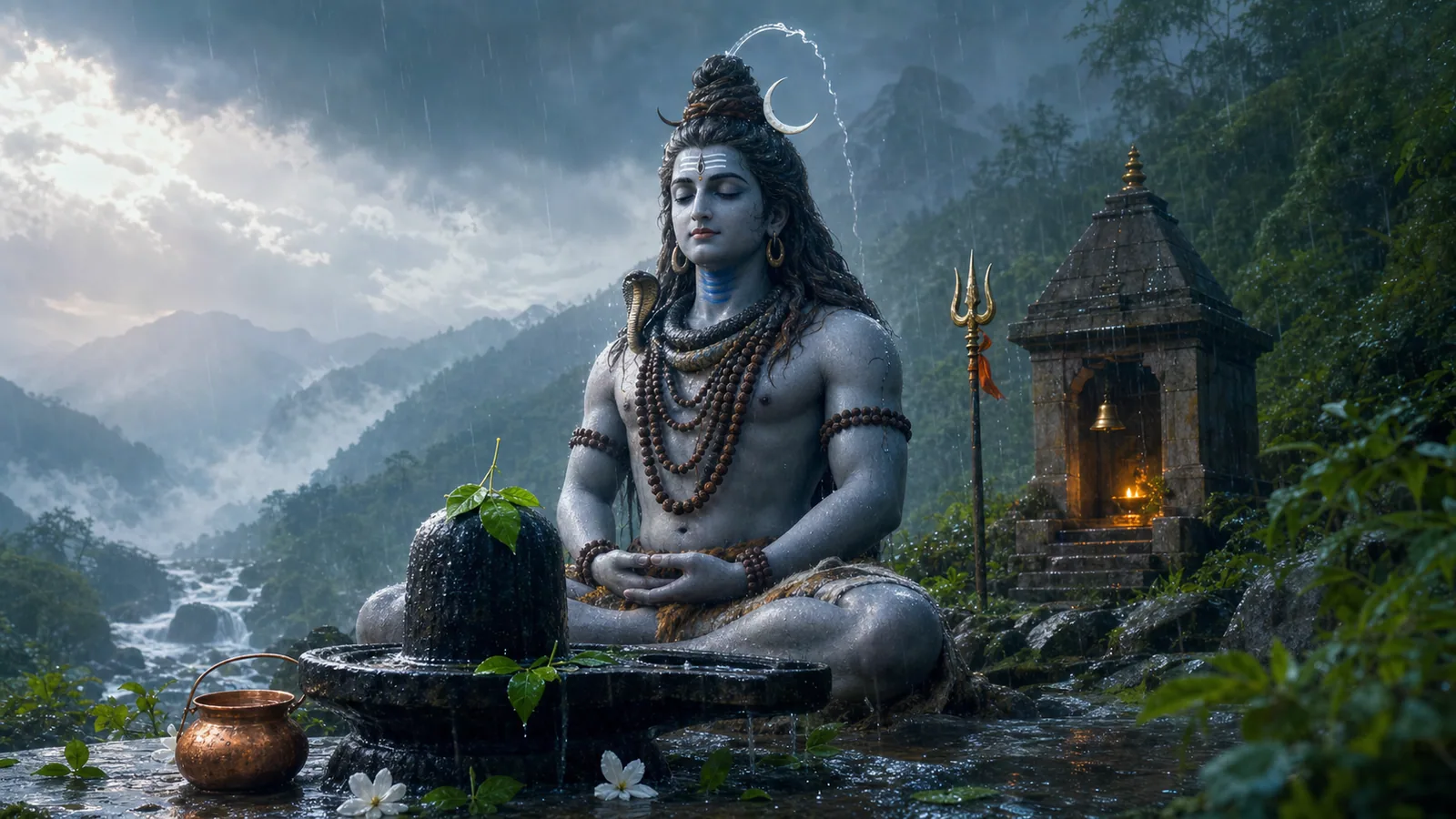
The vrat is dedicated to Maa Parvati — worshipped on this day as Gauri, Karwa Mata or Chauth Mata — together with Bhagwan Shiva, Ganesha, Kartikeya and Chandra, the moon. Parvati's place at the centre is no accident: in Puranic tradition she won Shiva through long tapasya, and she is revered as akhand saubhagyavati, the one whose married happiness never ends.
Traditionally, the fast is kept by married Hindu women of North and north-western India — Punjab, Haryana, Delhi, Rajasthan, Uttar Pradesh, Himachal Pradesh, Jammu and parts of Madhya Pradesh. Over the last few decades it has travelled far beyond that heartland. Unmarried women now often keep it, many husbands fast alongside their wives, and couples in Mumbai, Bengaluru, London and Toronto wait for the same moon.
At its best, Karwa Chauth is a vow taken out of love, not a test anyone must pass. Families observe it in very different ways, and those differences are part of the tradition, not departures from it.
What Do "Karwa" and "Chauth" Mean?
- Karwa (karva) is a small pitcher with a spout, traditionally of clay. The word comes from the Sanskrit karaka, a water vessel. On this day the karwa holds the water offered to the moon, and it is often filled with grain, sugar or sweets and given away after the puja.
- Chauth is the everyday Hindi form of chaturthi, the fourth day of a lunar fortnight.
Put together, the name simply means "the karwa's fourth day". The Sanskrit sankalp recited in many homes calls the vrat Karaka Chaturthi — the same name in the classical language. It is called Karwa Chauth because the karwa is at the heart of the ritual: it is worshipped, used for arghya, exchanged between women and gifted to elders.
History and Significance of Karwa Chauth
What history can — and cannot — tell us
There is no reliable record of when Karwa Chauth began. It has lived for generations in women's oral tradition: the katha told by an elder, the songs of the evening circle, the customs a mother-in-law teaches a new bride. What can be said with confidence is where it is rooted — the wheat-growing north and north-west of the subcontinent — and that it falls at the start of the rabi sowing season.
Writers have proposed several theories of its origin. None is proven:
- Prayers in wartime. Some anthropologists connect the fast to centuries when men of the north-west went away on military campaigns and their wives prayed for their safe return.
- A harvest connection. In some regions the large earthen pots used to store wheat are also called karwas, and the puja karwas are often filled with wheat — hinting at an older prayer for a good crop.
- A festival of friendship. Another view links it to the custom of a new bride forming a sacred friendship with a woman of her marital village — a dharam-behen — and celebrating that bond each year.
These are interpretations, not settled history. What is well documented is the festival's recent spread: Hindi films such as Dilwale Dulhania Le Jayenge (1995) and Baghban (2003), and then television, carried Karwa Chauth's moonlit rituals into homes that had never kept it.
What the day means
Ask women who keep the fast what it means, and the answer rarely stops at "a long life for my husband". They speak of:
- Marriage as a shared life — a day that puts the partnership itself at the centre.
- Prayer for a loved one's well-being — the oldest motive of any vrat.
- Family bonds — the mother-in-law's sargi at dawn, gifts from the mother's home, the elders' blessings at moonrise.
- Sisterhood — the women of a lane or housing society spending the whole day together.
- Faith and devotion — to Maa Gauri, whose steadfast love the tradition holds up as its ideal.
Karwa Chauth Katha: The Story of Veeravati
Every Karwa Chauth evening, someone — usually the eldest woman in the circle — tells the vrat katha. The most widely told version is the story of Veeravati. Like all vrat kathas, it is a traditional story handed down to carry a meaning, not a historical record, and its details differ from family to family.
Veeravati was the only sister of seven brothers, and the darling of them all. In many homes she is remembered as a princess who became a queen; in others, including the version recorded by Drik Panchang, she is the daughter of a Brahmin named Vedsharma of Indraprasthapur. After her marriage she kept her first Karwa Chauth at her parents' home.
As the day wore on, the fast grew too hard for her. By evening she was faint with hunger and thirst, and her brothers could not bear to watch. Knowing she would not eat until she had seen the moon, they made one. A brother climbed a distant tree and held a lamp behind a sieve; from the roof, the glow looked just like the moon rising behind the branches. (In other tellings it is a mirror, or a fire lit behind a hill.) Relieved, Veeravati offered arghya to the false moon and sat down to eat.
The first morsel made her sneeze. In the second she found a hair. As she lifted the third, word came that her husband had died. Heartbroken, she went to him and would not leave his side.
A goddess appeared to her — Indrani in some versions, Maa Parvati in others — and gently explained what had happened: her vow had been broken before the moon had truly risen. She told Veeravati to keep the Chauth fasts again with complete faith, in some tellings every Chauth of the year. Veeravati did so with perfect devotion, and when Karwa Chauth came round again her husband was restored to life — by Yama himself, in many versions, moved by her steadfastness.
What the story means
Read closely, the katha is less about punishment than about sincerity. The brothers' love was real, but a vow cannot be completed by someone else's shortcut. The contrast between the false moon and the true one explains why the fast ends only when the real moon is seen — and, many say, why women look at it through a sieve. Veeravati's second, wholehearted attempt carries the story's warmest message: devotion that persists is never wasted.
It is a story to reflect on, not a threat to fear. Nowhere does the tradition suggest that a sincere person who adapts the fast for her health brings harm to her family.
Other stories told on Karwa Chauth
- Karwa and the crocodile. A devoted wife named Karwa saw her husband seized by a crocodile while bathing in a river. She bound the crocodile with cotton thread and called on Yama to punish it and spare her husband; moved by her devotion, Yama granted her husband a long life. Some say the festival carries her name.
- Draupadi's vrat. A popular tradition holds that when Arjuna went away for penance and the Pandavas faced hardship, Krishna advised Draupadi to keep this fast, as Parvati once had. The episode belongs to the vrat-katha tradition rather than to the main narrative of the Mahabharata.
- Savitri and Satyavan. The story of the wife who followed Yama to win back her husband's life is often recalled on Karwa Chauth, though it has its own vrat, Vat Savitri.
Karwa Chauth Sargi: The Pre-Dawn Meal
Sargi is the meal eaten before sunrise on Karwa Chauth, traditionally prepared or sent by the mother-in-law for her daughter-in-law. It is the last food of the day, so it is meant to sustain — and it is also a gesture of affection from one generation to the next.
- Who gives it: in Punjabi families especially, the saas sends a sargi thali, often with shringar items like bangles, sindoor or a new dupatta alongside the food. Where the mother-in-law lives far away, a mother, sister, friend or the observer herself prepares it — just as valid.
- When it is eaten: before sunrise — in 2026, before about 6:31 AM in New Delhi (earlier in the east, later in the west). Many families eat between 4 and 5 AM.
- What it includes: pheniyan or soot feni (fine vermicelli) soaked in sweet milk, mathri, dry fruits, fresh fruit, a sweet and, in many homes, a paratha.
Because the day ahead is long and, for many, without water, a sargi works best when it is balanced and hydrating rather than heavy. Drink plenty of water the evening before as well as at sargi; very salty, spicy or fried food tends to make you thirstier later.
| Part of the plate | Good options |
|---|---|
| Fluids | Water, coconut water, a glass of milk or lassi |
| Fruit | Banana, papaya, apple, pomegranate, orange |
| Protein | Paneer, curd, milk, soaked almonds, walnuts |
| Slow-release grains | A lightly cooked whole-wheat paratha, poha or daliya |
| Tradition | A small bowl of pheniyan in milk, a piece of mithai |
A practical example: a glass of water and some coconut water, a bowl of pheniyan in milk, a paneer paratha with curd, a banana, and a few soaked almonds and walnuts.
Karwa Chauth Puja Samagri: A Checklist
Most of what the puja needs is already in an Indian home. Families differ in the details — treat this as a checklist, not a rulebook.
| Samagri | Used for |
|---|---|
| Karwa (clay or metal, with lid) | Holds water for arghya; filled with grain or sweets and gifted after the puja |
| Puja thali | Carries the diya, roli, rice, sweets and sieve |
| Diya, ghee or oil, cotton wicks | Lit for the evening puja and at moonrise |
| Roli or kumkum | Tilak and offerings |
| Akshat (unbroken rice) | Offering to the deities and the moon |
| Flowers and a small garland | Offering to Maa Gauri |
| Sieve (channi or chhalni) | Viewing the moon, then one's spouse |
| Lota filled with water | Arghya to the moon (some families use the karwa itself) |
| Sweets — mathri, halwa, ladoo | Bhog and the baya |
| Fruits | Bhog |
| Sindoor, bangles, bindi, mehendi | Shringar items offered to the Devi and worn |
| Image of Chauth Mata or Gauri | The focus of worship; many families use a Karwa Chauth calendar print |
| Dhoop or agarbatti | Fragrance offering |
| Red cloth and a chowki | A small altar |
| Katha book | If no elder is telling the story |
Regional additions: a baya of sweets, dry fruits and clothes for the mother-in-law in many Punjabi homes; a small Gaur Mata shaped from clay or cow dung in parts of Uttar Pradesh and Rajasthan; and, in some families, karwas filled with wheat or sugar to be exchanged among women.
Karwa Chauth Vrat Kaise Kare: A Step-by-Step Guide for the Day
Here is how the day traditionally unfolds. Customs vary by region and family — follow what your household does, and use this as a gentle outline.
Before sunrise
- Wake an hour or two before sunrise, bathe, and eat your sargi slowly, with plenty of water.
- Take the sankalp — the intention for the vrat. Many women make it in their own words. The traditional Sanskrit sankalp, as given in Drik Panchang's vidhi, is:
मम सुखसौभाग्य पुत्रपौत्रादि सुस्थिर श्री प्राप्तये करक चतुर्थी व्रतमहं करिष्ये।
Mama sukha-saubhagya putra-pautradi susthira shri praptaye karaka chaturthi vratam aham karishye.
Meaning: For happiness and lasting married good fortune, for the welfare of children and grandchildren, and for steady prosperity, I undertake the Karaka Chaturthi vrat.
During the day
- The fast begins at sunrise. In its traditional form it is nirjala — without food or water — until moonrise. (See the fasting rules below for how families adapt it.)
- Keep the day light: rest, pray, apply mehendi if it wasn't done the night before, and spend time with the other women who are fasting. In some Punjabi families, the traditional songs remind women to set aside chores like spinning and sewing for the day.
- Prepare for the evening: wash the karwa, set the thali and arrange the chowki.
Evening
- Dress festively. Bridal red, gold and pink are much loved, and many women wear their wedding outfit — but any clean, festive clothing is perfect.
- Gather for the Karwa Chauth puja during the evening muhurat (5:38 to 6:56 PM in New Delhi), often with neighbours or family.
- Listen to, or read, the vrat katha, then offer your prayers and the baya, and take the blessings of elders.
After moonrise
- Look for the moon — around 8:17 PM in New Delhi; check the city table above.
- Offer arghya where it is part of your family's practice: pour water from the karwa or lota towards the moon, with roli, rice and a flower, and pray to Chandra.
- View the moon through the sieve, often with the lit diya held alongside.
- Look at your spouse through the same sieve.
- Break the fast. Traditionally, the spouse offers the first sip of water and the first bite of something sweet. Many women then touch the feet of their husband and elders for blessings.
- Begin with a light meal before anything rich — your body has been without food all day.
Karwa Chauth Puja Vidhi: The Evening Puja Step by Step
There is no single method every family must follow. The steps below follow the commonly described vidhi, including Drik Panchang's, and leave room for your household's own customs.
- Prepare the altar. Clean the puja space, set a chowki with a red cloth, and place an image of Chauth Mata or Maa Gauri with Bhagwan Shiva, Ganesha and Kartikeya. Many women draw Gauri and Chauth Mata on the wall instead, or shape a small Gaur Mata from clay.
- Prepare the karwa. Fill it with water — some families use milk, wheat or sugar — draw a swastika on it with roli, tie a mauli thread around its neck and place a few sweets on its lid. Some families add a coin.
- Light the diya and dhoop, and remember Bhagwan Ganesha, as at the start of most pujas.
- Worship the divine family. Drik Panchang's vidhi worships Maa Parvati first, then Shiva, Kartikeya and Ganesha, with roli, akshat, flowers, shringar items and sweets. A prayer to the Devi recited in many homes:
नमः शिवायै शर्वाण्यै सौभाग्यं संतति शुभाम्। प्रयच्छ भक्तियुक्तानां नारीणां हरवल्लभे॥
Namah Shivayai Sharvanyai saubhagyam santati shubham, Prayachchha bhaktiyuktanam narinam Haravallabhe.
Meaning: Salutations to Shivaa, consort of Sharva. O beloved of Hara, grant good fortune and blessed children to the women who worship you with devotion.
- Listen to the katha. Sit in a circle with the other women and hear the story of Veeravati. In Punjabi tradition, the women then pass their thalis around the circle seven times — the thali feri — while singing traditional songs.
- Offer the baya and karwa. Give the baya, and often a karwa, to your mother-in-law or an elder married woman, touch her feet and receive her blessings. Drik Panchang's vidhi also describes gifting a karwa to a Brahmin or a married woman.
- Wait for the moon, then complete the moon puja and break the fast as described above.
Karwa Chauth Fasting Rules
The traditional rules are simple:
- The fast lasts from sunrise until moonrise.
- In its classic form it is nirjala — no food and no water.
- It begins with a sankalp and ends with arghya to the moon and the first sip of water offered by the spouse.
- Many families keep the day calm and devotional — prayer, the katha and time with other fasting women.
In practice, observance varies widely. Some women drink water or tea during the day; some keep a phalahar fast of fruit and milk; a newly married woman's first Karwa Chauth often comes with extra family customs; and many families adjust the fast for pregnancy, illness or age.
A note on health. A long fast without water is demanding. If you are pregnant, breastfeeding, diabetic, taking regular medication, elderly, or managing any medical condition, please speak to your doctor before attempting a prolonged or waterless fast, and follow their advice. Faith and health do not have to be in conflict: a fast with water, a fruit-and-milk fast, or a day of prayer and the katha alone are all ways families have long adapted Karwa Chauth. As with the Sawan Somvar vrat, the tradition values bhava — the feeling behind the fast — far above hardship.
Why Is the Moon Important on Karwa Chauth?
Devotees wait for moonrise because the Karwa Chauth vrat is completed only by offering arghya to Chandra, the moon, once it has risen. As on every Sankashti Chaturthi, the fast ends at moonrise, not at sunset.
Why the moon? Interpretations differ across families and traditions, but several ideas recur:
- In Hindu tradition, Chandra is linked with soma and amrit, with coolness and with the mind, and Bhagwan Shiva wears the crescent in his hair. Offering water to the moon honours that soothing, life-giving light.
- The moon's endless waning and waxing make it a natural symbol of renewal and continuity — of a bond that endures through change.
- On this night the moon is four days past full, so it rises well after sunset. The waiting is part of the vrat.
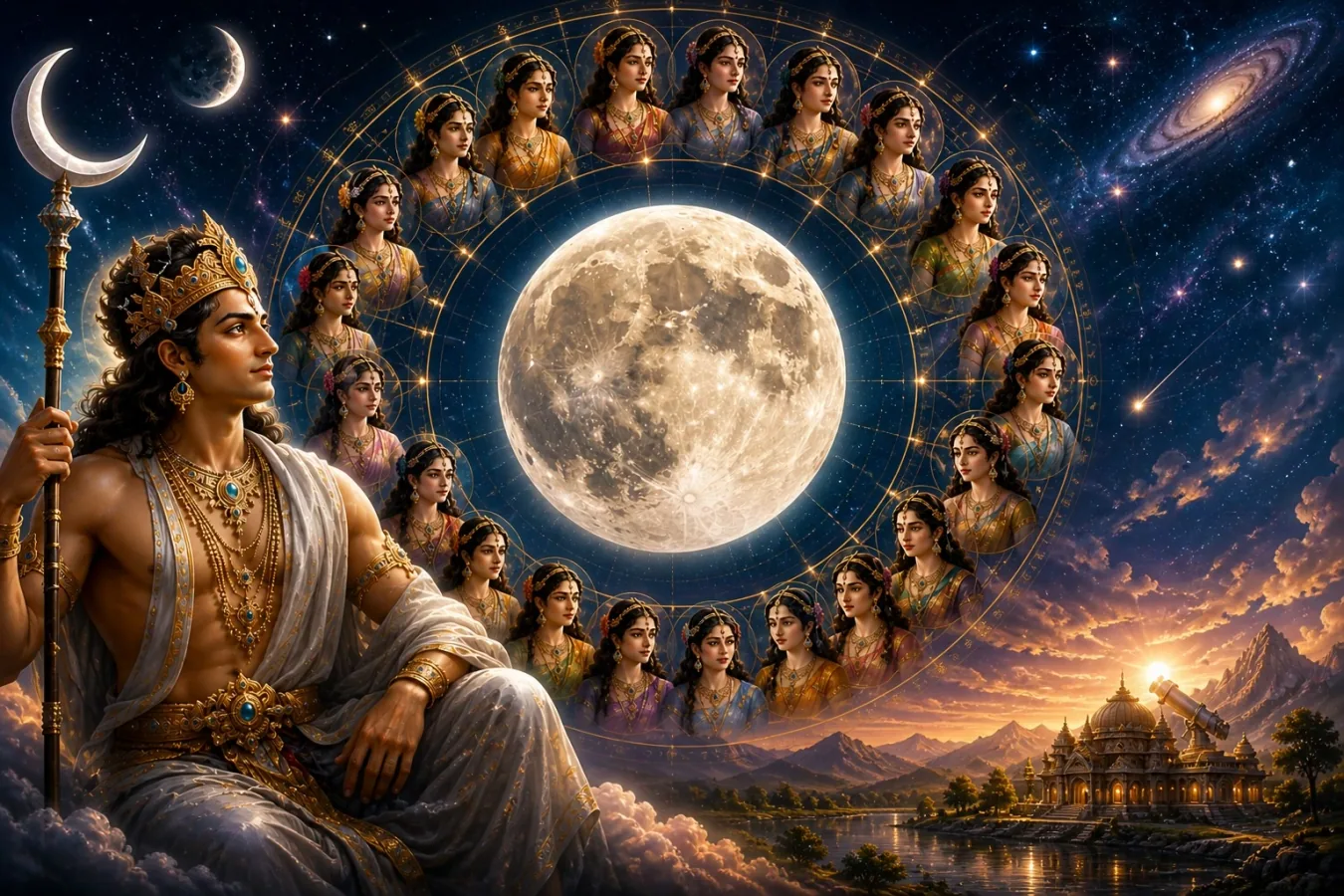
To learn more about Chandra in the scriptures and in the sky, read our story of the Moon and his 27 wives.
Why is the moon seen through a sieve?
There is no single scriptural explanation. Families offer several:
- It answers the katha. Veeravati was deceived by a lamp glowing behind a sieve. Looking at the true moon through a sieve recalls the story and, in a sense, sets it right.
- A reverent, indirect gaze. Some say the moon — and then one's husband — is viewed through a screen as a gesture of reverence.
- Many moons, many blessings. The mesh scatters the moonlight into countless points, which many read as blessings multiplied.
Whatever the reason in your family, the sieve has become the most recognisable image of the night.
Regional Karwa Chauth Traditions
Karwa Chauth is not celebrated the same way everywhere — and in much of eastern and southern India it is not traditionally observed at all. A few regional flavours:
- Punjab. The mother-in-law's sargi, with its bowl of pheniyan, opens the day, and the bride's family often sends a baya. In the evening, women sit in a circle and pass their decorated thalis around seven times while singing traditional Karwa Chauth songs.
- Haryana. Customs closely mirror those of Punjab and Delhi: an early sargi, a neighbourhood gathering for the katha led by an elder woman, and the moon puja on the rooftop.
- Delhi NCR. A meeting point of Punjabi, Haryanvi, UP and Rajasthani customs. Markets fill with mehendi artists the night before, and housing societies often hold a shared evening puja.
- Rajasthan. Chauth Mata is especially revered — her hilltop temple at Chauth Ka Barwara, in Sawai Madhopur district, draws devotees on Karwa Chauth. In parts of the state, a woman is asked before the arghya, "Dhapi ki ni dhapi?" (Are you satisfied?), and answers, "Jal se dhapi, suhaag se na dhapi" — "Satisfied with water, but never with my husband's love."
- Uttar Pradesh. Many families worship a Gaur Mata shaped from earth or cow dung, or draw Chauth Mata on the wall. Sargi often features soot feni in milk, and karwas filled with grain may be exchanged among the women.
Nearby regions — Himachal Pradesh, Jammu and parts of Madhya Pradesh — keep their own versions, while Andhra Pradesh and Telangana have a distinct women's festival around the same time, Atla Taddi.
Modern Karwa Chauth: Old Rituals, New Ways
The festival has changed a great deal in a generation — mostly in ways that widen its warmth.
Karwa Chauth for husbands
Many husbands now keep the fast with their wives — some nirjala, some simply skipping meals — so that each prays for the other. Tradition doesn't require it, and nothing forbids it. For many couples, it turns a one-sided vow into a shared one.
Couples, careers and long distances
- Working professionals often keep the fast through a normal workday: an early sargi, water if their practice allows, and the puja after office hours, timed to their city's moonrise.
- Long-distance couples break the fast together on a video call, each looking at the moon where they are. Moonrise differs by city and country, so each partner should go by their own local moonrise.
- Outside India, Hindu communities from London to Fiji gather in temples and community halls. Use a panchang set to your city — the moon may rise at a very different hour from India.
Keeping the heart, adapting the form
Some couples fast with water, some keep a phalahar vrat, and some focus on the puja and the katha. Clay karwas, a home-made sargi and simple shringar keep the day personal rather than commercial. The best Karwa Chauth is the one that feels true to your family.
Karwa Chauth Wishes
Traditional wishes
- May Chauth Mata keep your saubhagya bright and your home full of peace. Happy Karwa Chauth.
- May Maa Gauri accept your vrat and bless your family with health and harmony.
- As the moon rises tonight, may it bring long life and togetherness to everyone you love.
- May your karwa always be full and your home always blessed. Shubh Karwa Chauth.
- May Shiva and Parvati bless your marriage with patience, trust and lifelong companionship.
Romantic wishes
- I'll wait all day for the moon, but you are the light I look for every day. Happy Karwa Chauth, my love.
- Tonight, through the channi, I'll see two moons — one in the sky and one beside me.
- No sargi tastes sweeter than a lifetime with you.
- Today I pray for your long life; every other day, I simply thank God for it.
- However late the moon rises, my heart already knows where to look.
Simple, modern wishes
- Happy Karwa Chauth! Wishing you an easy fast and a beautiful moonrise.
- Here's to love, laughter and a clear sky tonight.
- Fasting together, celebrating together — Happy Karwa Chauth, partner.
- Miles apart, same moon. See you on a video call at moonrise!
- Drink up at sargi and smile all day — Happy Karwa Chauth!
A Closing Thought
Strip away the shopping and the selfies, and Karwa Chauth is a remarkably simple idea: one day set aside to pray for someone you love, and to wait — alongside others doing the same — for the moon to rise. However your family keeps it, may your sky be clear and your moon come early.
References
- Drik Panchang — Karwa Chauth 2026 date and timings (New Delhi): tithi, fasting time, puja muhurat and moonrise; its Jaipur and Mumbai pages were used to cross-check the city table.
- Drik Panchang — Karwa Chauth puja vidhi: the sankalp, order of worship and the prayer to Maa Parvati.
- Drik Panchang — Karwa Chauth legends: the Veeravati katha as recorded there.
- Wikipedia — Karva Chauth: regional customs, proposed origin theories and the festival's modern spread.
- Wikipedia — Chauth Mata Temple: the temple at Chauth Ka Barwara, Sawai Madhopur.
- City moonrise times were calculated astronomically by The Sanatan Way using the same convention as Drik Panchang, and checked against Drik Panchang for New Delhi, Jaipur and Mumbai.
Frequently Asked Questions
When is Karwa Chauth in 2026?
Karwa Chauth 2026 is on Thursday, October 29. The Chaturthi tithi runs from 1:06 AM to 10:09 PM that day. In New Delhi the fast lasts from 6:31 AM to 8:17 PM, the puja muhurat is 5:38 PM to 6:56 PM and the moon rises at 8:17 PM (Drik Panchang). Moonrise varies by city.
What is Karwa Chauth?
Karwa Chauth is a Hindu vrat kept on Kartik Krishna Chaturthi, the fourth day of the waning moon, in which the observer fasts from sunrise to moonrise and prays for a spouse's long life and well-being. It is dedicated to Maa Parvati as Chauth Mata, with Shiva, Ganesha, Kartikeya and the moon.
Why is Karwa Chauth celebrated?
Karwa Chauth is celebrated to pray for a spouse's long life, health and happiness, and to honour the bond of marriage. It is also a day of family ties and sisterhood: the mother-in-law's sargi, gifts from the mother's home, and women of a neighbourhood fasting, praying and waiting for the moon together.
What is Sargi?
Sargi is the pre-dawn meal eaten before sunrise on Karwa Chauth. In Punjabi tradition the mother-in-law prepares or sends it for her daughter-in-law, often with shringar items such as bangles or sindoor. It is the last food before the fast, so it should be balanced and hydrating.
What should be eaten in Sargi?
A good sargi combines fluids, fruit, protein and slow-release grains: water and coconut water, a banana or papaya, paneer or curd, soaked almonds and walnuts, a light whole-wheat paratha, and traditional pheniyan in milk. Very salty, spicy or fried food tends to increase thirst during the day.
Can we drink water during the Karwa Chauth fast?
The traditional Karwa Chauth fast is nirjala, meaning without food or water until moonrise. However, many families allow water, tea or fruit, especially for health reasons. Anyone pregnant, breastfeeding, diabetic, on medication, elderly or unwell should consult a doctor before a waterless fast.
At what time is the Karwa Chauth fast broken?
The Karwa Chauth fast is broken after moonrise, once arghya has been offered to the moon. In 2026 the moon rises at 8:17 PM in New Delhi, 8:28 PM in Jaipur, 8:06 PM in Lucknow and 9:00 PM in Mumbai. You may actually see it 10 to 30 minutes later because of buildings and haze.
Why is the moon seen through a sieve on Karwa Chauth?
There is no single scriptural reason. Many families connect it to the Veeravati katha, in which her brothers faked the moon with a lamp behind a sieve, so the true moon is now viewed through one. Others see it as a reverent, indirect gaze, or say the mesh multiplies the moonlight into many blessings.
Can an unmarried woman observe Karwa Chauth?
Yes. Many unmarried women keep Karwa Chauth today, often praying for a loving future partner or for someone they plan to marry. Some families ask unmarried women to keep a lighter fast. Follow your family's custom; nothing in the tradition stops a sincere person from praying on this day.
Can husbands keep the Karwa Chauth fast?
Yes. Many husbands now fast alongside their wives, so that both pray for each other's well-being. Tradition does not require it and nothing forbids it. For many couples, fasting together turns Karwa Chauth into a shared expression of love and companionship.
What is needed for Karwa Chauth puja?
The essentials are a karwa (clay or metal pitcher), a puja thali, a diya, roli, akshat, flowers, a sieve (channi), a lota of water for arghya, sweets, fruits, shringar items such as sindoor and bangles, and an image of Chauth Mata or Maa Gauri. Regional customs add items like a baya or a clay Gaur Mata.
Is Karwa Chauth celebrated everywhere in India?
No. Karwa Chauth is traditionally observed in North and north-western India, especially Punjab, Haryana, Delhi, Rajasthan, Uttar Pradesh, Himachal Pradesh and Jammu. It has spread to cities across India and abroad, but in much of eastern and southern India it is not a traditional festival.
What if the moon is not visible on Karwa Chauth because of clouds?
Families handle this differently. Many simply wait a while longer. Some break the fast after the published moonrise time by offering arghya towards the eastern sky, and some see the moon on a video call with relatives in a city with clear skies. When in doubt, follow your family elders or priest.
What should someone with a medical condition do about the Karwa Chauth fast?
Speak to your doctor before attempting a long or waterless fast, and follow their advice. Faith and health need not conflict: a fast with water, a fruit-and-milk fast, or keeping the day through prayer and the katha are all long-accepted ways of observing Karwa Chauth.