Where the Sea Bows to Shiva
On the western edge of Bharat, where the land of Saurashtra dissolves into the Arabian Sea, stands a temple that has watched over the tides for longer than most nations have existed. This is Somnath, the Shrine Eternal, the Aadi Jyotirlinga, the first light among the twelve.
To stand before Somnath is to stand at a meeting point of many currents: the roar of the ocean, the ring of temple bells, the chant of Har Har Mahadev, and the quiet memory of a shrine that has been broken and rebuilt again and again, and yet has never truly fallen. Somnath is not simply an old temple in Gujarat. It is a living symbol of Shiva bhakti, of sacred geography, and of the deep, unhurried resilience of Sanatan Dharma itself.
This is the story of why the Somnath Temple matters: spiritually, historically, and eternally.
Somnath Jyotirlinga at a Glance
For readers planning a pilgrimage, here are the essential facts about Somnath Jyotirlinga:
| Detail | Information |
|---|---|
| Temple | Somnath Temple, also called Somnath Mahadev Mandir |
| Deity | Bhagwan Shiva as Somnath Mahadev |
| Spiritual status | First among the 12 Jyotirlingas, traditionally honoured as the Aadi Jyotirlinga |
| Location | Prabhas Patan, near Veraval, Gir Somnath district, Gujarat |
| Sacred region | Prabhas Kshetra, near Triveni Sangam |
| Best known for | Shiva bhakti, Chandra Dev's story, repeated reconstruction, and Sanatan resilience |
| Nearby places | Triveni Sangam, Bhalka Tirth, Prabhas Patan Museum, Dwarka |
The Meaning of "Somnath": Lord of the Moon
The name Somnath is beautifully simple. Soma means the Moon, and Nath means Lord or Master. Together they mean "Lord of the Moon." The town itself carries a companion name (Prabhas, meaning lustre or radiance), and Shiva here is also called Someshvara, the Lord to whom the Moon turned.
This is no accident of language. In the Sanatan imagination, Bhagwan Shiva wears the crescent moon upon his matted hair, which is why he is called Chandrashekhara, "the one who bears the Moon." Somnath is the place where that relationship between Shiva and Chandra was sealed. To understand the temple, we must first understand the tender and sorrowful story behind that crescent.
The Story of Chandra Dev, Daksha's Curse, and Shiva's Grace
The Puranas (including the Shiva Purana, the Skanda Purana, and references in the Mahabharata) preserve one of the most quietly profound stories in our tradition.
Chandra Dev, the Moon God, was married to the twenty-seven daughters of Prajapati Daksha. In the sky, these twenty-seven are the Nakshatras, the lunar constellations through which the Moon travels each month. Chandra had promised to love and honour all of them equally. Yet his heart lingered with only one, Rohini, and he neglected the other twenty-six.
Feeling slighted, the sisters carried their sorrow to their father. Daksha counselled Chandra gently, then firmly, but the Moon would not change. In his anger, Daksha pronounced a curse: Chandra would slowly wither, his light fading, his brilliance draining away. As the Moon dimmed, the rhythms of the earth that depend on him (the tides, the growth of plants, the balance of life) began to suffer.
Desperate, Chandra sought counsel from Brahma, who directed him to the sacred shore of Prabhas. There, on the banks of the Saraswati where three rivers meet, Chandra installed a Shivalinga and offered a long and severe penance, reciting the Mahamrityunjaya Mantra to invoke the compassion of Mahadev.
Moved by his devotion, Shiva appeared. He could not entirely undo Daksha's curse, for even divine words carry consequence, and Chandra's fault was real. But grace found a middle way. Shiva decreed that the Moon would wane for one fortnight (Krishna Paksha) and wax again in the next (Shukla Paksha), forever cycling between loss and renewal. And to honour Chandra's bhakti, Shiva placed the crescent upon his own head.
This is the eternal lesson written into the night sky: no loss is final, and no darkness is permanent. In gratitude, Chandra is said to have built the first shrine here, and the Jyotirlinga came to be known as Somnath Mahadev.
Every waxing and waning moon since is a silent reminder of this story: that divine grace, sought with humility, can restore what karma has diminished.
Somnath: The First Among the Twelve Jyotirlingas
A Jyotirlinga is a place where Shiva is worshipped not as a carved image but as a jyoti, an infinite pillar of light and consciousness, self-manifest and beyond form. Across Bharat there are twelve such supreme shrines, and pilgrims traditionally undertake the Dwadasha Jyotirlinga Yatra to visit them all.
Somnath holds a place of singular honour: it is counted as the first Jyotirlinga. In the Jnanasamhita of the Shiva Purana, among the oldest texts to list the twelve, Somnath heads the list. For countless devotees, the great pilgrimage of the twelve Jyotirlingas begins here, at the edge of the sea, before turning inward toward the rest of the land.
To be first among the 12 Jyotirlingas is not merely a matter of sequence. It marks Somnath as a threshold, the doorway through which the soul steps onto the path of Shiva bhakti.
Prabhas Patan, Gujarat: A Land Sanctified Many Times Over
The Somnath Temple stands in Prabhas Patan, near the town of Veraval in the Gir Somnath district of Gujarat, facing the Arabian Sea. This coastline has been a tirtha, a sacred crossing place, since the earliest layers of memory, mentioned in texts as ancient as the Rig Veda and the Bhagavata Purana.
Part of its holiness comes from the Triveni Sangam nearby, the confluence of three sacred rivers: the Hiran, the Kapila, and the now-vanished Saraswati. Such river-meetings are revered across Sanatan Dharma as places of purification and liberation, and this Sangam is honoured as a Moksha Tirtha.
Prabhas Kshetra carries another, deeply moving association. It is remembered as the place where Bhagwan Shree Krishna concluded his earthly journey, his final rites performed at the Triveni Sangam. Thus the same sacred ground holds the memory of both Shiva and Krishna, a rare confluence of devotion that few places on earth can claim.
A History of Destruction and Rebirth, Told Honestly
The history of Somnath is, in many ways, the history of Sanatan Dharma's endurance.
The exact date of the earliest temple is uncertain; scholars place a significant stone temple at the site by around the 9th–10th century CE, built and enriched by rulers such as the Chaulukya (Solanki) kings. Tradition tells of even older shrines (of gold, silver, and sandalwood) raised by Chandra, by others of the Puranic age, and by Krishna, before the historical structures of later centuries.
What followed is well documented and painful. Beginning with the raid of Mahmud of Ghazni in 1026 CE, the temple was plundered and desecrated, and over the centuries it was destroyed and rebuilt many times, a cycle that stretched across roughly seven hundred years under various invaders and, later, the Portuguese. Popular memory speaks of the temple rising again some seventeen times.
We tell this history plainly, without embellishment and without hatred. The facts need no exaggeration; they carry their own weight. What matters most in the Sanatan telling is not the record of who tore the temple down, but the unbroken will of those who built it back, generation after generation, refusing to let the light go out.
After India's independence, this will found its final expression. Sardar Vallabhbhai Patel resolved that Somnath would be restored, and the Shree Somnath Trust was formed to carry out the work. Built by the traditional Somapura temple craftsmen of Gujarat, the present temple was completed and consecrated in 1951, with the installation ceremony performed by Dr. Rajendra Prasad, India's first President. Somnath thus became one of free India's first great acts of civilizational self-recovery.
Somnath as a Symbol of Sanatan Resilience
Why does a rebuilt temple move us so deeply? Because Somnath answers a question every civilization must eventually face: what do you do when what you hold sacred is taken from you?
The Sanatan answer, written in stone at Somnath, is this: you rebuild. Not out of stubbornness, but out of faith, the quiet certainty that the truth a temple points toward cannot be looted, because it was never made of gold or stone in the first place.
Shiva as the Jyotirlinga is nirguna and eternal, untouched by the tides of history. The physical shrine may rise and fall; the jyoti it enshrines does not flicker. In this sense, every reconstruction of Somnath is not a repair but a re-affirmation: a people saying, once more, that their inner life is not for sale and not for conquest. That is the civilizational memory Somnath keeps alive.
The Present Temple: Architecture and Spirit
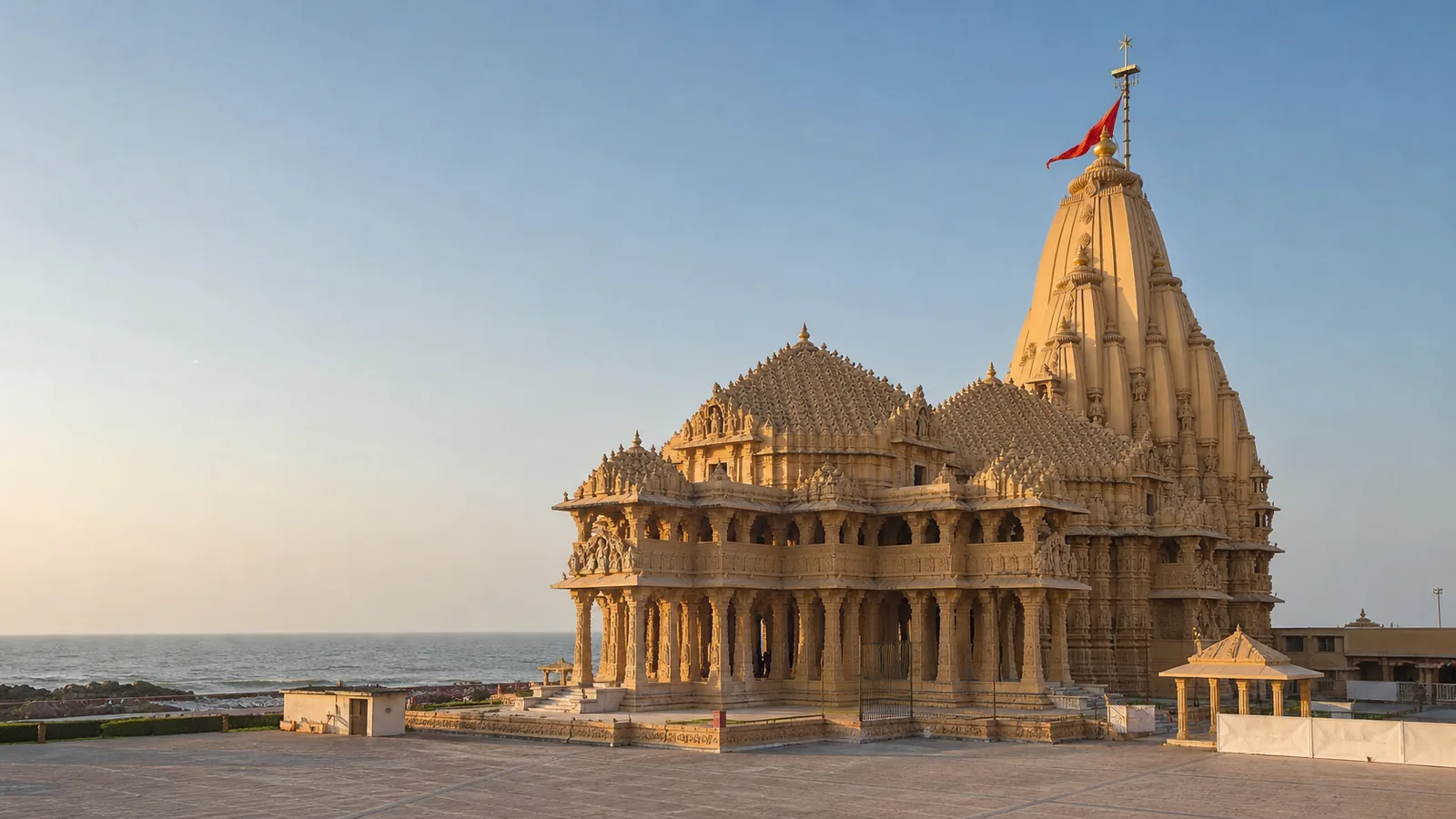
The temple that stands today is built in the graceful Chaulukya (Māru-Gurjara) style of temple architecture, using warm-toned sandstone and following the classical Nagara form. Its towering shikhara (spire) rises dramatically toward the sky, crowned by a golden kalash, with a sacred flag that flutters ceaselessly in the sea wind, a visible pulse of unbroken devotion.
Within the garbhagriha, the innermost sanctum, resides the Somnath Jyotirlinga, worshipped in continuous ritual. An Akhand Jyoti, an ever-burning flame, expresses the idea at the heart of the whole shrine: that the light of Shiva has never been, and will never be, extinguished.
Among the temple's most striking features is the Baan Stambh (Arrow Pillar). An old Sanskrit inscription here declares that there is no landmass in a straight line between this shore and the South Pole: an unbroken ocean stretching to Antarctica. Whether read as geography or as poetry, it marks Somnath as standing quite literally at the edge of the world, keeping watch.
Somnath Darshan, Aarti, and the Experience of Being There
Somnath is best experienced slowly. Devotees typically bathe or offer prayers at the Triveni Sangam before Somnath darshan, purifying themselves before entering the presence of Mahadev. The temple observes daily aartis (traditionally in the morning, midday, and evening), and the atmosphere shifts with each: the freshness of dawn, the fullness of midday, and, above all, the grandeur of the evening.
As the sun sets over the Arabian Sea and the evening aarti begins, the bells, conches, and chants of Har Har Mahadev rise together against the sound of the waves. Many pilgrims describe a rare stillness settling over them here: the feeling of standing at the ocean's edge and sensing that Shiva, the eternal truth, remains unmoved even as the world endlessly changes.
The temple darshan schedule and aarti timings may change during festivals, security arrangements, and special occasions, so pilgrims should confirm the latest Somnath temple timings from the temple notice boards or official channels before planning the day. A Light and Sound Show held at the temple in the evening narrates Somnath's long history against the night sky, a moving way to feel the depth of what this place has survived.
A practical note of reverence: only the temple priests may touch the Jyotirlinga. Devotees offer their prayers and darshan from the appropriate distance, as is proper before a self-manifest form of the Divine.
Sacred Places Near Somnath
A pilgrimage to Somnath naturally opens into the wider Prabhas Kshetra, dense with holy sites:
Bhalka Tirth: Perhaps the most emotionally resonant of all. This is revered as the spot where Bhagwan Shree Krishna, resting under a tree, was struck by a hunter's arrow and chose to leave his mortal form, departing for Nijdham. Standing here, one feels the tenderness and mystery of the Lord's earthly farewell.
Triveni Sangam: The sacred confluence of the Hiran, Kapila, and Saraswati, honoured as a place of liberation and the site of Krishna's final rites. A ritual dip here is central to the Somnath pilgrimage.
Prabhas Kshetra and its temples: The surrounding area holds many ancient shrines, including temples to Surya (the Sun), Parshuram, and others, along with the Prabhas Patan Museum, which preserves sculptures, inscriptions, and fragments from earlier versions of the Somnath Temple, the physical memory of its many rebirths.
Many pilgrims also combine Somnath with Dwarka, Krishna's own city further along the Gujarat coast, forming one of Bharat's most beloved spiritual circuits, a journey that holds both Shiva and Krishna within a single pilgrimage.
How to Reach Somnath Temple
Location: Prabhas Patan, near Veraval, Gir Somnath district, Gujarat.
By air: Diu Airport is the nearest commonly used airport, roughly 80–90 km away. Porbandar Airport is another option for some routes, around 110–130 km from Somnath.
By train: Veraval and Somnath railway stations connect the town with major cities. Veraval is only a few kilometres from the temple and is a convenient railhead for many pilgrims.
By road: Somnath is well connected by road from cities such as Rajkot, Junagadh, Ahmedabad, Porbandar, and Dwarka. Buses, taxis, and private vehicles are commonly used.
Best Time to Visit Somnath
Best time to visit: The winter months, roughly October to February, offer the most pleasant weather. Mahashivratri and the holy month of Shravan (especially Mondays) are the most spiritually charged times, and also the most crowded. For a quieter darshan, weekday early mornings in the cooler season are ideal.
Good to know: Entry to the temple is free. Dress modestly and respectfully. Photography and mobile phones are generally restricted inside the temple premises, so check current guidelines on arrival. Allow time not just for darshan but for the sea, the aarti, and the surrounding tirthas. Somnath rewards those who linger.
What Somnath Teaches Us Today
Somnath is easy to admire as history and architecture. But its deepest gift is a teaching, and that teaching is timeless.
The Moon in the Puranic story is, in a sense, every one of us: flawed, diminished by our own choices, fading under the weight of consequence. And Shiva's response at this shore is the response Sanatan Dharma offers to every seeker: grace that does not erase our struggles, but transforms them, turning the cycle of loss and recovery into a rhythm we can grow through.
The temple's own history repeats that same lesson on a civilizational scale. Broken again and again, it rose again and again, not because stone is strong, but because faith is. Somnath reminds us that the sacred cannot ultimately be destroyed, only tested; and that a people who remember who they are will always find the will to rebuild.
To visit Somnath, then, is to receive both a blessing and a challenge: to carry a little of that resilience home, to rebuild whatever within us has been broken, and to trust, like the waxing moon, that the light always returns.
Har Har Mahadev.
Frequently Asked Questions
Where is the Somnath Jyotirlinga located?
In Prabhas Patan, near Veraval, in the Gir Somnath district of Gujarat, on the Arabian Sea coast.
Why is Somnath called the first Jyotirlinga?
Somnath heads the traditional list of the 12 Jyotirlingas in texts such as the Shiva Purana, and the Dwadasha Jyotirlinga pilgrimage is traditionally said to begin here. It is honoured as the Aadi (first) Jyotirlinga.
What does the name Somnath mean?
It means "Lord of the Moon," from Soma (Moon) and Nath (Lord), referring to Bhagwan Shiva, who granted grace to Chandra Dev and wears the crescent moon on his head.
Why was the Somnath Temple destroyed and rebuilt so many times?
The temple was repeatedly plundered by invaders over several centuries, beginning with Mahmud of Ghazni in 1026 CE. Each time, devotees rebuilt it. The present temple was completed in 1951 under the leadership of Sardar Vallabhbhai Patel.
What is the best time to visit Somnath?
October to February offers the most comfortable weather. Mahashivratri and the month of Shravan are especially auspicious but very crowded; early weekday mornings are best for a peaceful darshan.
What sacred places can I visit near Somnath?
Bhalka Tirth (where Bhagwan Krishna left his mortal body), the Triveni Sangam, various temples of Prabhas Kshetra, the Prabhas Patan Museum, and, a little further, Dwarka.
Is Somnath connected to Bhagwan Krishna as well as Shiva?
Yes. While Somnath is a Shiva Jyotirlinga, the surrounding Prabhas Kshetra is revered as the place where Bhagwan Krishna concluded his earthly journey, making it sacred to devotees of both.
How can I reach Somnath Temple?
The nearest major railway access is Veraval/Somnath station. Diu and Porbandar are common airport options, and Somnath is well connected by road from major Gujarat cities.
Are mobile phones and photography allowed inside Somnath Temple?
Photography and mobile phones are generally restricted inside the temple premises. Devotees should check the latest temple guidelines at the entrance before darshan.