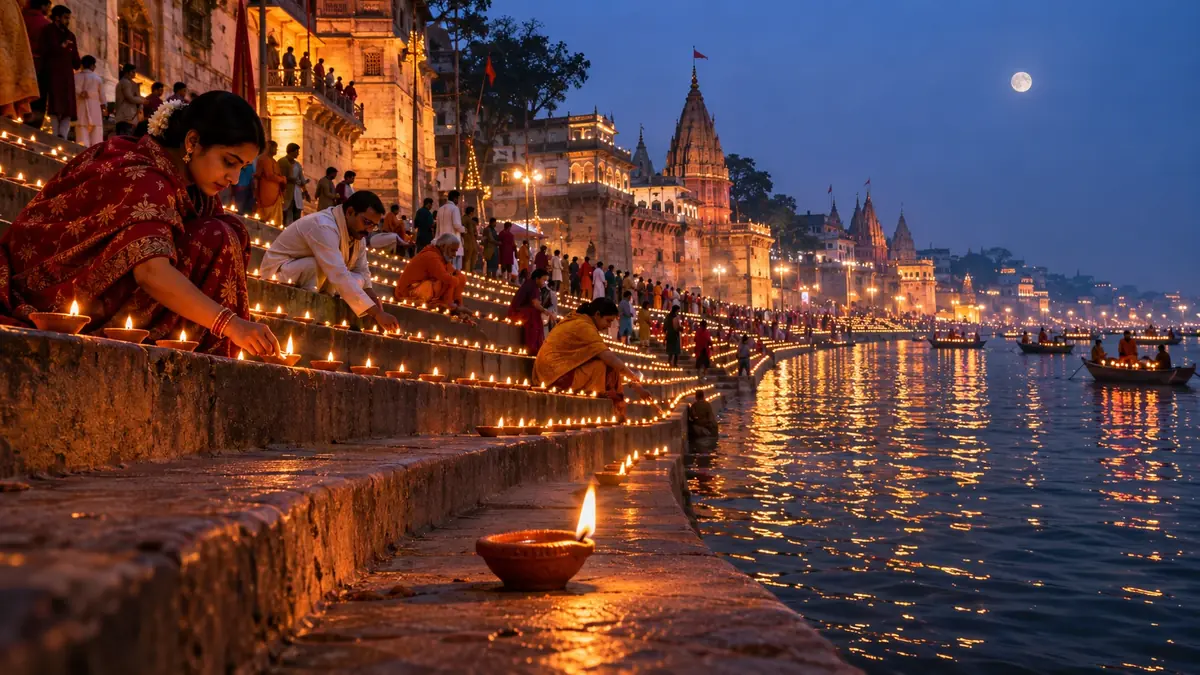
The light goes quickly on the river. A woman crouches on a step just above the water, a match in one hand and her other palm curved around a wick, because the breeze off the Ganga keeps leaning on the small flame. When it steadies, she tilts the lit diya to the next one in the row, waits for the cotton to catch, and moves one step along. All down the ghats, people are doing the same thing. Kashi lights its ghats on Dev Deepawali because, in devotional tradition, the devas themselves come down to the city on this full moon of Kartik to celebrate Shiva's victory over the demon cities of Tripura, and the people of Kashi line the river steps with lamps to welcome them. It is, in the plainest sense of its name, the Deepawali of the gods.
Dev Deepawali 2026 at a Glance
| Observance | Details |
|---|---|
| Date | Tuesday, 24 November 2026 |
| Occasion | Kartik Purnima, the full moon of Kartik |
| Purnima tithi | 11:42 PM, 23 November to 8:23 PM, 24 November (IST) |
| Local worship window, Varanasi | Pradosh Kaal, 5:08 PM to 7:47 PM IST, 24 November |
| Source | Drik Panchang: Dev Deepawali 2026, Varanasi |
The Pradosh window is the time for lighting lamps in worship in Varanasi, set by the local sunset. It is not the schedule of any public event. The timing of the Ganga Aarti and other events on the ghats is announced separately each year, so check a current local source before planning around it.
Not the Diwali You Already Know
If you have grown up with Diwali, much of Dev Deepawali will feel familiar: clay lamps, oil and cotton wicks, the hour after sunset. What changes is where the light goes and who it is for.
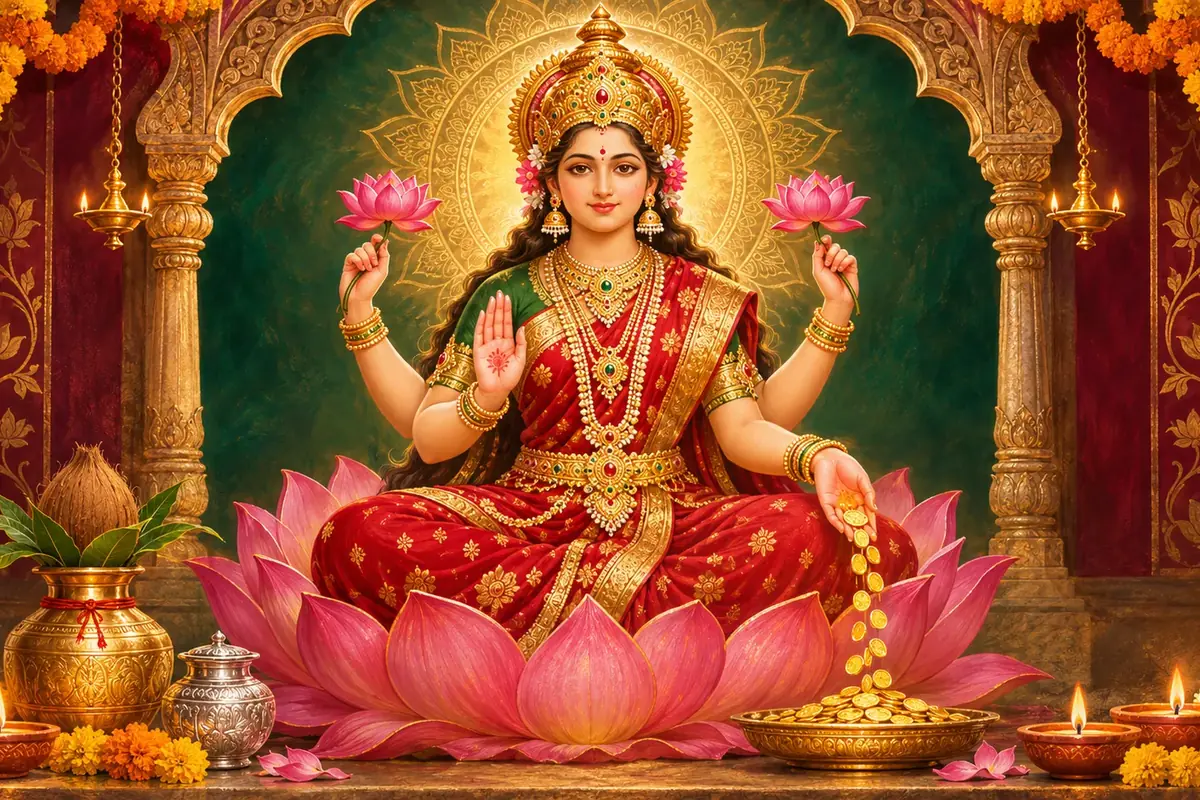
Diwali falls on Amavasya, the darkest night of Kartik, and its lamps are lit at home, in courtyards and doorways, while the family worships Lakshmi. Dev Deepawali comes about a fortnight later, on Purnima, the full moon that closes the month. Its lamps are lit at the river, on the stone steps of Kashi's ghats, and its worship turns to Shiva. One is a festival of the household on the darkest night; the other is a festival of the riverfront on the brightest.
The city itself has three names, and you will hear all of them: Kashi, the oldest and the one used in prayer; Varanasi, the name on the map, from the Varuna and Assi streams that bound it; and Banaras, the name of everyday speech. On this night all three are the same place, and the place is the river's edge.
The Story of Shiva as Tripurari
The festival's other names point straight to its story. Drik Panchang lists it as Tripurotsav and Tripurari Purnima, and both remember Shiva as Tripurari, the enemy of Tripura.
Tripura means "three cities". As devotional tradition tells it, drawing on the Puranas, the three sons of the asura Taraka, Tarakaksha, Kamalaksha and Vidyunmali, won a boon from Brahma after long austerities. The asura architect Maya built them three cities, one of gold, one of silver and one of iron, each set in a different realm. The boon made the cities almost untouchable: they could be destroyed only by a single arrow, loosed at the one moment when all three stood in a line. Protected by that condition, the brothers and their armies troubled the three worlds and drove the devas from their places.
The devas turned to Shiva. The tellings vary in detail, but in the most familiar version the whole cosmos assembles itself into his war chariot: the earth becomes its body, the Sun and the Moon its wheels, Brahma its charioteer. Mount Meru bends into his bow, the serpent Vasuki is strung across it, and Vishnu himself becomes the arrow. Shiva waited for the cities to align, and when they did, he let fly one arrow, and Tripura burned.
Devotees remember this victory on Kartik Purnima because tradition places it on this full moon, and because of what it means. Many devotees read the three cities as the layers of ego and attachment in which a person shuts themselves away, each seemingly impregnable, and Shiva's single arrow is the grace that ends them in one stroke. Whatever the reading, the story ends in relief and celebration, and that celebration is where the lamps begin.
Why the Devas Celebrate in Kashi
After Tripura fell, the devas were free again, and in Kashi's own tradition they came to celebrate in the one place that belongs to Shiva more than any other. Kashi is honoured as Shiva's own city, the home of the Kashi Vishwanath Jyotirlinga, a city he is said never to leave. So the belief runs: on the full moon of Kartik the devas descend to the ghats of Kashi and keep their Deepawali on the banks of the Ganga.
That belief gives the festival both its name and its shape. Dev means the divine ones, the devas; Deepawali is a row of lamps. The lamps on the ghats are lit as a welcome for unseen guests, which is why so many people light them with such care, and why the steps are filled from the water's edge upward rather than left to a few organisers. Every lamp is someone's share in receiving the gods.
What Deepdaan Means
The act at the heart of the evening has a simple name: deepdaan, the gift of a lamp. Deep is the lamp; daan is a gift, something given away with no expectation of return.
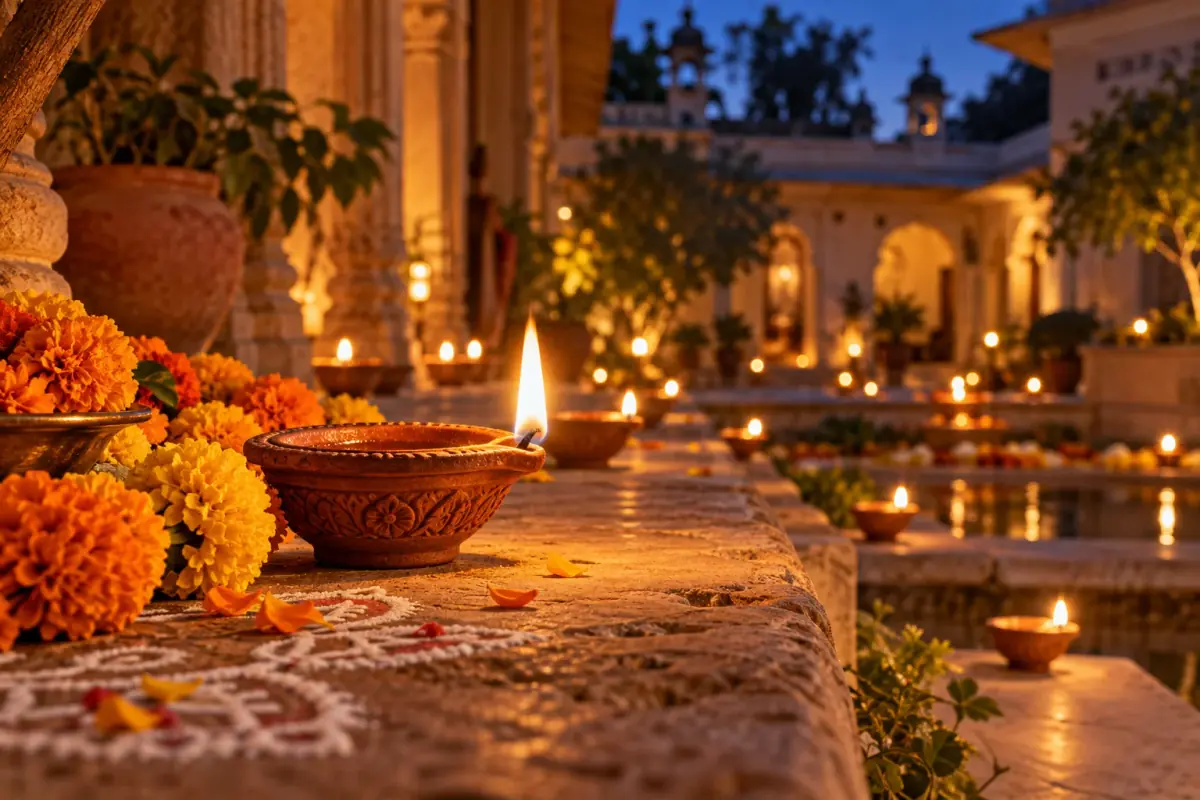
Most lamps we light are for our own use, to see by. A lamp offered in deepdaan is different. It is lit, placed with a moment of prayer, and left: on a temple step, beside the river, near the tulsi, at the threshold of the house, or set afloat on the water in a cup of leaves. Its light is no longer the giver's; it has been handed over. Kartik is traditionally a month of lamp-offering, and its full moon is the month's brightest close, which is why Kartik Purnima draws so many people to bathe in the Ganga and offer lamps on its banks.
Nothing about deepdaan needs to be elaborate. A clay diya, a little ghee or oil, a cotton wick and a match are the whole of the equipment. What makes it deepdaan is the intention with which it is lit and released.
Two Kinds of Light on the Ghats
A first-time visitor sees one great river of light and assumes it is a single event. It is really two different things happening side by side.
The lamps along the steps are deepdaan. They are small, mostly clay, and lit by ordinary people: families, pilgrims, neighbours, children holding the match for a grandparent. No one conducts them. They spread along the ghats one wick at a time, as the person at the start of this article was doing, and anyone may add one.
The Ganga Aarti is a ceremony. At ghats such as Dashashwamedh, where it is held every evening and with special observance on festivals, priests stand on raised platforms and offer large brass lamps to the river, moving them in rhythm with chants and bhajans. It is an offering made on behalf of everyone present; the crowd does not perform it but witnesses it and joins in with folded hands. On Dev Deepawali the aarti takes place amid the lamps, but it is a separate rite with its own organisers. Its timings are announced locally each year, and no schedule is given here: check a current, verified source before you go.
Both are worship, and both are beautiful. The difference is simply between offering and witnessing: the steps are where you give your lamp; the aarti is where you watch one being given for all.
If You Are Far from Kashi
Most people who love this festival will never stand on those steps on the night itself, and the tradition has never required it. If your family would like to take part from wherever you live, here is one simple way, offered as an optional devotional practice rather than a rule.
- Choose your own dusk. On Tuesday, November 24, light your lamps after sunset in your own city. The Varanasi window above is local to Varanasi; your local panchang or simply your own sunset gives your time.
- Prepare one lamp, or a few. A clay diya with ghee or oil and a cotton wick is enough. Some families light as many as there are members of the house; one lamp offered with attention is just as complete.
- Place it where water or blessing meets the home. At the threshold, near the tulsi, or beside a vessel of clean water kept to remember Ganga ji.
- Remember Tripurari. Sit for a moment, think of Shiva's single arrow ending the three cities, and pray in your own words, or with a simple Om Namah Shivaya. If the household is unhurried, retell the story to the children.
- Let the lamp burn. Leave it safely where it can burn down by itself. That letting go is the gift.
Somewhere in Kashi that evening, someone will be cupping a palm around a wick against the river wind, and somewhere far away, so will you. That is what the festival asks: one more lamp, carefully lit, passed along the row.
References
- Drik Panchang: Dev Deepawali 2026, Varanasi: the date (Tuesday, November 24, 2026), the Pradoshakal Dev Deepavali muhurat in Varanasi (5:08 PM to 7:47 PM), the Purnima tithi (11:42 PM, November 23 to 8:23 PM, November 24, IST), and the names Tripurotsav and Tripurari Purnima. Checked on November 18, 2026.
- Wikipedia: Tripurantaka: an overview of the Tripura legend, the sons of Taraka, Maya's three cities and Shiva's cosmic chariot, with its Puranic and Vedic sources.
- Wikipedia: Kartika Purnima: Kartik Purnima as Tripuri Purnima and Deva-Diwali, and the custom of offering lamps and bathing in the Ganga at Varanasi.
- Wikipedia: Dashashwamedh Ghat: the evening Ganga Aarti performed by priests at the ghat.
- The Tripurari story and the belief that the devas celebrate in Kashi are retold here as devotional tradition; tellings differ in their details from text to text and family to family.
Frequently Asked Questions
When is Dev Deepawali in 2026?
Dev Deepawali falls on Tuesday, November 24, 2026, the day of Kartik Purnima. Per Drik Panchang for Varanasi, the Purnima tithi begins at 11:42 PM on November 23 and ends at 8:23 PM on November 24 (IST), and the Pradosh Kaal worship window in Varanasi is 5:08 PM to 7:47 PM IST on November 24.
Why is it called Dev Deepawali?
Dev Deepawali means the Deepawali of the devas. In devotional tradition, the devas come down to Kashi on the full moon of Kartik to celebrate Shiva's victory over the three cities of Tripura, and the city lights its ghats to welcome them. Diwali a fortnight earlier is the lamp festival of households; this one is remembered as the lamp festival of the gods.
What is the story behind Dev Deepawali?
Tradition tells that three asura brothers ruled three flying cities, together called Tripura, which could be destroyed only by a single arrow at the moment all three came into line. Shiva rode a chariot made of the cosmos itself and loosed that one arrow, burning the cities and freeing the devas. He is remembered as Tripurari, the enemy of Tripura, and the full moon of Kartik is kept as Tripurari Purnima in his honour.
What is deepdaan?
Deepdaan means the gift of a lamp. Instead of lighting a lamp only to see by, a devotee lights it as an offering and leaves it, on a temple step, beside the river, by the tulsi or at the threshold, or floats it on the water in a leaf cup. On Dev Deepawali the lamps on the steps of the ghats are deepdaan, each one offered by a person.
Are the lamps on the steps the same as the Ganga Aarti?
No. The small clay lamps along the steps are deepdaan offered by individual devotees, and anyone may light one. The Ganga Aarti is a separate ceremony performed by priests with large brass lamps, moved in rhythm with chants and bhajans. Aarti timings on Dev Deepawali are announced by the organisers each year and should be checked from a current local source.
How can a family outside Varanasi observe Dev Deepawali?
As an optional devotional practice, a family can light one or more diyas at dusk on November 24 in its own city, place them at the threshold, near the tulsi or beside a vessel of water, and remember Shiva as Tripurari with a simple prayer such as Om Namah Shivaya. Use your own city's sunset for the timing; the Varanasi window is local to Varanasi.