How Shri Krishna Is Revealed as Lord Jagannath
In the sacred town of Puri in Odisha, the Supreme Lord is worshipped in a form unlike any other in the Hindu world: a great figure of neem wood with a round, smiling face, two enormous circular eyes, and arms that reach outward without fully formed hands. This is Lord Jagannath, whose very name means the Lord of the Universe, worshipped together with his elder brother Balabhadra and their sister Subhadra.
Ask a devotee of Puri who this Lord is, and the answer comes without hesitation: he is Krishna. The Krishna to Jagannath story is not the tale of one god quietly replacing another, nor of a folk image slowly turned into Vishnu. In the living faith of Puri, Shri Krishna is revealed as Jagannath — the same Lord of Vrindavan and Dwarka, who chose to remain upon the earth in a form of wood so that he could be near everyone, without distinction, for ages to come.
This article follows that sacred journey with care. It moves from Krishna's final earthly moments in the Mahabharata, through the cherished traditions of Odisha, the longing of King Indradyumna, the hidden worship of Neelamadhava, the appearance of the sacred Daru Brahma, and the divine carpenter whose work was left unfinished — to the Lord who, once a year, comes out among his people during the Jagannath Rath Yatra. Along the way we will keep four voices gently distinct — scripture, temple tradition, popular legend and modern scholarship — because each speaks in its own register, and honouring the difference is itself a form of respect.
Krishna's Final Earthly Moments
The close of Krishna's earthly life is told in the Mausala Parva, the sixteenth book of the Mahabharata. After the great war, the Yadava clan destroys itself in a quarrel at Prabhasa on the western coast. Balarama, Krishna's elder brother, withdraws first from the world through the discipline of yoga. Krishna then retires alone into a forest and rests in deep meditation, one foot raised.
There a hunter named Jara — whose name means "old age" — mistakes the Lord's reddish sole, glimpsed through the leaves, for a deer, and looses an arrow that strikes Krishna in the foot. Realising what he has done, the hunter is overcome with fear and grief; Krishna comforts him with gentle words and then withdraws from his mortal body, returning to his eternal abode.
It is important to notice what the Mahabharata does and does not say. The Mausala Parva continues beyond Krishna's departure and describes the rites performed afterward, but it says nothing about the making of a murti, nothing about Puri, and nothing about Krishna's remains being enshrined in a deity. The connection to Jagannath belongs not to the epic itself but to later sacred literature, temple tradition and the devotional memory of Odisha — and it is only fair to say so plainly.
From Krishna's Departure to Odisha's Sacred Tradition
How, then, does the trail lead from a forest near the western sea to a temple on the eastern coast? Here we cross from scripture into a cherished tradition of Odisha — one that is deeply loved, but which is not found in the Mahabharata and is best described as devotional belief rather than history.
According to this popular tradition, when Krishna's body was cremated, a sacred portion did not burn away. Carried by the waters, it is said to have drifted along the coast and reached the shore near Puri, where it is honoured as the Brahma Padartha — the mysterious "Brahman substance" enshrined within the wooden form of Jagannath and reverently transferred from the old forms to the new during the periodic renewal called Nabakalebara. Only a few hereditary servitors, blindfolded and bound by a lifelong vow of secrecy, ever touch it, and they never disclose what it is.
This belief should be held for exactly what it is. The identification of the Brahma Padartha with the surviving remains of Krishna is a matter of faith and regional tradition; other explanations are offered as well, and even accounts connected to the temple describe the "remains of Krishna" reading as pious belief with no historical basis. What the tradition expresses is not a forensic claim but a profound conviction: that the Lord who walked as Krishna did not truly leave the world at Prabhasa, but chose to remain, hidden within a form of wood, at Puri.
King Indradyumna and the Longing to Behold the Lord
The fullest account of how the Lord came to Puri belongs to the Puranas and regional temple tradition, above all the Utkala Khanda of the Skanda Purana, also known as the Purushottama Kshetra Mahatmya.
There a righteous king named Indradyumna — remembered in tradition as a ruler of Avanti, in the region of Malwa — is seized by a single longing: to behold the Supreme Lord with his own eyes. He hears of a hidden form of the Lord known as Neelamadhava, the "blue Madhava," a manifestation of Vishnu and Krishna worshipped somewhere in the forests of the eastern land. Consumed by devotion, the king resolves to find this deity and to raise a great temple where all people might have his darshan. His yearning sets the whole sacred story in motion — the ache of the soul that will not rest until it sees the face of God.
Neelamadhava, Vishvavasu and the Hidden Lord
Indradyumna sends messengers in every direction to seek Neelamadhava. Most return empty-handed; but a learned brahmin named Vidyapati journeys deep into the forested hills and there uncovers a secret.
Neelamadhava is already being worshipped — lovingly, and in hiding — by Vishvavasu, a devotee of the Sabara (Savara) people, one of the ancient forest-dwelling communities of Odisha. Each day Vishvavasu withdraws to a concealed shrine to offer worship to the blue Lord. In the tradition, Vidyapati is welcomed into the household and comes to marry Vishvavasu's daughter, Lalita; won over by trust and affection, he is at last led — his eyes covered along the secret path — to the hidden deity, so that he might carry word back to the king.
This part of the story deserves to be told with care and honour. In the sacred memory of Puri, the Lord is first guarded and served by a tribal devotee, and this is no minor detail. The Sabara guardianship is woven into the very origin of Jagannath, and it is remembered to this day in the special role of the daita servitors of the temple, who trace their descent to Vishvavasu. Far from being incidental, the forest devotee stands at the beginning of everything.
The Disappearance of Neelamadhava and the Appearance of Daru Brahma
When King Indradyumna finally arrives to behold the deity, he is met with sorrow rather than sight: Neelamadhava has vanished. In the tradition, the blue Lord conceals himself in the sands, so that he may return in a new and more enduring form, one that will not remain hidden in a forest but will be worshipped openly by all.
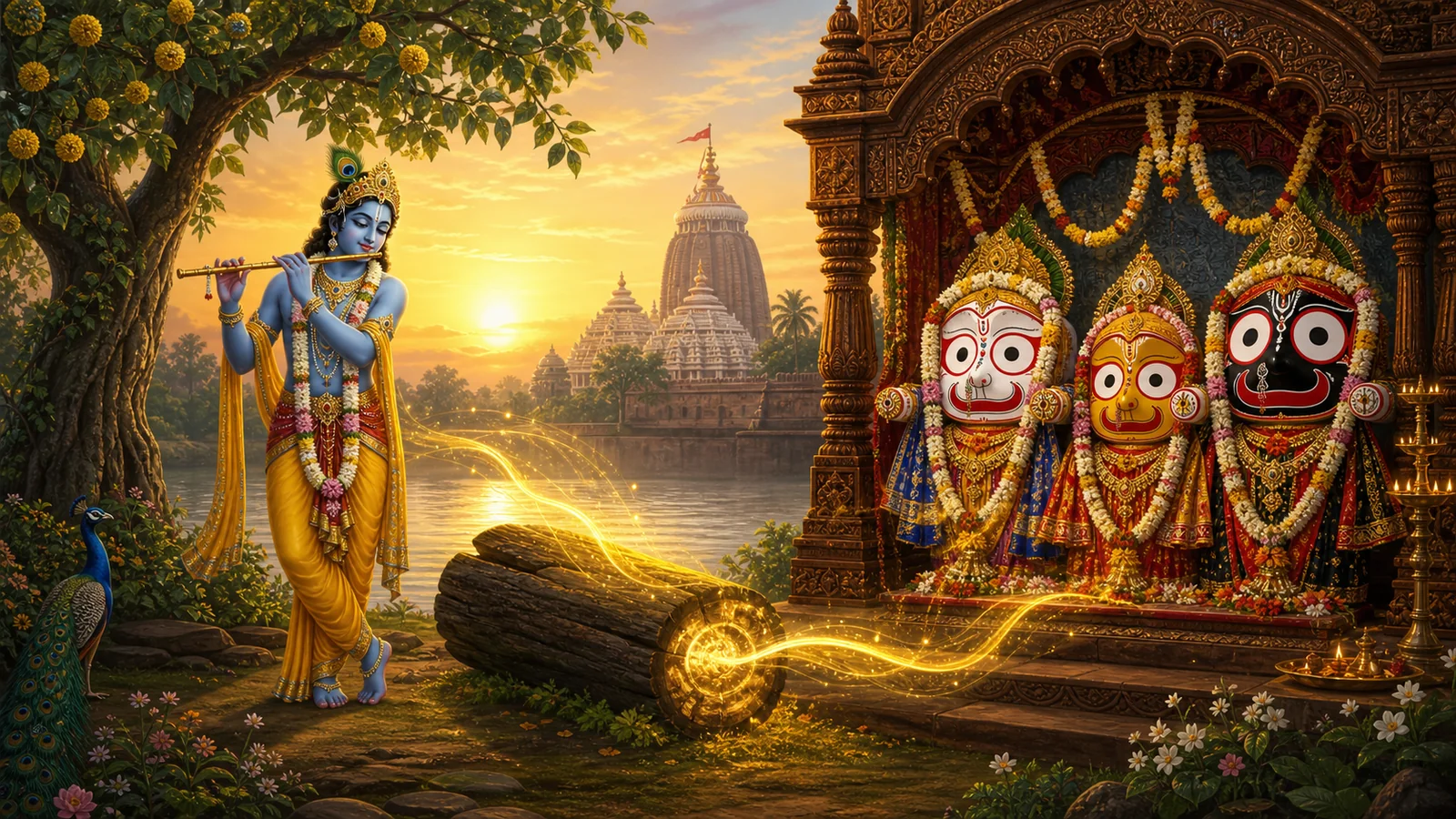
A divine voice consoles the grieving king. The Lord, it promises, will come again — not as blue stone, but as Daru Brahma, "the Absolute in the form of wood." According to the Skanda Purana's Purushottama Kshetra Mahatmya, a sacred particle of the Lord's own being manifests as a celestial tree floating upon the sea, and it is from this holy wood that his forms are to be carved. In due course a great log, marked with auspicious signs, drifts to the shore at Puri.
Here the two threads of the story quietly meet. The mysterious sacred wood, the Daru Brahma, is the very form in which the Lord chooses to remain — and it is within this wooden form that tradition places the hidden Brahma Padartha. What disappeared as Neelamadhava, and what tradition remembers of Krishna's undying presence, are now to become one visible Lord upon a jewelled throne.
The Divine Carpenter and the Unfinished Forms
A beloved Odisha tradition recounts what happened when the sacred log was drawn ashore. No ordinary craftsman could shape it. Then an aged carpenter appeared and offered to carve the sacred forms — on a single, strict condition: that he be left entirely alone behind closed doors, undisturbed, until his work was complete, a period tradition often counts as twenty-one days.
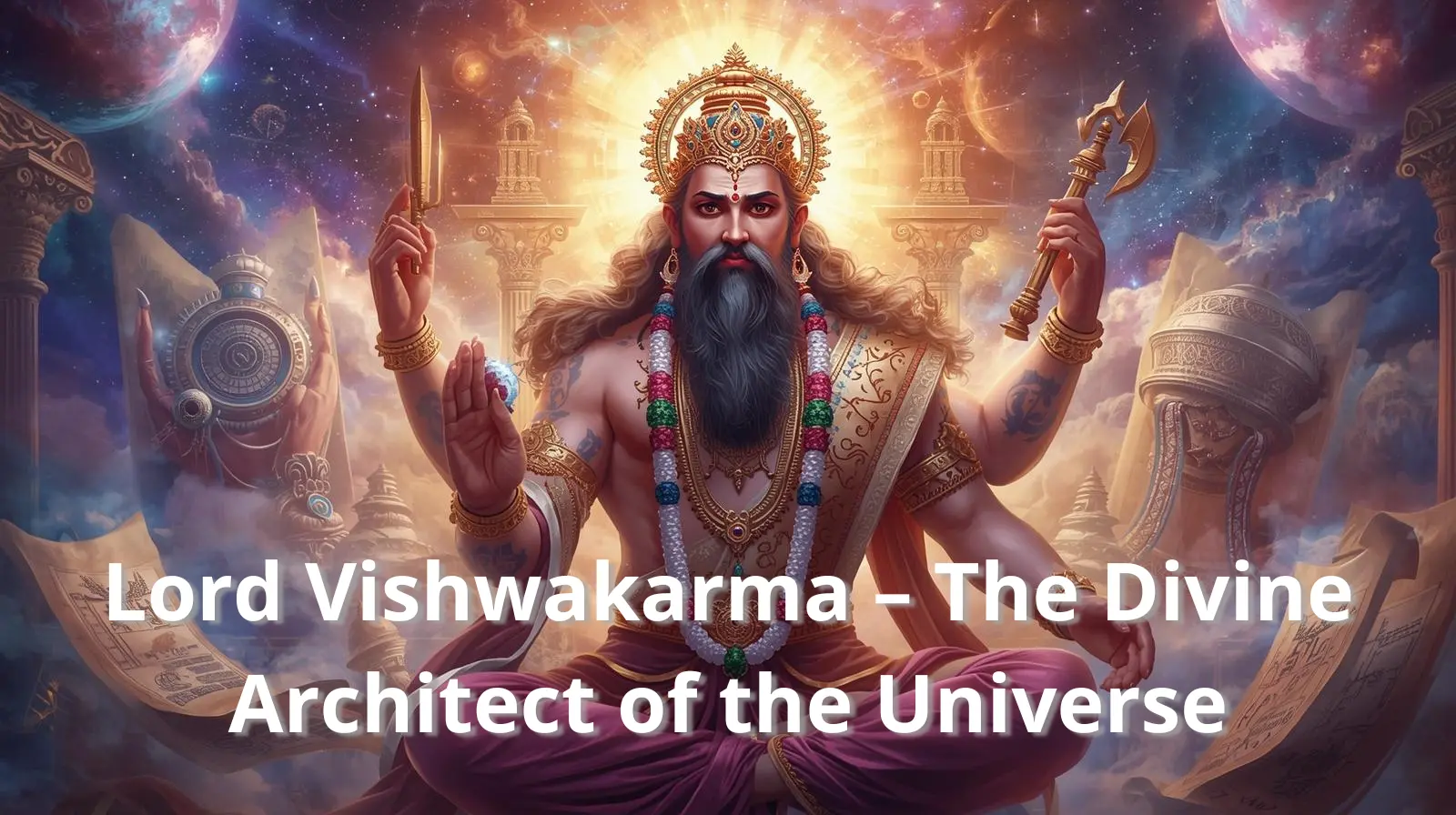
Devotees identify this mysterious artisan with Vishwakarma, the divine architect of the gods — and, in the temple's own theology, with the Supreme Lord himself, who needs no other hand to fashion his form. For days the sound of carving was heard from behind the doors. Then, suddenly, it fell silent.
Overcome by anxiety at the stillness — in many tellings it is Queen Gundicha, in others the king — the doors were opened before the appointed time. The carpenter had vanished. And the sacred forms of Jagannath, Balabhadra and Subhadra stood incomplete, without fully formed hands and feet, their features bold and unfinished.
Temple tradition does not read this as a misfortune or a failed carving. It reads it as the Lord's own will: Jagannath chose to remain in exactly this form. What looks unfinished to human eyes is, to the devotee, the deliberate and perfect shape in which the Lord of the Universe wished to be worshipped.
Jagannath, Balabhadra and Subhadra
On the Ratna Singhasana, the jewelled throne of the Shree Jagannath Temple, the Lord is never alone. Beside dark-complexioned Jagannath stand his fair elder brother Balabhadra and, between them, their sister Devi Subhadra, together with the disc Sudarshana. These four are known as the Chaturdha Daru Vigraha, the four wooden forms, which temple tradition relates to the four Vedas and to the four parts of the sacred syllable Om.
This is the same family the devotee already knows from the life of Krishna: Krishna, his brother Balarama, and their sister Subhadra. The divine household of Dwarka and Vrindavan is here enthroned in wood at Puri — not as a distant memory of a Lord who has departed, but as a living presence who receives worship every single day.
Is Lord Jagannath the Same as Krishna?
For the devotees of Puri, and across the Vaishnava traditions, the answer is a clear yes. Lord Jagannath is worshipped as Krishna himself — Purushottama, the Supreme Person; Balabhadra as Balarama; Subhadra as their sister. The Shree Jagannath Temple's own description states it directly: for the devotees of Krishna, "Lord Jagannatha is Lord Krishna, Lord Balabhadra is Lord Balarama."
Yet the deeper truth of Puri is that Jagannath refuses every narrow boundary. His name, Lord of the Universe, cannot be fenced within a single school. To the Vaishnava he is Vishnu and Krishna; and, as we shall see, other great traditions of dharma also find their Lord in him. To say that Jagannath is Krishna is not to shrink him, but to point to the heart of a form so vast that many devotional streams flow into it and call it home.
Why Lord Jagannath Looks Different
Newcomers are often struck by how unlike other deities Jagannath appears — and this very difference carries some of the tradition's most tender teachings. Devotees read the distinctive form not as a lack, but as a language.
- The great round eyes. Jagannath's enormous, unblinking eyes are seen as the ever-open, all-seeing gaze of the Lord who never closes his eyes upon his children. Wherever the devotee stands, the Lord is already looking back. The festival of Netrotsava, when his fresh eyes are revealed before the Rath Yatra, is cherished for exactly this reason.
- The open, armless form. The question "why does Jagannath have no hands?" is answered in devotion rather than in carpentry. The Lord who holds up the universe needs no ordinary hands to embrace his devotees; his stub-like arms are read as arms perpetually outstretched. The unfinished form becomes a mystery pointing beyond form itself — a reminder that the Divine cannot be captured by human standards of completeness or beauty.
- The wood, renewed. Unlike deities of stone or metal, Jagannath is worshipped in perishable neem wood and is periodically renewed in the Nabakalebara ritual. Even this is a teaching: the eternal Lord willingly accepts a form that ages and is renewed, sharing in the rhythm of the world he loves.
The Traditions That Meet in Jagannath
One of the most beautiful truths of Puri is that no single community "created" Jagannath or owns him alone. Over the centuries, his worship has become a living confluence in which several currents of dharma meet — and it is more honest, and more reverent, to describe that confluence than to force it into one box.
- The tribal (Sabara) stream. As we have seen, the Lord is first served by the forest devotee Vishvavasu, and the temple's daita servitors honour that ancestry to this day. The tribal roots of Jagannath's worship are treasured, not erased.
- The Vaishnava stream. The predominant theology understands Jagannath as Vishnu and Krishna, Purushottama, with Balabhadra and Subhadra as his family. The presence of the triad and the identification with Krishna give this reading its great strength.
- The Shakta stream. Within the temple complex, the goddess Vimala is revered as the presiding Shakti of the kshetra; by temple tradition, the mahaprasad offered to Jagannath attains its full sanctity only after being offered to her. Devi Subhadra, too, is honoured as the divine feminine enthroned beside the brothers.
- The Shaiva stream. Some worshippers approach Jagannath through the mood of Shiva, and the sacred town of Puri holds Shaiva associations of its own.
Alongside these devotional streams stand modern historical and academic interpretations, which try to reconstruct the deity's origins. Some scholars interpret the triad as growing chiefly from tribal or Vaishnava roots; others have proposed connections to Buddhist traditions (reading the three forms as a Buddha–Dharma–Sangha triad, or the Brahma Padartha as a relic) or to Jain traditions (linking the name to Jinanath). These are scholarly hypotheses, actively debated and far from settled. They belong to the study of history and should not be presented as established fact or as the settled teaching of the tradition.
Held together, these streams reveal something rare: a Lord in whom the forest devotee, the Vaishnava saint, the Shakta worshipper and the seeker of history can each stand before the same wide eyes.
Chaitanya Mahaprabhu and the Love of Jagannath
No account of Krishna and Jagannath is complete without Shri Chaitanya Mahaprabhu, the great sixteenth-century saint of Bengal and the fountainhead of Gaudiya Vaishnavism. For Chaitanya, Jagannath was Krishna without the slightest distance — and gazing upon the Lord of Puri could move him to tears and ecstatic love.
Tradition remembers that Chaitanya made Puri his home for the last years of his life, often counted as his final eighteen years, absorbed in devotion at the shrine of Jagannath. In his vision, the Rath Yatra itself became Krishna's return to Vrindavan and the longing of the devotees to draw the Lord back into their hearts. Chaitanya's overflowing bhakti did much to deepen and spread the understanding — still vivid across India today — that to look upon Jagannath is to look upon Krishna.
From the Sanctum to the Rath Yatra
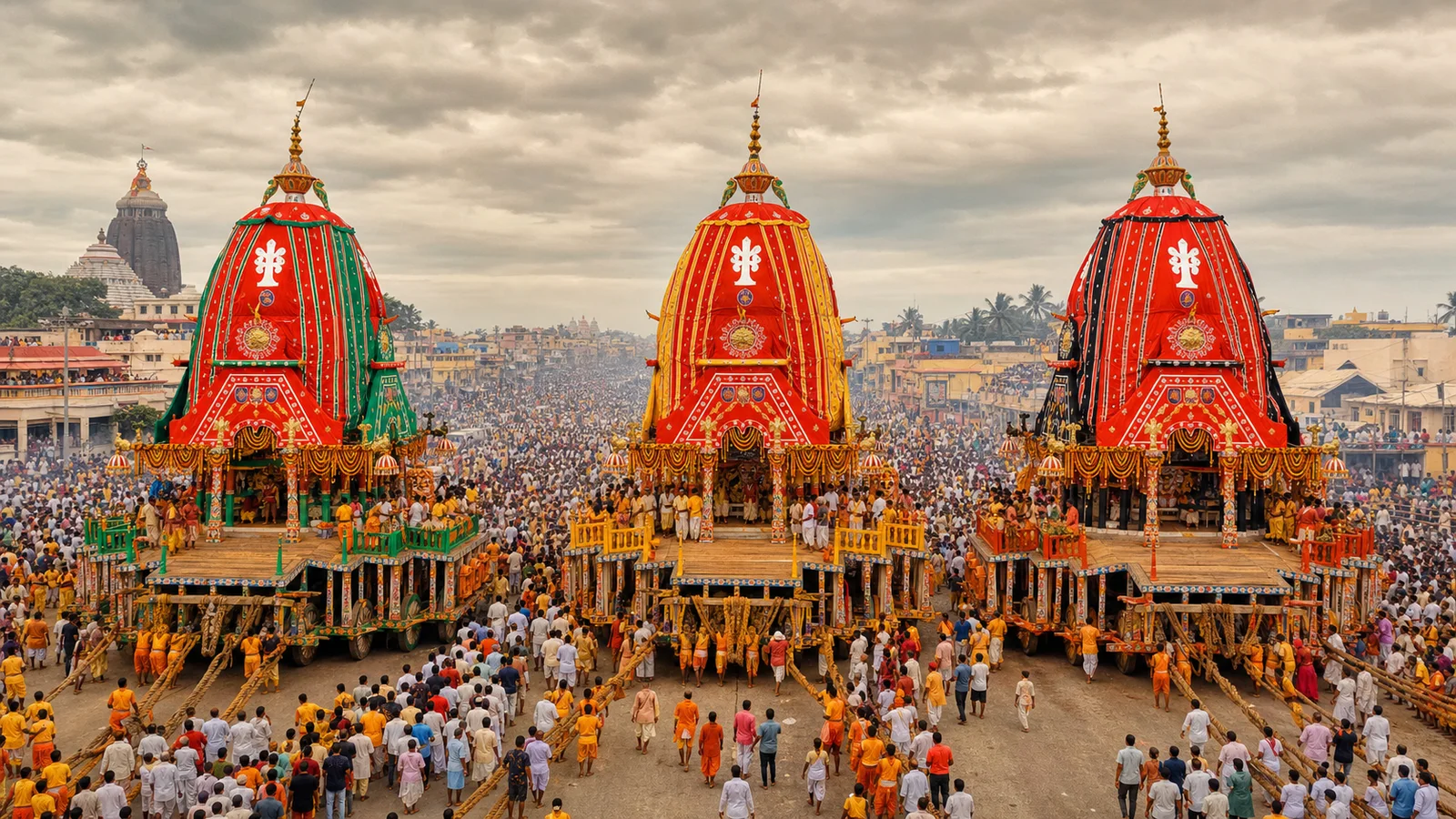
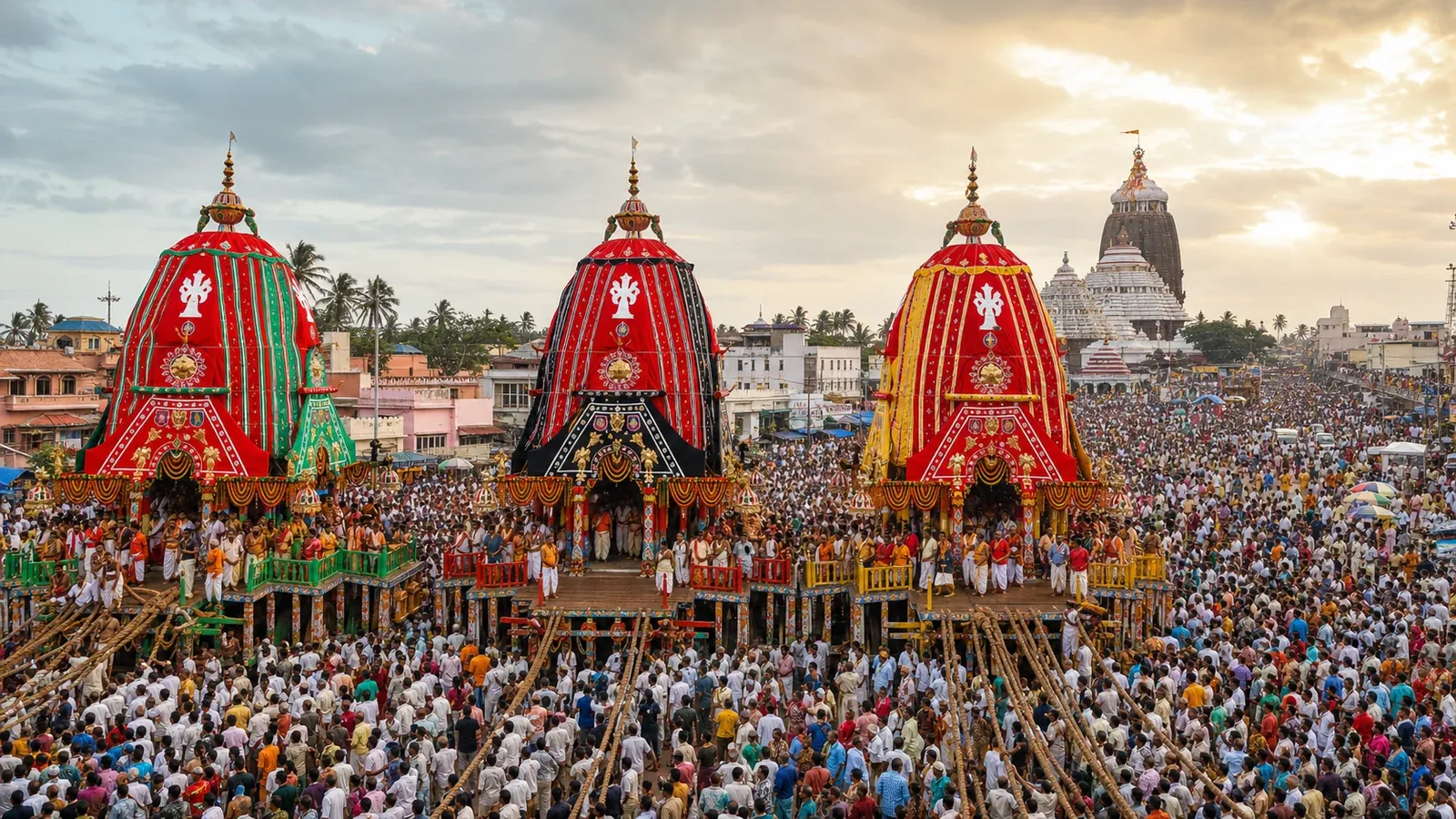
For most of the year, this wide-eyed Lord who chose wood remains within the sanctum of the Shree Jagannath Temple. But once a year the whole meaning of his form is made visible on the open road. During the Rath Yatra, Jagannath, Balabhadra and Subhadra leave the temple and ride out on towering chariots along Puri's Grand Road, offering darshan freely to all — the same message their form has always carried, now moving through the streets.
The chariots are built anew each year by hereditary craftspeople, their construction beginning ceremonially on Akshaya Tritiya. The Lord who needs no hands lets thousands of hands pull his ropes; the Lord who was first served in a hidden forest now comes out where no one can be turned away. For the full festival and its rituals, see our guide to the Jagannath Rath Yatra, and for the Lord's homeward journey, the Bahuda Yatra.
Seen in the light of this whole story, the Rath Yatra is the natural fulfilment of the journey from Krishna to Jagannath: the Lord who chose an accessible form now takes the first step toward every devotee.
The Spiritual Meaning of the Journey
What does this sacred journey mean for a devotee today? Read as one continuous movement, from a forest at Prabhasa to a throne at Puri, it carries a quiet and steadying message.
The Lord of Vrindavan did not abandon the world when he departed as Krishna. He remained — choosing a humble form of wood, wide-eyed and open-armed, so that anyone at all, of any people and any station, might come and stand before him. The unfinished form whispers that we need not be flawless or complete to belong wholly to the Lord. The great eyes promise that we are always seen. The tribal devotee at the origin declares that no one is too far, too simple, or too outside to be the first to hold God. And the Rath Yatra shows the Lord himself stepping down toward us.
From Krishna to Jagannath is, in the end, the journey of divine love making itself reachable — the Supreme Person willingly becoming the Lord who can be seen, served and loved by all.
Conclusion
The journey from Krishna to Jagannath is not a story of transformation from one god into another, but of revelation — the same Lord, known and loved as Krishna, showing himself at Puri as the wide-eyed, open-armed Lord of the Universe. Scripture gives us Krishna's departure; the Puranas and temple tradition give us Indradyumna, Neelamadhava and Daru Brahma; popular legend gives us the divine carpenter and the unfinished form; and modern scholarship offers its careful reconstructions. Each voice matters, and each is best heard for what it truly is.
What unites them is a single, tender conviction: that the Supreme chose to remain near us, in a form anyone can approach. Standing before Jagannath, the devotee is not looking at a distant memory of a Lord who once walked the earth — but at Krishna himself, still here, still gazing back, still ready to come out onto the road to meet everyone who calls.
Sources and Further Reading
Frequently Asked Questions
Is Lord Jagannath the same as Krishna?
In the devotional understanding of Puri and the Vaishnava traditions, yes. Lord Jagannath is worshipped as Shri Krishna himself — Purushottama, the Supreme Person — while Lord Balabhadra is his elder brother Balarama and Devi Subhadra is their sister. The Shree Jagannath Temple's own description affirms that, for devotees of Krishna, 'Lord Jagannatha is Lord Krishna, Lord Balabhadra is Lord Balarama.' At the same time, Jagannath's worship gathers many devotional streams and is honoured by several traditions.
How did Krishna become Jagannath?
Temple and Puranic tradition, chiefly the Utkala Khanda of the Skanda Purana, tells that the Supreme Lord chose to appear at Puri as Daru Brahma — the Absolute in the form of sacred wood. King Indradyumna longed to behold the Lord; the deity Neelamadhava, worshipped by the tribal devotee Vishvavasu, disappeared and reappeared as a great log from which the wooden forms of Jagannath, Balabhadra and Subhadra were carved. The faith of Puri understands this not as Krishna being replaced, but as Krishna being revealed in a new, enduring form.
Who was Neelamadhava?
Neelamadhava, the 'blue Madhava,' is an earlier hidden form of the Lord — a manifestation of Vishnu and Krishna — worshipped in secret in the forest by Vishvavasu, a devotee of the Sabara (Savara) tribal community. According to tradition, when King Indradyumna's search finally reached the shrine, Neelamadhava had vanished, promising to return as Daru Brahma, the sacred wooden form now worshipped as Jagannath.
Why does Lord Jagannath have large eyes and unfinished limbs?
A beloved Odisha tradition recounts that a divine carpenter agreed to carve the sacred forms only if left undisturbed, and when the doors were opened before the appointed time, he vanished, leaving the forms without fully formed hands and feet. Temple tradition does not regard this as incomplete but as the Lord's own chosen form. Devotees understand the great round eyes as the ever-open, all-seeing gaze of the Lord, and the open, armless form as a mystery showing that the Divine cannot be limited by human ideas of shape or beauty.
Who made the Jagannath murti?
Popular Odisha tradition holds that the sacred forms were carved by a mysterious divine carpenter, widely identified with Vishwakarma, the architect of the gods — and, in the temple's own theology, with the Supreme Lord himself. The wooden forms are not cast or sculpted from stone but carved anew from a sacred neem tree during the periodic Nabakalebara ritual by hereditary servitors.
What is Daru Brahma?
Daru Brahma means 'the Absolute (Brahman) in the form of wood.' According to the Skanda Purana's Purushottama Kshetra Mahatmya, a sacred particle of the Lord's own being manifested as a celestial tree floating upon the sea at Puri, and from this sacred wood the four Daru forms — Jagannath, Balabhadra, Subhadra and Sudarshana — were carved. It expresses the belief that the formless Supreme willingly takes a form of humble wood so as to be near his devotees.
Why are Jagannath, Balabhadra and Subhadra worshipped together?
They are worshipped as a divine family. Lord Jagannath is Krishna, Lord Balabhadra is his elder brother Balarama, and Devi Subhadra is their sister, with the disc Sudarshana as the fourth form. Together they are known as the Chaturdha Daru Vigraha, the four wooden forms, which temple tradition relates to the four Vedas and the sacred syllable Om.
Is the story of Krishna's heart found in the Mahabharata?
No. The Mahabharata's Mausala Parva describes Krishna's departure from the world after being struck in the foot by the hunter Jara, but it says nothing about his remains being enshrined in any deity. The much-loved belief that a portion of Krishna's body survived cremation and became the Brahma Padartha within Jagannath's form is a devotional tradition of Odisha, not a statement of the Mahabharata, and even the temple's own accounts treat it as pious belief rather than established history.