The Devi Who Chose Austerity
If Shailputri is the Devi beginning her journey, Maa Brahmacharini is the Devi in the middle of it — when the path is longest, the progress invisible, and the only fuel left is resolve. The second of the Navdurga, she is worshipped on Dwitiya — Monday, October 12, 2026 — and she is the tradition's portrait of tapasya itself: the mountain princess who renounced the palace to win Bhagwan Shiva through sheer, patient austerity.
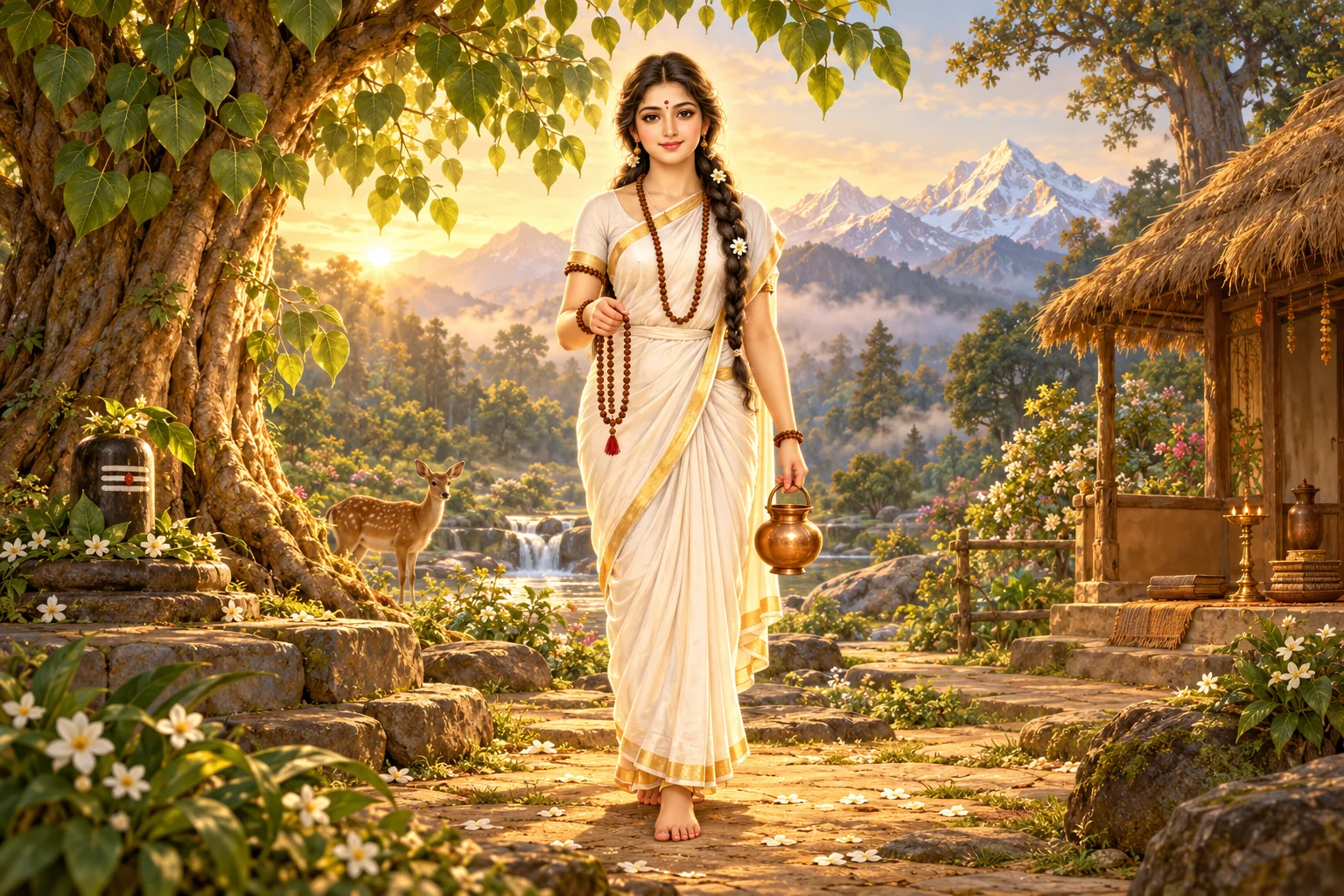
Among all nine forms, hers is the least martial. No weapon, no mount, no crown. Just a young woman walking barefoot, a rosary in one hand and a water-pot in the other. And yet the tradition ranks her among the most powerful — because the story she carries is about the one strength that outlasts every other: the refusal to give up.
Maa Brahmacharini at a Glance
| Traditional order | 2nd of the Navdurga |
| Tithi | Dwitiya (second lunar day) |
| 2026 worship date | Monday, October 12, 2026 (New Delhi, Drik Panchang convention); Chandra Darshana in the evening |
| Vahana | None — she walks barefoot |
| Iconography | Two arms — japa mala (rosary) in the right hand, kamandal (water-pot) in the left |
| Governing planet | Mangal (Mars) |
| Traditional bhog | Sugar / mishri |
| Flower | Jasmine (chameli) |
| Day colour (popular custom) | White in 2026 — a weekday-based custom, not a scriptural rule |
The full verified 2026 calendar, including why this year's festival spans ten civil days, is on the series landing page.
The Name: She Who Moves in Brahman
Brahmacharini joins Brahman — the absolute, and by extension sacred discipline — with charini, she who moves or conducts herself. A brahmacharini is one vowed to celibate, austere, study-filled discipline: the first of the four classical ashramas of life. As a name of the Devi, it honours the unmarried Parvati in the years she lived like a forest ascetic — royal by birth, renunciant by choice.
Her Story: The Tapasya That Moved Shiva
The Shiva Purana's Parvati Khanda — retold in Kalidasa's Kumarasambhava — tells the story at length.
Parvati, daughter of Himavan, loved Bhagwan Shiva from childhood. But Shiva, grieving Sati, had withdrawn into meditation and would not look at the world. When Kamadeva tried to stir love in him and was burnt to ash by the opening of Shiva's third eye, every easy path closed. Devarshi Narada's counsel to the young princess was stark: Shiva is won not by beauty but by tapasya. So she went to the forest.
The traditional accounts describe an escalating austerity that stretches imagination — and is meant to: a thousand years on fruit and flowers; a hundred years on leafy greens alone, sleeping on bare ground; then long ages on nothing but bilva leaves, standing through scorching summers, freezing winters and open-sky monsoons; and finally, the renunciation even of leaves — for which the sages named her Aparna, "she who ate not even a leaf." The forest around her, the texts say, grew gentle; sages came to see the princess whose tapasya outshone their own.
Shiva himself, in the well-loved telling, came to her disguised as a young brahmachari and tested her — listing his own faults: the ash-smeared vairagi, homeless, snake-garlanded. She answered that she desired no one else, in this birth or any other. The disguise fell away, and the wedding that followed gave the tradition its divine household.
Provenance note: the numbers of years differ across retellings — the Shiva Purana, the Devi Bhagavata tradition and popular kathas each tell it with their own arithmetic. What every version agrees on is the sequence: comfort renounced, austerity sustained, and love proven by perseverance rather than display.
Iconography: The Rosary and the Water-Pot
Maa Brahmacharini is depicted with two hands and no vahana — she goes on foot, as ascetics do. The right hand holds a japa mala, the rosary of continuous remembrance; the left holds a kamandal, the renunciant's water-pot, which carries exactly as much as one needs and nothing more. She wears white, and her face — the icons insist — is not gaunt but radiant: tapasya in the Hindu imagination is not self-harm; it is energy gathered inward until it glows.
Tradition associates her with Mangal (Mars) — the planet of energy and drive — read as a teaching that raw energy becomes a blessing only when disciplined. In the yogic overlay popular today, she is linked with steady, rising practice; treat such chakra mappings as a modern devotional lens rather than Puranic doctrine.
How to Worship Maa Brahmacharini at Home
The kalash from Ghatasthapana continues; the daily rhythm stays simple:
- Bathe, light the lamp before the kalash and the Devi's image in the morning.
- Offer jasmine or white flowers, roli and akshat.
- Offer the bhog of sugar or mishri — many families also offer panchamrit (milk, curd, ghee, honey, sugar).
- Chant her mantra (below), 108 times or as many as attention allows. This is a fine day for japa generally — her whole form is a rosary held up as an ideal.
- Read or listen to the Parvati-tapasya story at home — children remember the Devi who would not quit far longer than they remember any list of rules.
- Evening aarti; on this Dwitiya, step outside afterwards for Chandra Darshana — the slender new moon of Ashwin, a lovely family moment.
Our Practices & Rituals section covers lamps, offerings and aarti basics for all nine days.
Mantra, Prarthana and Meaning
Mantra
ॐ देवी ब्रह्मचारिण्यै नमः॥
Om Devi Brahmacharinyai Namah — "Om, salutations to Devi Brahmacharini."
Prarthana (as given in the Navdurga tradition):
दधाना कर पद्माभ्यामक्षमाला कमण्डलू। देवी प्रसीदतु मयि ब्रह्मचारिण्यनुत्तमा॥
Dadhana Kara Padmabhyam Akshamala Kamandalu, Devi Prasidatu Mayi Brahmacharinyanuttama.
"Holding a rosary and a kamandal in her lotus hands — may the supreme Devi Brahmacharini be gracious unto me."
Offerings, Flowers and the Day's Colour
- Bhog: sugar or mishri is the traditional second-day offering — tradition links it with sweetness in speech and long life in the family. Panchamrit is a common companion offering.
- Flowers: jasmine, as on the first day; white blossoms suit her ascetic whiteness.
- Colour: the popular colour calendar assigns white to October 12, 2026 — fitting for her form, but remember it is a weekday-derived modern custom, not scripture.
A Reflection for Dwitiya
Brahmacharini's question is the uncomfortable one: what do you want enough to wait for? Her story is an argument against the shortcut — a reminder that the things worth having (knowledge, skill, trust, a disciplined mind) are priced in years, not days.
On fasting: her day, more than any other, tempts devotees toward severity — she fasted for millennia, surely we can skip meals? Resist that framing. Her tapasya was her calling; yours is your life's duties done with a steady mind. Keep the vrat your health permits — phalahar, one meal, or simply giving up a comfort — and let the real austerity be consistency: the same japa, the same kindness, all nine days. The tradition promises no punishment for a gentle vrat; it promises transformation for a sincere one.
Tomorrow the ascetic becomes the bride, and gentleness arms itself — Maa Chandraghanta, the third form. The whole series lives at Navratri: Nine Forms of Maa Durga.
References
- Drik Panchang — Goddess Brahmacharini: iconography, mantra, the Aparna account and worship day.
- Drik Panchang — 2026 Shardiya Navratri Calendar (New Delhi): verified dates.
- Shiva Purana, Parvati Khanda (Gita Press, Gorakhpur) and Kalidasa's Kumarasambhava — the tapasya narrative.
- Durga Saptashati with Devi Kavacham (Gita Press) — the Navdurga enumeration ("dvitiyam Brahmacharini").
Frequently Asked Questions
When is Maa Brahmacharini worshipped in Navratri 2026?
Maa Brahmacharini is worshipped on Dwitiya, the second tithi of Shardiya Navratri — Monday, October 12, 2026 (New Delhi, Drik Panchang convention). The evening also carries Chandra Darshana, the first sighting of the new moon. Tithi timings vary by city, so confirm with your local panchang.
What is Maa Brahmacharini's mantra?
Her simple mantra is 'Om Devi Brahmacharinyai Namah' (ॐ देवी ब्रह्मचारिण्यै नमः). The traditional prarthana is 'Dadhana Kara Padmabhyam Akshamala Kamandalu, Devi Prasidatu Mayi Brahmacharinyanuttama' — may the supreme Brahmacharini, holding rosary and kamandal in her lotus hands, be gracious to me.
What bhog is offered to Maa Brahmacharini?
Sugar — and in many homes mishri or panchamrit — is the traditional second-day offering, associated with sweetness of speech and a long life for the family. Jasmine is her flower. As always, regional customs vary; devotion matters more than the menu.
Why is she called Brahmacharini and Aparna?
Brahmacharini means 'she who moves in Brahman' — one vowed to austere, celibate discipline. In her penance to win Bhagwan Shiva, tradition says she lived first on fruit, then on bilva leaves, and finally gave up even leaves — earning the name Aparna, 'she who ate not even a leaf' (a-parna).
Is the white colour of Navratri Day 2 compulsory in 2026?
No. White for October 12, 2026 comes from the popular weekday-based colour custom, loved especially in Maharashtra and Gujarat. It is a joyful modern tradition, not a scriptural rule — wear what is clean and comfortable.
What should students pray to Maa Brahmacharini for?
She is the Navdurga form most associated with tapasya — sustained, patient effort. Students and anyone pursuing a long goal traditionally seek her blessing for perseverance, focus and the strength to continue when results are far away.