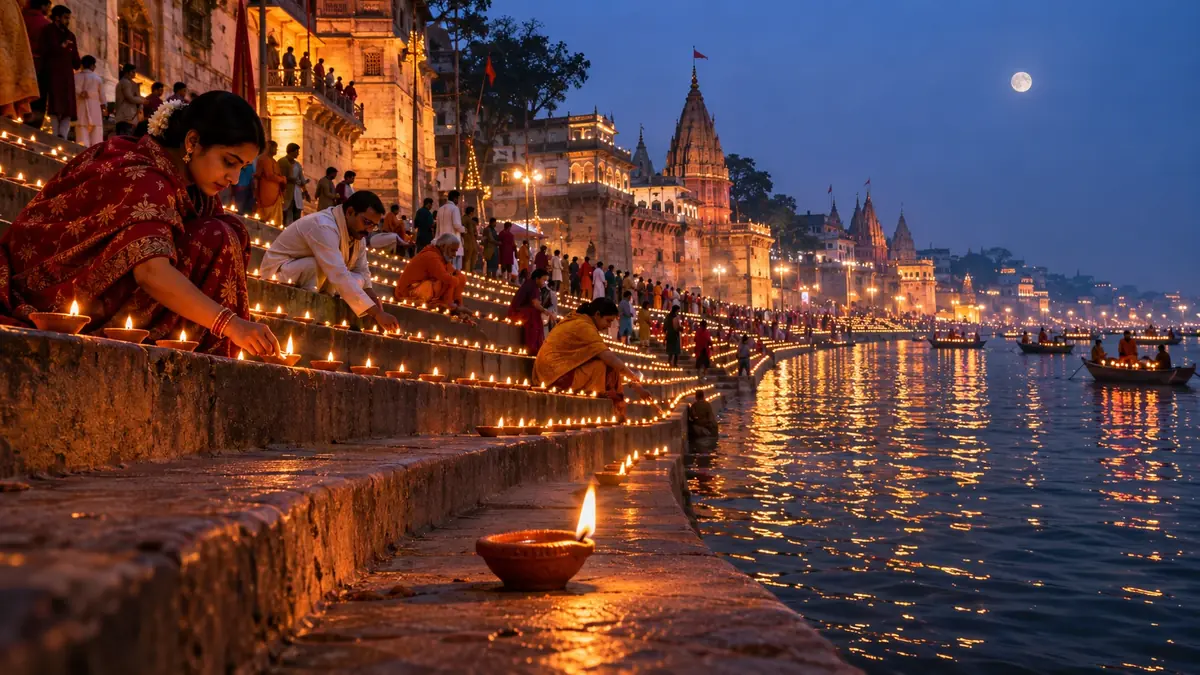
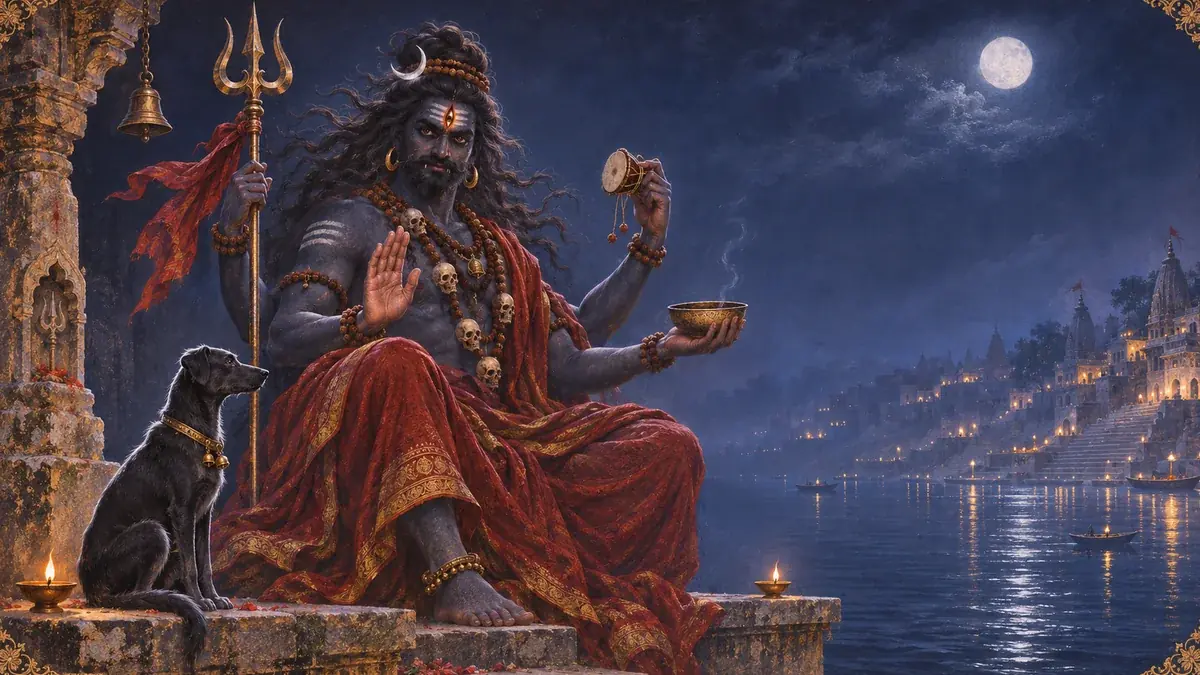
The complete Kalabhairava Ashtakam is below in Sanskrit, eight verses and the phalashruti, set out line by line for recitation.
Skip to the verse-by-verse meaning ↓
Shri Kalabhairava Ashtakam: Full Text
The Eight Verses · अष्टकम्
देवराजसेव्यमानपावनाङ्घ्रिपङ्कजं
व्यालयज्ञसूत्रमिन्दुशेखरं कृपाकरम्।
नारदादियोगिवृन्दवन्दितं दिगम्बरं
काशिकापुराधिनाथकालभैरवं भजे॥ १॥
भानुकोटिभास्वरं भवाब्धितारकं परं
नीलकण्ठमीप्सितार्थदायकं त्रिलोचनम्।
कालकालमम्बुजाक्षमक्षशूलमक्षरं
काशिकापुराधिनाथकालभैरवं भजे॥ २॥
शूलटङ्कपाशदण्डपाणिमादिकारणं
श्यामकायमादिदेवमक्षरं निरामयम्।
भीमविक्रमं प्रभुं विचित्रताण्डवप्रियं
काशिकापुराधिनाथकालभैरवं भजे॥ ३॥
भुक्तिमुक्तिदायकं प्रशस्तचारुविग्रहं
भक्तवत्सलं स्थितं समस्तलोकविग्रहम्।
विनिक्वणन्मनोज्ञहेमकिङ्किणीलसत्कटिं
काशिकापुराधिनाथकालभैरवं भजे॥ ४॥
धर्मसेतुपालकं त्वधर्ममार्गनाशकं
कर्मपाशमोचकं सुशर्मदायकं विभुम्।
स्वर्णवर्णशेषपाशशोभिताङ्गमण्डलं
काशिकापुराधिनाथकालभैरवं भजे॥ ५॥
रत्नपादुकाप्रभाभिरामपादयुग्मकं
नित्यमद्वितीयमिष्टदैवतं निरञ्जनम्।
मृत्युदर्पनाशनं करालदंष्ट्रमोक्षणं
काशिकापुराधिनाथकालभैरवं भजे॥ ६॥
अट्टहासभिन्नपद्मजाण्डकोशसन्ततिं
दृष्टिपातनष्टपापजालमुग्रशासनम्।
अष्टसिद्धिदायकं कपालमालिकन्धरं
काशिकापुराधिनाथकालभैरवं भजे॥ ७॥
भूतसङ्घनायकं विशालकीर्तिदायकं
काशिवासलोकपुण्यपापशोधकं विभुम्।
नीतिमार्गकोविदं पुरातनं जगत्पतिं
काशिकापुराधिनाथकालभैरवं भजे॥ ८॥
Phalashruti · फलश्रुति
कालभैरवाष्टकं पठन्ति ये मनोहरं
ज्ञानमुक्तिसाधनं विचित्रपुण्यवर्धनम्।
शोकमोहदैन्यलोभकोपतापनाशनं
ते प्रयान्ति कालभैरवाङ्घ्रिसंनिधिं ध्रुवम्॥ ९॥
॥ इति श्रीकालभैरवाष्टकस्तोत्रं सम्पूर्णम्॥
Text: Shivastotraratnakar, Gita Press, Gorakhpur (book code 1417), pages 201 to 204, followed as printed, including its readings अधर्ममार्गनाशकं (verse 5), कपालमालिकन्धरं (verse 7) and ते प्रयान्ति in the phalashruti. Other editions differ in a few words.
About the Kaal Bhairav Ashtakam
An ashtakam is a hymn of eight verses. This one praises Kalabhairava, the fierce form of Shiva whom Kashi honours as its guardian. Each verse describes him, his weapons, his ornaments and his power over time and death, and then ends with the same line: I worship Kalabhairava, the supreme lord of the city of Kashi. A ninth verse, the phalashruti, describes the fruit of reciting it.
Many collections attribute the hymn to Adi Shankaracharya, and it appears among his stotras in collected editions of his works. The Gita Press edition followed here prints it without an author's name.
The story behind Bhairava's bond with Kashi is told in the Shiva Purana (Shatarudra Samhita, chapters 8 and 9): Bhairava severs the fifth head of Brahma, and the skull stays fixed to his hand until it falls away in Kashi. Kashi tradition keeps him there as its kotwal, the guardian of the city. For more on Shiva's forms and on Kashi, read Mahadev, the Lord of Kashi and the guide to the Kashi Vishwanath Jyotirlinga.
For first-time readers. The Sanskrit metre is quick and even, with long compound words. Read slowly the first few times, and let the refrain set the rhythm: it comes back at the end of every verse. Bhairava is a fierce form, but the hymn is a hymn of refuge, and nothing special is needed to recite it beyond attention. The phalashruti speaks of the blessing of recitation in devotional terms; it is not a promise of a particular result.
Verse-by-Verse Meaning
Each verse below is given in Roman transliteration, written for reading aloud, with hyphens to show where the long compound words divide. The meaning follows in plain English.
The Eight Verses
1. Devaraja-sevyamana-pavananghri-pankajam,
Vyala-yajnasutram indu-shekharam kripakaram.
Naradadi-yogi-vrinda-vanditam digambaram,
Kashika-puradhinatha-Kalabhairavam bhaje.
"His pure lotus feet are served by Indra, king of the gods. He wears a serpent as his sacred thread and the moon on his head, and he is a mine of mercy. Narada and the hosts of yogis bow to him, and he is clothed only by the sky. I worship Kalabhairava, the supreme lord of the city of Kashi."
The refrain appears for the first time here, so it is worth reading slowly. Kashika is Kashi, pura is city and adhinatha is the supreme lord. Every verse of the hymn will end by bringing Bhairava back to Kashi, because that is where his story settles him: the skull that clung to his hand fell away in Kashi, and the city has kept him as its guardian ever since. Digambara, "sky-clad", is the ascetic who owns nothing.
2. Bhanu-koti-bhasvaram bhavabdhi-tarakam param,
Nilakantham ipsitartha-dayakam trilochanam.
Kala-kalam ambujaksham aksha-shulam aksharam,
Kashika-puradhinatha-Kalabhairavam bhaje.
"He shines like ten million suns and carries us across the ocean of worldly life; he is the highest. Blue-throated, three-eyed, he grants what we long for. He is the death of Death, lotus-eyed, holding the rosary and the trident, imperishable. I worship Kalabhairava, the supreme lord of Kashi."
Kala means both time and death, and Kala-kala is the one who is death even to Death: the name behind the name Kalabhairava. Aksha is the rosary and shula the trident.
3. Shula-tanka-pasha-danda-panim adi-karanam,
Shyama-kayam adi-devam aksharam niramayam.
Bhima-vikramam prabhum vichitra-tandava-priyam,
Kashika-puradhinatha-Kalabhairavam bhaje.
"In his hands are the spear, the axe, the noose and the staff; he is the first cause. Dark in body, the first of the gods, imperishable and free from all affliction, the Lord of fearsome valour, he delights in the wondrous tandava dance. I worship Kalabhairava, the supreme lord of Kashi."
The weapons are a guardian's tools. Niramaya means untouched by any illness or distress, and the tandava is Shiva's cosmic dance.
4. Bhukti-mukti-dayakam prashasta-charu-vigraham,
Bhakta-vatsalam sthitam samasta-loka-vigraham.
Vinikvanan-manojna-hema-kinkini-lasat-katim,
Kashika-puradhinatha-Kalabhairavam bhaje.
"He grants both the joys of the world and liberation, and his form is beautiful and praised. He loves his devotees, he stands firm, and all the worlds are his body. Around his waist a lovely golden belt of little bells chimes as he moves. I worship Kalabhairava, the supreme lord of Kashi."
Bhukti is enjoyment in this life and mukti is freedom from rebirth: the verse says he gives both.
5. Dharma-setu-palakam tvadharma-marga-nashakam,
Karma-pasha-mochakam susharma-dayakam vibhum.
Svarna-varna-shesha-pasha-shobhitanga-mandalam,
Kashika-puradhinatha-Kalabhairavam bhaje.
"He guards the bridge of dharma and destroys the paths of adharma. He frees us from the noose of karma, gives true well-being and pervades everything. His whole body is adorned with golden serpents coiled like nooses. I worship Kalabhairava, the supreme lord of Kashi."
The image of the bridge is apt for a guardian: he keeps the way of right living open and closes the ways that lead astray. The noose of karma is the chain of actions and their results that binds a person to rebirth.
6. Ratna-paduka-prabhabhirama-pada-yugmakam,
Nityam advitiyam ishta-daivatam niranjanam.
Mrityu-darpa-nashanam karala-damshtra-mokshanam,
Kashika-puradhinatha-Kalabhairavam bhaje.
"His feet glow with the light of jewelled sandals. He is eternal, without a second, the beloved deity, without stain. He crushes the pride of Death and sets us free from its terrible fangs. I worship Kalabhairava, the supreme lord of Kashi."
Ishta-daivata is the deity a devotee holds dearest. The second half returns to the hymn's central theme: as lord of time, Bhairava is the one who can free us from time's devouring jaws.
7. Attahasa-bhinna-padmajanda-kosha-santatim,
Drishti-pata-nashta-papa-jalam ugra-shasanam.
Ashta-siddhi-dayakam kapala-malikandharam,
Kashika-puradhinatha-Kalabhairavam bhaje.
"His thunderous laughter splits apart the shells of the worlds born from Brahma. A single glance from him destroys the whole web of sin, and his rule is stern. He grants the eight powers and wears a garland of skulls. I worship Kalabhairava, the supreme lord of Kashi."
Padmaja, "lotus-born", is Brahma, and the "eggs" are the universes he creates. The skull garland is the sign of the lord of death and time, and his sternness is directed at sin, not at the devotee.
8. Bhuta-sangha-nayakam vishala-kirti-dayakam,
Kashi-vasa-loka-punya-papa-shodhakam vibhum.
Niti-marga-kovidam puratanam jagatpatim,
Kashika-puradhinatha-Kalabhairavam bhaje.
"He leads the hosts of beings and spirits and grants great renown. He weighs and purifies the merit and the sins of all who live in Kashi, and he pervades all. He knows the path of right conduct, he is the ancient one, the lord of the world. I worship Kalabhairava, the supreme lord of Kashi."
The last verse says plainly what the refrain has been hinting at: Bhairava's office in Kashi. In Kashi tradition, Bhairava is the one who settles the account of deeds for those who die in the city, which is why he is honoured there as both guardian and judge.
The Phalashruti
9. Kalabhairavashtakam pathanti ye manoharam,
Jnana-mukti-sadhanam vichitra-punya-vardhanam.
Shoka-moha-dainya-lobha-kopa-tapa-nashanam,
Te prayanti Kalabhairavanghri-sannidhim dhruvam.
"This lovely Kalabhairava Ashtakam is a means to knowledge and liberation; it increases merit in wonderful ways and removes sorrow, delusion, dejection, greed, anger and torment. Those who read it surely come into the presence of Kalabhairava's feet."
A phalashruti, "the hearing of the fruit", closes many stotras. Notice what this one names as the fruit: not wealth or victory but freedom from inner troubles, and nearness to the Lord's feet. It speaks the language of devotion and hope rather than of guaranteed results.
Frequently Asked Questions
Who is Kaal Bhairav?
Kaal Bhairav, or Kalabhairava, is a fierce form of Shiva. The Shiva Purana (Shatarudra Samhita, chapters 8 and 9) tells how Bhairava cut off the fifth head of Brahma and wandered with the skull stuck to his hand until it fell away in Kashi. Kashi honours him as its guardian, and pilgrims traditionally take his darshan as part of a Kashi yatra.
Who composed the Kaal Bhairav Ashtakam?
Many collections attribute the Kalabhairava Ashtakam to Adi Shankaracharya, and it is included among his stotras in collected editions of his works. The Gita Press Shivastotraratnakar, which this page follows, prints it without naming an author.
What does Kashika Puradhinatha Kalabhairavam Bhaje mean?
It means "I worship Kalabhairava, the supreme lord of the city of Kashi." Kashika is Kashi, pura is city and adhinatha is supreme lord. The line ends all eight verses, so every praise in the hymn returns to Bhairava as the guardian of Kashi.
What is the phalashruti?
A phalashruti, literally the hearing of the fruit, is the closing verse of many stotras that describes the blessing of reciting them. Here it says that those who read the Ashtakam come near to Kalabhairava's feet. It expresses the hymn's faith; it is not a promise of a particular result.
When is the Kaal Bhairav Ashtakam usually recited?
Many devotees recite it on Kalashtami, the eighth day of the waning moon each month, and especially on Kaal Bhairav Jayanti, the Krishna Ashtami of Margashirsha. Others recite it daily or before visiting a Bhairava temple. Any calm, regular time is fine.
Which text of the Ashtakam does this page follow?
The Sanskrit on this page follows the Shivastotraratnakar published by Gita Press, Gorakhpur (book code 1417), pages 201 to 204, including its readings such as adharma-marga-nashakam in verse 5 and kapala-malikandharam in verse 7. Other editions differ in a few words.