The full Hanuman Chalisa is below in Devanagari, set out line by line for recitation. If you are reading it for the first time, you may want to begin with the meaning instead.
Skip to the verse-by-verse meaning ↓
Shri Hanuman Chalisa: Full Text
॥ श्रीहनूमते नमः ॥
Opening Dohas · दोहा
श्रीगुरु चरन सरोज रज
निज मनु मुकुरु सुधारि।
बरनउँ रघुबर बिमल जसु
जो दायकु फल चारि॥
बुद्धिहीन तनु जानिके,
सुमिरौं पवन-कुमार।
बल बुधि बिद्या देहु मोहिं,
हरहु कलेस बिकार॥
The 40 Chaupais · चौपाई
जय हनुमान ज्ञान गुन सागर।
जय कपीस तिहुँ लोक उजागर॥
राम दूत अतुलित बल धामा।
अंजनि-पुत्र पवनसुत नामा॥
महाबीर बिक्रम बजरंगी।
कुमति निवार सुमति के संगी॥
कंचन बरन बिराज सुबेसा।
कानन कुंडल कुंचित केसा॥
हाथ बज्र औ ध्वजा बिराजै।
काँधे मूँज जनेऊ साजै॥
संकर सुवन केसरीनंदन।
तेज प्रताप महा जग बंदन॥
बिद्यावान गुनी अति चातुर।
राम काज करिबे को आतुर॥
प्रभु चरित्र सुनिबे को रसिया।
राम लषन सीता मन बसिया॥
सूक्ष्म रूप धरि सियहिं दिखावा।
बिकट रूप धरि लंक जरावा॥
भीम रूप धरि असुर सँहारे।
रामचंद्र के काज सँवारे॥
लाय सजीवन लखन जियाये।
श्रीरघुबीर हरषि उर लाये॥
रघुपति कीन्ही बहुत बड़ाई।
तुम मम प्रिय भरतहि सम भाई॥
सहस बदन तुम्हरो जस गावैं।
अस कहि श्रीपति कंठ लगावैं॥
सनकादिक ब्रह्मादि मुनीसा।
नारद सारद सहित अहीसा॥
जम कुबेर दिगपाल जहाँ ते।
कबि कोबिद कहि सके कहाँ ते॥
तुम उपकार सुग्रीवहिं कीन्हा।
राम मिलाय राज पद दीन्हा॥
तुम्हरो मंत्र बिभीषन माना।
लंकेस्वर भए सब जग जाना॥
जुग सहस्त्र जोजन पर भानू।
लील्यो ताहि मधुर फल जानू॥
प्रभु मुद्रिका मेलि मुख माहीं।
जलधि लाँघि गये अचरज नाहीं॥
दुर्गम काज जगत के जेते।
सुगम अनुग्रह तुम्हरे तेते॥
राम दुआरे तुम रखवारे।
होत न आज्ञा बिनु पैसारे॥
सब सुख लहै तुम्हारी सरना।
तुम रच्छक काहू को डर ना॥
आपन तेज सम्हारो आपै।
तीनों लोक हाँक तें काँपै॥
भूत पिसाच निकट नहिं आवै।
महाबीर जब नाम सुनावै॥
नासै रोग हरै सब पीरा।
जपत निरंतर हनुमत बीरा॥
संकट तें हनुमान छुड़ावै।
मन क्रम बचन ध्यान जो लावै॥
सब पर राम तपस्वी राजा।
तिन के काज सकल तुम साजा॥
और मनोरथ जो कोइ लावै।
सोइ अमित जीवन फल पावै॥
चारों जुग परताप तुम्हारा।
है परसिद्ध जगत उजियारा॥
साधु संत के तुम रखवारे।
असुर निकंदन राम दुलारे॥
अष्ट सिद्धि नौ निधि के दाता।
अस बर दीन जानकी माता॥
राम रसायन तुम्हरे पासा।
सदा रहो रघुपति के दासा॥
तुम्हरे भजन राम को पावै।
जनम जनम के दुख बिसरावै॥
अंत काल रघुबर पुर जाई।
जहाँ जन्म हरि-भक्त कहाई॥
और देवता चित्त न धरई।
हनुमत सेइ सर्ब सुख करई॥
संकट कटै मिटै सब पीरा।
जो सुमिरै हनुमत बलबीरा॥
जै जै जै हनुमान गोसाईं।
कृपा करहु गुरु देव की नाईं॥
जो सत बार पाठ कर कोई।
छूटहि बंदि महा सुख होई॥
जो यह पढ़ै हनुमान चलीसा।
होय सिद्धि साखी गौरीसा॥
तुलसीदास सदा हरि चेरा।
कीजै नाथ हृदय महँ डेरा॥
Closing Doha · दोहा
पवनतनय संकट हरन,
मंगल मूरति रूप।
राम लखन सीता सहित,
हृदय बसहु सुर भूप॥
॥ इति ॥
Text: Shri Hanuman Chalisa, Gita Press, Gorakhpur (book code 695), followed as printed, including its spellings लषन (chaupai 8), सहस्त्र (18) and चलीसा (39). Other editions differ in small spellings.
About the Hanuman Chalisa
The Hanuman Chalisa is a hymn of praise to Hanuman, the devoted servant of Shri Rama. Chalisa means "a poem of forty": its heart is forty chaupais, short four-part verses, opened by two dohas and closed by one.
Tradition attributes it to Goswami Tulsidas, the sixteenth-century poet-saint who retold the Ramayana as the Ramcharitmanas, and the last chaupai carries his name. Popular accounts of when and where he composed it differ. It is written in Awadhi, the old Hindi of the Ayodhya region, which is why words like bidya, jas and bikar look slightly unfamiliar to modern Hindi readers.
The hymn moves through three modes, and noticing them makes it easier to follow:
- Praise, which describes who Hanuman is: his strength, wisdom, appearance and devotion.
- Story, which recalls what he did in the Ramayana: finding Sita, burning Lanka, bringing the healing herb for Lakshmana.
- Prayer, in which the devotee speaks directly and asks for something.
The Chalisa begins and ends in prayer. Everything in between explains why the devotee trusts the one being prayed to. For more on Hanuman's story and how different traditions see him, read his profile in The Divine League.
A Note for First-Time Readers
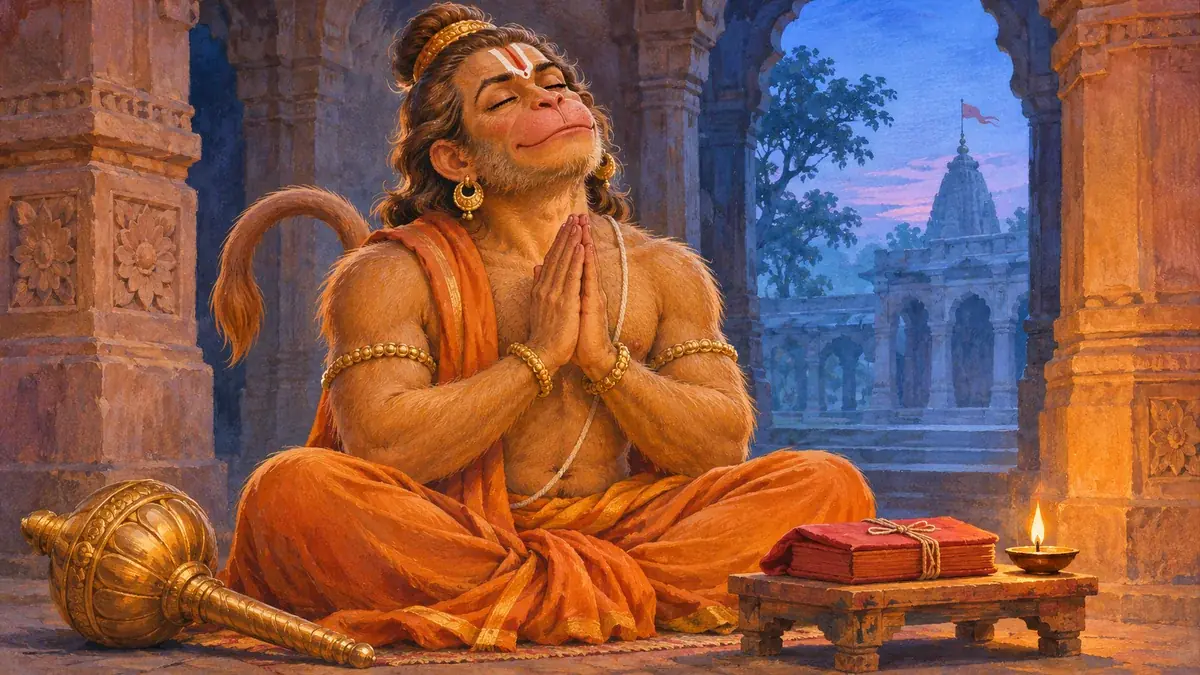
You do not need special preparation to read the Chalisa. Many people sit before an image of Hanuman or Shri Rama, light a lamp or incense if they wish, and recite at an unhurried pace. Others read it quietly on a phone during the day. What matters most in devotional tradition is attention, not ceremony.
A few practical points help:
- Read the meaning once. Even a single slow reading of the explanations below changes how the words feel when you recite them.
- Go slowly at first. Awadhi endings such as -ai (आवै, aavai) and the nasal sounds marked with a dot or a moon-sign are easier to say clearly when you are not rushing.
- Tuesdays and Saturdays are kept in much of North India as days of special Hanuman worship, and the Chalisa is sung widely on Hanuman Jayanti. Any day and any regular time is fine.
- Some lines speak of freedom from illness, fear and trouble. They express the devotee's faith in Hanuman's grace. They are not a substitute for medical care, and no number of recitations comes with a guaranteed result.
Verse-by-Verse Meaning
Each verse below is given in Roman transliteration, written for reading aloud rather than for scholarly precision, followed by its meaning in plain English.
The Opening Dohas: Preparing the Mind
Doha 1
Shri guru charan saroj raj, nij manu mukuru sudhari,
Baranaun Raghubar bimal jasu, jo dayaku phal chari.
"With the dust of my guru's lotus feet I clean the mirror of my mind, and then I describe the spotless glory of Raghubar, Shri Rama, which grants the four fruits of life."
The hymn begins before Hanuman is even named. The poet first prepares himself: the mind is a mirror, and humility before the guru, pictured as the dust of his feet, wipes it clean so that it can reflect truthfully. Notice too whose glory he says he will describe: Rama's. In this tradition, praising Hanuman and praising Rama are one act, because Hanuman's greatness is his devotion to Rama. The four fruits are the four aims of life: dharma (right living), artha (prosperity), kama (fulfilment) and moksha (liberation).
Doha 2
Buddhiheen tanu janike, sumiraun Pavan-kumar,
Bal budhi bidya dehu mohin, harahu kales bikar.
"Knowing myself to be without understanding, I remember you, son of the Wind. Give me strength, intelligence and knowledge, and take away my troubles and my faults."
This is the first direct prayer, and it sets the tone for everything after it. The devotee begins by admitting a limit: buddhiheen, "lacking understanding". Then he asks, and look at what he asks for. Not wealth, not victory, not a particular outcome, but three capacities: bal, strength; buddhi, intelligence or discernment; and bidya, knowledge. These are the very qualities the chaupais go on to praise in Hanuman, the "ocean of wisdom", the "abode of matchless strength", the one who is "learned, virtuous and wise". The devotee is asking to become a little more like the one he is praying to, so that he can act well. Only then does he ask for relief: kales, afflictions, and bikar, the distortions of the mind such as anger and greed.
Chaupais 1 to 8: Who Hanuman Is
1. Jai Hanuman gyan gun sagar,
Jai Kapis tihun lok ujagar.
"Victory to Hanuman, ocean of wisdom and virtue! Victory to the lord of the vanaras, who lights up the three worlds." The hymn opens in praise. Kapis means lord of the monkeys, the vanaras of the Ramayana, and ujagar means bright, famous, shining.
2. Ram doot atulit bal dhama,
Anjani-putra Pavanasut nama.
"Messenger of Rama, home of matchless strength, you are known as the son of Anjani and the son of the Wind." His first title is a role, not a power: he is Rama's doot, his messenger. His mother is Anjana and his father is Vayu, the Wind.
3. Mahabeer bikram Bajrangi,
Kumati nivar sumati ke sangi.
"Great hero, mighty one, whose body is as strong as a thunderbolt, you drive away bad thinking and keep company with good sense." Bajrangi comes from vajra-anga, "thunderbolt-limbed". The second line turns his strength inward: he removes kumati, a twisted mind, and stands beside sumati, a sound one.
4. Kanchan baran biraj subesa,
Kanan kundal kunchit kesa.
"Golden in colour and handsomely dressed, with earrings in your ears and curling hair." The hymn now paints his form so the reciter can picture him.
5. Hath bajra au dhvaja birajai,
Kandhe moonj janeu sajai.
"In your hand shine the thunderbolt and the banner, and a sacred thread of munj grass adorns your shoulder." The bajra here is his weapon, often pictured as the mace. Moonj is a sacred grass used in rites of initiation, and the line pictures his sacred thread made of it.
6. Sankar suvan Kesarinandan,
Tej pratap maha jag bandan.
"Son of Shankara, son of Kesari, your brilliance and might are honoured by the whole world." Kesari is Anjana's husband. Sankar suvan links Hanuman to Shiva: many traditions honour Hanuman as born of Shiva's power, or as Shiva's own amsha, a part of him, while others do not.
7. Bidyavan guni ati chatur,
Ram kaj karibe ko atur.
"Learned, virtuous and very wise, you are always eager to do Rama's work." Knowledge and cleverness are praised, but the line turns at once to their purpose: service.
8. Prabhu charitra sunibe ko rasiya,
Ram Lakhan Sita man basiya.
"You delight in hearing the Lord's story, and Rama, Lakshmana and Sita dwell in your heart." Rasiya is one who relishes something. The Gita Press text spells Lakshmana's name लषन here, an older way of writing the sound kh; it is pronounced Lakhan.
Chaupais 9 to 20: What Hanuman Did
9. Sookshma roop dhari Siyahin dikhava,
Bikat roop dhari Lank jarava.
"Taking a tiny form you appeared before Sita, and taking a terrible form you set Lanka ablaze." The hymn now tells the story. In the Sundara Kanda, Hanuman makes himself small to reach Sita in the Ashoka grove, and later burns Lanka with the fire set to his own tail.
10. Bheem roop dhari asur sanhare,
Ramachandra ke kaj sanvare.
"Taking a fearsome form you destroyed the demons, and you brought Ramachandra's work to success." Sanvare means set right, accomplished.
11. Laya Sajeevan Lakhan jiyaye,
Shri Raghubeer harashi ur laye.
"You brought the Sanjivani herb and revived Lakshmana, and Shri Rama, overjoyed, held you to his heart." When Lakshmana falls in battle, Hanuman flies to the Himalaya for the life-giving herb, and Rama embraces him in gratitude.
12. Raghupati keenhi bahut badai,
Tum mam priya Bharatahi sam bhai.
"Raghupati praised you greatly: 'You are as dear to me as my brother Bharata.'" Bharata is the brother whose love for Rama is the measure of love in the Ramayana; to be compared with him is the highest praise.
13. Sahas badan tumharo jas gavain,
As kahi Shripati kanth lagavain.
"'May the thousand-mouthed one sing your glory,' said the Lord of Shri, and he embraced you." The thousand-mouthed one is Shesha, the cosmic serpent, whom tradition imagines singing the Lord's praise endlessly. Rama says that Hanuman's fame deserves such a singer.
14. Sanakadik Brahmadi munisa,
Narad Sarad sahit Ahisa.
15. Jam Kuber Digapal jahan te,
Kabi kobid kahi sake kahan te.
"Sanaka and the sages, Brahma and the gods, the great munis, Narada, Sharada and Shesha, Yama, Kubera and the guardians of the directions: if even they fall short, how could poets and scholars describe you?" These two chaupais run together as one sentence. Sharada is Saraswati, Ahisa is the lord of serpents, and kobid means a learned person. The poet is admitting that his praise can only ever be partial.
16. Tum upakar Sugreevahin keenha,
Ram milaya raj pad deenha.
"You did Sugriva a great kindness: you brought him to Rama and gave him back his kingdom." Exiled by his brother Vali, Sugriva meets Rama through Hanuman, and that friendship restores his throne.
17. Tumharo mantra Bibheeshan mana,
Lankeshvar bhae sab jag jana.
"Vibhishana followed your counsel and became the lord of Lanka, as the whole world knows." Here mantra means advice. Vibhishana, Ravana's brother, takes refuge with Rama and is later crowned king of Lanka.
18. Jug sahastra jojan par bhanu,
Leelyo tahi madhur phal janu.
"The sun, thousands of yojanas away, you swallowed, thinking it a sweet fruit." The childhood story: the infant Hanuman sees the rising sun, takes it for a ripe fruit and leaps to eat it. The distance is a poet's way of saying "impossibly far"; the line is about the boundless strength of a child who did not yet know his own power.
19. Prabhu mudrika meli mukh maheen,
Jaladhi langhi gaye acharaj naheen.
"Holding the Lord's ring in your mouth you leapt across the ocean, and that is no wonder." Rama gives Hanuman his ring as a token for Sita. The poet's point is gentle: for one carrying Rama's sign, crossing the sea is not surprising.
20. Durgam kaj jagat ke jete,
Sugam anugrah tumhare tete.
"However many hard tasks there are in the world, by your grace they all become easy." Jete and tete mean "as many as" and "so many". The story section closes by turning to the reader: the strength shown in the Ramayana is the same grace a devotee can lean on.
Chaupais 21 to 31: Refuge and Protection
21. Ram duare tum rakhavare,
Hot na agya binu paisare.
"You are the guardian at Rama's door; no one enters without your permission." Paisare means entry. Devotees take this to mean that the way to Rama passes through his servant.
22. Sab sukh lahai tumhari sarana,
Tum rachchhak kahu ko dar na.
"Whoever takes refuge in you finds every joy; with you as protector, there is no one to fear." Rachchhak is the Awadhi form of rakshak, protector.
23. Apan tej samharo apai,
Teenon lok hank ten kanpai.
"Only you can hold your own power in check; the three worlds tremble at your roar." The line pictures strength so great that only its owner can contain it, and devotees read in it the idea of strength under self-control.
24. Bhoot pisach nikat nahin avai,
Mahabeer jab nam sunavai.
"Ghosts and evil spirits do not come near when the name of the great hero is spoken." This is the faith that the Lord's name holds back what frightens us, whether we picture it outside or inside the mind.
25. Nasai rog harai sab peera,
Japat nirantar Hanumat beera.
"Illness is destroyed and all pain is taken away for one who constantly repeats the name of the brave Hanuman." This verse expresses the devotee's trust in Hanuman's grace in times of suffering. It is a prayer of faith, not medical advice, and devotional tradition has never treated it as a reason to refuse treatment.
26. Sankat ten Hanuman chhudavai,
Man kram bachan dhyan jo lavai.
"Hanuman frees from trouble the one who holds him in mind, deed and word." The condition matters: man, kram, bachan, thought, action and speech together. The devotion asked for is whole, not only spoken.
27. Sab par Ram tapasvee raja,
Tin ke kaj sakal tum saja.
"Rama, the ascetic king, is above all, and you accomplished all his work." Rama is called tapasvi, a king who lived as an ascetic in the forest.
28. Aur manorath jo koi lavai,
Soi amit jeevan phal pavai.
"And whoever brings any other heart's wish to you receives it, and with it the boundless fruit of life." Manorath is a heartfelt desire and amit means without limit. The second half reaches beyond the particular wish to life's deeper fruit.
29. Charon jug paratap tumhara,
Hai parasiddh jagat ujiyara.
"Your glory spans the four ages, and your fame lights up the world." Hanuman is counted among the chiranjivis, the long-lived ones, so his glory is described across all four yugas.
30. Sadhu sant ke tum rakhavare,
Asur nikandan Ram dulare.
"You protect the holy and the good; you destroy the demonic and are Rama's beloved." Nikandan means one who uproots, and dulare means cherished.
31. Ashta siddhi nau nidhi ke data,
As bar deen Janaki mata.
"You are the giver of the eight powers and the nine treasures; Mother Janaki gave you this boon." Sita, Janaki, blesses Hanuman. The siddhis are traditionally listed as yogic powers and the nidhis as treasures, but the line's emphasis is that whatever Hanuman gives, he gives as Sita's gift.
Chaupais 32 to 36: The Path to Rama
32. Ram rasayan tumhare pasa,
Sada raho Raghupati ke dasa.
"You hold the elixir of Rama's name, and you remain forever the servant of Raghupati." Rasayan is an elixir or medicine; here it is love for Rama, which Hanuman both has and shares.
33. Tumhare bhajan Ram ko pavai,
Janam janam ke dukh bisaravai.
"Through devotion to you a person reaches Rama and forgets the sorrows of many lifetimes." Bisaravai means "lets go of" or "forgets".
34. Ant kal Raghubar pur jai,
Jahan janm Hari-bhakt kahai.
"At the end of life one goes to the city of Raghubar, and wherever one is born again, one is known as a devotee of Hari." The hope here is not escape from the world but to remain a devotee in every birth.
35. Aur devata chitt na dharai,
Hanumat sei sarb sukh karai.
"Even one who keeps no other deity in mind finds every happiness by serving Hanuman." This is a devotee's expression of complete trust in the one he worships, not a dismissal of other forms of the divine; the same hymn sees Hanuman always in relation to Rama, Sita and Shiva.
36. Sankat katai mitai sab peera,
Jo sumirai Hanumat balbeera.
"Troubles are cut away and all pain fades for whoever remembers Hanuman, the strong and brave." Sumirai, from smaran, means to remember with love.
Chaupais 37 to 40: The Final Prayer
37. Jai jai jai Hanuman gosain,
Kripa karahu gurudev ki nain.
"Victory, victory, victory to you, Lord Hanuman! Be gracious to me as a guru is." The hymn returns to direct prayer. Gosain means master, and ki nain means "in the manner of". The devotee asks for the kind of grace a teacher gives: patient, correcting and kind, echoing the guru with whom the hymn began.
38. Jo sat bar path kar koi,
Chhootahi bandi maha sukh hoi.
"Whoever recites this a hundred times is freed from bondage and finds great joy." Some readers take bandi literally, as captivity; many take it as the bonds that tie the mind. Some devotees keep a vow of a hundred recitations on special occasions. Like the other lines of promise, this one expresses the faith of the hymn rather than a guaranteed outcome.
39. Jo yah padhai Hanuman chaleesa,
Hoy siddhi sakhi Gaureesa.
"Whoever reads this Hanuman Chalisa attains fulfilment, and Gaurisha is the witness." Gaurisha, the lord of Gauri, is Shiva. Siddhi here means the fulfilment of one's spiritual aim. The edition spells the hymn's name chalisa with a short first vowel here, to fit the rhythm of the line.
40. Tulsidas sada Hari chera,
Keejai nath hriday mahan dera.
"Tulsidas is forever Hari's servant. Lord, make your home in my heart." The poet signs his name as a servant, chera, and his last request is the most personal one in the hymn: not a gift, but a presence. Dera is a dwelling or camp.
The Closing Doha: A Prayer to Stay
Pavanatanay sankat haran, mangal moorati roop,
Ram Lakhan Sita sahit, hriday basahu sur bhoop.
"Son of the Wind, remover of troubles, embodiment of all that is auspicious: O king among the gods, dwell in my heart together with Rama, Lakshmana and Sita."
The Chalisa ends where it began, in prayer. The first doha cleaned the mirror of the mind; the last one asks that the mind become a home. And Hanuman is not asked to come alone. The devotee asks him to bring Rama, Lakshmana and Sita with him, which is exactly where Hanuman himself would want to be.
Frequently Asked Questions
Who wrote the Hanuman Chalisa?
Tradition attributes the Hanuman Chalisa to Goswami Tulsidas, the sixteenth-century poet-saint who also wrote the Ramcharitmanas. The hymn names him in its last chaupai, "Tulsidas sada Hari chera". It is a separate work, not a part of the Ramcharitmanas.
Why is it called the Chalisa?
Chalisa means a poem of forty. The Hanuman Chalisa has forty chaupais (four-part verses), framed by two dohas at the beginning and one doha at the end.
What language is the Hanuman Chalisa in?
It is in Awadhi, the old eastern Hindi of the Ayodhya region, the same language as the Ramcharitmanas. Many words look familiar to Hindi readers but are spelled the way they were spoken, for example bidya for vidya and jas for yash.
Do I need to understand every word before reciting it?
No. Many devotees recite it daily long before they know the meaning of every line. Reading the meaning once, slowly, helps the recitation become prayer rather than sound, and you can return to the explanations whenever a line puzzles you.
When is the Hanuman Chalisa usually recited?
Many devotees recite it every morning or evening. In much of North India, Tuesdays and Saturdays are kept as days of special Hanuman worship, and the Chalisa is sung in temples and homes on those days and on Hanuman Jayanti. There is no fixed rule; a calm, regular time suits most people best.
Which text of the Chalisa does this page follow?
The Devanagari on this page follows Shri Hanuman Chalisa published by Gita Press, Gorakhpur (book code 695), including its spellings such as लषन in the eighth chaupai and चलीसा in the thirty-ninth. Other printed editions differ in small spellings.