When the Lord of the Universe Comes Home
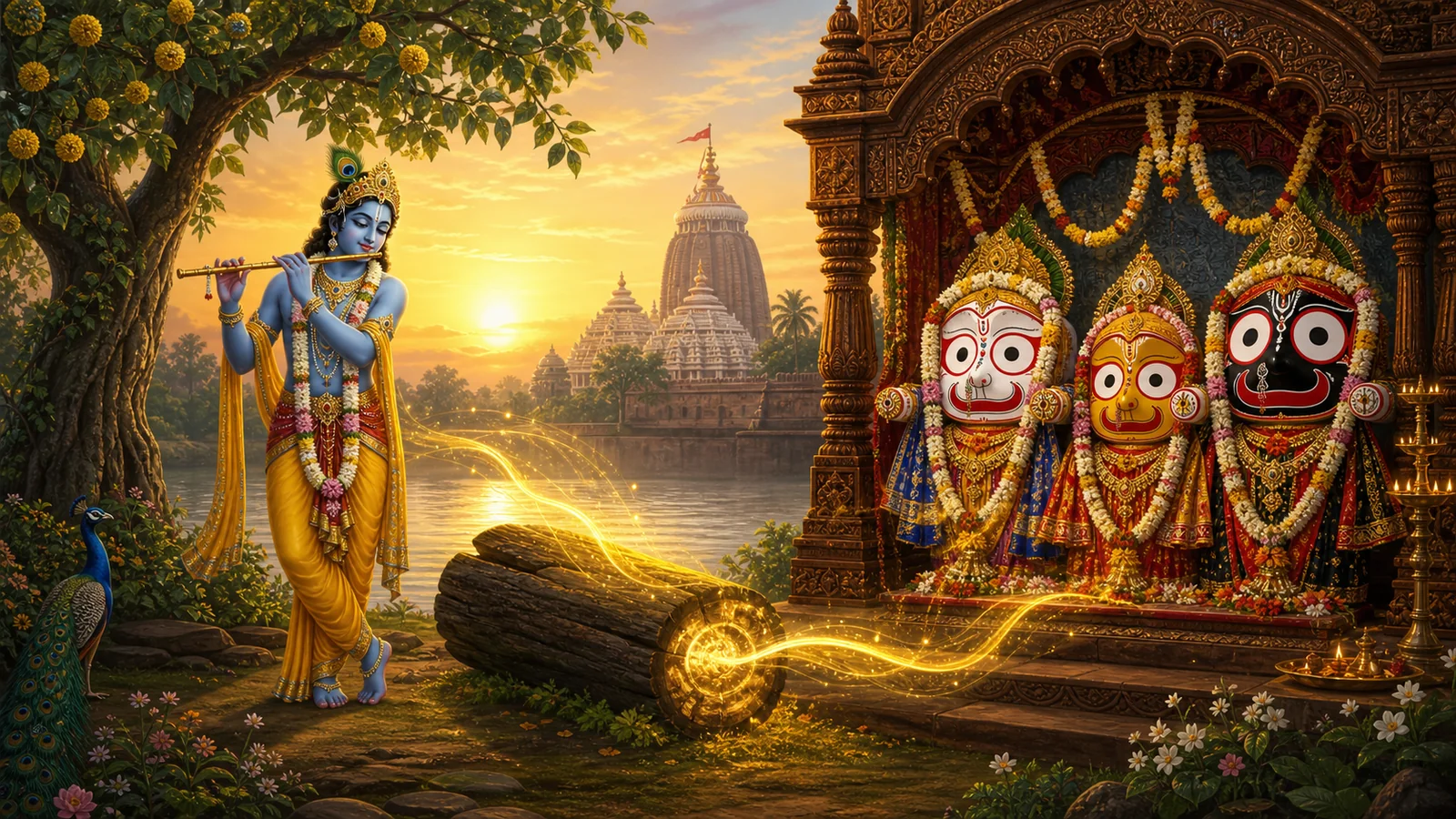
Every year, Lord Jagannath, his elder brother Lord Balabhadra and their sister Devi Subhadra leave the great temple at Puri and travel to the Gundicha Temple on their towering chariots. That outward procession is the celebrated Rath Yatra. Yet the festival is not complete until the divine siblings come back. Their homeward journey is Bahuda Yatra — the sacred return.
If Rath Yatra is the joy of the Divine coming out to meet everyone, Bahuda Yatra is the tenderness of the Divine returning home. After days as an honoured guest, the Lord travels the same Bada Danda, Puri's Grand Road, in the opposite direction, back to the sanctum where he is worshipped through the rest of the year.
This article follows that return in full — the meaning of Bahuda, the beloved halt at the Mausi Maa Temple, the offering of poda pitha, the reunion known as Lakshmi Narayana Bheta, the golden splendour of Suna Besha, the Adhara Pana offering, and finally Niladri Bije, when the festival truly concludes. For the outward journey, the three chariots and the earlier rituals, see our companion guide to the Jagannath Rath Yatra.
What Does Bahuda Yatra Mean?
The word Bahuda means return. Bahuda Yatra is therefore the return car festival — the journey of the deities from the Gundicha Temple back to the Shree Jagannath Temple. In temple tradition it is also known as the Dakshinabhimukhi Yatra.
Bahuda Yatra takes place on Ashadha Shukla Dashami, the tenth day of the bright fortnight of the month of Ashadha. Because Rath Yatra begins on Ashadha Shukla Dwitiya, the return falls eight days later, after the deities have spent about a week at the Gundicha Temple, remembered as the Lord's garden retreat.
It is important not to confuse the return itself with the rituals that follow it. Bahuda Yatra is the journey home. The festival reaches its true close only a few days later with Niladri Bije, once the deities have re-entered the sanctum. Between the two come Suna Besha and Adhara Pana — each explained below.
Bahuda Yatra 2026 Dates
- Bahuda Yatra: Friday, 24 July 2026
- Suna Besha: Saturday, 25 July 2026
- Adhara Pana: Sunday, 26 July 2026
- Niladri Bije: Monday, 27 July 2026
These rituals fall on four successive days of the bright fortnight of Ashadha — Dashami, Ekadashi, Dwadashi and Trayodashi. Because the festival follows the lunar calendar, the dates change every year, and ritual timings and crowd arrangements can also change. Pilgrims should always confirm with the Shree Jagannath Temple Administration and current Odisha government advisories before travelling.
Rath Yatra and Bahuda Yatra: Two Halves of One Journey
The chariot festival is best understood as a single arc with two movements:
- Rath Yatra (the outward journey) — On Ashadha Shukla Dwitiya, the deities leave the Shree Jagannath Temple and are pulled along the Bada Danda to the Gundicha Temple, roughly three kilometres away.
- The sojourn at Gundicha — The divine family stays at the Gundicha Temple for about a week. During this time comes Hera Panchami, when Goddess Lakshmi visits in search of the Lord.
- Bahuda Yatra (the return journey) — On Ashadha Shukla Dashami, the same three chariots are turned around and drawn back toward the main temple.
Seen this way, Rath Yatra and Bahuda Yatra are not two festivals but one continuous act of devotion — a going out and a coming back. The full sequence of the outward journey, the Pahandi procession, Chhera Pahanra and the sacred wooden forms of the deities is described in our main Jagannath Rath Yatra guide.
The Three Chariots Turn Homeward
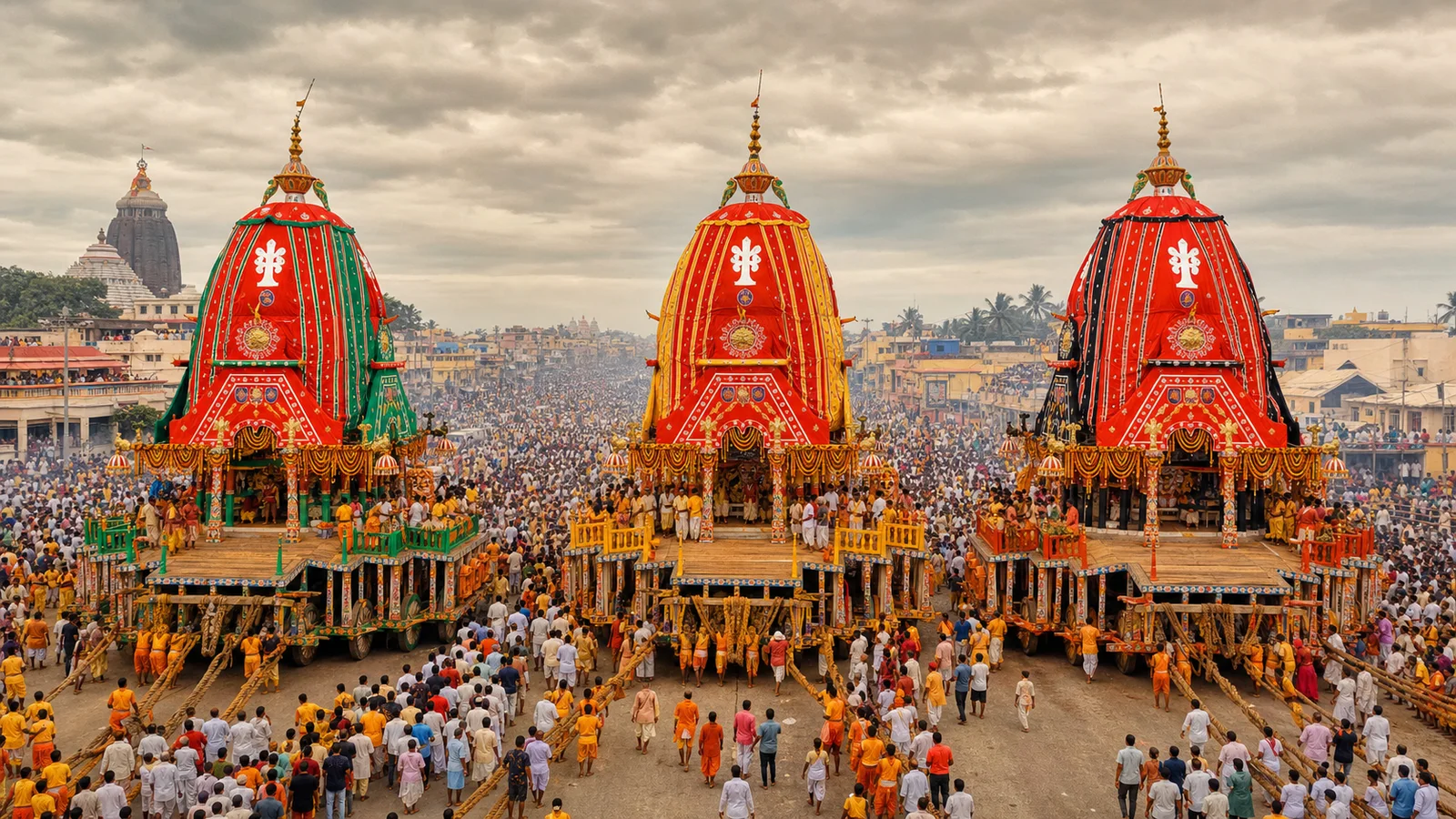
Bahuda Yatra uses the very same three chariots that carried the deities to Gundicha:
- Nandighosha carries Lord Jagannath.
- Taladhwaja carries Lord Balabhadra.
- Darpadalana, also called Devadalana, carries Devi Subhadra.
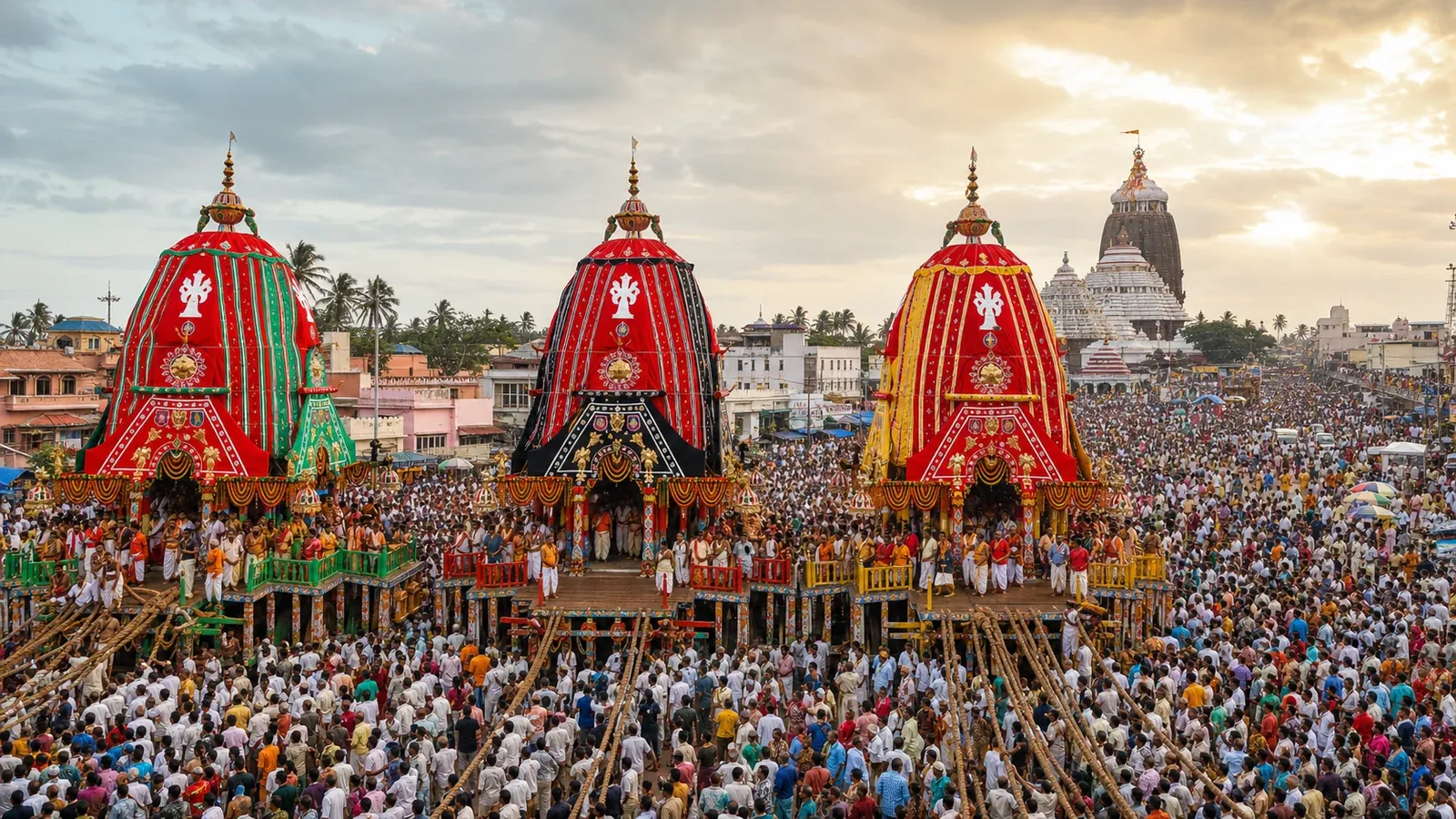
These great wooden chariots are built anew each year by hereditary craftspeople, their construction beginning ceremonially on Akshaya Tritiya. On the return, they are pulled back along the Grand Road toward the Singhadwara, the Lion's Gate of the Shree Jagannath Temple. As on the outward day, no engine or animal moves them — thousands of devotees draw the ropes together, and the immense vehicles advance through shared human effort alone.
The Halt at the Mausi Maa Temple
The most beloved episode of Bahuda Yatra is the pause at the Mausi Maa Temple, a small shrine on the Bada Danda dedicated to the goddess Ardhasini. Mausi means maternal aunt, and in the devotional imagination of Puri this is the home of the Lord's aunt, where the returning deities stop to be received with a family's love.
Here Lord Jagannath's chariot halts and he is offered poda pitha — a humble, slow-baked cake of rice, lentils, jaggery and coconut. Unlike the elaborate temple offerings, poda pitha is simple, rustic food, and tradition cherishes it as the Lord's favourite. That the Lord of the Universe should delight in such a plain cake at his aunt's doorstep is precisely the point: divine love is expressed not through grandeur but through warmth, familiarity and belonging.
Lakshmi Narayana Bheta: The Reunion of the Divine Couple
As the return draws to a close, the chariots of Balabhadra and Subhadra reach the front of the Singhadwara, while Lord Jagannath's Nandighosha halts nearby at Shreenahara. According to the Temple Administration's account of the return, Goddess Lakshmi is then carried in a palanquin to meet the Lord, and the ritual of Lakshmi Narayana Bheta — the meeting of the Goddess with Narayana, the Lord — is observed.
After days of separation while Jagannath was away at Gundicha, this reunion carries a deeply human tenderness: the joy of a household made whole again. It is worth distinguishing this meeting from two related moments — Hera Panchami, Lakshmi's earlier visit to Gundicha during the sojourn, and the playful reconciliation at the temple gate during Niladri Bije, described below. Each belongs to a different point in the sacred sequence.
Suna Besha: The Golden Attire
The day after Bahuda Yatra, on Ashadha Shukla Ekadashi, the deities appear in their most magnificent adornment — Suna Besha, the Golden Attire (also spelt Sona Besha). Still seated upon their chariots near the Lion's Gate, Jagannath, Balabhadra and Subhadra are decorated with gold ornaments: crowns, hands, feet and jewellery of gold, so that the divine forms shine before the gathered devotees.
Suna Besha is among the most anticipated darshans of the entire year. For countless pilgrims, the sight of the deities in gold upon their chariots is the emotional summit of the festival — a vision of the Lord in royal splendour, offered freely on the open road.
Adhara Pana: An Offering at the Lips
On Ashadha Shukla Dwadashi, the deities are honoured with Adhara Pana. The word adhara means the lips, and pana is a drink. Enormous cylindrical earthen pots are filled with a sweet, fragrant beverage — a mixture that traditionally includes milk, chhena (fresh cheese), sugar and spices — and raised on the chariots to the very lips of the deities as an offering.
By tradition, once the offering is complete the great pots are broken upon the chariots. Devotees understand this as an act of boundless compassion: the sacred drink is shared not only with the deities but is believed to reach every being present, so that no one is left out of the Lord's grace before he withdraws into the temple.
Niladri Bije: The Homecoming and the Conclusion
The festival reaches its close with Niladri Bije on Ashadha Shukla Trayodashi, when the deities finally re-enter the temple and return to the Ratna Singhasana, the bejewelled throne of the sanctum.
Puri tradition preserves a beautiful and much-loved episode here. Lord Balabhadra and Devi Subhadra enter without difficulty, but Lord Jagannath is met at the inner gate by Goddess Lakshmi, who is displeased at having been left behind during the long journey. She playfully bars his entry. To reconcile with her, the Lord offers her rasagola, the celebrated sweet — and this is remembered as the one occasion in the year when rasagola is offered to the deities. Only after this sweet reconciliation does Jagannath step back into his sanctum, and the great chariot festival comes to its gentle end.
The Spiritual Meaning of the Return
Bahuda Yatra completes a spiritual movement that Rath Yatra only begins. Read together, the two journeys trace a rhythm every seeker will recognise — departure, hospitality, return and reunion.
- Departure. In Rath Yatra the Lord goes out into the world, leaving the security of the sanctum to be among all people.
- Hospitality. At Gundicha and at the Mausi Maa Temple he is received with love, and delights in the simplest of offerings.
- Return. In Bahuda Yatra he turns homeward, reminding us that every outward journey seeks its way back to the source.
- Reunion. In the Lakshmi Narayana Bheta and at Niladri Bije, separation dissolves into reunion, and the sweetness of reconciliation restores the divine household.
The soul, too, ventures out into the world and longs, at last, to return home. Bahuda Yatra tells the devotee that the return is not an ending but a homecoming — and that love, patient and forgiving, always makes a place at the door.
Rath Yatra, Bahuda Yatra and the Concluding Rituals
Because the names are often used loosely, it helps to hold the distinctions clearly:
- Rath Yatra — the outward chariot journey to the Gundicha Temple (Ashadha Shukla Dwitiya).
- Bahuda Yatra — the return chariot journey to the main temple (Ashadha Shukla Dashami). It is sometimes called Bahuda Rath Yatra.
- The concluding rituals — Suna Besha (Ekadashi), Adhara Pana (Dwadashi) and Niladri Bije (Trayodashi), which take place at the chariots and the temple after the return and bring the festival to its close.
Bahuda Yatra is the return; Niladri Bije is the conclusion. The days in between are the festival's radiant farewell.
Attending Bahuda Yatra in Puri
The return draws immense crowds, and Suna Besha the following evening draws even larger ones. Anyone planning to attend should treat preparation and safety as part of responsible pilgrimage.
- Follow current advisories from the Shree Jagannath Temple Administration and Odisha authorities.
- Confirm the day's ritual timings in advance — Suna Besha, in particular, is an evening darshan and its schedule can shift.
- Use designated routes, public transport and official facilities, and never obstruct the chariot path, ropes or emergency lanes.
- Carry water and essential medication, but travel light.
- Keep children, older relatives and vulnerable companions away from dense crowd pressure, and agree on a meeting point in case your group is separated.
- Rely on official sources rather than old schedules or unverified social-media claims.
Darshan is an act of devotion; caring for one's fellow pilgrims is also dharma.
A Journey That Ends in Reunion
Rath Yatra shows us a Lord who comes out to meet the world. Bahuda Yatra shows us a Lord who comes home. In the halt at his aunt's shrine, in the simple cake he loves, in the golden splendour of Suna Besha, and in the sweetness offered to a waiting Lakshmi, the return journey speaks quietly of belonging.
The chariots that carried the Divine out along the Grand Road carry him back again — and in that turning homeward, Bahuda Yatra reminds every devotee that the path of love always leads, at last, to reunion.
Sources and Further Reading
Frequently Asked Questions
What is Bahuda Yatra?
Bahuda Yatra is the return journey of Lord Jagannath, Lord Balabhadra and Devi Subhadra from the Gundicha Temple back to the main Jagannath Temple in Puri. The word 'Bahuda' means return, and it is the homeward half of the annual Rath Yatra.
What is the difference between Rath Yatra and Bahuda Yatra?
Rath Yatra is the outward journey, when the deities travel from the Jagannath Temple to the Gundicha Temple on Ashadha Shukla Dwitiya. Bahuda Yatra is the return journey, when they come back on Ashadha Shukla Dashami. The concluding rituals — Suna Besha, Adhara Pana and Niladri Bije — follow over the next days at the temple.
Why does Lord Jagannath's chariot stop at the Mausi Maa Temple?
On the return journey, Lord Jagannath's chariot halts at the Mausi Maa (Ardhasini) Temple on the Grand Road. Mausi means maternal aunt, and here the Lord is offered poda pitha, a humble baked cake said to be his favourite, as an expression of a family's affection.
What is Suna Besha?
Suna Besha, also called the Golden Attire, takes place the day after Bahuda Yatra. The deities are adorned with gold ornaments while still seated on their chariots near the Lion's Gate, and it is one of the most sought-after darshans of the year.
What is Niladri Bije?
Niladri Bije is the final ritual of the festival, when Jagannath, Balabhadra and Subhadra re-enter the temple sanctum. Tradition holds that Goddess Lakshmi playfully bars the Lord's entry until he offers her rasagola, and only then does he return to the bejewelled throne.
When is Bahuda Yatra in 2026?
In 2026, Bahuda Yatra falls on Friday, 24 July. Suna Besha follows on 25 July, Adhara Pana on 26 July and Niladri Bije on 27 July. As the festival follows the lunar calendar, these dates change each year, so pilgrims should check current temple and Odisha government advisories.