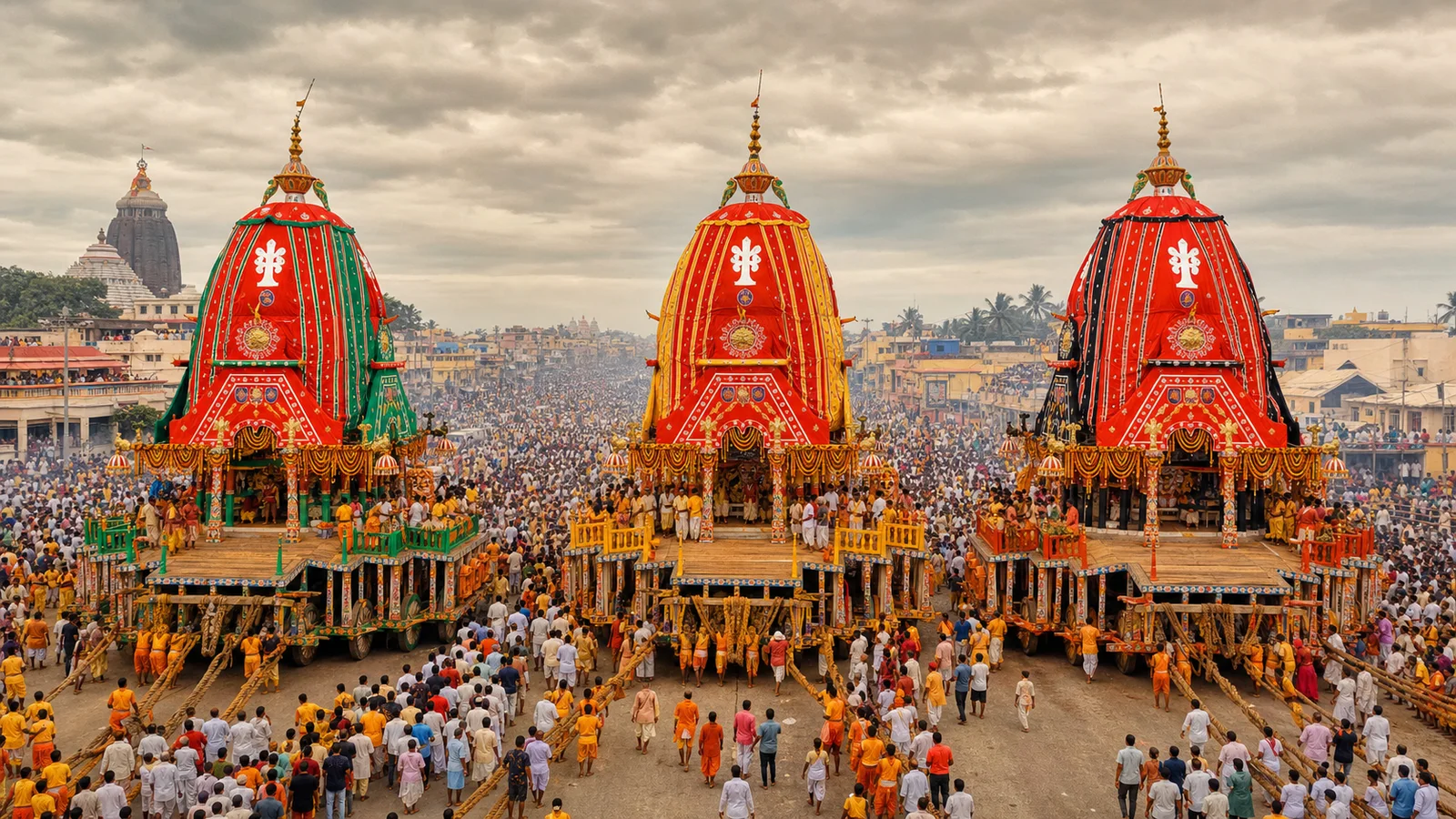
When the Lord of the Universe Comes Out to Meet Everyone
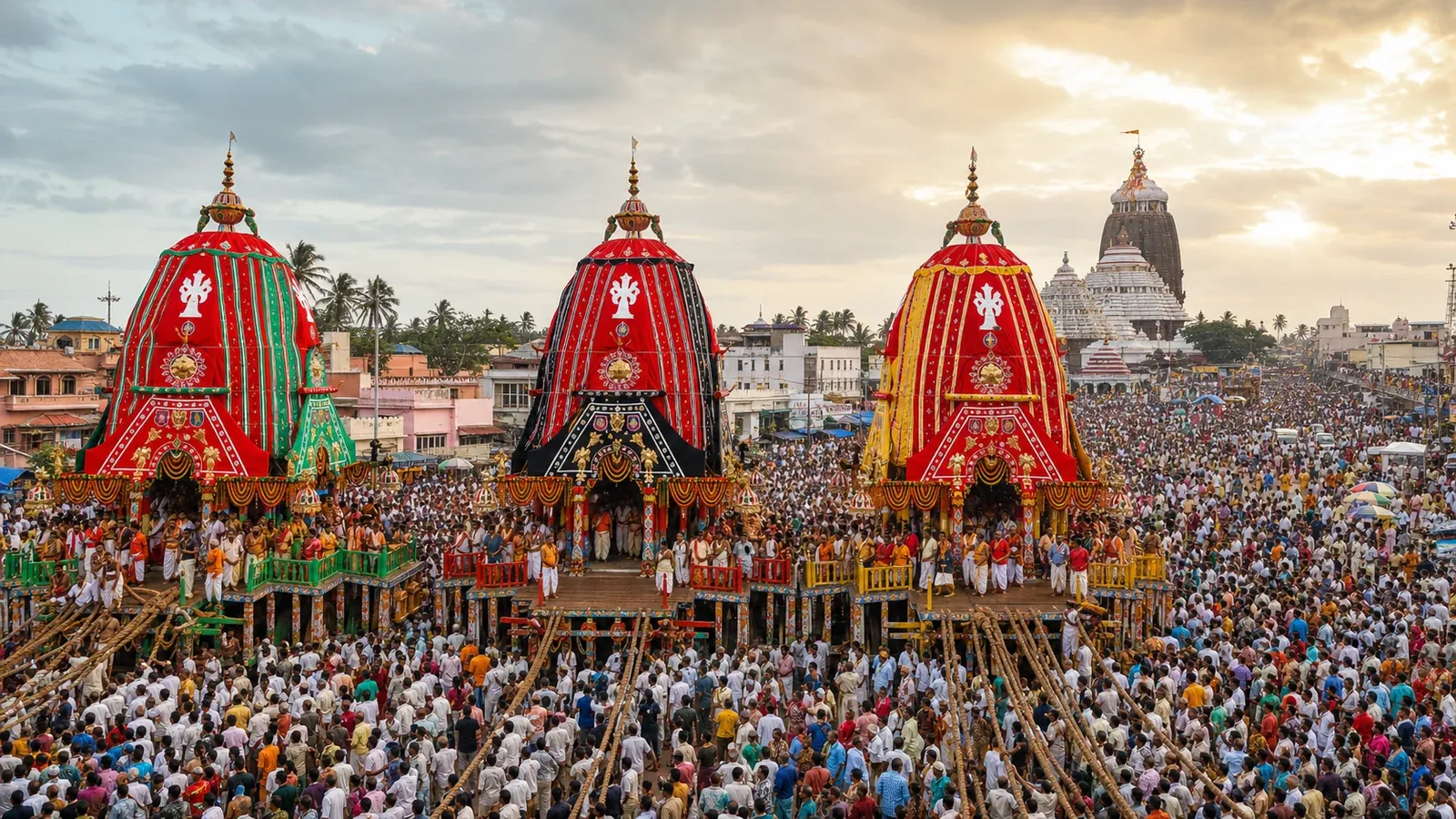
Most days of the year, Lord Jagannath is worshipped within the sanctum of the great temple at Puri. During Rath Yatra, however, the Lord of the Universe comes out onto the public road with his elder brother, Lord Balabhadra, and younger sister, Devi Subhadra. Seated on three towering wooden chariots, the divine siblings travel along the Bada Danda, Puri's Grand Road, to the Gundicha Temple.
This movement from temple sanctum to open street is what gives Rath Yatra its extraordinary spiritual character. The Divine does not remain distant or available only to a few. Jagannath comes among the people, offering darshan without distinctions of wealth, status, caste, region or nationality.
The festival is celebrated in many parts of India and across the world, but its sacred heart remains Shree Kshetra Puri in Odisha.
Jagannath Rath Yatra 2026 Dates
- Rath Yatra: Thursday, 16 July 2026
- Bahuda Yatra: Friday, 24 July 2026
Rath Yatra follows the lunar calendar and begins on Ashadha Shukla Dwitiya, the second day of the bright fortnight of the month of Ashadha. The date therefore changes each year. Ritual timings, traffic arrangements and public access can also change, so pilgrims should consult the Shree Jagannath Temple Administration and Odisha government advisories before travelling.
What Is Jagannath Rath Yatra?
Rath Yatra is the annual ceremonial journey of the deities from the Shree Jagannath Temple to the Gundicha Temple, situated roughly three kilometres away. The journey is sometimes understood as a visit to the Lord's garden house or to the place associated with his appearance.
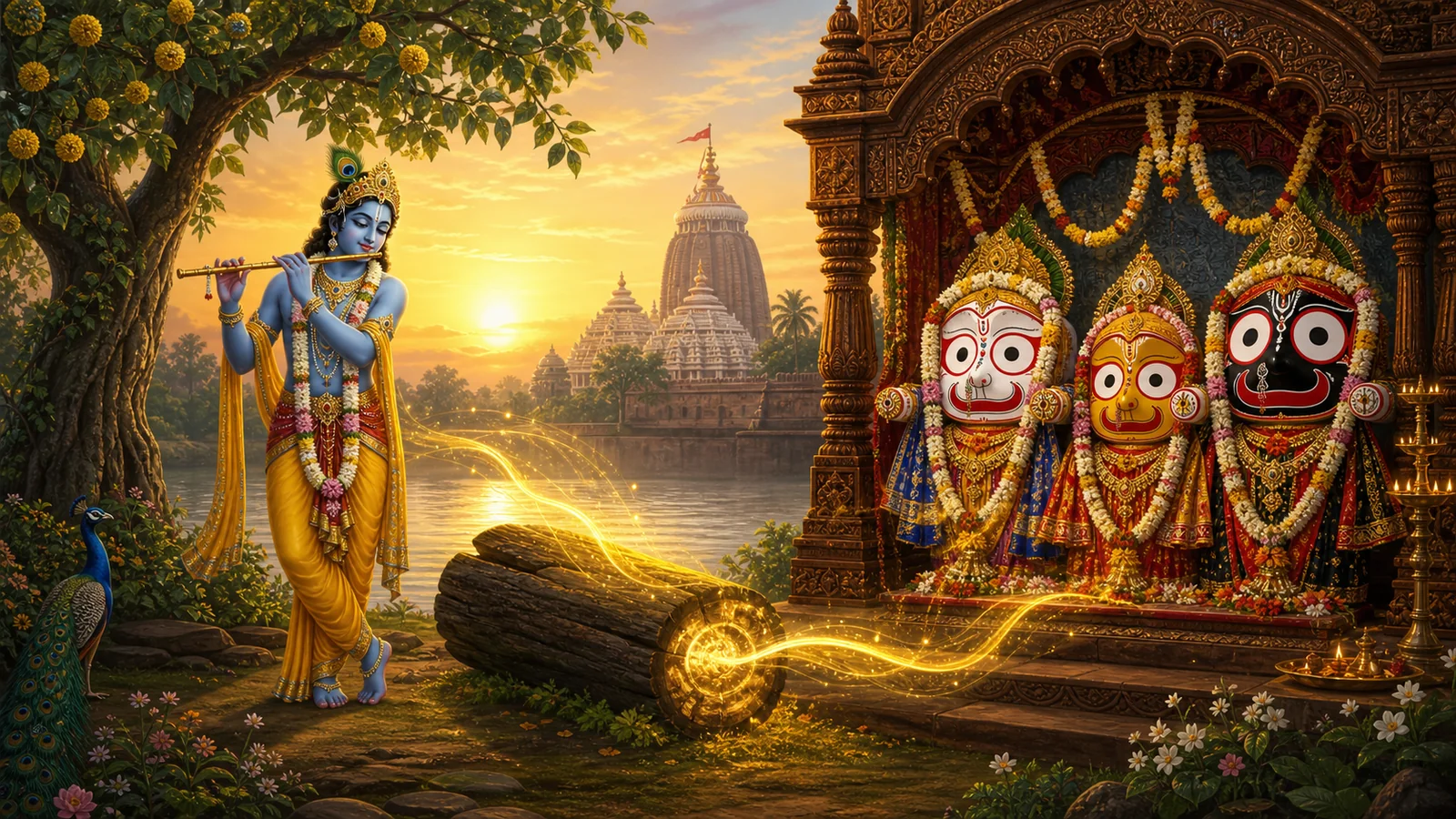
Lord Jagannath is worshipped with Balabhadra and Subhadra as a divine family. Their forms are unlike the classical stone or metal murtis seen in many temples: they are made of sacred wood, with large compassionate eyes and a distinctive unfinished appearance. Devotees see in these forms a profound message—that the Divine cannot be limited by conventional ideas of beauty, form or social boundary. To understand how these sacred wooden forms came to be—and how Shri Krishna is revealed here as Lord Jagannath—see From Krishna to Jagannath: The Sacred Journey to the Lord of Puri.
The English expression “chariot festival” describes the outward event, but Rath Yatra is fundamentally a festival of darshan, movement and divine accessibility.
The Spiritual Meaning of Rath Yatra
The Divine Comes to the Devotee
Pilgrimage usually means that a devotee travels toward a sacred place. Rath Yatra reverses that movement: the deities leave the temple and come into the world of the devotee. The procession expresses divine compassion—the Lord taking the first step toward those who seek him.
Equality Before Jagannath
The name Jagannath means “Lord of the Universe.” During the Yatra, his darshan is available on the open Grand Road. The festival has therefore become an enduring symbol of spiritual equality and universal belonging.
This principle is dramatically expressed in Chhera Pahanra, when the Gajapati Maharaja of Puri sweeps the platforms of the chariots with a golden-handled broom. A king performs an act of service before Jagannath, reminding everyone that worldly rank disappears in the presence of the Divine.
The Body as a Chariot
The chariot is also a powerful image in Hindu philosophy. The Katha Upanishad compares the body to a chariot, the senses to horses, the mind to reins and the discerning intellect to the charioteer. Read in this light, Rath Yatra invites a personal question: Who guides the chariot of our life—restless impulses or awakened wisdom?
Pulling the ropes can thus be understood not only as a public act of devotion, but also as an inward resolve to draw one's life toward dharma.
The Three Sacred Chariots
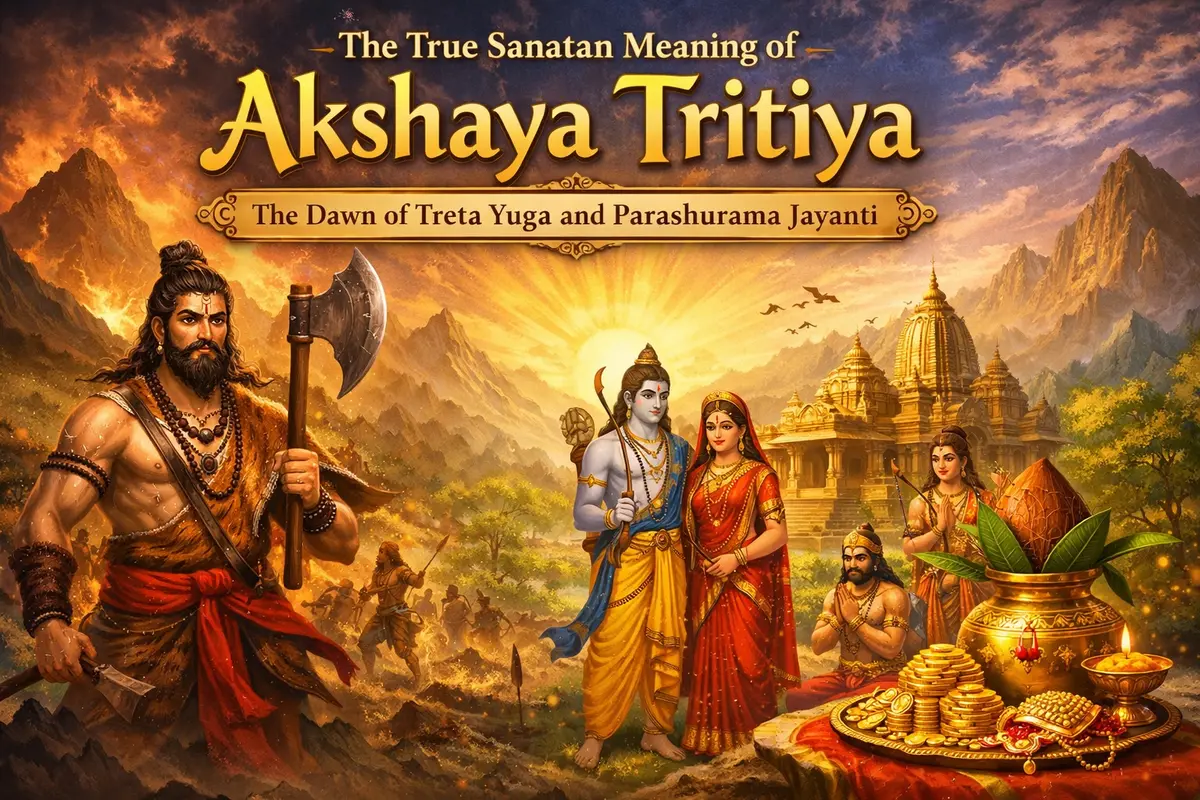
The chariots are not permanent vehicles. They are constructed anew every year by hereditary craftspeople according to traditional measurements and ritual disciplines. Their construction begins ceremonially on Akshaya Tritiya, linking the festival to a day associated with auspicious beginnings and inexhaustible merit.
Nandighosha — Lord Jagannath's Chariot
Nandighosha is the chariot of Lord Jagannath. It is traditionally distinguished by red and yellow coverings and has sixteen wheels. Garuda is associated with its emblem, reflecting Jagannath's identification with Vishnu and Krishna.
Taladhwaja — Lord Balabhadra's Chariot
Taladhwaja carries Lord Balabhadra. It is traditionally dressed in red and green and has fourteen wheels. Its name refers to the palm-tree emblem connected with Balabhadra.
Darpadalana — Devi Subhadra's Chariot
Darpadalana, also known as Devadalana, carries Devi Subhadra. Its coverings are traditionally red and black, and it has twelve wheels. The name Darpadalana may be understood as “the crusher of pride,” a fitting reminder of humility on the spiritual path.
Although the three chariots share a majestic form, each has its own colours, guardian deities, horses, flag and charioteer. Their annual reconstruction sustains a living heritage of ritual carpentry, painting, textile work and collective service.
The Sacred Sequence of Rath Yatra
Rath Yatra is not a single-day event in isolation. It belongs to an extended ritual cycle that begins weeks earlier and concludes only when the deities return to the main temple.
Snana Purnima and Anavasara
On Snana Purnima, the deities receive a ceremonial public bath. Tradition holds that after this elaborate bathing they become unwell and withdraw from public darshan during a period called Anavasara. Devotees experience this absence as a period of longing.
Before Rath Yatra, the renewed forms of the deities are revealed again in connection with Nava Yauvana Darshan and Netrotsava, celebrating their fresh, youthful appearance.
Pahandi Bije
On the morning of Rath Yatra, the deities are brought from the temple to their chariots in the ceremonial movement called Pahandi. They advance in a distinctive swaying rhythm amid drums, cymbals, chants and the cry of “Jai Jagannath.”
Balabhadra comes first, followed by Subhadra and then Jagannath. The movement is both majestic and intimate: the deities who ordinarily preside within the sanctum are carried through a sea of devotees.
Chhera Pahanra
Once the deities are seated, the Gajapati Maharaja performs Chhera Pahanra, sweeping and cleansing the chariot platforms and offering scented water. The rite teaches that sovereignty itself becomes seva before Jagannath.
The Journey to Gundicha Temple
After the ropes are fastened, devotees pull the chariots along the Bada Danda toward the Gundicha Temple. The immense vehicles move through collective effort rather than through engines or animals. Thousands of hands become part of one act of devotion.
The deities remain at Gundicha Temple during their annual sojourn. For pilgrims, this period offers another opportunity for darshan away from the main temple.
Hera Panchami
Hera Panchami introduces a tender and playful episode into the festival cycle. Goddess Lakshmi, who remains at the main temple, ceremonially visits Gundicha in search of Jagannath. The ritual is interpreted through the intimate devotional moods of separation, affection and divine household life.
Bahuda Yatra — The Return Journey
The return procession is known as Bahuda Yatra. The three chariots travel back toward the Shree Jagannath Temple, traditionally pausing near the Mausi Maa Temple, where the deities are offered poda pitha, a beloved baked preparation of Odisha.
For 2026, Bahuda Yatra falls on 24 July. It is not merely the closing of the outward procession; it begins the final sequence through which the deities return to their temple home. For a full account of the return — the Mausi Maa halt, Lakshmi Narayana Bheta, Suna Besha, Adhara Pana and Niladri Bije — see our dedicated guide to Bahuda Yatra, Lord Jagannath's sacred return journey.
Suna Besha and Niladri Bije
After Bahuda, the deities appear upon their chariots in the magnificent Suna Besha, adorned with golden ornaments. The festival cycle ultimately concludes with Niladri Bije, when Jagannath, Balabhadra and Subhadra re-enter the main temple.
A cherished tradition associates Jagannath's return with an offering of rasagola to Goddess Lakshmi, expressing reconciliation through sweetness after the Lord's long absence.
Why Pulling the Chariot Rope Is Considered Sacred
Devotees regard the opportunity to touch or pull the chariot ropes as a blessing. The act is not a magical transaction; its deeper meaning lies in seva and surrender. No single person can move such a chariot. Progress becomes possible only when many people act together with a shared direction.
The rope therefore becomes a symbol of collective devotion. Each person contributes a small effort, yet the divine journey advances through the unity of all.
Rath Yatra Beyond Puri
Rath Yatra processions are now held across India and in cities throughout the world. Local celebrations vary in scale, but they preserve the central act: bringing the Divine into public space through kirtan, community service, prasada and collective participation.
These celebrations should not be seen as replacements for Puri. Rather, they demonstrate the universal reach of Jagannath—whose very name refuses confinement to one community or geography.
Visiting Puri During Rath Yatra
Puri receives exceptionally large crowds during the festival. Anyone planning to attend should treat safety and preparation as part of responsible pilgrimage.
- Follow current advisories issued by Odisha authorities and temple administration.
- Use designated routes, public transport and official facilities.
- Carry water and essential medication, but travel light.
- Keep children, older relatives and vulnerable companions away from dense crowd pressure.
- Agree on a meeting point in case members of the group become separated.
- Do not obstruct ropes, chariot paths, emergency lanes or service personnel.
- Avoid relying on old schedules, unofficial passes or viral social-media claims.
Darshan is an act of devotion; protecting one's fellow pilgrims is also dharma.
A Festival of Divine Nearness
Jagannath Rath Yatra is magnificent because of its vast chariots and immense gathering, but its deepest truth is simple: the Lord comes near.
He comes out of the sanctum and enters the shared road. A king takes up a broom. Countless hands hold one rope. The Divine, the ruler and the ordinary pilgrim meet within a single field of seva.
In that movement toward Gundicha and back again, Rath Yatra teaches that spiritual life is not withdrawal from the world alone. It is also the discovery of sacred presence moving through the world—openly, compassionately and for everyone.
Sources and Further Reading
Frequently Asked Questions
When was Jagannath Rath Yatra in 2026?
Jagannath Rath Yatra was observed on Thursday, 16 July 2026. The return journey, Bahuda Yatra, is observed on Friday, 24 July 2026.
Why is Rath Yatra celebrated?
Rath Yatra celebrates the annual journey of Lord Jagannath, Lord Balabhadra and Devi Subhadra from the Jagannath Temple to the Gundicha Temple. Spiritually, it represents the Divine coming out to meet everyone without distinction.
What are the names of the three chariots?
Lord Jagannath travels on Nandighosha, Lord Balabhadra on Taladhwaja, and Devi Subhadra on Darpadalana, also called Devadalana. Each chariot has its own colours, emblems and traditional design.
What is Bahuda Yatra?
Bahuda Yatra is the return journey of the three deities from the Gundicha Temple to the main Jagannath Temple after their annual stay.
Can everyone attend the Puri Rath Yatra?
The procession takes place on Puri's public Grand Road and is known for offering darshan of the deities to people from every community. Visitors should follow current official crowd, route and safety advisories.