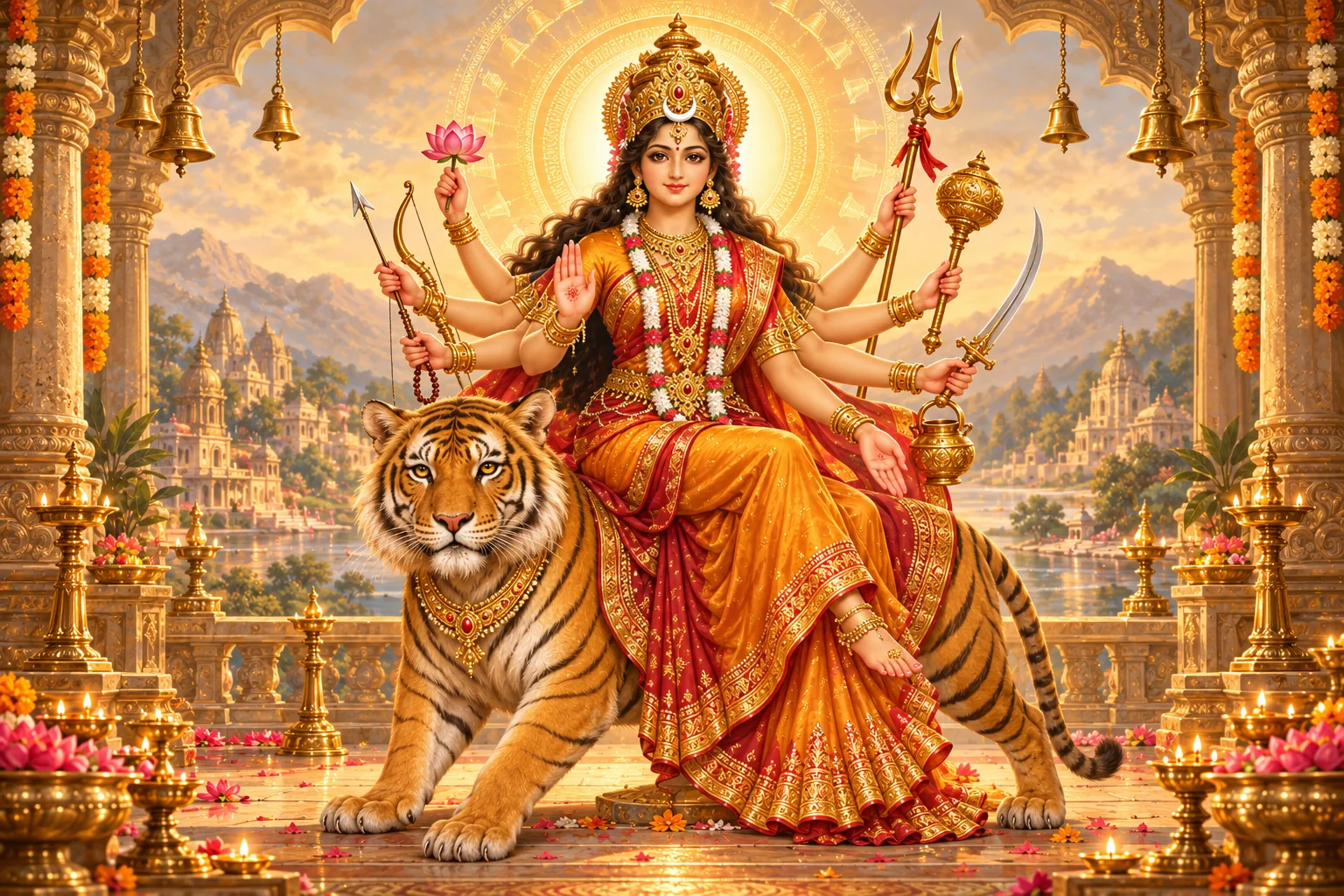
The Bride Who Bears Ten Weapons
On the third day of Navratri the story turns a page. The tapasvini's austerity has borne fruit; the wedding has taken place; and the Devi appears in her new form — Maa Chandraghanta, the married Parvati, a crescent moon shaped like a bell gleaming on her forehead. In 2026 her worship falls on Tritiya — Tuesday, October 13, a day several regions also observe as Sindoor Tritiya, when married women offer sindoor to the Devi.
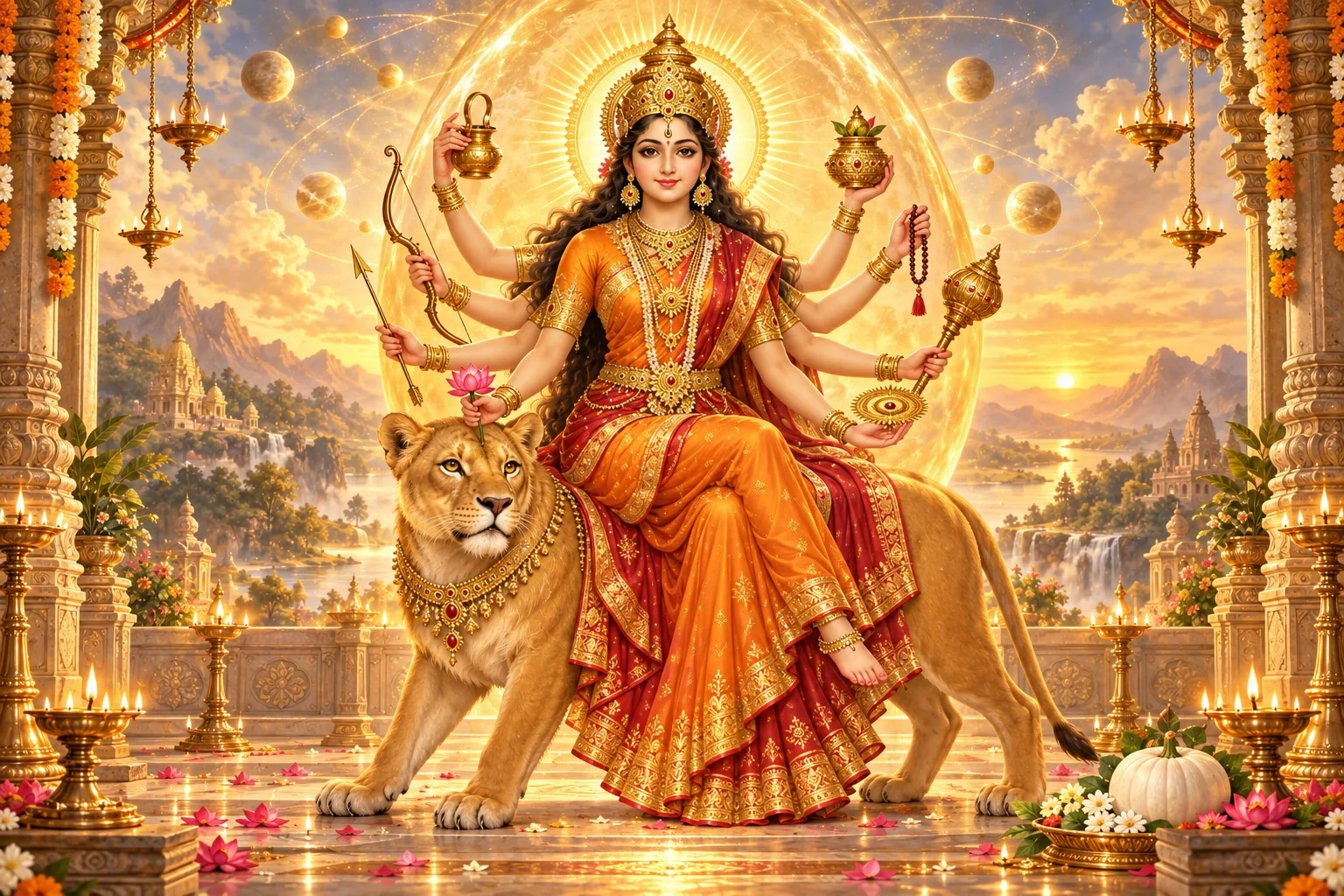
But look at her image closely and the tradition's subtlety reveals itself. This gentlest, most auspicious bridal form carries ten arms full of weapons and rides a tigress. The honeymoon icon is a war icon. That paradox — profound, deliberate — is the whole teaching of the third day.
Maa Chandraghanta at a Glance
| Traditional order | 3rd of the Navdurga |
| Tithi | Tritiya (third lunar day) |
| 2026 worship date | Tuesday, October 13, 2026 (New Delhi, Drik Panchang convention); also Sindoor Tritiya |
| Vahana | Tigress |
| Iconography | Ten arms — trishul, gada, sword, kamandal, lotus, arrow, bow and japa mala, with two hands in Varada and Abhaya mudras; crescent moon-bell on the forehead |
| Governing planet | Shukra (Venus) |
| Traditional bhog | Kheer and milk sweets |
| Flower | Jasmine (chameli) |
| Day colour (popular custom) | Red in 2026 — a weekday-based custom, not a scriptural rule |
The verified full calendar for 2026 — including the ten-civil-day quirk of this year — is on the series landing page.
The Name: She Whose Bell Is the Moon
Chandra is the moon; ghanta is the temple bell. After her wedding to Bhagwan Shiva, tradition says, the Devi adorned her forehead with the ardha-chandra, the half-moon — Shiva's own emblem, now shared, as married lives share everything. Drawn on her brow, the crescent takes the shape of a bell, and so she is Chandraghanta — "she whose bell is the moon."
The bell is no ornament. In Hindu worship the ghanta's sound opens every puja: it scatters inauspicious influences and announces the sacred. Tradition holds that the moon-bell on the Devi's brow does cosmically what the temple bell does locally — its sound alone drives hostile forces away from her devotees. She does not always need to lift a weapon; sometimes her presence, ringing, is enough.
Her Story: Gentleness Takes Up Arms
Unlike Shailputri and Brahmacharini, whose stories are anchored in the Shiva Purana's narrative chapters, Chandraghanta's account lives primarily in the living Navdurga tradition — the kathas told during Navratri itself. That is worth saying honestly: she is the tradition's meditation on the Devi's married state rather than the heroine of one fixed Puranic episode.
The meditation runs like this. With the wedding, Parvati does not retire into domestic softness. Marriage, in the dharmic imagination, is the entry into grihastha — the stage of life that protects all other stages. So the bride arms herself: ten hands, each carrying a power — not because her home is at war, but because a household's peace is something kept, with alertness and strength. In popular retellings she rides into battle against demons who disturb the three worlds, the moon-bell's thunder alone scattering whole armies — and returns home gentle, golden, smiling.
For devotees, she is the form that blesses courage without cruelty: the warrior whose default is grace, whose weapons exist so they need rarely be used.
Iconography: Ten Arms and One Bell
Maa Chandraghanta's golden form rides a tigress — alert power, distinct from the lion of later forms. Her ten arms carry, in the traditional description: trishul, gada (mace), sword and kamandal on one side; lotus, arrow, bow and japa mala on the other; with her remaining two hands in Abhaya mudra (fear-not) and Varada mudra (boon-giving). Weapons and rosary in the same figure; battle-readiness and blessing in the same gesture.
Tradition associates her with Shukra (Venus) — the planet of beauty, harmony and married happiness — a fitting patron for the bridal form whose whole lesson is that harmony must be defended to be kept.
How to Worship Maa Chandraghanta at Home
- Morning lamp and worship at the kalash, as on every day of the festival.
- Ring the ghanta — today of all days, let the bell open the puja; its sound is her signature.
- Offer jasmine or golden-white flowers, roli, akshat; married women in many regions offer sindoor today (Sindoor Tritiya) and apply it as the Devi's blessing.
- Offer bhog of kheer or milk sweets.
- Chant her mantra (below) — and if your family recites the Durga Saptashati across the nine nights, the early chapters fall naturally in these days.
- Evening aarti with the family, bell and conch sounding.
New to home worship? Our Practices & Rituals section walks through the elements used above.
Mantra, Prarthana and Meaning
Mantra
ॐ देवी चन्द्रघण्टायै नमः॥
Om Devi Chandraghantayai Namah — "Om, salutations to Devi Chandraghanta."
Prarthana (as given in the Navdurga tradition):
पिण्डज प्रवरारूढा चण्डकोपास्त्रकैर्युता। प्रसादं तनुते मह्यम् चन्द्रघण्टेति विश्रुता॥
Pindaja Pravararudha Chandakopastrakairyuta, Prasadam Tanute Mahyam Chandraghanteti Vishruta.
"Mounted on her noble vahana, armed against furious evil — may she who is renowned as Chandraghanta extend her grace to me."
Offerings, Flowers and the Day's Colour
- Bhog: kheer — rice simmered in milk and sugar — and other milk sweets; tradition associates the offering with relief from pain and a settled mind.
- Flowers: jasmine remains her flower; golden and white blossoms suit her complexion "radiant like gold."
- Colour: the popular calendar assigns red to October 13, 2026 — festive and bridal, but a weekday-based custom, not a scriptural requirement.
A Reflection for Tritiya
Chandraghanta asks a householder's question: is your gentleness strong? Kindness without strength collapses at the first test; strength without kindness becomes the very thing it fights. Her form holds the two together — mudra of blessing beside the sword — and her bell suggests the method: presence before force. Most conflicts in a home dissolve not when someone wins, but when someone rings clearly — names the truth calmly and lets its sound do the work.
On the vrat: the third day continues whatever discipline you began — no escalation is required. If fasting, keep hydration and health first; if not fasting, keep the day's real austerity: a gentle tongue in one difficult conversation.
Tomorrow the scale explodes — from one household to the whole cosmos — with Maa Kushmanda, the fourth form, she who created the universe with a smile. The full series lives at Navratri: Nine Forms of Maa Durga.
References
- Drik Panchang — Goddess Chandraghanta: iconography (ten arms, tigress), mantra, worship day.
- Drik Panchang — 2026 Shardiya Navratri Calendar (New Delhi): verified dates, including Sindoor Tritiya on October 13.
- Durga Saptashati with Devi Kavacham (Gita Press, Gorakhpur) — "tritiyam Chandraghanteti" in the Navdurga enumeration.
- Her katha as given here follows the living Navratri tradition; it is not tied to a single Puranic chapter, and we say so rather than invent one.
Frequently Asked Questions
When is Maa Chandraghanta worshipped in Navratri 2026?
Maa Chandraghanta is worshipped on Tritiya, the third tithi of Shardiya Navratri — Tuesday, October 13, 2026 (New Delhi, Drik Panchang convention). The day is also observed as Sindoor Tritiya in several regions. Tithi timings vary by city, so confirm with your local panchang.
What is Maa Chandraghanta's mantra?
Her simple mantra is 'Om Devi Chandraghantayai Namah' (ॐ देवी चन्द्रघण्टायै नमः). The traditional prarthana is 'Pindaja Pravararudha Chandakopastrakairyuta, Prasadam Tanute Mahyam Chandraghanteti Vishruta' — may the renowned Chandraghanta, mounted on her fierce vahana and armed against furious evil, extend her grace to me.
Why is she called Chandraghanta?
After her marriage to Bhagwan Shiva, the Devi began wearing a half-moon (chandra) on her forehead, shaped like a bell (ghanta) — hence Chandra-ghanta, 'she whose bell is the moon.' Tradition holds that the sound of this moon-bell drives away all hostile forces from her devotees.
What bhog is offered to Maa Chandraghanta?
Kheer and milk-based sweets are the traditional third-day offering, associated with relief from pain and a calm mind. Her flower is jasmine; many devotees also offer other white or golden flowers. Regional customs differ — offer with devotion and your family's practice first.
Is Maa Chandraghanta a peaceful or fierce form?
Both, deliberately. She is the married, golden-complexioned Parvati at her gentlest, yet depicted with ten arms carrying weapons, mounted on a tigress, ready for war. The tradition's point is that true peace is protected peace — gentleness with the strength to defend what it loves.