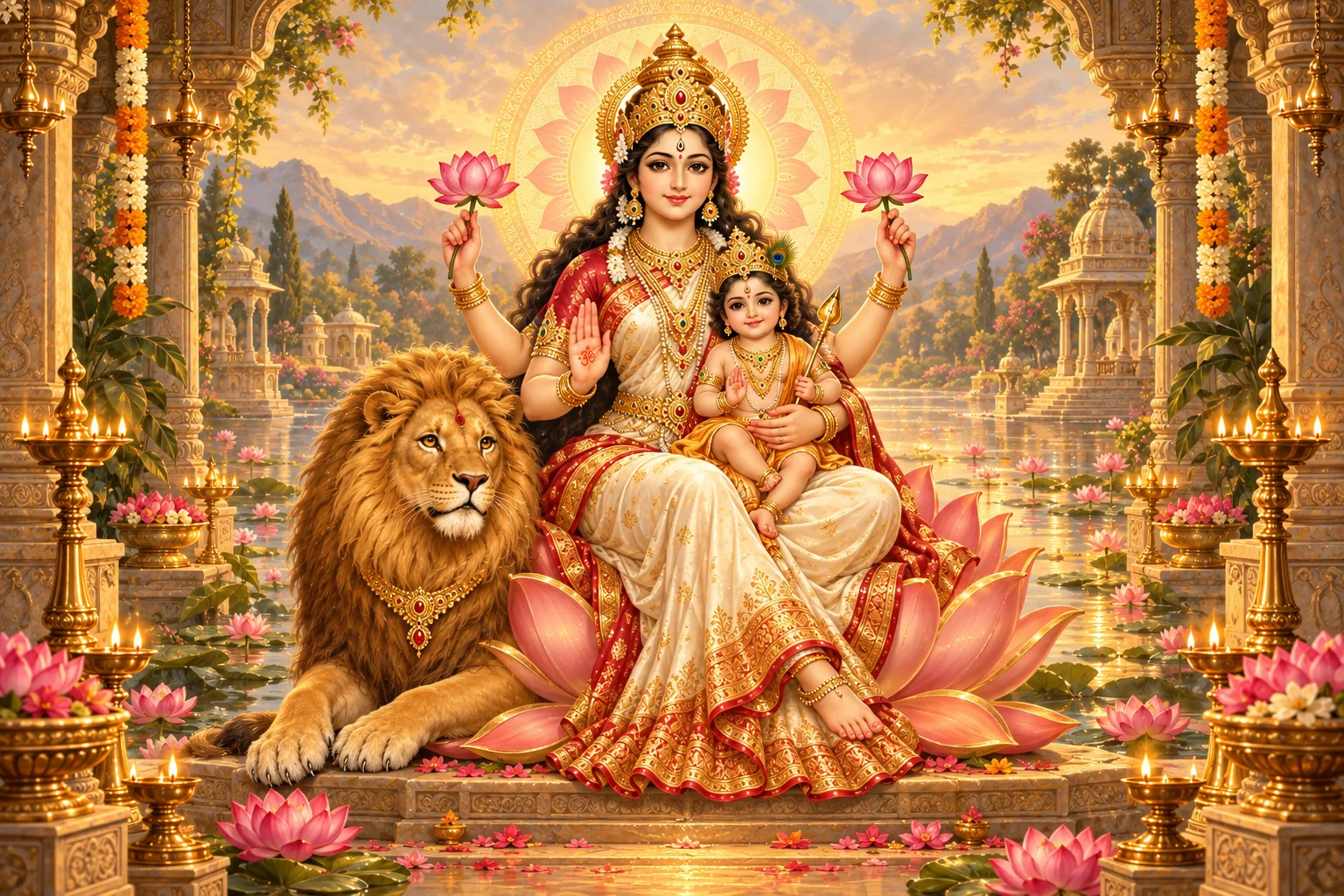
Born from the Anger of the Gods
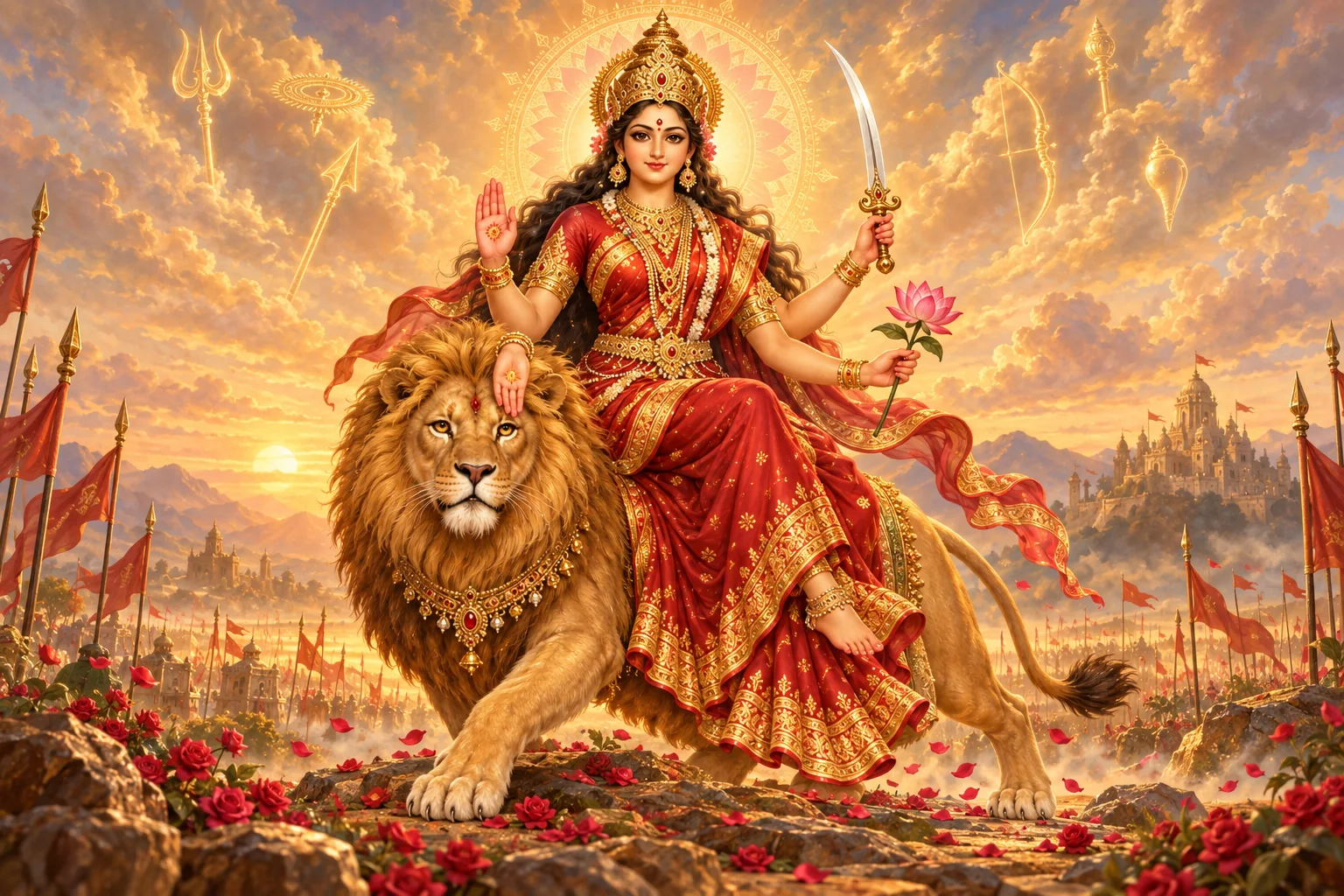
The sixth day of Navratri belongs to the form in which the Devi did her most famous deed. Maa Katyayani — worshipped in 2026 on Shashthi, Friday, October 16 — is the Devi as the devas' answer to the buffalo-demon Mahishasura: the warrior born of the gathered fire of every god, radiant, many-armed, riding a lion into the battle that Navratri itself commemorates.
Yet her name comes not from the battlefield but from a hermitage. Before she was the slayer of Mahishasura, she was — by her own grace — the daughter of a sage named Katyayana, who had prayed that the Mother of the universe might be born in his house. The tradition loves this detail, and it should: the Devi who could not be contained by the three worlds let herself be contained by a father's love.
Maa Katyayani at a Glance
| Traditional order | 6th of the Navdurga |
| Tithi | Shashthi (sixth lunar day) |
| 2026 worship date | Friday, October 16, 2026 (New Delhi, Drik Panchang convention); Saraswati Avahan in several traditions |
| Vahana | Lion |
| Iconography | Four arms — sword and lotus in the left hands; Abhaya and Varada mudras in the right |
| Governing planet | Brihaspati (Jupiter) |
| Traditional bhog | Honey |
| Flower | Red flowers, especially rose |
| Day colour (popular custom) | Green in 2026 — a weekday-based custom, not a scriptural rule |
The verified 2026 calendar is on the series landing page.
The Name: Daughter of the Sage
Katyayani means "she of the Katya line" — the daughter of sage Katyayana, of the lineage of Katya. The Vamana Purana and the Navdurga tradition tell that the sage performed long tapasya with one wish: that the Adi Shakti herself take birth as his daughter. When the devas, tormented by Mahishasura, poured out their collective tejas — the blazing essence described in the Devi Mahatmya — the Devi took form in Katyayana's ashram, and he was granted the first worship of her. His fatherhood named her forever.
There is a tenderness in this that the warrior iconography can hide: the fiercest form of the Devi carries, as her very name, the memory of being somebody's daughter.
Her Story: The Slaying of Mahishasura
This is the central narrative of the Devi Mahatmya (Durga Saptashati, chapters 2–3, in the Markandeya Purana), the scripture read in homes and pandals through Navratri.
Mahishasura, the shape-shifting buffalo demon, had won a boon that no man or god could kill him — women, he did not think to mention. He drove the devas from heaven. Beaten and homeless, the gods pooled their radiance: from Shiva's tejas and Vishnu's and Brahma's and every deva's, a single blazing feminine form took shape — each limb from a different god's light, each hand gifted a god's own weapon: Shiva's trident, Vishnu's chakra, Vayu's bow, Indra's thunderbolt, Himavan's lion to ride.
The battle the Saptashati describes is cosmic and vivid: Mahishasura charging as buffalo, as lion, as elephant, as man, the Devi laughing in the middle of war — the text's unforgettable detail — until at last she pins the buffalo under her foot and, as he half-emerges from its severed neck in his own form, ends him. The worlds exhale. The devas sing the hymns that Navratri still sings.
In 2026, the festival's own calendar completes this story: Vijayadashami on October 20 celebrates precisely this victory — alongside Shri Rama's victory over Ravana.
The gopis' vrat: the Bhagavata Purana (10.22) adds a gentler chapter — the young gopis of Vraja observed the Katyayani vrat for a month, bathing in the Yamuna at dawn and praying to the Devi for Shri Krishna as their husband. From this grew the living custom of unmarried girls worshipping Katyayani for a worthy spouse — one of the few Navratri customs with an explicit scriptural anchor. (Our Janmashtami article tells Krishna's story.)
Iconography: The Sword and the Open Hand
Maa Katyayani rides a magnificent lion and is shown with four arms: her left hands hold the sword (the Chandrahasa of her prarthana) and the lotus; her right hands are held in Abhaya (fear-not) and Varada (boon-giving) mudras. Weapon and flower, protection and generosity — the warrior who fights for something, not against everything.
Tradition assigns her governance of Brihaspati (Jupiter) — the guru among planets — fitting for the form born in a guru's ashram.
How to Worship Maa Katyayani at Home
- Morning worship at the kalash — lamp, incense, water.
- Offer red flowers — roses if you have them — roli, akshat.
- Offer honey as bhog, by itself or drizzled over fruit; many homes also make halwa.
- Read or listen to the Mahishasura-mardini katha — chapters 2–3 of the Durga Saptashati; this is the evening for it. The Aigiri Nandini stotra is a beloved companion.
- Unmarried daughters who wish to may keep the traditional Katyayani prayer for a good spouse — a wish, not an obligation; no young woman should be pressed into it.
- Chant her mantra (below) and close with the family aarti.
Worship basics live in our Practices & Rituals section.
Mantra, Prarthana and Meaning
Mantra
ॐ देवी कात्यायन्यै नमः॥
Om Devi Katyayanyai Namah — "Om, salutations to Devi Katyayani."
Prarthana (as given in the Navdurga tradition):
चन्द्रहासोज्ज्वलकरा शार्दूलवरवाहना। कात्यायनी शुभं दद्याद् देवी दानवघातिनी॥
Chandrahasojjvalakara Shardulavaravahana, Katyayani Shubham Dadyad Devi Danavaghatini.
"Her hand radiant with the Chandrahasa sword, riding the noblest of lions — may Devi Katyayani, slayer of the danavas, grant auspiciousness."
Offerings, Flowers and the Day's Colour
- Bhog: honey — the sixth day's traditional offering; the tradition's own gloss is learning to direct fierce energy sweetly.
- Flowers: red flowers, especially the rose, are dear to her.
- Colour: the popular calendar assigns green to October 16, 2026 — the usual weekday-based custom, joyful and optional.
A Reflection for Shashthi
Katyayani's story carries a precise teaching about anger. The devas' fury at injustice did not explode individually — it was pooled, shaped, and given a dharmic aim, and only then did it become the Devi's victory. Anger scattered is damage; anger offered is power. The sixth day asks: the thing that outrages you — can you give it a form that protects someone?
On the vrat: Shashthi evenings often begin the festival's most social stretch — garba, pandals, late nights. Enjoy them; just keep the vrat's inner thread (japa, truthfulness, moderation) from snapping amid the celebration.
Tomorrow the Devi goes darker than night itself to protect her devotees — Maa Kalaratri, the seventh form. The whole series lives at Navratri: Nine Forms of Maa Durga.
References
- Drik Panchang — Goddess Katyayani: iconography, mantra, the Katyayana account, worship day.
- Drik Panchang — 2026 Shardiya Navratri Calendar (New Delhi): verified dates, including Saraswati Avahan on October 16.
- Durga Saptashati / Devi Mahatmya, chapters 2–3 (Markandeya Purana; Gita Press, Gorakhpur) — the Mahishasura narrative.
- Bhagavata Purana 10.22 (Gita Press) — the gopis' Katyayani vrat; Vamana Purana tradition for the birth in Katyayana's ashram.
Frequently Asked Questions
When is Maa Katyayani worshipped in Navratri 2026?
Maa Katyayani is worshipped on Shashthi, the sixth tithi of Shardiya Navratri — Friday, October 16, 2026 (New Delhi, Drik Panchang convention). The same day carries Saraswati Avahan in several traditions. Confirm timings with a panchang set to your city.
What is Maa Katyayani's mantra?
Her simple mantra is 'Om Devi Katyayanyai Namah' (ॐ देवी कात्यायन्यै नमः). The traditional prarthana is 'Chandrahasojjvalakara Shardulavaravahana, Katyayani Shubham Dadyad Devi Danavaghatini' — may Katyayani, radiant with the Chandrahasa sword, riding the majestic lion, slayer of demons, grant auspiciousness.
Why do unmarried girls worship Maa Katyayani?
The Bhagavata Purana (10.22) records that the gopis of Vraja observed the Katyayani vrat through the month of Margashirsha, praying to the Devi for Shri Krishna as their husband. From that account grew the living tradition of unmarried girls worshipping Katyayani for a good spouse — a custom with genuine scriptural roots.
What bhog is offered to Maa Katyayani?
Honey is the traditional sixth-day offering — tradition reads it as the sweetness that transforms fierce energy into grace. Red flowers, especially roses, are dear to her. Regional customs vary; devotion matters most.
Is Katyayani the same as Durga who killed Mahishasura?
The tradition identifies them. The Devi Mahatmya describes the Devi born from the combined tejas of all the devas to slay Mahishasura; the Vamana Purana and the Navdurga tradition name her Katyayani, as she manifested in the ashram of sage Katyayana, who had the privilege of worshipping her first.