The Darkness That Protects
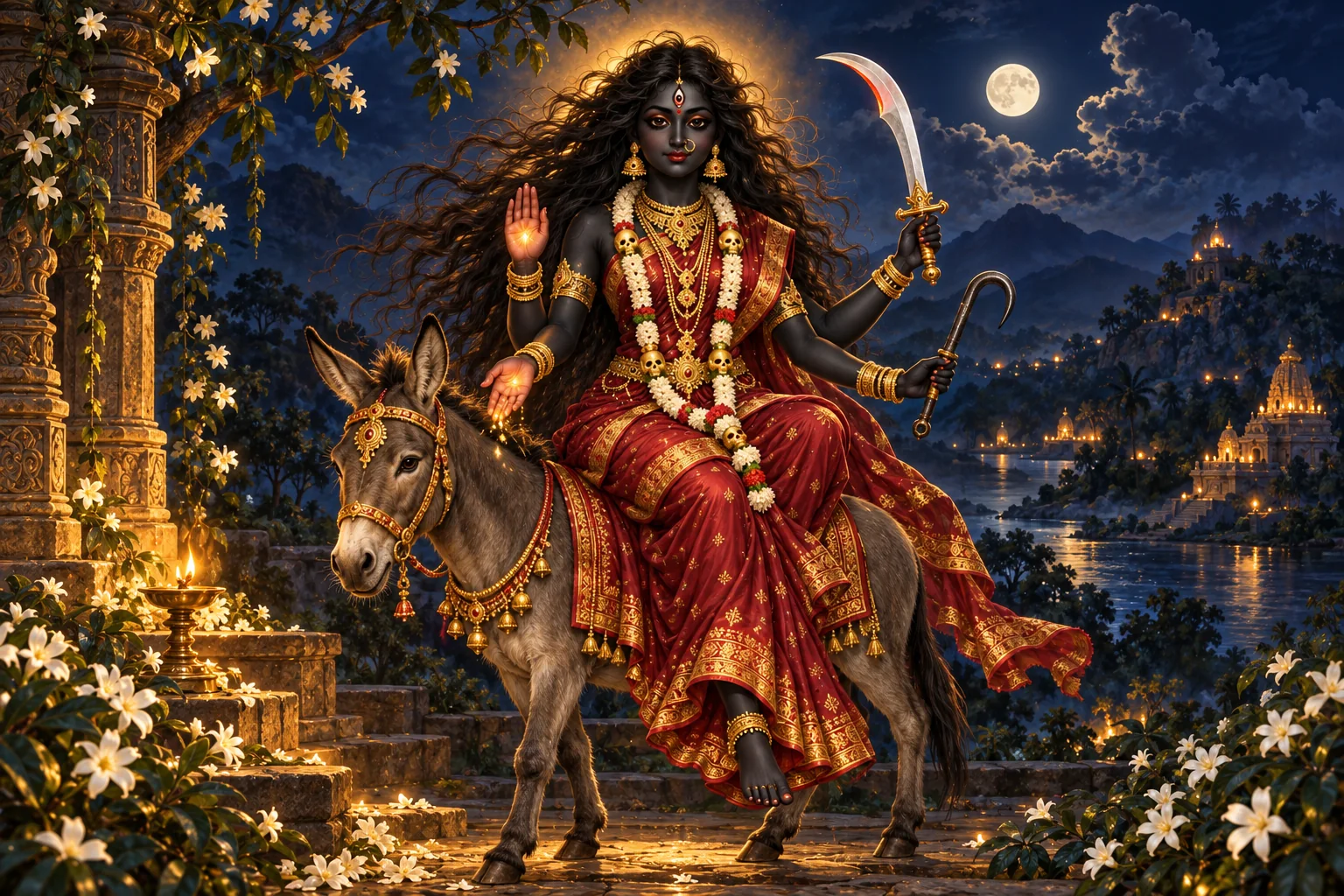
Midway through the festival's final ascent stands its most misunderstood form. Maa Kalaratri — "the Night of Time" — is the Devi with night-dark skin, loosened hair, riding a donkey, breathing flame. First-time viewers flinch; the tradition smiles. For it has given her a second, telling name: Shubhankari — "she who does good." The fiercest face in the Navdurga is turned outward, at what threatens her devotees; toward the devotee she holds up an open hand that says fear not.
In 2026 her worship falls on Saptami — Saturday, October 17, with an astronomical footnote that shapes the whole year's calendar: this Saptami stretches across two sunrises, through October 18, which is why Navratri 2026 occupies ten civil days.
Maa Kalaratri at a Glance
| Traditional order | 7th of the Navdurga |
| Tithi | Saptami (seventh lunar day) |
| 2026 worship date | Saturday, October 17, 2026 (New Delhi, Drik Panchang convention); the tithi continues through October 18 — no separate form that day |
| Vahana | Donkey (gardabha) |
| Iconography | Four arms — sword and iron hook in the left hands; Abhaya and Varada mudras in the right; dark complexion, unbound hair, three eyes |
| Governing planet | Shani (Saturn) |
| Traditional bhog | Jaggery (gur) |
| Flower | Night-blooming jasmine (raat ki rani) |
| Day colour (popular custom) | Grey on October 17, purple on October 18 in 2026 — a weekday-based custom, not a scriptural rule |
The verified 2026 calendar, including the two-sunrise Saptami, is on the series landing page.
The Name: Night of Time
Kala means both time and death-as-time — the force that ends all things; ratri is night. Kalaratri is the night in which time itself dissolves what must end — the Devi as the final darkness that evil cannot survive. The name is cousin to Mahakala, Shiva's aspect as time, whose city and jyotirlinga we visited in the Mahakaleshwar article; in Kashi, the Devi as protectress of the city bears related fierce forms.
The tradition's honesty here is bracing: it does not pretend darkness away. Night comes; endings come. The seventh form says — that too is your Mother.
Her Story: The Devi Unveiled for War
The traditional account, carried by the Navdurga kathas and anchored in the later chapters of the Devi Mahatmya, belongs to the war against Shumbha and Nishumbha — the demon brothers who conquered the three worlds after Mahishasura's fall.
When their generals — the arrogant Chanda and Munda, and the nightmare-general Raktabija, from whose every spilled drop of blood a new demon sprang — advanced on the Devi, she set aside her golden radiance. From her darkened brow sprang the night-dark, fierce-eyed form the Saptashati calls Kali or Chamunda — the form the Navdurga tradition venerates as Kalaratri. She destroyed Chanda and Munda (earning the name Chamunda), and in the Raktabija battle she spread her vast tongue across the battlefield and drank each drop before it touched earth, until the multiplying demon stood alone — and ended.
Provenance note: the identification of Kalaratri with the Saptashati's Kali/Chamunda is the living tradition's reading (the name Kalaratri itself appears among the Devi's names in the Saptashati tradition); Drik Panchang's account summarises it as the Devi shedding her golden skin for the war against Shumbha and Nishumbha. We present it as the tradition does, without inventing chapter-and-verse precision it does not claim.
The Sandhi Puja performed at the Ashtami–Navami junction (in 2026, the morning of October 19, 10:27–11:15 AM in Delhi) commemorates the Chamunda manifestation — the fierce instant between two tithis.
Iconography: Fierce Form, Blessing Hands
Everything in Maa Kalaratri's image is deliberately unpolished. Her complexion is darkest night; her hair unbound; her three eyes round like the cosmos; her breath, the texts say, flares with flame. She rides not a lion but a donkey — the humblest of mounts, the animal that carries burdens no one else will. Her four arms: a sword and the iron hook (vajra-kantaka) in her left hands — and, crucially, Abhaya and Varada mudras in her right: fear not; I give.
That is the whole theology in one frame: terror on the side facing evil, tenderness on the side facing you. Tradition assigns her governance of Shani (Saturn) — the slow, stern teacher-planet — and devotees facing Shani's hard seasons have always taken refuge in her.
On depicting her respectfully: her dark complexion is her glory, not a defect to be lightened — devotional art should show her dark, dignified and powerful, as the tradition describes her.
How to Worship Maa Kalaratri at Home
- Morning worship at the kalash as usual — her fierce form changes nothing in a householder's gentle routine.
- Offer night-blooming jasmine (raat ki rani) if available, or any fragrant flower, with roli and akshat.
- Offer jaggery (gur) as bhog — plain, or as gur-based sweets; traditionally also given to brahmins and the needy on this day.
- Light a sesame-oil lamp in the evening; many families keep a lamp burning through this night as her symbol.
- Chant her mantra (below). Those who read the Saptashati reach her chapters (7–8) naturally around this day.
- Evening aarti; and if the household's children find her image frightening, tell them the truth the tradition tells: the fierce one is on our side — darkness in her hands becomes a shield.
Worship basics are in our Practices & Rituals section.
Mantra, Dhyana and Meaning
Mantra
ॐ देवी कालरात्र्यै नमः॥
Om Devi Kalaratryai Namah — "Om, salutations to Devi Kalaratri."
Dhyana verse (as given in the Navdurga tradition):
एकवेणी जपाकर्णपूरा नग्ना खरास्थिता। लम्बोष्ठी कर्णिकाकर्णी तैलाभ्यक्त शरीरिणी॥
Ekaveni Japakarnapura Nagna Kharasthita, Lamboshthi Karnikakarni Tailabhyakta Sharirini.
A vivid portrait of the ascetic-fierce Devi — single-braided, hibiscus at her ear, mounted on the donkey, her form anointed with oil — the tradition's unflinching meditation image of power stripped of ornament.
Offerings, Flowers and the Day's Colour
- Bhog: jaggery (gur) — the seventh day's traditional offering; sweets of gur are shared and given in daan.
- Flowers: night-blooming jasmine (raat ki rani) — the flower that releases its fragrance only in darkness, which is the day's entire teaching in botanical form.
- Colour: the popular calendar assigns grey to October 17 and purple to October 18, 2026 — a weekday-derived custom, not scripture.
A Reflection for Saptami
Kalaratri asks the festival's bravest question: can you trust the dark? Some seasons of life are night — loss, uncertainty, the long middle of hard things. The seventh form does not promise devotees exemption from night; she promises that the night itself is the Mother in disguise, dissolving what needed to end. What her devotee practices is not fearlessness by denial but fearlessness by trust — the Abhaya mudra received, not performed.
On the vrat: with the extended Saptami, 2026 gives this form an unusually long watch — October 17 and 18. Keep whatever discipline you hold steadily through both days; no special severity is asked. Rest well — Ashtami and Navami arrive together on the 19th, the festival's most intense day.
Night ends in radiance: Maa Mahagauri, the eighth form, worshipped on Durga Ashtami. The whole series lives at Navratri: Nine Forms of Maa Durga.
References
- Drik Panchang — Goddess Kalaratri: iconography, the Shubhankari name, mantra and dhyana, worship day.
- Drik Panchang — 2026 Shardiya Navratri Calendar (New Delhi): verified dates, including the Saptami that spans October 17–18.
- Durga Saptashati / Devi Mahatmya, chapters 7–8 (Markandeya Purana; Gita Press, Gorakhpur) — the Chanda-Munda and Raktabija narratives.
- Durga Saptashati with Devi Kavacham (Gita Press) — "saptamam Kalaratriti" in the Navdurga enumeration.
Frequently Asked Questions
When is Maa Kalaratri worshipped in Navratri 2026?
Maa Kalaratri is worshipped on Saptami, the seventh tithi — Saturday, October 17, 2026 (New Delhi, Drik Panchang convention). Note that in 2026 the Saptami tithi spans two sunrises, continuing through Sunday, October 18 — which is why the festival runs ten civil days this year. Confirm timings with your local panchang.
What is Maa Kalaratri's mantra?
Her simple mantra is 'Om Devi Kalaratryai Namah' (ॐ देवी कालरात्र्यै नमः). Her traditional dhyana verse begins 'Ekaveni Japakarnapura Nagna Kharasthita' — describing the one-braided Devi mounted on the donkey, dark as night, fierce in form yet auspicious in power.
Is Maa Kalaratri dangerous to worship?
No — the tradition says the opposite. Her fierceness is aimed entirely at what threatens her devotees: negativity, fear and hostile forces. For the devotee she is Shubhankari, 'the doer of good.' She is frightening the way a mother defending her child is frightening — never toward the child.
What bhog is offered to Maa Kalaratri?
Jaggery (gur), and sweets made of it, is the traditional seventh-day offering. Night-blooming jasmine (raat ki rani) is the flower associated with her. Customs vary by region and family, as always.
Why is Maa Kalaratri's complexion dark?
Tradition says the Devi set aside her golden outer form to become night-dark for battle against the demons Shumbha and Nishumbha and their generals. Her darkness is the darkness of Kala — time and dissolution — in which every evil ends; the tradition treats it with reverence, as her glory and not a flaw.
Which form is worshipped on October 18, 2026?
No separate Navdurga form is assigned to October 18 in the Drik Panchang calendar for 2026: it is the continuation of the same Saptami tithi that began on October 17. Durga Ashtami with Maa Mahagauri's worship follows on Monday, October 19.