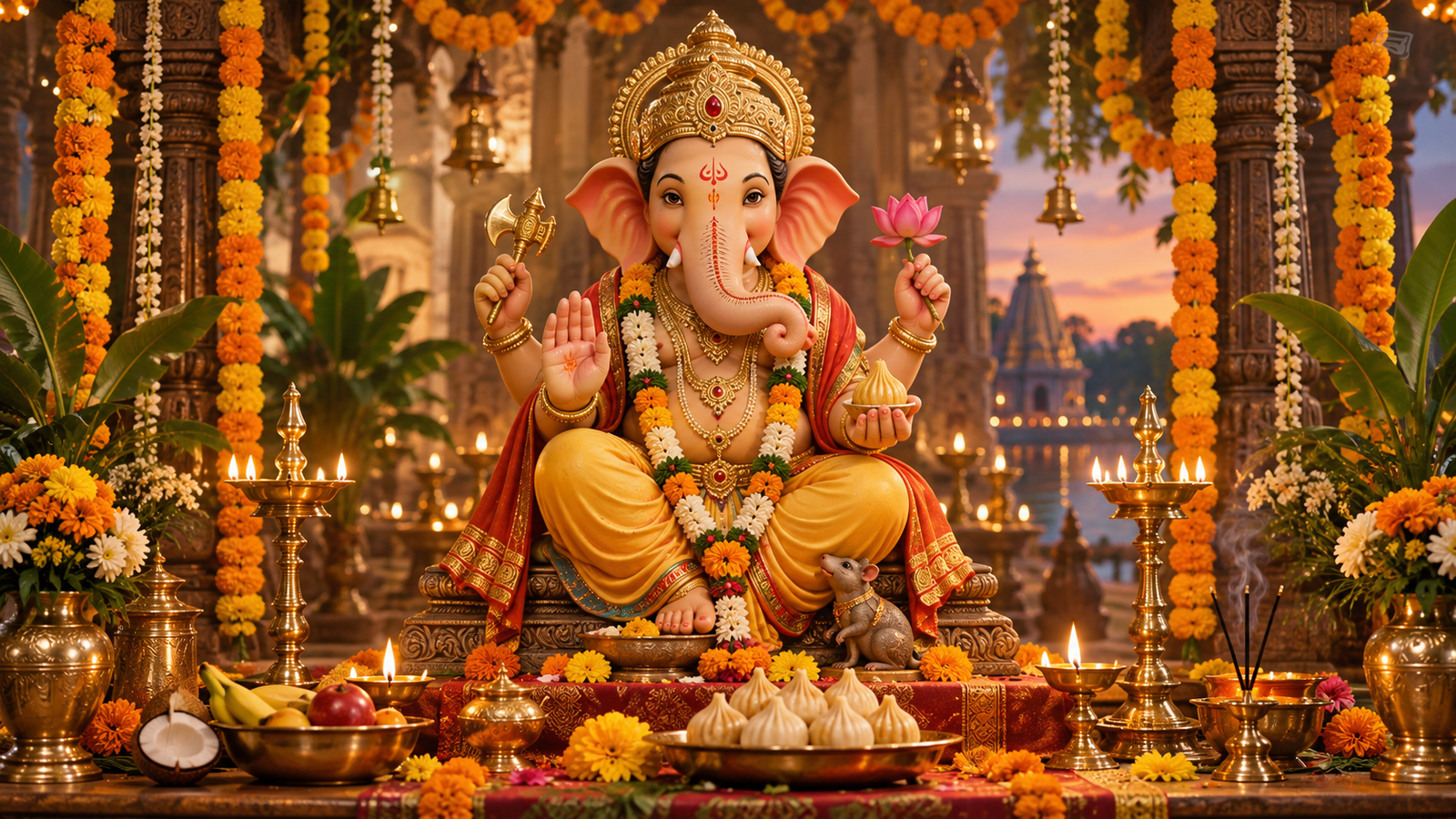
On the afternoon of Monday, 14 September 2026, a small clay figure will be carried through millions of front doors with his face veiled by a cloth. He will be set on a decorated stool, the cloth lifted, and someone will shout Ganpati Bappa Morya! From that moment he is not an image but a guest: bathed, fed and sung to for a day and a half, five days or ten. Then, with drums and a lump in the throat, he is carried to the water and let go. That arc of welcome, hospitality and farewell is Ganesh Chaturthi.
What Ganesh Chaturthi Celebrates
Ganesh Chaturthi honours the birth of Ganesha, the elephant-headed son of Shiva and Parvati. It falls on Chaturthi, the fourth lunar day of the bright fortnight (Shukla Paksha) of Bhadrapada.
The puja belongs to midday. Drik Panchang explains that Hindu timekeeping divides daylight into five parts and that Ganesha is believed to have been born in the middle one, Madhyahna, so the murti is installed (sthapana) and worshipped then. The festival culminates on Anant Chaturdashi, when many devotees immerse the murti. Although commonly described as a ten-day festival, its span in calendar days varies with the lunar tithis. In 2026, 14–25 September covers 12 calendar days, counting both dates.
Ganesh Chaturthi 2026 date and puja times
All timings are in Indian Standard Time, checked on Drik Panchang while writing.
- Ganesh Chaturthi: Monday, 14 September 2026
- Chaturthi tithi: begins 7:06 AM on 14 September, ends 7:44 AM on 15 September
- Madhyahna Ganesha puja, Mumbai: 11:20 AM to 1:48 PM
- Madhyahna Ganesha puja, New Delhi: 11:02 AM to 1:31 PM
- Moon sighting to be avoided, Mumbai: 9:10 AM to 8:37 PM on 14 September
- Anant Chaturdashi and Ganesh Visarjan: Friday, 25 September 2026
The tithi is the same across India, but the midday window depends on local sunrise and sunset, so use a panchang set to your own city or your temple's notice. The moon custom is explained in the FAQs.
The Story of Ganesha's Birth
The best-known account is in the Shiva Purana, Rudra Samhita, Kumara Khanda, chapters 13 to 18 (J. L. Shastri's translation).
Parvati's companions Jaya and Vijaya remark that every attendant on Kailasa obeys Shiva and none is truly hers, so she fashions a boy from the unguents of her own body, "the dirt from her body" in Shastri's words, gives him life and posts him at her door.
Shiva arrives while she bathes; the boy, who has never seen him, bars the way and strikes him. After a battle, Shiva himself severs the child's head. Parvati's grief turns to fury, and she threatens the worlds until the gods beg for terms: her son must live and be honoured. Shiva sends his men north to take the head of the first being they meet, a single-tusked elephant. The head is joined, the boy breathes, and the goddess is delighted.
Finally Brahma, Vishnu and Shiva proclaim him chief of the ganas, hence Ganapati. Shiva declares, "He shall be worshipped first and we shall be worshipped afterwards," names him foremost in "quelling obstacles" and asks that he be worshipped on the fourth tithi. The passage places his birth on Bhadra's fourth day "at the auspicious hour of the moonrise", though it reads "the dark half" where today's festival keeps the bright one.
Other tellings
The Brahmavaivarta Purana, whose surviving form dates to about the fifteenth or sixteenth century, has Parvati win a son through a vow; the child is Krishna himself, and it is the glance of Shani that destroys the infant's head, after which Vishnu brings the head of a young elephant. These accounts have different sequences of events and should be read within their respective Puranic traditions rather than merged into a single narrative.
Wisdom, Beginnings and the Lord of Obstacles
Ganesha's names are a theology in miniature: Ekadanta, the one-tusked, among his earliest names; and Vighnaharta or Vighnaraja, the remover, and the lord, of obstacles. He does not only clear the road; he governs the roadblocks, which is why he is invoked before weddings, journeys and the first line of a new notebook.
Two texts show how his stature grew. The Rigveda verse gaṇānāṃ tvā gaṇapatiṃ havāmahe (2.23.1), sung today at the opening of Ganesha pujas, is in its own setting a hymn to Brahmanaspati, lord of sacred speech; the tradition later gave it a new home. The Ganapati Atharvashirsha, a late Upanishadic text probably composed in the sixteenth or seventeenth century, addresses Ganesha as the Absolute: tvameva pratyakṣaṁ tattvamasi, "You alone are the Reality made visible."
In the Mahabharata's opening section (Adi Parva, Ganguli's translation), Brahma tells Vyasa, "Let Ganesa be thought of, O Muni, for the purpose of writing the poem." Ganesha agrees on condition that his pen never pause; Vyasa replies that Ganesha must first understand every verse. The Critical Edition's editors treat the episode as a later addition, but it captures him well: the patron of intellect who insists on understanding before speed.
A Mantra to Begin With
The most widely used Ganesha mantra is built on his seed syllable, gaṁ, which the Atharvashirsha itself explains:
ॐ गं गणपतये नमः
Oṁ gaṁ gaṇapataye namaḥ — "Om. Salutations to Ganapati, lord of the ganas."
Many families also recite this meditation verse, whose textual origin is variously reported:
वक्रतुण्ड महाकाय सूर्यकोटि समप्रभ ।
निर्विघ्नं कुरु मे देव सर्वकार्येषु सर्वदा ॥
Vakratuṇḍa mahākāya sūryakoṭi samaprabha, nirvighnaṁ kuru me deva sarvakāryeṣu sarvadā — "O Lord of the curved trunk and vast form, radiant as ten million suns: make all my undertakings free of obstacles, always."
Offerings and Symbols: Scripture and Devotion
Modak. The rice-flour dumpling with a coconut-and-jaggery heart has clear textual roots. The Skanda Purana's chapter on Ganesha worship (Maheshvara Khanda, Kedara Khanda, chapter 11) says "twenty-one modakas should be offered", and the Padma Purana and Nilamata Purana list modaka among foods fit for Vinayaka. The popular reading of plain shell and sweet centre as effort and its hidden joy is devotional gloss, not scripture.
Durva grass. The same Skanda Purana chapter prescribes twenty-one blades, two with each name of the Lord, and the Shiva Purana asks for shoots with three knots and no roots. The beloved story in which Ganesha swallows the fire-demon Analasura and only cool durva quenches his burning is popularly attributed to the Ganesha Purana.
Red flowers and sindoor. The Atharvashirsha meditates on Ganesha as red-hued, anointed with red paste and worshipped with red flowers, hence the crimson jaswand (hibiscus) and vermilion. Many households do not offer tulsi to him; popular retellings trace this to a Puranic quarrel between Tulsi and the god. Follow your family's custom.
The symbols. The Atharvashirsha describes the classic form: one tusk, four hands, noose and goad, a mouse on his banner, a large belly. Traditions explain the broken tusk variously, from Parashurama's blow with Shiva's own axe to the folk tale that he snapped it to keep writing the Mahabharata. Scholars read the mouse as desire and tamas mastered, or as the crop-stealing pest subdued. The lessons about big ears that listen and small eyes that focus are modern teaching aids: charming, but not scripture.
A Simple Home Puja
There is no single correct way to welcome Ganesha; regions and families differ. This outline follows the sixteen-step shodashopachara form documented by Drik Panchang. Adapt it as your elders would.
- Prepare. Clean the space and set a raised stool (chowki) with a red or yellow cloth. Keep ready a lamp, incense, unbroken rice (akshata), sindoor, durva, red flowers, modak, fruit and a coconut.
- Light the lamp and take sankalpa, stating who you are, what you are doing and for how many days.
- Invite him in. For a new clay murti, avahana and pranapratishtha invite the Lord into the form while you repeat the mantra. Drik Panchang notes these steps are skipped for a permanently installed murti worshipped daily.
- Offer the upacharas: a seat; water for feet, hands and mouth; a bath (for unbaked clay, a few drops sprinkled with durva); cloth and sacred thread; sandal paste, akshata, flowers, durva and sindoor; incense and lamp.
- Pray. Recite the mantra 21 or 108 times, the Vakratunda verse, or simply speak to him.
- Naivedya and aarti. Offer modak and fruit, then coconut and dakshina. In Maharashtra and Goa the aarti is Sukhakarta Dukhaharta, composed by the seventeenth-century saint Samarth Ramdas; elsewhere Jai Ganesh Deva is common. Circle the murti and ask forgiveness for any lapse.
- Share prasad with everyone present, and let nothing go to waste.
Repeat a short morning and evening worship each day until the send-off (utthapana) and visarjan.
Pandals, Pune and Lokmanya Tilak
The Peshwas were devotees of Ganesha, and eighteenth-century Pune kept the festival under their patronage. The community festival, the Sarvajanik Ganeshotsav, is a creation of the 1890s.
In 1892 Bhausaheb Laxman Javale, remembered as Bhau Rangari, a royal physician and freedom activist, installed the first public Ganesha in his wada at Shalukar Bol, Pune. Lokmanya Bal Gangadhar Tilak did not start the public festival, as is often said, but he is the reason it became a mass institution. He praised the new celebration in his newspaper Kesari on 26 September 1893, installed a Ganesha at the Kesari office in 1894 and, as the historian Richard Cashman documents in The Myth of the Lokamanya (1975), gave the festival its modern machinery: community subscriptions for large murtis in public mandaps, a synchronised immersion procession on the tenth day, and melas whose songs carried political themes.
That inheritance lives on in Mumbai's Lalbaugcha Raja, founded in 1934 by Koli fisherfolk and revered as the Navsacha Ganapati, the granter of vows, and on 10 July 2025 Maharashtra declared Sarvajanik Ganeshotsav its state festival. Beyond Maharashtra the day is kept as Chavath in Goa, Vinayaka Chavithi in Karnataka, Andhra Pradesh and Telangana, and Vinayagar Chaturthi in Tamil Nadu.
Visarjan: Letting Go With Love
The god invited into clay by avahana is released by visarjan, immersion, to the cry Ganpati Bappa Morya, pudhchya varshi lavkar ya, "come early next year". The theology is simple and hard: form arises from the formless and returns to it, and even the Divine, in a shape we can hold, teaches us how to let go. Sthapana trains presence; visarjan trains non-attachment.
Anant Chaturdashi 2026 is Friday, 25 September. For Mumbai, Drik Panchang lists auspicious visarjan windows in the morning (6:28 to 10:59 AM), afternoon (12:30 to 2:01 PM), evening (5:02 to 6:32 PM) and night (9:31 to 11:01 PM).
Celebrating in an environmentally responsible way
The Central Pollution Control Board's Revised Guidelines for Idol Immersion (12 May 2020) ask for murtis of natural clay and natural colours, prohibit toxic paints, single-use plastic and thermocol, encourage artificial ponds, and note that small household murtis can be immersed at home in a bucket. In Mumbai this year, following Bombay High Court orders, murtis under six feet must go to artificial ponds.
Practical ideas that keep the sacredness intact:
- Choose an unbaked shadu mati or river-clay murti painted with turmeric, geru or other natural colours, in a size your home can immerse.
- Immerse at home in a tub with a prayer, then pour the clay and water into a garden bed or potted plants.
- Return nirmalya, the offered flowers and leaves, to compost or a municipal collection rather than the river.
- Decorate with cloth, flowers, paper and lamps; skip thermocol and plastic.
A Closing Reflection
The god of beginnings is also the god of thresholds. We welcome an unknown boy who defended his mother's door; we feed the guest who taught the gods to worship him first; and we learn, during the festival, that the best way to keep him is to give him back. When the drums fade on 25 September and the clay softens in the water, what remains is not absence but a house that has practised love, hospitality and letting go. That, more than any modak, is the offering he came for.
Ganpati Bappa Morya. Mangal Murti Morya.
Related Reading
- Krishna Janmashtami: birth story and puja
- Shravan and Sawan Somvar vrat
- The trinity of Brahma, Vishnu and Shiva
Sources and Further Reading
- Drik Panchang — Ganesh Chaturthi 2026 date and Madhyahna puja muhurta, Mumbai
- Drik Panchang — Ganesh Chaturthi 2026, New Delhi
- Drik Panchang — Ganesh Visarjan 2026 muhurta, Mumbai
- Drik Panchang — Day panchang for Mumbai, 14 September 2026 (moonrise and moonset)
- Drik Panchang — Shodashopachara Ganesha Chaturthi puja vidhi
- Shiva Purana, Rudra Samhita, Kumara Khanda, chapter 13 — The birth of Ganesa (J. L. Shastri translation, Wisdom Library)
- Shiva Purana, chapter 17 — The resuscitation of Ganesa
- Shiva Purana, chapter 18 — Ganesa crowned as the chief of Ganas
- Skanda Purana, Maheshvara Khanda, Kedara Khanda, chapter 11 — Procedure of Ganesa worship (Wisdom Library)
- Wisdom Library — Modaka: Puranic references
- Wisdom Library — Durva: Puranic references
- Rig Veda 2.23.1, H. H. Wilson translation (Wisdom Library)
- Ganapati Atharvashirsha with meaning (Sanskrit Documents)
- Mahabharata, Adi Parva, Section I, K. M. Ganguli translation (Project Gutenberg)
- Green Message — Vakratunda Mahakaya, Sanskrit text and meaning
- Wikipedia — Ganesha: iconography, dating, Rigveda 2.23.1 and the mouse
- Wikipedia — Mythological anecdotes of Ganesha: the Brahmavaivarta Purana version and Parashurama
- Wikipedia — Brahmavaivarta Purana (dating)
- Wikipedia — Syamantaka
- Wikipedia — Ganesh Chaturthi: history, citing Courtright (1988), Kaur (2003), Cashman (1975) and Brown (1991)
- Richard I. Cashman, The Myth of the Lokamanya: Tilak and Mass Politics in Maharashtra (1975), Internet Archive
- UCLA Center for India and South Asia — Ganpati festival
- The Better India — India's oldest Ganeshotsav was set up by a freedom fighter in 1892
- Wikipedia — Lalbaugcha Raja
- Wikipedia — Sukhakarta Dukhaharta
- News on AIR — Maharashtra declares Sarvajanik Ganeshotsav as state festival (11 July 2025)
- Central Pollution Control Board — Revised Guidelines for Idol Immersion (May 2020, PDF)
- India TV News — Ganpati idols below six feet must be immersed in artificial ponds in Mumbai, says BMC (1 September 2026)
Panchang timings follow Drik Panchang for Mumbai and New Delhi as checked on 12 September 2026; muhurta values are location-specific and may be revised. Please confirm with a trusted local panchang or your temple before sthapana or visarjan.
Frequently Asked Questions
When is Ganesh Chaturthi in 2026?
Ganesh Chaturthi 2026 falls on Monday, 14 September, on Bhadrapada Shukla Chaturthi. The Chaturthi tithi runs from 7:06 AM IST on 14 September to 7:44 AM IST on 15 September, so the midday puja falls on the 14th across India. The festival ends with Anant Chaturdashi and Ganesh Visarjan on Friday, 25 September 2026.
What is the Ganpati sthapana muhurat for 2026?
The murti is installed and worshipped during Madhyahna, the middle fifth of the daylight hours, because Ganesha is believed to have been born at that time. Drik Panchang lists 11:20 AM to 1:48 PM IST for Mumbai and 11:02 AM to 1:31 PM IST for New Delhi on 14 September 2026. The window depends on local sunrise and sunset, so check a panchang set to your own city or follow your temple's notice.
Why should you not look at the moon on Ganesh Chaturthi?
Tradition holds that sighting the moon on Bhadrapada Shukla Chaturthi brings mithya dosha, the risk of being falsely accused, and recalls the episode in which Krishna was wrongly blamed for stealing the Syamantaka jewel. The Bhagavata Purana tells the jewel story; the link to the Chaturthi moon comes from later devotional tradition. For Mumbai in 2026 the window to avoid is 9:10 AM to 8:37 PM IST on 14 September, from moonrise to moonset.
Can I do Ganesh Chaturthi puja at home without a priest?
Yes. Household worship of Ganesha has always been led by the family. Light a lamp, take sankalpa, invite the Lord into the murti with Om Gam Ganapataye Namah, offer durva, red flowers, sindoor and modak, sing an aarti and share prasad. Keep him for one and a half, three, five, seven or ten days according to your family's custom. Sincerity matters more than perfect Sanskrit.
How can I make Ganesh Visarjan eco-friendly?
Choose an unbaked clay murti painted with natural colours, avoid plaster of Paris, thermocol and chemical paints, and immerse it at home in a tub or at an artificial pond, as the Central Pollution Control Board's 2020 guidelines recommend. The clay and water can go to plants and the offered flowers to compost. In Mumbai in 2026, murtis under six feet must be immersed in artificial ponds under Bombay High Court orders.