The Fortnight of Gratitude
Every year, as the bright half of Bhadrapada closes, Hindu homes turn quieter. Kitchens cook simpler food, riverbank ghats fill with people holding small copper vessels of water and black sesame, and families pause to speak names that are no longer called out at the dinner table — a grandfather's, a mother's, a great-grandmother's.
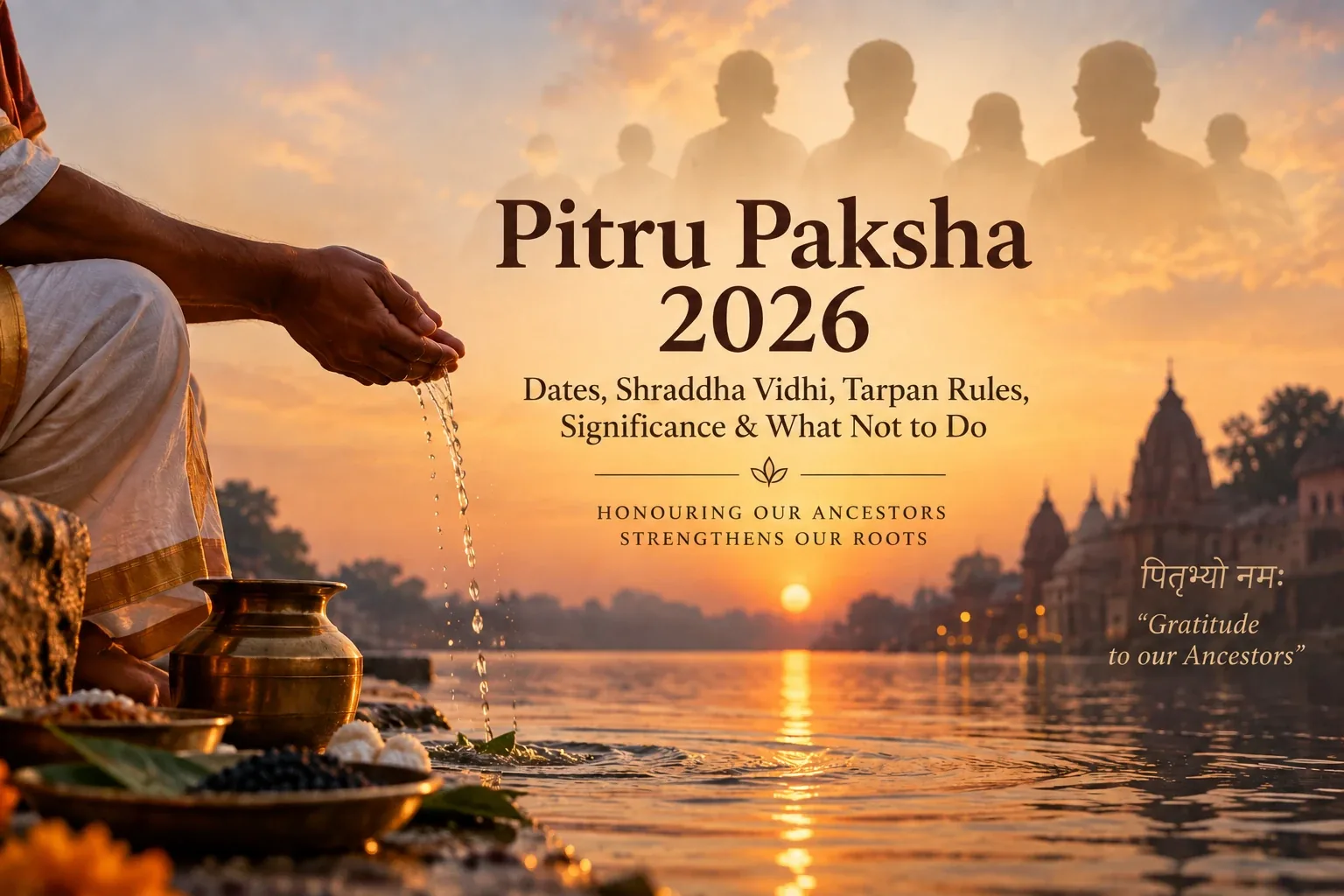
This is Pitru Paksha — the fortnight of the ancestors. In 2026 it begins on Saturday, September 26 and concludes with Sarva Pitru Amavasya on Saturday, October 10.
The internet often reduces Pitru Paksha to a list of warnings: don't buy this, don't start that, beware of "pitru dosha." That framing misses the heart of it. Pitru Paksha is not a haunted fortnight to be survived. It is Sanatan Dharma's annual act of gratitude — fifteen days set aside to remember, thank and nourish the people because of whom we exist. Grief is part of it; fear is not.
This guide covers the verified 2026 dates, the meaning of Shraddha and Tarpan, a practical vidhi a householder can follow, what tradition genuinely asks us to avoid (and what is merely internet folklore), and how the fortnight can be observed anywhere in the world.
What Is Pitru Paksha?
The words themselves are simple:
- Pitru (पितृ) means "ancestor" or "forefather" — the departed members of one's lineage, and more broadly the Pitrs, the ancestral beings honoured in Vedic tradition.
- Paksha (पक्ष) means a lunar fortnight — half of a lunar month.
Pitru Paksha is the Krishna Paksha (waning fortnight) that follows Bhadrapada Purnima, falling in September–October. In the Purnimanta calendar of North India this fortnight belongs to the month of Ashwin; in the Amanta calendar of western and southern India it is counted in Bhadrapada. The names differ, but — unlike Shravan, where the two systems produce different windows — the actual days of Pitru Paksha are the same across India.
Three more terms will appear throughout this guide:
- Shraddha (श्राद्ध): the ceremony performed for one's departed, named after shraddha — faith. Whatever is offered with true faith reaches the ancestors; that is the tradition's core conviction.
- Tarpan (तर्पण): from trip, "to satisfy" — the offering of water, usually mixed with black sesame seeds, poured for the departed.
- Pitru Rina (पितृ ऋण): the "debt to the ancestors." The Vedic texts, including the Taittiriya Samhita, speak of every person being born with three debts — to the devas, to the rishis, and to the pitrs. The debt to our ancestors is repaid in two ways: by raising the next generation with the values we received, and by remembering and honouring those who came before us. Shraddha is that remembrance made visible.
Pitru Paksha 2026 Dates
Pitru Paksha 2026 begins on Saturday, 26 September 2026 (Purnima Shraddha) and ends on Saturday, 10 October 2026 (Sarva Pitru Amavasya).
Here is the full Shraddha calendar for 2026, verified against Drik Panchang (Delhi timings):
| Date (2026) | Day | Shraddha Tithi |
|---|---|---|
| 26 September | Saturday | Purnima Shraddha (Pitru Paksha begins) |
| 27 September | Sunday | Pratipada Shraddha |
| 28 September | Monday | Dwitiya Shraddha |
| 29 September | Tuesday | Tritiya Shraddha · Maha Bharani |
| 30 September | Wednesday | Chaturthi and Panchami Shraddha (combined) |
| 1 October | Thursday | Shashthi Shraddha |
| 2 October | Friday | Saptami Shraddha |
| 3 October | Saturday | Ashtami Shraddha |
| 4 October | Sunday | Navami Shraddha (Matri Navami) |
| 5 October | Monday | Dashami Shraddha |
| 6 October | Tuesday | Ekadashi Shraddha (Indira Ekadashi) |
| 7 October | Wednesday | Dwadashi Shraddha · Magha Shraddha |
| 8 October | Thursday | Trayodashi Shraddha |
| 9 October | Friday | Chaturdashi Shraddha |
| 10 October | Saturday | Sarva Pitru Amavasya (Mahalaya) |
Two honest notes on this table:
- Panchami this year is a short tithi. Most Panchangs, including Drik Panchang for Delhi, combine Chaturthi and Panchami Shraddha on September 30. A few regional Panchangs list Panchami separately on October 1. If your ancestor's tithi is Panchami, confirm with your local Panchang or family priest.
- Tithi timings shift by city. A tithi that covers the afternoon in Delhi may not do so in Kolkata, Ahmedabad or New Jersey. Since Shraddha is traditionally performed when the tithi prevails during Aparahna Kala (roughly the mid-afternoon portion of the day), always confirm your specific date from a Panchang set to your own city.
How the right Shraddha tithi is determined
Shraddha follows the lunar tithi of death, not the English date. If your grandfather passed away on the Ashtami of any lunar month, his Shraddha during Pitru Paksha 2026 falls on Ashtami — Saturday, October 3 — regardless of the civil date on which he died. A few tithis also carry special assignments by tradition:
- Maha Bharani (September 29): Shraddha performed when Bharani Nakshatra prevails is considered especially meritorious for the recently departed.
- Matri Navami (October 4): dedicated to departed mothers and the married women of the family.
- Chaturdashi (October 9): traditionally reserved for those who died untimely deaths — accidents, violence — even if that was not their actual tithi. Those who died naturally on a Chaturdashi are often remembered on Amavasya instead.
- Sarva Pitru Amavasya (October 10): for all ancestors together, and for anyone whose tithi is unknown.
Why Do Hindus Observe Pitru Paksha?
Sanatan Dharma sees a human being not as an isolated individual but as a living link in a chain — rishi to pitr to us to our children. Our bodies, our names, our languages, our temperaments and our opportunities are inheritances. The tradition asks: having received so much, what do we give back to those who can no longer receive anything material from us?
Its answer is remembrance offered as nourishment. In the traditional understanding, the departed — in their subtle form as pitrs — are satisfied not by the physical rice or water but by the shraddha, the faith and love, carried through them. The Ishavasya-like insight underneath is simple: a culture that feeds its ancestors in memory will not abandon its elders in life.
There is also the concept of Pitru Rina discussed above. Shraddha during Pitru Paksha is the year's appointed occasion for acknowledging that debt. Tradition holds that during this fortnight the pitrs draw near to their descendants and return satisfied when remembered — and that their satisfaction flows back as blessing: harmony, progeny, prosperity. Where texts speak of "pitru dosha," the tradition's own remedy is never fear — it is remembrance, charity and care for the living family.
Scriptural Origins
Ancestor veneration in Sanatan Dharma is ancient and textually deep-rooted, though readers should know what kind of text says what:
- The Vedic layer: The Rigveda contains hymns invoking the pitrs, and the Yajurveda tradition (Taittiriya Samhita) articulates the three debts, including pitru rina. Pinda offerings appear in the shrauta and grihya ritual literature.
- The Dharmashastras: The Manusmriti devotes a large portion of its third chapter to Shraddha — who may perform it, who should be fed, and with what attitude.
- The Mahabharata: The Anushasana Parva, in Bhishma's teachings to Yudhishthira, discusses Shraddha at length, including its lore and merits.
- The Garuda Purana: especially its Preta Khanda, is the tradition's best-known text on the soul's journey after death and the rites — including pinda daan — that assist it. It is customarily recited during mourning periods.
- The Markandeya Purana and others describe the satisfaction of the pitrs and the blessings that follow sincere Shraddha.
This article deliberately quotes no Sanskrit verses, because loose translations and misattributed shlokas are rampant online. The references above are to well-known sections; for exact verses, consult a printed edition with a traditional commentary or a learned acharya.
The Story of Karna and Pitru Paksha
A beloved traditional account — told in retellings associated with the Mahabharata's hero Karna, though its details live more in living tradition than in the critical text — explains why this fortnight became the season of feeding the departed.
When Karna, the great giver, died in the Kurukshetra war and rose to the higher realms, he was received with honour. Yet when he sat to eat, he was served gold and jewels — never food. Puzzled, he asked why. He was told: "All your life you gave gold, land and wealth in charity. But you never offered food and water to your ancestors. What one gives is what one receives here."
Karna answered honestly that he had never known his ancestors — his true parentage was hidden from him until the very end. Moved by this, he was granted a return to earth for a fortnight, during which he offered food and water to his ancestors and fed the hungry. That fortnight is remembered as Pitru Paksha.
The story's teaching is gentle but pointed: wealth given to the world does not substitute for remembrance owed to one's own lineage — and it is never too late to begin.
Shraddha vs Tarpan vs Pind Daan
These three words are often used interchangeably online. They are related but distinct:
| What it is | What is offered | When | |
|---|---|---|---|
| Tarpan | The simplest water-offering to satisfy the pitrs | Water, usually with black sesame (til) and sometimes kusha grass | Daily during Pitru Paksha; also on Amavasyas and at tirthas year-round |
| Pind Daan | Offering of pindas — rounded balls of cooked rice mixed with til, honey or milk | The pindas themselves, symbolically nourishing the departed's subtle body | On the ancestor's Shraddha tithi; at tirthas like Gaya |
| Shraddha | The complete ceremony of ancestral honour, performed with faith | Tarpan + Pind Daan + feeding (Brahmins, the needy, cow, crow, dog) + daan | On the death tithi during Pitru Paksha; also on death anniversaries |
A useful way to remember it: Tarpan is an offering, Pind Daan is a rite, Shraddha is the whole ceremony — and shraddha, faith, is the ingredient without which none of it is considered complete.
How to Perform Tarpan During Pitru Paksha
Tarpan is the observance most householders can realistically do daily through the fortnight. Traditions differ by region, family and sampradaya — the steps below describe a widely followed general form. Where your family's custom or your priest's guidance differs, follow that.
- Bathe and wear clean, simple clothes — traditionally a dhoti for men; white or muted colours are preferred.
- Choose the time and place. Morning after sunrise is usual for daily tarpan. A riverbank or any waterbody is ideal; at home, a clean corner facing south — the direction of the pitrs — works.
- Keep the materials ready: a copper or brass vessel of clean water, black sesame seeds (kala til), kusha grass if available, and a ring of kusha (pavitri) worn on the right hand in many traditions.
- Wear the sacred thread (yajnopavita) over the right shoulder — the apasavya position used for ancestral rites — if you are a thread-wearer.
- Take a sankalpa — a spoken intention stating your name, lineage (gotra, if known) and that you offer this tarpan for the satisfaction of your pitrs.
- Offer the water. Take water with black sesame in your joined palms and pour it — in ancestral rites the water is released over the space between the right thumb and forefinger (the pitru tirtha of the hand) — while remembering each ancestor by name and relationship: father, mother, grandparents, great-grandparents, and then all departed of the lineage, known and unknown. Three librations per ancestor is a common practice.
- Close with a prayer asking the pitrs to be satisfied and to bless the family, then feed a cow, crow or the needy if you can.
No Sanskrit fluency is required. Names, water, sesame and sincerity are the substance; a priest or an elder can add the traditional mantras where available.
Basic Shraddha Vidhi
The fuller Shraddha ceremony — typically performed once, on the ancestor's tithi — is best done with a knowledgeable priest (purohit), and its details vary genuinely between regions and sampradayas. There is no single universal vidhi; what follows is the commonly shared skeleton:
- Preparation: house cleaned, kitchen strictly vegetarian that day, food cooked fresh with devotion — traditionally including kheer, rice, seasonal vegetables and puris.
- Sankalpa: the performer states the intention, the ancestor's name, gotra and tithi.
- Invocation of the pitrs: the ancestors are invited and offered a seat, often symbolised with kusha grass.
- Tarpan: water-and-sesame offerings as described above.
- Pind Daan: rice pindas offered to the departed of up to three generations, placed on kusha grass with sesame.
- Bhojana / feeding: portions are first set aside — the panchabali, commonly for the cow, the crow, the dog, ants and the devas — after which Brahmins and/or the needy are fed respectfully. The crow's portion (kakbali) is watched with particular affection: a crow accepting the food is traditionally taken as the ancestors' acceptance.
- Daan and dakshina: donations — food grains, clothes, sesame, or money — given according to capacity.
- Feeding the family: the household eats last, taking the Shraddha food as prasada.
If a full ceremony is beyond your circumstances, tradition explicitly honours the scaled-down forms: tarpan alone, or simply feeding the needy in your ancestors' name with a prayer.
What Can Be Offered?
Every item in the Shraddha basket carries meaning:
- Water: the fundamental offering — life itself, given back in gratitude.
- Black sesame (kala til): the seed most associated with the pitrs; tradition regards til as purifying and as beloved of the ancestors, appearing in tarpan, pindas and daan alike.
- Rice / Pinda: cooked rice formed into pindas represents the body's nourishment offered to the subtle body of the departed.
- Kusha grass: the sacred grass of Vedic ritual, used as seat and conduit for the invoked pitrs.
- Food (anna daan): the highest offering of the fortnight — feeding Brahmins, the poor, or anyone hungry in the ancestors' name.
- Kheer: milk, rice and sugar — the dish most traditionally associated with Shraddha meals.
- Donations: clothes, blankets (the fortnight precedes winter), grain, footwear, umbrellas or money — given quietly, without display.
- Care for creatures: grass or chara to cows, food for crows and dogs, sugar or flour near anthills — the panchabali's reminder that the lineage's gratitude extends to all beings.
Food During Pitru Paksha
Food is where Pitru Paksha touches daily life most visibly. Widely followed customs — with the usual caveat that regions and families differ:
Commonly eaten: simple sattvic meals — rice, dal, seasonal vegetables, chapati or puri, kheer, fruits, milk. Food cooked fresh at home, eaten without extravagance.
Commonly avoided by observing families:
- Onion and garlic (tamasic in traditional food classification)
- Meat, fish and eggs
- Alcohol
- In many families: masoor dal, chana in some regions, and "impure" or stale food generally
- Lavish feasting, eating out and party food — not because restaurants are "sinful," but because the fortnight's mood is simplicity
The person performing Shraddha traditionally eats one simple meal on that day. Guests are not turned away — feeding anyone who arrives hungry during Pitru Paksha is considered especially meritorious.
What NOT to Do During Pitru Paksha — Tradition vs Myth
This is where honest separation matters. Some restraints are genuinely traditional; others are internet-era exaggerations.
Genuinely traditional restraints (for families observing Shraddha):
- No new auspicious beginnings: weddings, engagements, griha pravesh, mundan and upanayana are scheduled outside the fortnight, since the days are dedicated to the departed rather than to celebration.
- Simplicity in living: simple food, restrained entertainment, no lavish parties.
- Respectful conduct: no speaking ill of the departed; conflicts within the family are considered especially jarring in these days.
- Personal austerity by the performer of Shraddha: many traditions ask the karta to avoid haircuts, shaving and nail-cutting during the fortnight, and to observe celibacy — customs of mourning-like discipline that vary by family.
Popular claims that deserve nuance:
- "Buying anything new brings misfortune" — discussed in the next section; this is custom and mood, not scriptural prohibition, and several traditions actively disagree.
- "Travel during Pitru Paksha is inauspicious" — there is no traditional ban on travel; indeed, this is precisely the fortnight when lakhs travel to Gaya, Varanasi and Prayagraj for Shraddha.
- "If you miss Shraddha, your ancestors will curse you" — the tradition's own texts describe the pitrs as compassionate elders, not vengeful spirits. Missing a ritual out of genuine inability is answered by doing what one can — even water and remembrance — not by punishment.
- "Cutting vegetables / washing hair on certain days harms ancestors" — regional folk customs at most; they carry no general scriptural weight.
The reliable inner compass: Pitru Paksha asks for restraint out of respect, the way a household naturally quietens when remembering a recent loss. Any "rule" whose only engine is fear of catastrophe deserves skepticism.
Can You Buy New Things During Pitru Paksha?
This is one of Google's most-asked Pitru Paksha questions, so here is the nuanced answer.
There is no scriptural verse forbidding purchases during Pitru Paksha. The custom of postponing big celebratory purchases — gold, a car, a house — arose because such purchases are traditionally inaugurated with puja and celebration, which sits oddly within a fortnight dedicated to the departed. Over time, "we postpone the celebration" hardened into "buying is inauspicious," which is not what the tradition says.
Practical guidance most priests would endorse:
- Necessities: buy freely — groceries, medicines, school supplies, work equipment, emergency replacements. No tradition asks a family to defer genuine needs.
- Celebratory purchases: if your family's custom is to wait, waiting costs little — Navratri and Diwali, the year's most celebrated buying seasons, begin immediately after (Ghatasthapana falls on October 11, 2026).
- A growing counter-view, voiced by many acharyas, holds that Pitru Paksha is a period of ancestral blessing, and that a purchase made after offering Shraddha carries those blessings. Families following this view buy without hesitation.
In short: follow your family's practice, and let neither marketing ("buy now!") nor fear ("buy nothing!") make the decision for you.
Can Weddings, Griha Pravesh or Other Auspicious Ceremonies Be Performed?
By near-universal custom, no new auspicious ceremonies (mangal karya) are scheduled during Pitru Paksha — weddings, engagements, griha pravesh, mundan, upanayana or business inaugurations. Panchangs list no wedding muhurats in this fortnight.
Two clarifications keep this balanced:
- Ongoing dharmic life continues. Daily puja, temple visits, ekadashi vrats (Indira Ekadashi falls on October 6, 2026, and is specifically dedicated to the welfare of ancestors), satsang, and festivals that fall within the fortnight by the calendar are all observed.
- What is paused is inauguration, not devotion. The fortnight is not "inauspicious time" in the sense of a cursed period; it is reserved time — booked, as it were, in the ancestors' name.
Who Can Perform Shraddha?
The traditional first responsibility rests with the eldest son, and by extension the sons of the deceased. But the Dharmashastra tradition is far more accommodating than popular belief suggests. In the absence of a son, tradition recognises (with variations across texts and sampradayas): the grandson or great-grandson, the wife, the daughter, the daughter's son, brothers and their sons, and even a disciple or friend — the principle being that someone who loves the departed should feed them, rather than no one at all.
On women performing Shraddha: tradition itself carries the celebrated account of Devi Sita offering Pind Daan at Gaya for King Dasharatha when Bhagwan Rama and Lakshmana were delayed — an offering the tradition holds was accepted. Today, priests at Gaya, Varanasi and other tirthas routinely guide daughters, widows and mothers through Tarpan and Pind Daan, and several sampradayas explicitly encourage daughters where sons are absent. Some traditional lineages still reserve the rite for male descendants; families should follow their own parampara with the guidance of their purohit, without treating either practice as illegitimate.
What If You Don't Know the Ancestor's Death Tithi?
This worry stops many people from observing anything — needlessly, because the tradition solved it long ago:
- Sarva Pitru Amavasya (October 10, 2026) exists precisely for this: Shraddha for all pitrs, of known and unknown tithi alike.
- If only the month of death is unknown but the tithi is known, the same tithi within Pitru Paksha is used.
- For those who died untimely deaths, Chaturdashi (October 9, 2026) is the traditional day.
- For ancestors beyond living memory — the lineage as a whole — Amavasya covers everyone, and daily tarpan through the fortnight may simply address "all pitrs of our line."
Not knowing a date is no barrier to gratitude.
Sarva Pitru Amavasya 2026: The Most Important Day
Saturday, October 10, 2026 is Sarva Pitru Amavasya — also called Mahalaya Amavasya, the "great abode" day when tradition holds that all the pitrs together approach their descendants before returning to their realm.
Its special significance:
- Shraddha may be offered here for all ancestors at once — the safety net for missed tithis, unknown dates and forgotten generations.
- Those who could not perform Shraddha on the proper tithi during the fortnight perform it on this day.
- It is traditionally the day for remembering everyone who ever contributed to our life — teachers, mentors, friends — not only blood relatives.
- In Bengal and eastern India, Mahalaya dawn carries a second sweetness: the chanting of Mahishasura Mardini announces that Devi Durga has set out for her earthly home. The very next day, Sharad Navratri begins (Ghatasthapana, October 11, 2026) — the tradition's eloquent sequence: first gratitude to our roots, then celebration of the Divine Mother.
Important Places for Pitru Paksha and Pind Daan
Shraddha performed at certain tirthas is held to carry special power:
- Gaya (Bihar): the foremost. Tradition holds Bhagwan Vishnu ever-present here as Gadadhara; the Vishnupad temple enshrines his footprint, and the Falgu riverbank and Akshaya Vata are the classic Pind Daan sites. The saying goes that Shraddha at Gaya grants the ancestors lasting satisfaction — many families make the Gaya pilgrimage once, on behalf of the whole lineage. During Pitru Paksha, Gaya hosts a full Pitru Paksha Mela.
- Varanasi (Kashi): Pind Daan at the city of Bhagwan Vishwanath — especially at Pishach Mochan Kund, associated with freeing restless departed souls — and tarpan on the Ganga ghats.
- Prayagraj: the Triveni Sangam of Ganga, Yamuna and the unseen Saraswati; tarpan at the confluence is among the most ancient observances.
- Haridwar: Shraddha and asthi-visarjan at Har Ki Pauri; many families' priests (pandas) keep genealogical registers here going back centuries.
- Others: Badrinath's Brahma Kapal, Siddhpur in Gujarat (especially for Matru Shraddha, the mother's rite), Rameswaram, Nashik's Trimbakeshwar and the Godavari ghats, and Kurukshetra.
A tirtha adds sanctity, but no text makes it compulsory: Shraddha done at home with faith is fully valid.
Can Pitru Paksha Be Observed Outside India?
Yes — completely. The pitrs are not bound by geography, and neither is gratitude. For Hindus in the US, UK, Australia, Singapore, the Gulf or anywhere else:
- Do tarpan at home: a clean balcony, garden or bathroom-adjacent washing area, facing south, with water and black sesame. Use your local sunrise and a Panchang app set to your city for tithi timings — the tithi table above shifts by time zone.
- Anna daan works everywhere: donate to a food bank, sponsor meals at a temple or gurudwara langar, or cook and share food in your ancestors' name.
- Temple and priest support: most Hindu temples abroad organise Pitru Paksha tarpan and Shraddha on Sarva Pitru Amavasya; many families also arrange Shraddha at Gaya or Varanasi through relatives or reputable priests, with the sankalpa taken in the family's name.
- Keep the mood, not just the mechanics: simple food at home, an evening where children hear stories of their great-grandparents, a diya lit facing south — the fortnight's essence travels well.
Pitru Paksha for the Modern Generation
For a generation raised on productivity and forward motion, a fortnight devoted to looking backward can seem puzzling. Yet Pitru Paksha may be the most psychologically modern of all Hindu observances:
- It is structured gratitude. Once a year, the tradition makes us name the people we come from — an antidote to the rootlessness that mobility brings.
- It is family history, kept alive. Ask an elder for the names of your great-great-grandparents this fortnight and write them down. Most families are two conversations away from losing them forever.
- It is charity with a face. Anna daan in a grandmother's name lands differently than an anonymous online donation — it teaches children that giving is a family inheritance.
- It is grief given a container. Modern life offers no calendar for mourning; Pitru Paksha does — a yearly, bounded, communal space in which missing someone is not awkward but sacred.
You do not need to master every mantra to participate. Cook your grandfather's favourite simple dish. Feed someone hungry. Light a diya, fold your hands, and say thank you to the chain of people who carried life all the way to you. That is Pitru Paksha.
Conclusion: The Fortnight That Remembers
Pitru Paksha is not merely about mourning the dead. It is about remembering the people because of whom we exist today — and letting that remembrance shape how we live: simpler for a fortnight, more generous, more aware that we are one link in a very long chain.
In 2026, the fortnight runs from September 26 to October 10. Whether you perform a full Shraddha at Gaya, a quiet tarpan on your balcony, or simply feed someone hungry in your ancestors' name on Sarva Pitru Amavasya — do it with shraddha, with faith. That, the tradition promises, is the offering that always reaches.
May the pitrs of all lineages be satisfied, and may their blessings rest on every home that remembers them.
Frequently Asked Questions
When does Pitru Paksha 2026 start and end?
Pitru Paksha 2026 begins on Saturday, September 26 with Purnima Shraddha and ends on Saturday, October 10, 2026 with Sarva Pitru Amavasya (Mahalaya Amavasya). Exact tithi timings vary by city, so confirm your specific Shraddha day from a local Panchang.
When is Sarva Pitru Amavasya in 2026?
Sarva Pitru Amavasya falls on Saturday, October 10, 2026. It is the concluding day of Pitru Paksha, on which Shraddha may be offered for all ancestors together — including those whose death tithi is not known.
What is the difference between Shraddha, Tarpan and Pind Daan?
Shraddha is the complete ceremony of honouring ancestors, performed with faith (shraddha). Tarpan is the simpler offering of water — usually with black sesame seeds — to satisfy the departed. Pind Daan is the offering of rice balls (pindas) that symbolically nourish the ancestor's subtle body. Tarpan and Pind Daan are components; Shraddha is the whole.
How do I know which Shraddha date applies to my ancestor?
Shraddha is performed on the lunar tithi on which the person passed away, falling within Pitru Paksha — not on the English calendar date. For example, if an ancestor died on any month's Ashtami tithi, their Shraddha in 2026 falls on Ashtami, October 3. If the tithi is unknown, observe Sarva Pitru Amavasya on October 10.
What should not be done during Pitru Paksha?
Traditionally, families observing Shraddha avoid celebrations and new auspicious beginnings such as weddings and griha pravesh, eat simple sattvic food, and many avoid onion, garlic, meat and alcohol. Personal grooming customs like skipping haircuts vary by family. These are marks of respect and remembrance, not fear — nothing terrible is prescribed to happen if a sincere person cannot follow every custom.
Can we buy new things during Pitru Paksha 2026?
There is no scriptural ban on buying necessities. Many families traditionally postpone celebratory purchases like gold, vehicles or a new home out of respect for the fortnight's solemn mood, while others point out that Pitru Paksha is a time of blessing, not inauspiciousness. Buying essentials is fine everywhere; for big celebratory purchases, follow your family custom.
Can women perform Shraddha or Tarpan?
Traditionally the eldest son performs Shraddha, but Dharmashastra tradition and long-standing practice allow others — including daughters, wives and grandsons — when a son is not available. The Sita-performing-Shraddha-at-Gaya account in tradition is often cited. Many priests at Gaya and Varanasi today guide daughters through Pind Daan. Family and sampradaya customs differ, so consult your family priest.
Can Pitru Paksha rituals be performed outside India?
Yes. Tarpan needs only clean water, black sesame, a quiet place and a sincere heart — a bathroom-cleaned balcony, garden or nearby waterbody works. Use your local sunrise timings and a Panchang set to your city. Donating food in your ancestors' name and feeding the needy are fully valid anywhere in the world.
Is it wrong to cut hair or shave during Pitru Paksha?
Some families observe this restraint, especially the person performing Shraddha, as a mark of mourning-like simplicity. It is a custom, not a universal scriptural command, and practices differ widely by region and family. Follow your household tradition without anxiety.
Can we do daily puja of our deities during Pitru Paksha?
Yes — regular daily worship of your home deities continues as normal. Pitru Paksha pauses new auspicious beginnings (weddings, griha pravesh, mundan), not nitya puja. Many families in fact add extra prayers, Gita or Garuda Purana recitation for their ancestors.
What food is offered and eaten during Pitru Paksha?
Shraddha food is simple and sattvic — commonly kheer, rice, seasonal vegetables, puri or chapati cooked in a clean kitchen. Portions are traditionally offered to a cow, a crow (believed to carry them to the ancestors), a dog and ants before Brahmins or the needy are fed. Onion, garlic, meat, fish, eggs and alcohol are commonly avoided by observing families; regional customs vary.
Why is Gaya considered the most important place for Pind Daan?
Tradition holds that Bhagwan Vishnu is ever-present at Gaya as Gadadhara, and the Vishnupad temple bears his footprint. Puranic tradition — including the story of Bhagwan Rama and Devi Sita offering Pind Daan there — regards Shraddha at Gaya as granting lasting satisfaction to ancestors. Hence the saying that a Gaya Shraddha need never be repeated.
What happens if someone cannot perform Shraddha at all?
Tradition itself provides the answer: offer what you can. Even water with sesame seeds, a meal fed to the needy, grass to a cow, or a heartfelt remembrance with folded hands is accepted. The Dharmashastras emphasise bhava — the feeling of gratitude — over expense. Doing something small with sincerity is always better than doing nothing out of fear of doing it imperfectly.
Do Navratri celebrations begin immediately after Pitru Paksha 2026?
Yes. Pitru Paksha ends with Sarva Pitru Amavasya on October 10, 2026, and Sharad Navratri begins the next day with Ghatasthapana on October 11, 2026. This is why Mahalaya Amavasya is also the day Bengal welcomes Devi Durga with Mahalaya chants.