
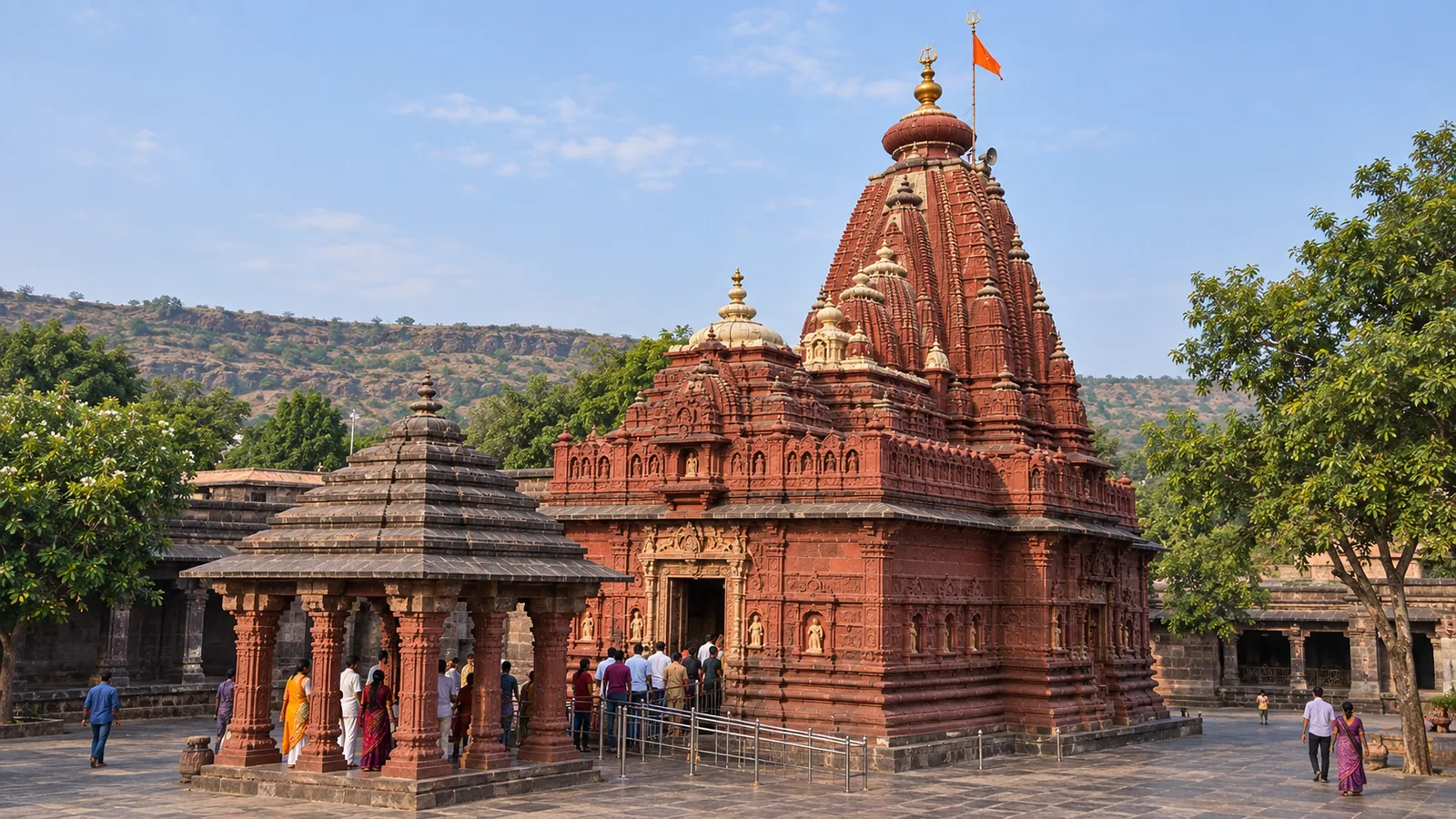
Where the Journey of Twelve Ends: A Red-Stone Temple Beside the Caves
Come to Verul from the city in the early morning and the road tells you the story before anyone else does. First the hill-fort of Devagiri lifts its conical head above the plain — the same Devagiri near which, the Shiva Purana says, a brahmin named Sudharma once lived with two wives. Then the road climbs into the Charanandri hills, and the long basalt cliff of Ellora opens on your right, its thirty-four caves cut into the rock face over four centuries. And then, barely a kilometre further, a lane turns off between shops selling bel leaves and coconuts, and a shikhara of dark red stone rises above the village roofs. This is Grishneshwar Jyotirlinga — traditionally the twelfth and final of the twelve Jyotirlingas, and the smallest of them, says Incredible India.
The temple is at once very old and quite young. Its Jyotirlinga is named in the Shiva Purana and, according to Maharashtra Tourism, in the Skanda Purana; the building you walk into was raised largely in the sixteenth and eighteenth centuries by two of the most consequential Hindu rulers of the Deccan — Maloji Bhosale, grandfather of Chhatrapati Shivaji Maharaj, and Ahilyabai Holkar of Indore. It stands in Verul, in Khuldabad taluka of Chhatrapati Sambhajinagar district, Maharashtra — the city and district formerly called Aurangabad — about 30 km north-west of the city, and a short walk from the Ellora Caves. Two of Maharashtra's three Jyotirlingas in our series lie in forest and on a river-source; this one lies beside a World Heritage Site.
This is article #12 in our weekly "12 Mondays, 12 Jyotirlingas" journey — and the last. After the sea at Somnath, the hills of Srisailam, the ghats of Ujjain, the island in the Narmada, the snows of Kedarnath, the forest of Bhimashankar, the lanes of Kashi, the river-source at Trimbakeshwar, the healer's courtyard at Baidyanath, the underground sanctum at Nageshwar and the sea-edge at Rameshwaram, the yatra comes to rest at Verul, where the stotra itself comes to rest. You can revisit all twelve abodes on our 12 Jyotirlingas series page.
Grishneshwar Jyotirlinga at a Glance
| Detail | Information |
|---|---|
| Temple | Grishneshwar (Ghrishneshwar) Jyotirlinga Temple, Verul – 431102, Khuldabad taluka, Chhatrapati Sambhajinagar district |
| Deity | Bhagwan Shiva as Grishneshwar / Ghushmeshwar — "the Lord of Ghushma" in the Shiva Purana's own derivation |
| Spiritual status | One of the 12 Jyotirlingas; named last in the Dvadasha Jyotirlinga Stotra as Ghuśmeśaṁ ca Śivālaye — twelfth in the stotra's order and #12 in our series |
| Scriptural source | Shiva Purana, Kotirudra Samhita, chapters 32–33; Maharashtra Tourism also cites the Skanda Purana |
| Location | Verul village, about 30–31 km north-west of Chhatrapati Sambhajinagar city (formerly Aurangabad); roughly 1–1.5 km from the Ellora Caves |
| Temple form | Red volcanic stone in the Hemadpanti manner; five-tiered carved shikhara; 24-pillared hall with Nandi; the Jyotirlinga faces east (Maharashtra Tourism) |
| Rebuilding | 16th century by Maloji Bhosale; 18th-century restoration credited to Ahilyabai Holkar (Maharashtra Tourism) |
| Sacred water | Shivalaya Tirtha — the tank of the katha, within the temple complex according to Incredible India |
| Great days | Mahashivratri (February–March); the Mondays of Shravan |
| Nearest railhead | Chhatrapati Sambhajinagar (CPSN, formerly Aurangabad AWB), about 29 km |
| Nearest airport | Chikalthana airport, Chhatrapati Sambhajinagar (IXU), about 36–40 km on different official pages |
The Meaning of "Grishneshwar": One Name, Many Spellings
The Shiva Purana gives the name its own derivation, and it is the tenderest etymology among the twelve. When Shiva agreed to stay, he told the devotee Ghushma, in the Kotirudra Samhita's words, "I shall stay here in your name. I shall be named Ghuśmeśa." Ghuṣmā + īśa is Ghushmesha, the Lord of Ghushma — the only Jyotirlinga named after a woman who worshipped there. Every other form of the name descends from that one.
Descend it did, through several tongues. Ghushmeshwar is the Purana's form with īśvara in place of īśa. Ghrishneshwar and Grishneshwar are the forms that took hold in Marathi and in English usage, and they are the ones on the signboards. Government pages use them interchangeably and inconsistently: Maharashtra Tourism titles its page Ghrishneshwar and writes Grishneshwar in the body; Incredible India uses Grishneshwar; the district administration writes Ghrishneshwar in one heading and Grushneshwar in the next line. A gloss found in some secondary writing reads Ghrishneshwar as "lord of compassion" — attractive, given the katha, but we could not trace it to any text, so we offer it as a devotional reading rather than an etymology. In Hindi and Marathi the temple is written घृष्णेश्वर most often, and घुश्मेश्वर where the Purana is followed.
On the village: Verul is the Marathi name, and the one UNESCO records in its property description — Khulatabad Taluk, Verul Village. Ellora is the anglicised form of the same place, now attached in everyday speech to the caves alone. When people say "the temple at Ellora" and "the temple at Verul", they mean the same red shikhara.
The Twelfth in the Stotra, the Twelfth in Our Journey
Every Shiva bhakta who recites the Dvadasha Jyotirlinga Stotra ends it here:
हिमालये तु केदारं घुश्मेशं च शिवालये ॥
Himālaye tu Kedāraṁ Ghuśmeśaṁ ca Śivālaye — Kedara in the Himalaya, and Ghushmesha at Shivalaya. Three things are worth noticing. The stotra names the Jyotirlinga Ghushmesha, the Purana's form. It gives its location not as a town but as Shivalaya — which is the name the Purana gives the sacred lake of the katha, as we shall see. And it names Ghushmesha last. The stotra's order is not a ranking of holiness, and our series has said so at every stop where the two orders differed; but at Grishneshwar the stotra's order and ours finally coincide. It is the twelfth in the hymn, the twelfth in the Shiva Purana's narration, and the twelfth in our Monday journey.
One regional count deserves a word. The district administration describes Grishneshwar as one of the five Jyotirlingas of Lord Shiva in Maharashtra. That is how the state counts them: Bhimashankar, Trimbakeshwar and Grishneshwar, whose seats are undisputed, plus Aundha Nagnath in Hingoli district, honoured as Nageshwar, and Parli Vaijnath in Beed district, honoured as Vaidyanath. Our series visited Nageshwar near Dwarka and Baidyanath at Deoghar, and explained in those articles why different regions read the same verse differently. Neither reading cancels the other. A devotee who completes the Maharashtra five and a devotee who completes our twelve have both done what the stotra asks.
The Katha: Ghushma, Sudharma and Sudeha
What follows is sacred tradition, narrated as tradition. The Shiva Purana tells it across two chapters of the Kotirudra Samhita — the thirty-second, on Sudeha and Sudharma, and the thirty-third, on the origin of the Jyotirlinga Ghushmeshwara. No official page publishes a fuller version, and no historical record could confirm or deny a story of this kind. We tell it as the Purana tells it, and we do not shorten the hard part.
In the southern country, near the mountain called Devagiri — which the standard English translation identifies in a footnote with Daulatabad, the fort-hill you pass on the way to Verul — lived a brahmin of the Bharadvaja lineage named Sudharma. His wife Sudeha was devoted to him and to Shiva, but they had no child. The Purana gives the grief a human face: a neighbour mocked Sudeha for her barrenness, and she came home and told her husband that unless he begot a son somehow, she would give up her body. Sudharma resisted; she pleaded; at last he agreed to her plan, and married her younger sister Ghushma.
Ghushma was a bhakta of a particular kind. Every day she made one hundred and one earthen lingas — parthiva lingas, shaped from clay — worshipped each one, and then carried them to a nearby lake and consigned them to the water. She kept this up until she had made and worshipped a hundred thousand lingas. Then, by Shiva's grace, a son was born to her — beautiful, fortunate, endowed with every auspicious quality, says the text. The boy grew, and was married.
And Sudeha's heart turned. The Purana says her jealousy "began to blaze like fire". The kindness that had brought her sister into the house became, in her, resentment that the sister had what she lacked. One night she took a knife to the sleeping young man, killed him, cut the body in pieces, and threw them into the very lake where Ghushma's lingas lay. In the morning the young wife found the blood on the bed and ran weeping to her mother-in-law.
Here is the centre of the katha. Ghushma did not stop. She heard the news, the Purana says, and "did not show signs of grief"; her mind stayed where it always was. She made the day's hundred and one lingas, worshipped them, and walked to the lake to immerse them as she had every morning for years, repeating the names of Shiva. Her reasoning is given in a single line: He who has given this boy will protect him too. When she turned from the water, her son was standing on the bank of the lake, alive.
Then Shiva appeared before her and offered a boon — and in the same breath told her what her sister had done, and raised his trident to kill Sudeha. Ghushma's answer is the reason the temple exists. She asked that her sister be forgiven. Her argument, as the Purana records it, is that sin falls away at the very sight of one who does good to those who harm them — that she would rather be that person than see justice done. Shiva relented. She then asked one more thing: that he remain in that place for the protection of the world, and that he be known by her name. "I shall stay here in your name," he said. "I shall be named Ghushmesha." And the lake, the text says, would from then on be called Shivalaya, the abode of Shiva.
Many Tellings of One Story
Like every living katha, this one has been told in more than one way, and honesty asks us to say so.
- Ghushma or Kusuma? The Shiva Purana names the devotee Ghushma. Incredible India's page tells a much shorter tale in which a devout woman named Kusuma worships a linga under a tamarind tree and a honeybee pours honey on it, after which the linga becomes Shiva himself. The Kusuma name is widespread in Marathi retellings, where Kusuma and Ghushma are treated as the same woman. The bee and the tamarind we could find nowhere else; we record them as the Ministry's telling.
- Knife or drowning? The Purana is explicit that Sudeha killed her nephew with a knife and dismembered the body before throwing it into the lake. Most popular retellings soften this to a drowning, and many omit the daughter-in-law entirely. The softer version loses nothing of the teaching, but it is not what the text says.
- Which Purana? Maharashtra Tourism cites the Shiva Purana and the Skanda Purana; some secondary accounts also attribute a version to the Padma Purana under the name Ghrishna. We verified only the Shiva Purana's text.
- Where was Devagiri? The Purana names it; the translation's footnote points to Daulatabad, about 16 km from the city and well short of Verul. Whether the Purana's Devagiri is that hill or a general name for the region, nobody can prove. It is enough that the tradition has always placed the katha in this country of hills.
What every version shares is the shape that matters: a woman who keeps her daily worship through the worst morning of her life, and who, offered vengeance by God himself, asks for mercy instead. Hold on to that, and the differences of detail need not trouble your devotion at all.
Shivalaya Tirtha: The Lake in the Katha
The lake into which Ghushma immersed her lingas is, in the Purana, renamed by Shiva himself — Shivalaya, the abode of Shiva — and the stotra fixes the Jyotirlinga's address by it: Ghushmesham cha Shivalaye. Today a tank within or beside the temple complex carries the name Shivalaya Tirtha. Incredible India describes it as "the Shivalaya Teerth, a sacred tank within the temple complex", and Maharashtra Tourism records that devotees take a holy dip in the sacred pond before entering the sanctum, believing it purifies them.
The Purana attaches promises to it. Shiva says the lake shall yield desires by its mere sight, and that those who worship at Ghushmesha gain worldly happiness and liberation. These are the words of tradition, reported as tradition. They are promises a devotee holds in faith; they are not a claim this article makes about what water does to a body or a life. We say the same here that we said at the twenty-two theerthams of Rameshwaram and the healer's courtyard of Baidyanath: no bath and no darshan is a treatment, and no article should pretend otherwise. If you are ill, see a doctor, and then, if you wish, go to Verul.
A practical caution follows from the sources' silence. Neither official page says whether bathing is currently permitted in the tank, whether it is a bathing ghat or a walled reservoir, or what its condition is in the dry months. Ask at the temple, and do not enter any water where local people are not entering it.
What History Records: Rashtrakutas, Maloji Bhosale and Ahilyabai Holkar
Two cautions shape this section. First, the temple publishes no inscriptions, records or official history that we could find — there appears to be no trust-run website, and the government pages that describe the temple do not cite documents. Second, the government pages disagree with each other. We print the disagreements rather than average them.
Antiquity. Incredible India states that the temple's construction began "in the 6th century, during the reign of the illustrious Rashtrakuta dynasty" and was completed in the eighteenth. Take the date with care: the Archaeological Survey of India dates Rashtrakuta activity at Ellora to the mid-eighth century — Dantidurga's inscription in Cave 15 is placed at c. 753–757 CE and the Kailasa is attributed to Krishna I (c. 757–783 CE) — and no source names the Rashtrakuta patron of a Grishneshwar shrine. What is safe to say is that a Shiva temple at Verul is plausibly as old as the Hindu caves beside it, and that the Purana that names it was, in the form we have, compiled well before the Marathas.
Destruction. Maharashtra Tourism records that the temple "faced numerous challenges, including destruction during the 13th and 14th centuries under the Delhi Sultanate" — the same centuries in which Devagiri fell to Alauddin Khalji's forces and was renamed Daulatabad under Muhammad bin Tughluq, who moved his capital there in 1327. No source dates the destruction more precisely, and none describes what stood before it.
Maloji Bhosale, sixteenth century. The first rebuilding on record belongs to Maloji Bhosale, "the grandfather of the legendary Maratha warrior king, Chhatrapati Shivaji Maharaj", in Maharashtra Tourism's words. Maratha tradition connects the Bhosale family closely with Verul itself, and a much-loved story says Maloji found a buried treasure near the village and spent it on the temple and its tank. The connection is historical; the treasure is tradition, and we mark it so. No government page gives a year for the work.
Ahilyabai Holkar, eighteenth century. The temple's "current grandeur", Maharashtra Tourism says, "owes much to the 18th-century restoration efforts of Queen Ahilyabai Holkar of Indore" — the same ruler our series met at Somnath, Kashi Vishwanath and Omkareshwar, and the reason so many of the twelve look the way they do. Here too, read the fine print: some secondary accounts name Gautama Bai Holkar, Ahilyabai's mother-in-law, and a date of 1729, which would be a generation earlier and before Ahilyabai's rule (1767–1795). Both attributions may be partly true of different phases of work. Without the trust's own records, we can say only that the temple as it stands is a Holkar-era building on Maloji's foundations, and that Ahilyabai is the name the state's own tourism department gives it.
Protection. Some regional descriptions call the temple a nationally protected site, but we could not find it on a published ASI list of centrally protected monuments in the district, and no official page we consulted states its protection status. The Ellora Caves beside it are managed by the ASI and were inscribed by UNESCO in 1983 under criteria (i), (iii) and (vi). The temple itself is a functioning place of worship run by a temple trust, which is why its rules are the trust's to make.
The Temple Today: Red Stone, Five Tiers and Twenty-Four Pillars
Everything visible about the temple today is described in one paragraph of Maharashtra Tourism's page, and it is worth reading closely.
The stone. The temple is "constructed from striking red volcanic rock" — the same Deccan basalt from which the caves next door were carved, here quarried and dressed into blocks rather than hollowed out. In morning and late-afternoon light the colour deepens to the shade of wet brick, which is why the temple photographs so differently at different hours.
The style. Maharashtra Tourism calls it Hemadpanti, a Deccan manner "characterised by its intricate carvings and robust structures", named after Hemadpant, the thirteenth-century minister of the Yadava kings of Devagiri. Its hallmark is dressed stone fitted without mortar. Incredible India instead describes "an awe-inspiring blend of South Indian and North Indian styles" — not a contradiction so much as a different vocabulary: a Deccan temple sits between the two great traditions and borrows from both.
The shikhara. The temple "boasts a five-tiered shikhara (spire) adorned with detailed sculptures depicting various deities and mythological scenes". Visitors and secondary accounts describe panels of the Dashavatara, Vishnu's ten incarnations, carved in the red stone on the outer walls — fitting beside a cave complex whose Cave 15 is itself named Dashavatara.
The hall. Within the complex "a spacious court hall rests upon 24 pillars, each embellished with carvings that narrate legends of Lord Shiva". This is the sabhamandapa, where pilgrims wait and where, Maharashtra Tourism records, "a prominent statue of Nandi" stands, facing the sanctum. Incredible India adds the one living monument in the courtyard: "a venerable Audumbar tree, believed to be over 300 years old".
The sanctum. The garbhagriha "houses the revered Jyotirlinga, facing east", which the department reads as "symbolising the infinite nature of Shiva". It is a small chamber — Incredible India calls this the smallest of the Jyotirlingas — and on ordinary mornings the linga is a few feet away.
Compact, then, by the standards of the twelve: no thousand-pillared corridor, no three-storeyed hall, no underground descent. Grishneshwar's beauty is the beauty of a well-made thing in one material, in one colour, doing one job.
Darshan at Grishneshwar: Timings, Abhishek and the Rules of the Sanctum
Timings, with the source named. Incredible India gives opening at 5:30 am and closing at 9:30 pm, with aartis at 5:30 am, 12:00 noon, 7:00 pm and 9:30 pm. Unofficial listings — several of which style themselves "official" — give a midday closure of roughly noon to 1 pm, a closing time of 9:00 pm, or an evening session from 4 pm. Maharashtra Tourism publishes no hours at all. We could not locate a website of the temple trust, and no page we found carries a revision date. Confirm at the temple; treat any third-party "online booking" site with caution unless the temple itself directs you to it.
The rule of the sanctum. Maharashtra Tourism records "a unique tradition observed here" that "requires male devotees to enter the inner sanctum bare-chested as a mark of humility and respect". Incredible India puts it as a request: "Men are requested to remove their shirts before entering." Two things should be said plainly. First, this is a real and long-standing custom, reported by the state and the Union tourism bodies alike, and it applies to the garbhagriha, not to the courtyard or the hall. Second, rules of this kind are set by the temple administration and can change; on crowded festival days the sanctum may be closed to individual entry altogether. Follow the staff, and carry a small towel or shawl. Belts and leather are commonly reported as left outside too.
Women. No official source we consulted restricts women's entry to the temple or the sanctum, and we make no such claim. Secondary reports say women enter the sanctum for darshan in modest traditional dress. As always, the arrangement on the day is the temple's.
Touching the linga. Incredible India records that "devotees are allowed to directly touch the Shiva Linga with their bare hands, a rare privilege" — rare indeed among the twelve, where most sanctums keep the linga behind a rail. Expect this to be regulated or suspended on crowded days.
Abhishek and poojas. Maharashtra Tourism lists the rituals devotees perform here: Panchamrut Pujan, Rudra Abhishek and the Mahamrityunjay Jaap. Arrangements and charges are made at the temple's own counter; no official page publishes a tariff, and no official page offers online booking. Pay nothing in advance to a stranger who promises a quick darshan.
Phones, cameras, footwear. Photography and mobile phones are widely reported as prohibited inside, with lockers outside; no official page says so, but assume it. Footwear is left at the entrance, and the stone courtyard is hot by mid-morning in summer.
Mahashivratri and Shravan at Verul
Mahashivratri is the temple's greatest night. Maharashtra Tourism describes night-long vigils, chanting and special poojas, the temple "adorned with vibrant decorations", and pilgrims arriving "from across the country". It falls on the fourteenth night of the dark fortnight of Phalguna (or Magha, by the Amanta reckoning used in Maharashtra) — "usually in February or March", as the department says. Most panchangs place the next one on Saturday, 6 March 2027; check your own before you book. Expect very long queues, a regulated sanctum, and arrangements that differ from year to year.
Shravan is the other high season. Maharashtra follows the Amanta calendar, so its Shravan begins about two weeks after the North Indian Purnimanta Shravan and runs roughly from late July or August into August or September; the Shravan Mondays draw the largest crowds of the year outside Shivratri. Unofficial listings report greatly extended hours in Shravan — early-morning opening and late closing — and we have no way to confirm them. Nearby, Incredible India notes, the Bhadra Maruti temple at Khuldabad fills on the Saturdays of Shravan, so the whole Verul–Khuldabad road is busy through the month.
Two honest notes. The temple publishes no festival calendar that we could find, so we print none. And our own series was published across the Shravan and Bhadrapada of 2026; if you are reading this on the day it appears, the next Shravan at Verul is the summer of 2027.
How to Reach Grishneshwar from Chhatrapati Sambhajinagar
Names first, because they have changed. The city of Aurangabad was officially renamed Chhatrapati Sambhajinagar in 2023, and the district with it. The railway station followed on 25 October 2025, when Aurangabad (AWB) became Chhatrapati Sambhajinagar (CPSN) under the Nanded division of South Central Railway. The airport at Chikalthana, long recorded as Aurangabad Airport, received the Ministry of Civil Aviation's approval to be called Chhatrapati Sambhajinagar Airport in December 2025, and the Airports Authority of India's own page now carries that name — though the renaming was briefly put on hold and some booking systems still show the old one. The IATA code, IXU, has not changed. Government tourism pages, including Incredible India and Maharashtra Tourism, still print "Aurangabad Railway Station (AWB)"; do not be confused by it.
By air. Fly to IXU. The airport is about 5.5 km east of the city centre; from there the district administration puts the temple at around 36 km and Maharashtra Tourism's temple page at about 40 km — its Ellora page says 36. Taxis are available at the airport; fix the fare, or book a return, since Verul has few taxis of its own.
By rail. Trains to Chhatrapati Sambhajinagar (CPSN) on the Manmad–Secunderabad line connect the city with Mumbai, Pune, Hyderabad, Nagpur and beyond. The station is about 29 km from Verul according to both the district administration and Maharashtra Tourism. We print no train numbers or timings — check IRCTC or the National Train Enquiry System (139), and search under the new name if the old one returns nothing.
By road. Verul lies on the road the ASI calls the Aurangabad–Chalisgaon road, 30–31 km north-north-west of the city. Maharashtra State Road Transport buses run to Ellora from the city's bus stands, and, in the district's words, the temple "can be visited by State Transport Bus or Private Taxi". Autos and shared vehicles cover the last kilometre between the caves' car park and the temple, or you can walk it. The district puts the city about 300 km east-north-east of Mumbai; Pune and Shirdi are the other common starting points, and many pilgrims combine Shirdi, Trimbakeshwar and Grishneshwar in one circuit — we print no distances we could not source.
Ellora Caves and the Kailasa Temple: Neighbours, Not the Same Site
Because the two sites share a village and a car park, first-time visitors often conflate them. They should not. Grishneshwar Temple is a living Hindu shrine with daily worship, rebuilt in dressed red stone by Maratha and Holkar patrons, run by a temple trust, open every day and free to enter. The Kailasa Temple is Cave 16 of the Ellora Caves: a monument carved downward out of the living cliff in the eighth century, managed by the Archaeological Survey of India, ticketed, and closed every Tuesday. Worship is not conducted there. A ticket to one has nothing to do with the other, and the bare-chest rule of the sanctum has nothing to do with the caves.
That said, no pilgrim to Grishneshwar should skip Ellora, and this is what the official sources say about it. UNESCO describes 34 monasteries and temples extending over more than 2 km, dug into the wall of a high basalt cliff, with "an uninterrupted sequence of monuments dating from A.D. 600 to 1000" that illustrates "the spirit of tolerance that was characteristic of ancient India". Its brief synthesis divides them into three groups: the Buddhist caves 1–12, excavated between the fifth and eighth centuries; the Brahmanical caves 13–29, including Kailasa, between the seventh and tenth; and the Jain caves 30–34, between the ninth and twelfth. The ASI adds that nearly a hundred caves exist in the hill range, of which these 34 are the ones visited.
Cave 16, Kailasa, the ASI attributes to the Rashtrakuta king Krishna I (c. 757–783 CE) and calls the "largest single monolithic excavation in the world". UNESCO calls it "the largest monolithic temple" and "the culmination of rock-cut architecture in India", singling out the sculpture of Ravana attempting to lift Mount Kailasa and the remains of paintings on the ceilings of the front mandapa. Standing in its courtyard, remember that everything above your head was once solid hill: the builders began at the top and cut down, removing the rock around a temple they could already see in their minds. Other caves the official synthesis names are Cave 10, Vishvakarma (the Carpenter's cave), Cave 12, Teen Tal (the three-storeyed monastery), Cave 15, Dashavatara, Cave 21, Rameshvara and Cave 29, Dumar Lena.
Practicalities, per the ASI: open sunrise to sunset, closed on Tuesday; entry ₹40 for Indian, SAARC and BIMSTEC visitors (₹35 online) and ₹600 for others (₹550 online); free for children under 15. Maharashtra Tourism warns that the caves can be slippery in the monsoon and hot above 35°C in summer, and recommends arriving early. Plan darshan at Grishneshwar for the early morning and the caves afterwards — or, on a Tuesday, plan the caves for another day.
Sacred and Notable Places Near Verul
Bhadra Maruti Temple, Khuldabad — About 4 km from the Ellora Caves, per Incredible India, in the small town of Khuldabad on the road back towards the city. Its Hanuman is in the reclining bhava-samadhi posture, one of very few such images in India, and tradition holds it to be self-manifest and discovered by Samarth Ramdas. Incredible India gives hours of 6:00 am to 8:00 pm and notes the Saturday crowds of Shravan. Khuldabad is also, as a matter of record, the town where the Mughal emperor Aurangzeb was buried in 1707 in a deliberately plain grave, and it holds several Sufi dargahs; the town's older name, the page says, was Bhadravati.
Daulatabad / Devgiri Fort — About 16 km from the city, on the road to Ellora, on a conical hill about 200 metres high. Maharashtra Tourism titles its page "Devgiri / Daulatabad" and records the essentials: built in the twelfth century by Bhillama V of the Yadava dynasty, the capital of the Yadavas, then in 1327 the destination of Muhammad bin Tughluq's failed transfer of his capital from Delhi. Its Chand Minar the department gives as 30 metres on one page and 64 metres on another — attribute whichever you quote. The state's tourism minister announced in 2022 a proposal to restore the name Devgiri; the fort remains an ASI monument and is signposted under both names. This is the hill the Shiva Purana's translators identify with the Devagiri of the katha.
Bibi Ka Maqbara — About 3 km from the city centre per the district administration, the "Taj of the Deccan" in white and stucco, built in the 1650s–1670s in memory of Aurangzeb's wife Dilras Banu Begum, Rabia-ud-Daurani. On who commissioned it the same department contradicts itself — Maharashtra Tourism's Ellora page says Aurangzeb, its Devgiri page says his son Azam Shah in memory of his mother — and Incredible India says Aurangzeb in 1679. Incredible India gives hours of 8:00 am to 8:00 pm.
Aurangabad Caves — Buddhist caves cut into the hills behind Bibi Ka Maqbara, "carved between the 6th and 8th centuries", Maharashtra Tourism says, and much quieter than Ellora.
Panchakki — A seventeenth-century water mill in the city, driven by a water channel from a distance; Maharashtra Tourism and Incredible India both list it.
Ajanta Caves — Incredible India puts them about 100 km from the city; a separate day, and, note, closed on Mondays rather than Tuesdays. Together with Ellora they form the region's two World Heritage Sites.
Trimbakeshwar and Bhimashankar — Maharashtra's other two undisputed Jyotirlingas, which our series has already visited: Trimbakeshwar near Nashik, and Bhimashankar in the Sahyadri forest. Many pilgrims complete the three in one journey.
Best Time to Visit Grishneshwar
- October to March — Maharashtra Tourism's recommendation for the temple and for Ellora alike, "cool and pleasant", with daytime temperatures it gives as 15°C to 30°C. Incredible India's destination page narrows it to November to March. Attribute the window; both are current.
- February to early March — Within that window, the season of Mahashivratri: the greatest devotion, and the greatest crowds. Book accommodation in the city well ahead.
- June to September (the monsoon and Shravan) — Maharashtra Tourism calls the landscape "lush green" and the caves potentially slippery. Shravan Mondays and Khuldabad's Shravan Saturdays fill the road. Carry rain protection and expect queues.
- April to June — Temperatures "can soar above 35°C", the department warns, and the red-stone courtyard and the cave paths both hold the heat. Darshan at dawn; caves early or not at all.
Safety and Official Guidance
- Verify before you travel. No official source publishes a revision-dated set of timings, rules or tariffs for this temple, and we could not find a temple-trust website. Confirm hours, sanctum arrangements and abhishek procedures at the temple itself, and treat third-party sites — including those that call themselves official — as unverified.
- Respect the sanctum's customs. Men should expect to remove upper garments before entering the garbhagriha, and everyone should dress modestly; follow temple staff on the day, since rules can change and crowd arrangements override normal practice.
- At Shivalaya Tirtha and any water, enter only where local devotees are entering and where the temple permits; no official page describes depth, steps or supervision.
- At Ellora, remember Tuesday closure, sunrise-to-sunset hours and the ASI ticket; paths are uneven and slippery in rain, and the caves are unlit inside.
- Heat and stone. Footwear is left outside the temple; by mid-morning in summer the paving burns. Carry water, cover your head, and keep children and elders in the shade of the hall.
- Crowds and money. On Mahashivratri and Shravan Mondays expect very long queues and closed or regulated sanctum entry. Use the official line, keep valuables minimal, and pay no one in advance for "special" darshan.
- Names on tickets. Search rail bookings under Chhatrapati Sambhajinagar (CPSN) and flights under IXU, whichever airport name the site shows.
What Grishneshwar Teaches Us Today
Every tirtha carries a teaching, and the twelfth carries the one that is hardest to live.
Ghushma's worship is not the miracle of the story. Her worship is ordinary — clay, water, a hundred and one small lingas, the same walk to the same lake every morning. The miracle is that she did it on the morning after. Most of us can pray when life is kind; the katha asks what happens to the practice when the practice is all that is left. Her answer — the one who gave will protect — is not resignation. It is the refusal to let grief decide what she does with her hands. Sanatan dharma has a word for a discipline like that: nitya, daily, unconditional. The Purana's promise is not that such a discipline undoes every loss. It is that Shiva notices.
Then the trident. God offers Ghushma exactly what any of us would want in her place, and she says no. Sudeha is not sympathetic; the text does not soften her. The forgiveness is granted anyway, and it is granted by the victim, not by an onlooker — and for a reason Ghushma states plainly: she would rather be the kind of person whose presence dissolves sin than the kind whose grievance is satisfied. The Jyotirlinga is the reward not of her lingas but of her mercy. The last of the twelve is named after a woman who forgave. That is worth sitting with in a courtyard of red stone.
And the temple itself teaches a quieter lesson, one this whole series has kept meeting. Grishneshwar was destroyed, rebuilt by a Maratha grandfather, and restored by a Holkar queen, in a village whose cliff holds three religions' sanctuaries side by side. A Jyotirlinga, we have learned twelve times over, is not a building. It is a place people keep returning to, and rebuilding, because something there was found to be true.
Twelve Mondays, Twelve Jyotirlingas: The Journey Completed
On the first of our twelve Mondays we stood on the shore at Somnath, where the moon is said to have regained his light, and we said that a Jyotirlinga was a pillar of light that the eye cannot see but the pilgrim can walk to. We have walked to twelve. From the Arabian Sea to the sea at Rameshwaram, from the snows of Kedarnath to the Sahyadri forest of Bhimashankar; from the lanes of Kashi and the ghats of Ujjain to the island in the Narmada; from Srisailam's hills to Deoghar's courtyard to Dwarka's underground room, and now to a village in the Deccan where the caves and the temple share a car park. Three of the twelve stand in Maharashtra, two in Gujarat, two in Madhya Pradesh, and one each in Andhra Pradesh, Uttarakhand, Uttar Pradesh, Jharkhand and Tamil Nadu. Twelve different stones, one Shiva.
Some patterns emerged that no single article could show. Nearly every one of the twelve was broken and rebuilt, several of them by the same two hands — Ahilyabai Holkar's and the Marathas' — in the same half-century. Nearly every one has a katha in which a devotee's unconditional practice, not a king's power, brings God to stay. Several have more than one claimed seat, and each time we found that the tradition survived the disagreement. And every one of the twelve publishes fewer verified facts than the internet claims about it, which is why this series so often said ask at the temple — and will say it one last time now.
We claim nothing for having written this, and you should claim nothing for having read it. Twelve articles are not a yatra, and even a yatra is not a guarantee of anything — not of healing, not of prosperity, not of forgiveness, not of liberation. Those belong to the tradition's promises and to Shiva, not to us. What we can honestly say is smaller and, we think, enough: these twelve places exist, they have been loved for a very long time, and a person who goes to them with the attention Ghushma brought to her clay will not come back unchanged.
If you go to Verul, go early. Bow at the red shikhara, then walk the kilometre to the cliff and stand in the Kailasa courtyard, and let the two tell you the same thing in two languages. Then come home, and make something small with your hands tomorrow morning, whatever the morning brings.
Om Namah Shivaya.
Sources and Official References
- Maharashtra Tourism, Government of Maharashtra — Ghrishneshwar Temple
- Maharashtra Tourism — Ellora Caves
- Maharashtra Tourism — Devgiri / Daulatabad Fort
- Incredible India, Ministry of Tourism — Grishneshwar Temple
- Incredible India — Ellora Caves
- Incredible India — Chhatrapati Sambhaji Nagar destination
- Incredible India — Bhadra Maruti Temple, Khuldabad
- Incredible India — Bibi Ka Maqbara
- District Chhatrapati Sambhajinagar — Ellora Leni and Ghrishneshwar Jyotirlinga Temple, Verul
- District Chhatrapati Sambhajinagar — Tourist Places
- UNESCO World Heritage Centre — Ellora Caves
- Archaeological Survey of India — World Heritage Site: Ellora Caves
- Airports Authority of India — Chhatrapati Sambhajinagar Airport
- Shiva Purana, Kotirudra Samhita, ch. 32 — The narrative of Sudeha and Sudharma (Wisdom Library, J. L. Shastri translation)
- Shiva Purana, Kotirudra Samhita, ch. 33 — Origin and glory of the Jyotirlinga Ghushmeshvara
Frequently Asked Questions
Where is Grishneshwar Jyotirlinga, and how far is it from Ellora and the city?
Grishneshwar Jyotirlinga stands in Verul village, Khuldabad taluka, in Chhatrapati Sambhajinagar district of Maharashtra — the district formerly called Aurangabad. It is about 30–31 km north-west of the city by road, according to the district administration and Maharashtra Tourism, and roughly 1–1.5 km from the entrance of the Ellora Caves — the district page calls it a kilometre's walk from the caves. The temple and the caves are two separate sites with separate managements.
Is Grishneshwar really the twelfth and final Jyotirlinga?
In the most widely recited order, yes. The Dvadasha Jyotirlinga Stotra closes with the line Himalaye tu Kedaram Ghushmesham cha Shivalaye, placing Ghushmesha twelfth and last. Maharashtra Tourism and Incredible India both call it the 12th and final Jyotirlinga, and the Shiva Purana narrates it last in its Kotirudra Samhita. Our series follows the same order, which is why this is article #12 and the conclusion of the '12 Mondays, 12 Jyotirlingas' journey.
Grishneshwar, Ghrishneshwar or Ghushmeshwar — which name is correct?
All three are in use, and none is wrong. The Shiva Purana calls the Jyotirlinga Ghushmesha or Ghushmeshwar, after the devotee Ghushma. Maharashtra Tourism spells it Ghrishneshwar in its page title and Grishneshwar in its text; Incredible India uses Grishneshwar; the district administration uses Ghrishneshwar and Grushneshwar. In Hindi and Marathi the common forms are घृष्णेश्वर and घुश्मेश्वर. This article uses Grishneshwar for the temple and Ghushmesha where the Purana is quoted.
What is the story of Ghushma at Grishneshwar?
The Shiva Purana's Kotirudra Samhita (chapters 32–33) tells it as sacred tradition. Near Devagiri lived the brahmin Sudharma and his wife Sudeha, who was childless. At her urging he married her younger sister Ghushma, a devotee who made 101 earthen Shiva lingas every day and immersed them in a nearby lake. A son was born to her; Sudeha's jealousy grew until she killed the young man and threw his body into the lake. Ghushma continued her worship unshaken, found her son alive on the bank, and when Shiva appeared she asked him to forgive her sister. He remained there as Ghushmesha.
What are the darshan timings and rules at Grishneshwar temple?
Incredible India, a Ministry of Tourism site, gives opening at 5:30 am and closing at 9:30 pm, with aartis at 5:30 am, 12 noon, 7 pm and 9:30 pm; unofficial listings differ on a midday break and closing time, and we could not find a temple-trust website to settle it. Maharashtra Tourism records a tradition that male devotees enter the inner sanctum bare-chested. No official source we consulted restricts women's entry. Phones and cameras are widely reported as not allowed inside. Confirm all of this at the temple on the day.
Do men have to remove their shirts to enter the sanctum?
That is the reported custom. Maharashtra Tourism describes a unique tradition that requires male devotees to enter the inner sanctum bare-chested as a mark of humility and respect, and Incredible India says men are requested to remove their shirts before entering. Such rules are set and changed by the temple administration, not by tourism websites, so treat this as the likely practice, follow the instructions of temple staff, and carry a shawl or towel in case one is asked for.
Are Grishneshwar Temple and the Kailasa Temple at Ellora the same place?
No. Grishneshwar is a living Shiva temple with daily worship, rebuilt in red stone in the 16th–18th centuries and run by a temple trust. The Kailasa Temple is Cave 16 of the Ellora Caves, a monolithic rock-cut monument attributed by the Archaeological Survey of India to the Rashtrakuta king Krishna I (c. 757–783 CE), managed by the ASI, ticketed, and closed on Tuesdays. They stand about a kilometre apart and are usually visited on the same day, but a ticket for one has nothing to do with the other.
How do I reach Grishneshwar by air, rail and road?
The airport is at Chikalthana in Chhatrapati Sambhajinagar (IATA code IXU), which the district puts about 36 km from the temple and Maharashtra Tourism about 40 km; it has long been called Aurangabad Airport, and the Ministry of Civil Aviation approved its renaming as Chhatrapati Sambhajinagar Airport in December 2025, so booking sites may show either name. The railway station was renamed Chhatrapati Sambhajinagar (new code CPSN, formerly AWB) on 25 October 2025 and is about 29 km away. State transport buses and taxis run from the city to Ellora and Verul.
When is the best time to visit, and what happens at Mahashivratri and Shravan?
Maharashtra Tourism recommends October to March; Incredible India's destination page says November to March. The monsoon is green but the Ellora caves can be slippery, and summer afternoons exceed 35°C. Mahashivratri, usually in February or March, brings night-long vigils and by far the largest crowds — most panchangs place the next one on Saturday 6 March 2027; verify with yours. The Shravan Mondays, reckoned in Maharashtra by the Amanta calendar, are the other high season. Festival arrangements and extended hours change every year; ask the temple before travelling.


