
Where Shiva Stayed Back as the Healer
There is a month every year when an entire landscape in eastern Bharat turns saffron. From Sultanganj on the Ganga, a river of walking pilgrims (bare feet, water-pots swinging from decorated kanwars, the air ringing with "Bol Bam!") flows south for a hundred kilometres and more, through villages and forests, toward a small town whose very name means the abode of the gods: Deoghar. At the centre of that town, within a courtyard of white shikharas tied together with red sacred threads, waits the one they have walked all this way to bathe: Baba Baidyanath.
The Baidyanath Jyotirlinga, also written Vaidyanath, is one of the twelve Jyotirlingas of Bhagwan Shiva, and among them it carries the tenderest of his names: the Lord of healers, the divine physician. The linga here is lovingly called the Kamana Linga, the fulfiller of wishes. People do not come to Deoghar merely to see God. They come to be healed by him, of grief, of illness, of longing, of the thousand invisible wounds a life collects, and they have been coming for a very long time.
This is article #9 in our weekly "12 Mondays, 12 Jyotirlingas" journey. After the sea at Somnath, the hills of Srisailam, the ghats of Ujjain, the island in the Narmada, the snows of Kedarnath, the forest of Bhimashankar, the lanes of Kashi and the river-source at Trimbakeshwar, the yatra now turns east, to the land where Shiva stayed back as a healer.
Baidyanath Jyotirlinga at a Glance
| Detail | Information |
|---|---|
| Temple | Baba Baidyanath Temple, Baba Baidyanath Dham (Babadham) |
| Deity | Bhagwan Shiva as Baidyanath, "the Lord of healers" |
| Spiritual status | One of the 12 Jyotirlingas of Bhagwan Shiva |
| The linga | Revered as the Kamana Linga, the wish-fulfilling linga |
| Also revered as | A Shakti Peetha (by tradition, where Mata Sati's heart fell) |
| Location | Deoghar, Santhal Parganas region, Jharkhand |
| Temple complex | Main shrine surrounded by some twenty-one temples |
| Architecture | Stone shikhara about 72 feet high, crowned with the panchshula |
| Present structure | Parts of the temple front are attributed to Raja Puran Mal of Gidhaur, 1596 CE |
| Great gathering | Shravani Mela: Kanwar Yatra from Sultanganj, roughly 108 km |
| Nearest railheads | Jasidih Junction (about 7 km); Baidyanath Dham station in town |
| Nearest airports | Deoghar Airport; Patna, Ranchi and Kolkata for wider connections |
The Meaning of "Baidyanath"
Baidyanath is the eastern voice of Vaidyanath: in the speech of Bihar, Bengal and Jharkhand, the Sanskrit va softens naturally into ba, so Vaidyanath becomes Baidyanath and the affectionate short form Baijnath. The name itself is made of two words: vaidya, the physician, and nath, the lord. Vaidyanath is the Lord of healers, the divine physician.
The name is no poetic flourish. It rises straight out of this tirtha's katha, in which Shiva restored the severed heads of his fiercest devotee, mending flesh and life the way a vaidya mends a wound. And it rises out of something older still: the Vedic tradition salutes Rudra as the first divine physician, the healer of healers, whose very glance is medicine. At Deoghar that ancient intuition has a home and a name.
Every pilgrim who walks to Babadham carries some ailment: of body, of circumstance, of heart. The name over the door tells them they have come to the right place.
The Katha of Baidyanath: Ravana's Tapasya and the Linga That Would Not Move
The story of this Jyotirlinga, told in the Shiva Purana and cherished across eastern Bharat, belongs, remarkably, to Ravana, the ten-headed king of Lanka, the greatest and most dangerous devotee Shiva ever had.
Ravana, tradition says, wished for the ultimate prize: that Shiva himself should leave Kailash and dwell in Lanka, making his island kingdom invincible and holy at once. He went to the mountains and performed tapasya of terrifying intensity. When austerity alone did not bring the Lord, Ravana began offering the only wealth he truly owned: himself. One by one he cut his ten heads and laid them before the linga. As the tenth was about to fall, Mahadev appeared, moved as only he can be moved by extremity of devotion. And then Shiva did the thing that gave this tirtha its name: he restored all ten heads, joining them whole and unhurt, healing his devotee like a physician. The Lord who was pleased became, in that moment, Vaidya-nath.
Shiva granted the boon. He gave Ravana a linga, his own presence in stone, to carry to Lanka, with a single condition: the linga must not be set down on the earth anywhere along the way. Wherever it touched the ground, there it would remain, forever.
The devas watched in alarm. Were Shiva to settle in Lanka, Ravana's power would be beyond all restraint, and the order of the worlds would tilt. So the play began, as it always does. By the devas' design (some tellings say Varuna entered Ravana's body through the water he had sipped, others credit young Ganesha's mischief), an unbearable urge to relieve himself seized Ravana as he crossed the land that is now Jharkhand. He could not hold the linga and could not set it down. Just then a boy appeared on the empty path (a cowherd in some tellings, Ganesha or Vishnu himself in disguise in others), and Ravana, desperate, pressed the linga into his hands: hold it, only for a moment, do not put it down.
The moment stretched. The boy called out once, twice, thrice, and then, as Ravana tarried, set the linga gently on the earth. When Ravana returned, it had rooted. He gripped it with all the strength that had once shaken Kailash itself; the linga did not stir. In his frustration he pressed it down with his thumb, and then, recognising the will of the Lord in what had happened, he bowed, worshipped, and went home to Lanka with empty hands and a full heart. Tradition holds that he returned again and again to offer worship at the place where Shiva had chosen to stay.
Local tradition adds a gentle sequel. Ages later, the linga stood forgotten in the forest (the old names of this land, tradition remembers, include Haritakivan and Chitabhoomi) until a simple cowherd named Baiju found it and began to worship it every day in his own artless way. Pleased with that unlettered love, the Lord took his devotee's name: Baijnath, the lord of Baiju. So the same linga bears two names: one earned by healing the mightiest of kings, the other by accepting the daily flowers of a herdsman.
It is worth pausing on what this katha actually teaches. Ravana's devotion was real, so real that Shiva himself came, healed him and agreed to go with him. What failed was not his bhakti but his wish to possess the Lord, to carry the infinite home as a trophy for his own kingdom's glory. The linga stayed where it chose to stay: in an unfamous forest, with a nameless boy, for everyone. Shiva can be invoked, adored, even carried; he cannot be owned. And the healer who mended ten severed heads left one wound untreated, because only Ravana could treat it: the ego. That wound, the katha quietly says, each of us must bring to Baidyanath ourselves.
Why Baidyanath Is Special Among the Jyotirlingas
A Jyotirlinga is a place where Shiva is worshipped not as an image shaped by human hands but as jyoti, a self-manifest pillar of light and consciousness. There are twelve such supreme abodes across Bharat; follow the whole journey in our 12 Jyotirlingas series. Baidyanath is article #9 in this Monday series (our travelling order, not a claim about the traditional list). Several things set this Jyotirlinga in Jharkhand apart:
- Jyotirlinga and Shakti Peetha together. By tradition, Deoghar is the Hridaya Peetha, the Chitabhoomi where the heart of Mata Sati fell. Shiva and Shakti dwell in one courtyard here, and the red gathbandhan threads tied between the shikharas of the Baba Baidyanath and Mata Parvati temples proclaim their union to every pilgrim who looks up. Very few tirthas on earth hold both a Jyotirlinga and a Shakti Peetha.
- The Kamana Linga. The Jyotirlinga of Deoghar is revered as the wish-fulfilling linga. The faith is simple and vast: what is asked here with a whole heart is heard.
- The healer's seat. Baidyanath is the Jyotirlinga of Shiva as the divine physician, the aspect of Mahadev to whom people bring their diseases, their griefs and their broken places.
- The closeness of darshan. By long-standing tradition at Babadham, pilgrims offer Ganga jal and bel patra directly upon the linga with their own hands, a nearness many great temples cannot offer. (Arrangements naturally vary on peak days; follow the temple's guidance.)
- The greatest walking pilgrimage of Shravan. The month-long Shravani Mela, fed by the Kanwar Yatra from Sultanganj, makes Deoghar one of the largest congregations of faith in the world, year after year.
One Vaidyanath, More Than One Tradition
Honesty asks us to note it gently: among the twelve, the seat of Vaidyanath is remembered differently in different regional traditions. The Parli Vaidyanath temple in Maharashtra and the Baijnath temple in the Kangra valley of Himachal Pradesh are each honoured in their own traditions as the Vaidyanath Jyotirlinga, and the verses of the Dvadasha Jyotirlinga stotra are read in more than one way.
This article follows the Baba Baidyanath Dham at Deoghar, the seat woven into the Ravana katha of eastern tradition, and one of the most visited Shiva tirthas in all of Bharat. But the disagreement, such as it is, need not trouble a devotee. Light does not quarrel over addresses. Wherever Shiva is called Vaidyanath with faith, the healer answers; a bhakta may bow at Deoghar, at Parli and at Kangra, and be right all three times.
The Temple Complex of Baba Baidyanath Dham
The worship at Deoghar is considered far older than any structure that stands today; the tirtha belongs to Puranic memory, and the land around it carries old sacred names. According to the Deoghar district history, parts of the front portion of the temple are attributed to Raja Puran Mal of Gidhaur, in 1596 CE. The complex expanded in the centuries that followed.
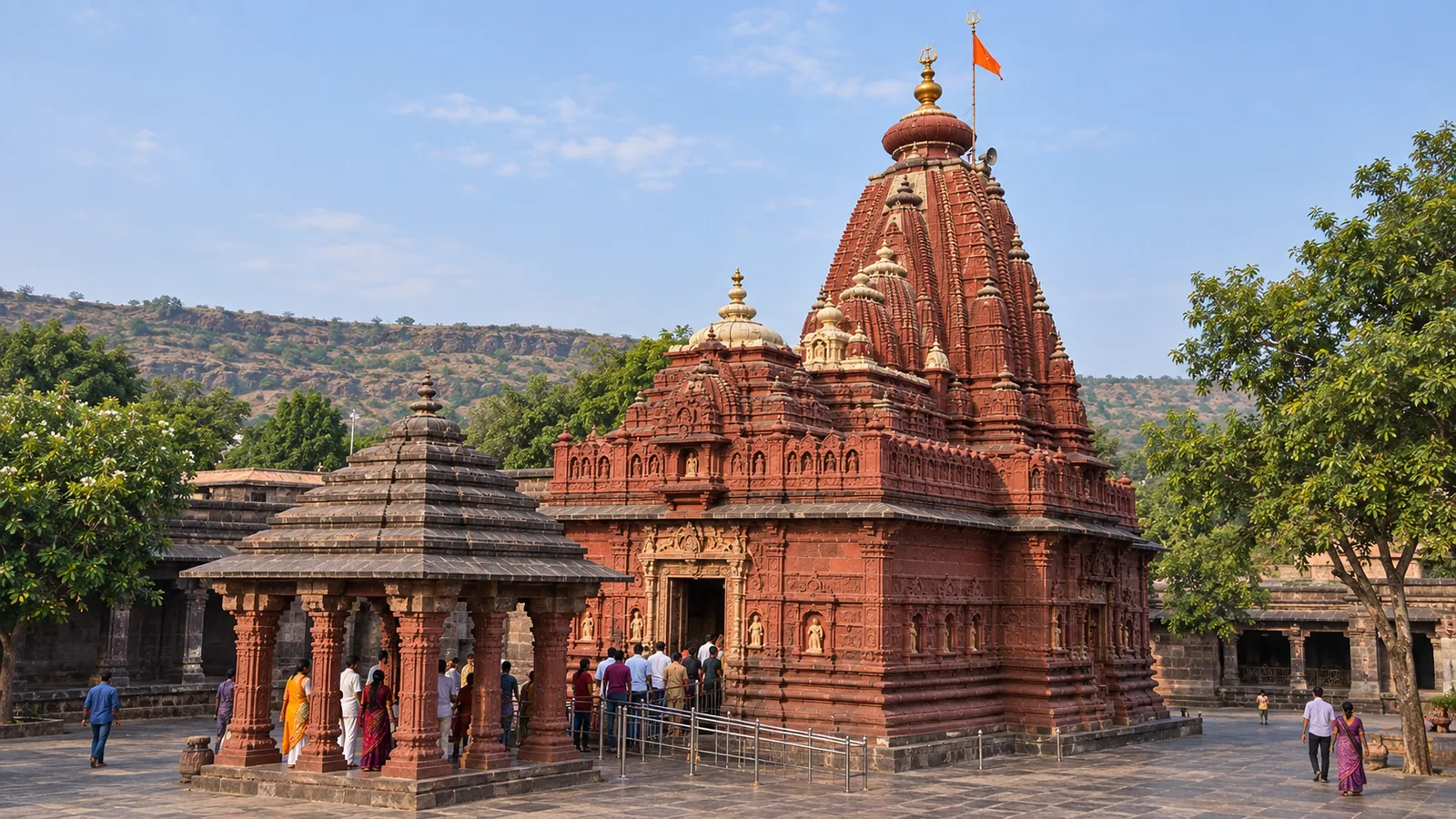
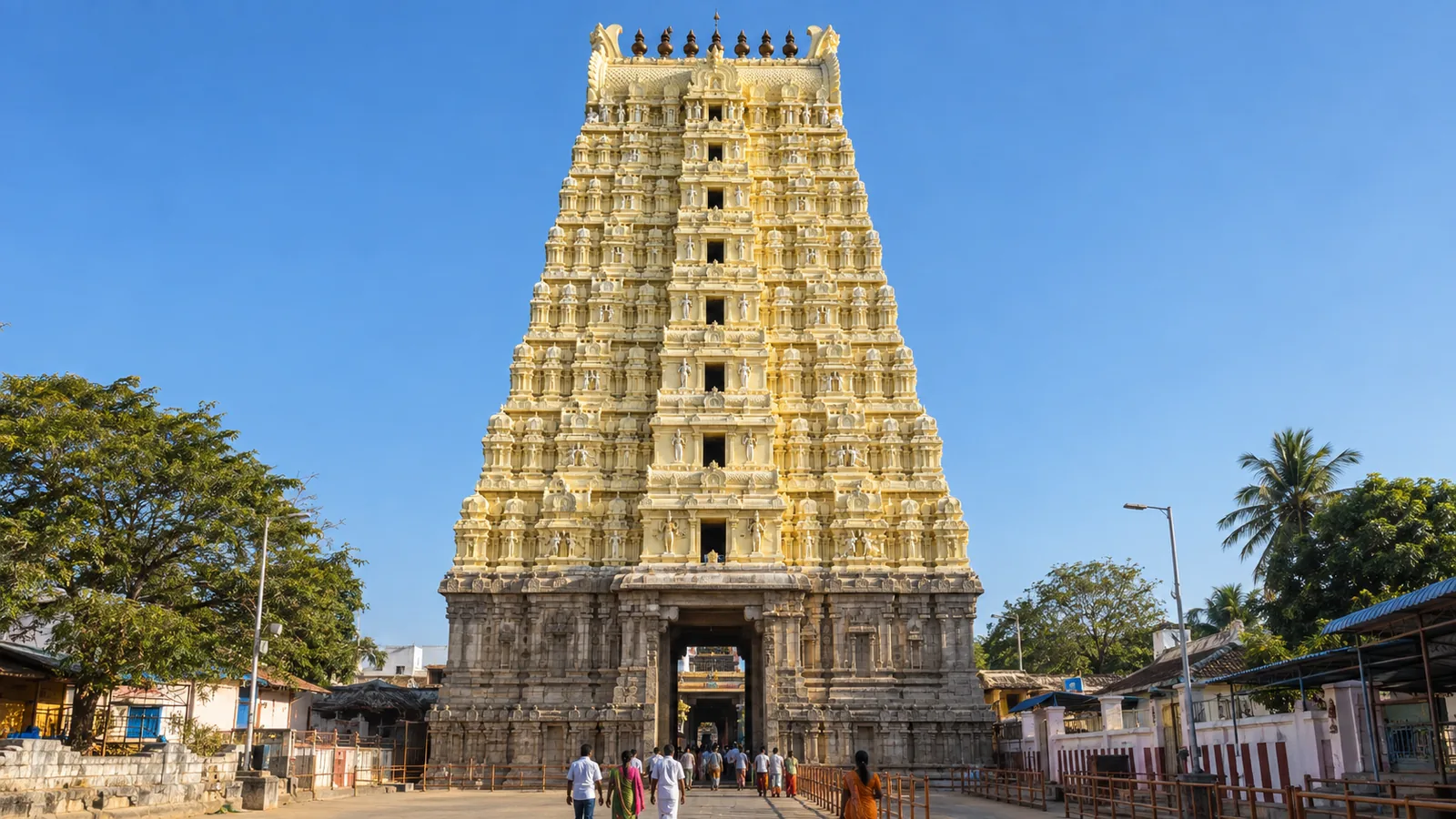
The main temple of Baba Baidyanath rises about 72 feet, a plain, strong, whitewashed stone shikhara that faces east: architecture that seeks not to dazzle but to gather. On its crown, instead of the usual trishul, gleams the panchshula, a rare five-pointed sacred emblem, along with gold kalashas honoured in local tradition; look around the courtyard and you will see that every shrine in the complex bears the panchshula, a signature found at few other tirthas.
Around the main shrine stand some twenty-one temples: Mata Parvati, Jai Durga, Kal Bhairav, Ganesh ji, Surya Narayan, Lakshmi-Narayan and others, so that a parikrama of the courtyard becomes a darshan of the whole divine family. And overhead run the red sacred threads, the gathbandhan tied between the shikhara of Baba and the shikhara of Mata Parvati. Pilgrims often have these threads offered in gratitude for a marriage, a harmony, a healing. Few sights in Bharat say so simply what this place is: Shiva and Shakti, knotted together above the heads of their children.
Within the sanctum, the Kamana Linga rests low: a broad basalt form, its top bearing, tradition says, the small depression left by Ravana's thumb. Ten heads could not move it. A boy's trust rooted it. Both facts are still true.
Baidyanath Darshan: The Pilgrimage Experience
A yatra to Babadham has an unmistakable texture: devotional, busy, intimate, and old.
Many pilgrims begin at the Shivganga, the sacred pond a short walk from the temple, taking snan or carrying its jal; kanwariyas arrive with Ganga jal borne all the way from Sultanganj. The lanes to the temple run past shops of bel patra, flowers, kanwar ribbons and Deoghar's famous pedas, and past the offices of the hereditary tirtha purohits (pandas) whose families have served pilgrims here for generations; many households in Bharat have their own ancestral purohit at Babadham who keeps the record of their visits.
Inside, the queue winds through the courtyard to the east-facing sanctum. Darshan at Baidyanath is close and physical in a way that stays with people: by the dham's tradition, the devotee's own hands pour the jal, the bel patra touches the linga directly, the prayer travels through the fingertips. On ordinary days the flow is steady and warm; on Shravan days, Mondays and Mahashivratri the lines grow enormous, and the administration channels darshan through special arrangements that change from year to year. Accept them gracefully; the Lord is not in a hurry, and neither should we be.
Do not rush away after darshan. Stand in the courtyard among the twenty-one shrines, watch the red threads move in the wind between the two shikharas, and let the place do what it has done for centuries: quietly rearrange what hurts.
Shravani Mela and the Kanwar Yatra from Sultanganj
In the month of Shravan (roughly July–August), the rains arrive, the earth cools, and eastern Bharat begins to walk.
At Sultanganj in Bihar, where the Ganga, in a rare gesture, turns to flow northward past the rock temple of Ajgaibinath, pilgrims fill their vessels with Ganga jal and hang them from a decorated bamboo carried across the shoulder: the kanwar. From that moment the water must not touch the ground, just as the linga once could not. Dressed in saffron, mostly barefoot, they walk roughly 108 kilometres to Deoghar (the kanwariyas: men and women, the old and the very young), the chant "Bol Bam!" passing up and down the line like a current. Some, called dak bams, vow to walk without stopping at all. The jal they carry is poured, at journey's end, over the Kamana Linga: Ganga meeting Shiva, as she does on his own matted locks.
This is the Shravani Mela, and it lasts the entire month: lakhs upon lakhs of pilgrims, a tent city of rest camps and langars along the route, one of the largest annual religious gatherings anywhere in the world. A smaller stream continues into the following month of Bhadrapad. Many kanwariyas then carry a second offering of jal about 43 km onward to Basukinath, for tradition holds the yatra complete only when both Baba Baidyanath and Baba Basukinath have received their share.
To walk it even once is to understand something no article can give: that in the Sanatan way, the journey itself is the puja. Every blistered step from Sultanganj is a mantra with a body.
How to Reach Deoghar
By air: Deoghar Airport serves the town with domestic connections, a short drive from the temple. Patna, Ranchi and Kolkata airports offer wider connectivity for pilgrims coming from across Bharat and abroad, each roughly a half-day's journey from Deoghar by road or rail.
By train: The main railhead is Jasidih Junction, on the Howrah–Delhi main line, about 7 km from the temple, with connections from Kolkata, Patna, Delhi and much of the country. A short branch line runs from Jasidih to Baidyanath Dham station in Deoghar town itself. Autos, e-rickshaws and taxis ply constantly between Jasidih and the dham.
By road: Deoghar is well connected by highway: roughly 250 km from Ranchi, 270–280 km from Patna, 320–330 km from Kolkata, and about 65–70 km from Dumka, with regular buses and taxis on all routes. During the Shravani Mela, special transport and traffic arrangements operate; expect diversions and plan extra time.
For the Sultanganj walk: the Kanwar Yatra is a real padayatra of roughly 108 km, not a stroll. If you undertake it, prepare your feet and your fitness beforehand, walk in the cooler hours, use the marked route and official rest camps, stay hydrated, and let elders and children take the yatra by vehicle without any embarrassment; the jal they offer is no less dear to Baba.
Sacred Places Near Baba Baidyanath Dham
Shivganga: The sacred pond a short walk from the temple, where pilgrims traditionally bathe or draw jal before darshan.
Naulakha Mandir: The graceful Radha-Krishna temple about 2 km from the dham, named for the nine lakh rupees its construction is said to have cost, with a soaring shikhara.
Trikut Parvat: The three-peaked hill roughly 10–13 km away, wrapped in forest and legend, with the ashram-shrine of Trikutachal Mahadev and wide views over the countryside; a ropeway has operated here at times (confirm its current status locally).
Tapovan: Hills and caves about 10 km from town, associated with the tapasya of rishis and with Taponath Mahadev; quiet, green, and worth an unhurried morning.
Nandan Pahar: The small hill at the edge of Deoghar town, with a Nandi temple and sunset views over the dham.
Satsang Ashram: The serene headquarters of the Satsang movement of Sri Sri Anukulchandra, visited by devotees from Bengal and beyond.
Rikhiapeeth: The ashram founded by Swami Satyananda Saraswati at Rikhia, a short drive from Deoghar, known for seva and yogic sadhana.
Harila Jori: About 8 km from town, traditionally remembered as the very spot where Ravana handed the linga to the boy, the place where the katha turned.
Basukinath: About 43 km away on the Dumka road, the temple of Baba Basukinath, whose darshan tradition joins inseparably with Baidyanath's; the Shravani jal is offered at both.
Best Time to Visit Baidyanath Dham
- October to March: The most comfortable season: cool, clear days for unhurried darshan, the temple courtyard at ease, and pleasant excursions to Trikut, Tapovan and Basukinath. Mahashivratri, falling in this period, is one of the dham's greatest days, with festive crowds.
- July to August (Shravan and the Shravani Mela): The most intense and extraordinary time. The town becomes a sea of saffron, darshan queues stretch for hours, and the whole region hums with "Bol Bam". Come in Shravan for the experience of a lifetime, not for comfort, and come prepared for waiting, walking and crowds.
- April to June: Hot, with harsh afternoons. If you visit, keep darshan and outings to early morning and evening.
Safety and Official Guidance
- Do not rely on this or any article for current darshan timings, queue systems, puja arrangements or fees. These change with season and festival, and the Shravani Mela brings special systems every year. Confirm from official sources (the Deoghar district page on Baidyanath Temple, the district history page and the Incredible India page on Baba Baidyanath Dham) and from the temple administration on the ground.
- During the Shravani Mela, follow the marked kanwariya route, use the official rest camps and medical posts, keep children and elders close, and obey the directions of police and mela staff; the arrangements exist to keep lakhs of people safe.
- For pujas and offerings, deal with the temple's recognised arrangements and hereditary purohits; be cautious with strangers promising "quick darshan" for money, and let no one hurry you into anything through pressure.
- On the walk from Sultanganj, tend your feet daily, drink safe water, rest before exhaustion; the yatra honours effort, not injury.
- Keep valuables minimal in crowds, carry a small cloth bag for prasad and jal, and treat the old town gently; it has been receiving guests for centuries.
What Baidyanath Teaches Us Today
Every tirtha carries a teaching. Baidyanath carries a clinic full of them.
The name teaches that God does not only rule; he heals. The Sanatan imagination was unafraid to call the Absolute a physician, to say that what is wrong with us is not merely to be judged but to be treated, with the patience and tenderness treatment requires. Whatever you carry to Deoghar (a diagnosis, a grief, a habit that will not break), you carry it to a healer, not a magistrate.
Ravana teaches the harder lesson: that devotion can move God himself and still be undone by the wish to possess him. The linga that would not go to Lanka waits instead in an open courtyard where anyone (king, cowherd, kanwariya) may pour water on it with their own hands. What Ravana wanted for one kingdom, Shiva gave to everyone.
And the kanwariyas teach the last lesson, the one that cannot be learned from reading: that love walks. A hundred kilometres barefoot with water on your shoulder is not a hardship the tradition imposes; it is a language the heart invented, because some things cannot be said standing still.
If you go, go once in Shravan, even just to see it: the saffron river, the red threads against the white shikhara, the water raised over the Kamana Linga by hands that carried it a hundred kilometres. And if you go in the quiet months instead, stand before the healer with whatever hurts, and ask. That, after all, is what the name on the door has promised for centuries.
Om Namah Shivaya.
Frequently Asked Questions
Where is the Baidyanath Jyotirlinga located?
The Baba Baidyanath Temple stands in the heart of Deoghar town in Jharkhand, in the Santhal Parganas region of eastern Bharat. Deoghar is served by Jasidih Junction on the Howrah–Delhi main line, about 7 km away, by the small Baidyanath Dham station in town, and by Deoghar Airport, with wider connections through Patna, Ranchi and Kolkata.
Is Baidyanath one of the 12 Jyotirlingas?
Yes. Baidyanath, also written Vaidyanath, is counted among the 12 Jyotirlingas of Bhagwan Shiva. In our weekly Monday series it is article #9, which is simply our travelling order through the twelve. Some regional traditions associate the Vaidyanath Jyotirlinga with Parli in Maharashtra or Baijnath in Himachal Pradesh; this article follows the widely visited Baba Baidyanath Dham at Deoghar.
What does the name Baidyanath mean?
Baidyanath is the eastern form of Vaidyanath: vaidya, the physician, joined with nath, the lord. It means the Lord of healers, the divine physician. The name remembers the katha in which Shiva restored Ravana's offered heads, healing him as a vaidya heals, and it holds the deeper faith that Mahadev heals the inner ills of all who come to him. The linga itself is lovingly revered as the Kamana Linga, the wish-fulfilling linga.
What is the story of Ravana and the Baidyanath Jyotirlinga?
Tradition tells that Ravana performed fierce tapasya to bring Shiva to Lanka and offered his ten heads one by one. Pleased, Shiva restored them, healing him like a physician, and gave him a linga to carry home, on the condition that it never touch the earth on the way. Through the devas' play, Ravana had to hand the linga to a boy near Deoghar, who set it down; it rooted there forever, and Shiva remained as Baidyanath.
What is the Kanwar Yatra from Sultanganj to Deoghar?
In the Kanwar Yatra, pilgrims called kanwariyas fill Ganga jal at Sultanganj in Bihar, where the Ganga turns northward, and carry it in decorated kanwars on their shoulders, mostly barefoot, roughly 108 km to Deoghar to offer on the Baidyanath Jyotirlinga. The route resounds with the chant 'Bol Bam'. It is one of the great walking pilgrimages of Bharat.
What is the Shravani Mela at Deoghar?
The Shravani Mela is the month-long congregation at Baba Baidyanath Dham during Shravan (roughly July–August), when lakhs of kanwariyas arrive from Sultanganj and across Bharat to offer Ganga jal to Baba. It is among the largest religious gatherings in the world, organised each year with elaborate arrangements by the administration. Expect very large crowds and follow official guidance during this period.
How do I reach Deoghar and Baba Baidyanath Dham?
By rail, Jasidih Junction on the Howrah–Delhi main line is about 7 km from the temple, with a branch line to Baidyanath Dham station in town. By air, Deoghar Airport has domestic connections, while Patna, Ranchi and Kolkata offer wider options. By road, Deoghar is well connected to Ranchi, Patna, Dumka and Kolkata; buses and taxis are easily available.
What is the best time to visit Baidyanath Dham?
October to March is the most comfortable season for unhurried darshan and the sights around Deoghar. Shravan (July–August) is the most intense and devotional time: the Shravani Mela fills the town with kanwariyas, and waiting times grow very long. Mahashivratri is another great day at the dham. Summer afternoons are hot, so plan mornings and evenings then.
Which places can I visit near Baba Baidyanath Dham?
Close to the temple are the Shivganga pond and the Naulakha Mandir. A short drive away are Trikut Parvat, the caves and hill of Tapovan, Nandan Pahar and the Satsang Ashram. About 43 km away on the Dumka road stands the Basukinath temple, whose darshan is traditionally joined with Baba Baidyanath's; many hold the yatra complete only after both.
Is Deoghar also a Shakti Peetha?
Yes, by tradition. Deoghar is revered as the Hridaya Peetha or Chitabhoomi, where the heart of Mata Sati is said to have fallen, making it one of the rare tirthas where a Jyotirlinga and a Shakti Peetha stand together. The shikharas of the Baba Baidyanath and Mata Parvati temples are tied with sacred red threads, the gathbandhan that weds Shiva and Shakti in one courtyard.