The Universe in Her Lap
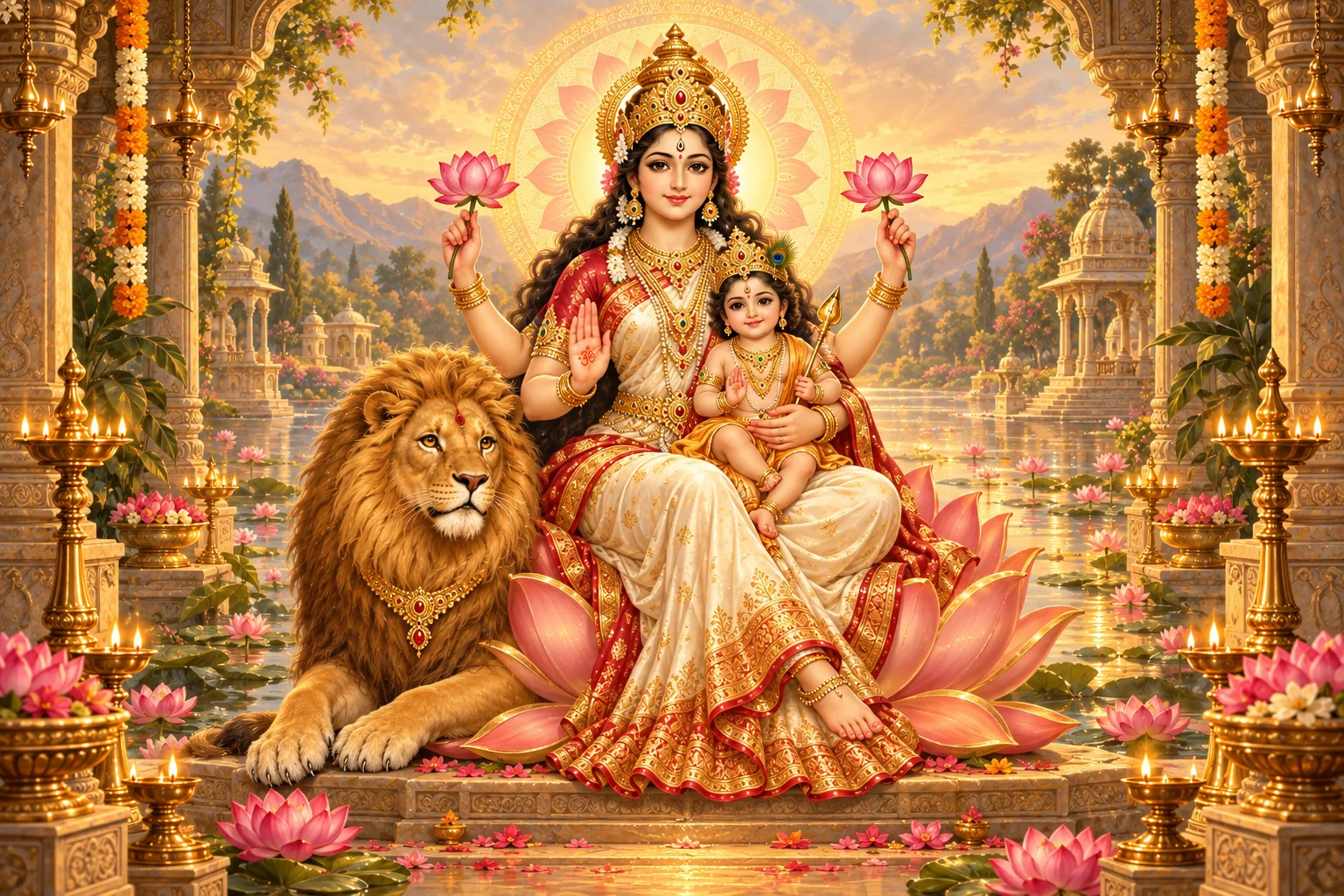
Yesterday the Devi was the creator of the cosmos. Today she is a mother holding her boy. The fifth form of the Navdurga is Maa Skandamata — "mother of Skanda" — worshipped in 2026 on Panchami, Thursday, October 15. In her lap sits the child Skanda, who will grow into Kartikeya, commander of the armies of the devas; around them both stands the lion she rides into battle.
No other Navdurga form is named this way. Shailputri is named for her father, Katyayani for her sage, Chandraghanta for her ornament — but the fifth form is named for her child. The tradition is making a quiet, radical point: of all the Devi's powers — creation, austerity, war — the one it chooses to crown the festival's midpoint is motherhood.
Maa Skandamata at a Glance
| Traditional order | 5th of the Navdurga |
| Tithi | Panchami (fifth lunar day) |
| 2026 worship date | Thursday, October 15, 2026 (New Delhi, Drik Panchang convention); Upang Lalita Vrat in some traditions |
| Vahana | Lion; she is seated on a lotus (Padmasana) |
| Iconography | Four arms — lotuses in the upper two hands, baby Skanda held in one hand, the other in Abhaya mudra |
| Governing planet | Budha (Mercury) |
| Traditional bhog | Bananas |
| Flower | Red flowers |
| Day colour (popular custom) | Yellow in 2026 — a weekday-based custom, not a scriptural rule |
The verified 2026 calendar for the whole series is on the series landing page.
The Name: Mother of Skanda
Skanda is the ancient name of Kartikeya — Murugan in the Tamil south — the six-faced warrior god born to lead the devas against the asura Tarakasura. Mata is mother. The Devi's fifth form is thus defined by relationship: she who gave the worlds their general.
Because she sits on a fully bloomed lotus, tradition also calls her Padmasana — the lotus-throned. And the tradition attaches a practical sweetness to her worship: whoever worships Skandamata, it is said, receives the blessing of worshipping Skanda himself — the child in the lap is never apart from the mother. Devotees with children, or longing for them, have always held this day especially dear.
Her Story: The Child the Gods Waited For
Skanda's birth is one of the great connected stories of the Puranas — the Shiva Purana and Skanda Purana carry it in full, and Kalidasa's Kumarasambhava ("the birth of the war-god") made it immortal literature.
The asura Tarakasura had won a boon that he could be slain only by a son of Shiva — a clever wish, since Shiva, after Sati's loss, seemed destined never to marry again. Creation groaned under Taraka while the devas waited on an impossible birth. This is why Parvati's tapasya (the Brahmacharini story) mattered to the whole universe, not merely to one heart: her marriage was the world's rescue plan.
From the union of Shiva and Parvati came Skanda — nursed, in the most-told version, by the six Krittika stars (hence Kartikeya, and his six faces), reared amid reeds, and anointed general of the devas while still a boy. He slew Tarakasura and freed the three worlds.
Skandamata's image gathers that whole epic into one frame: the mother whose penance made the impossible child possible, holding him with one hand while blessing the worlds — which he will defend — with the other.
Iconography: Four Arms, One Child
Maa Skandamata's complexion is described as shubhra — luminous white. She is depicted seated on a lotus, with the lion as her mount, and four arms: the upper two hold lotus flowers; one lower hand holds baby Skanda (often shown six-faced); the other is raised in Abhaya mudra — the gesture that says do not fear.
Read the image as parents instinctively do: one arm for the child, one for the world. Tradition assigns her governance of Budha (Mercury) — the planet of intellect and speech — and holds that her worship refines both; the mother who raised the devas' general knows something about education.
How to Worship Maa Skandamata at Home
- Morning worship at the kalash — lamp, incense, water, as every day.
- Offer red flowers, roli, akshat.
- Offer bananas as bhog — simple, and traditionally linked to health; many families also prepare kheer or sheera shared afterwards as prasada.
- Include the children: let them ring the bell, offer a flower, receive the first prasada. On Skandamata's day this is not indulgence; it is theology.
- Chant her mantra (below), 108 times or as attention allows.
- Evening aarti with the family.
For worship basics across all nine nights, see our Practices & Rituals section.
Mantra, Prarthana and Meaning
Mantra
ॐ देवी स्कन्दमात्रे नमः॥
Om Devi Skandamatre Namah — "Om, salutations to Devi Skandamata."
Prarthana (as given in the Navdurga tradition):
सिंहासनगता नित्यं पद्माञ्चित करद्वया। शुभदास्तु सदा देवी स्कन्दमाता यशस्विनी॥
Simhasanagata Nityam Padmanchita Karadvaya, Shubhadastu Sada Devi Skandamata Yashasvini.
"Ever enthroned upon the lion, her two hands adorned with lotuses — may the illustrious Devi Skandamata always be the giver of auspiciousness."
Offerings, Flowers and the Day's Colour
- Bhog: bananas — the traditional fifth-day offering, associated with good health; easily shared with children and the needy afterwards.
- Flowers: red flowers are dear to her.
- Colour: the popular calendar assigns yellow to October 15, 2026 — a bright, beloved custom rotating by weekday; not a scriptural rule.
A Reflection for Panchami
Skandamata's day honours an underrated form of tapasya: raising someone. The tradition that celebrates thousand-year austerities gives the festival's central day to night feeds, school runs and worry — because, it insists, they are the same discipline. Whoever you are bringing up — a child, a student, a younger colleague, an ageing parent — that labour of attention is worship in her language.
On the vrat: parents fasting during Navratri should remember her example rather than compete with it — children's meals come first, and a mother's or father's strength is itself an offering the household depends on. Adjust the fast; keep the tenderness.
Tomorrow tenderness turns to steel: the sage's daughter who became the slayer of Mahishasura — Maa Katyayani, the sixth form. The whole series lives at Navratri: Nine Forms of Maa Durga.
References
- Drik Panchang — Goddess Skandamata: iconography (lotus seat, baby Murugan, Abhaya mudra), mantra, worship day.
- Drik Panchang — 2026 Shardiya Navratri Calendar (New Delhi): verified dates, including Upang Lalita Vrat on October 15.
- Shiva Purana and Skanda Purana (Gita Press editions) — the Tarakasura and Skanda-birth narratives; Kalidasa's Kumarasambhava for the literary telling.
- Durga Saptashati with Devi Kavacham (Gita Press) — "panchamam Skandamateti" in the Navdurga enumeration.
Frequently Asked Questions
When is Maa Skandamata worshipped in Navratri 2026?
Maa Skandamata is worshipped on Panchami, the fifth tithi of Shardiya Navratri — Thursday, October 15, 2026 (New Delhi, Drik Panchang convention). The day also carries the Upang Lalita Vrat in some traditions. Confirm timings with a panchang set to your city.
What is Maa Skandamata's mantra?
Her simple mantra is 'Om Devi Skandamatre Namah' (ॐ देवी स्कन्दमात्रे नमः). The traditional prarthana is 'Simhasanagata Nityam Padmanchita Karadvaya, Shubhadastu Sada Devi Skandamata Yashasvini' — may the illustrious Skandamata, ever enthroned on the lion with lotuses in her hands, always grant auspiciousness.
Who is Skanda, and why is the Devi named after him?
Skanda is Lord Kartikeya (Murugan), commander of the devas' army and elder brother of Lord Ganesha. Uniquely among the Navdurga, the Devi's fifth form is named not for her own deed but for her motherhood — Skanda-mata, 'mother of Skanda' — and worshipping her is held to carry the blessing of worshipping Kartikeya too.
What bhog is offered to Maa Skandamata?
Bananas are the traditional fifth-day offering, associated with health and well-being. Red flowers are dear to her. As with every day of Navratri, regional and family customs vary — bhava over menu.
What is special about Skandamata's iconography?
She sits on a lotus (hence her name Padmasana) and rides a lion, with four arms: two holding lotuses, one holding baby Skanda in her lap, and one in Abhaya mudra. She is the only Navdurga form depicted with a child — the Devi as mother, fierce and tender at once.