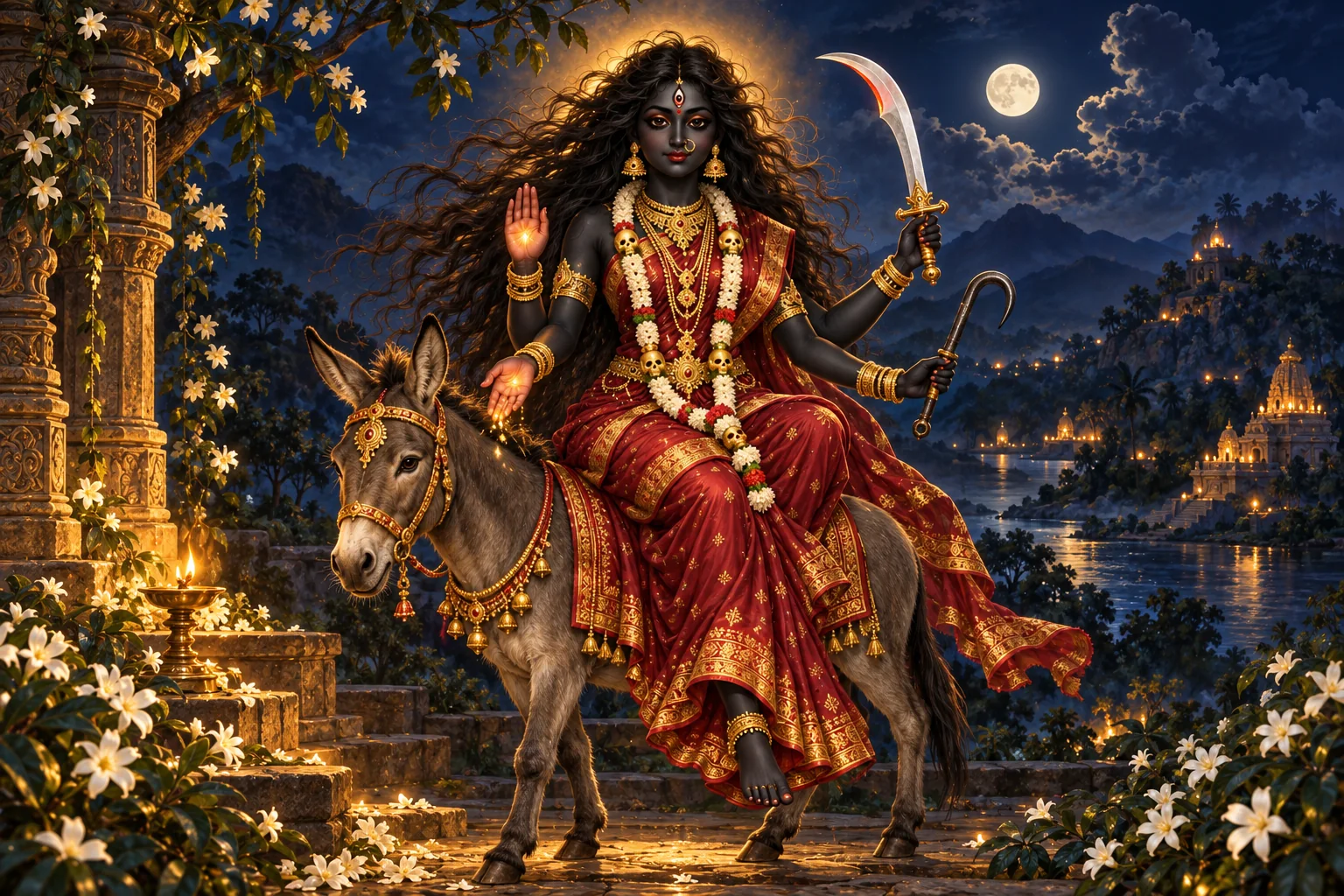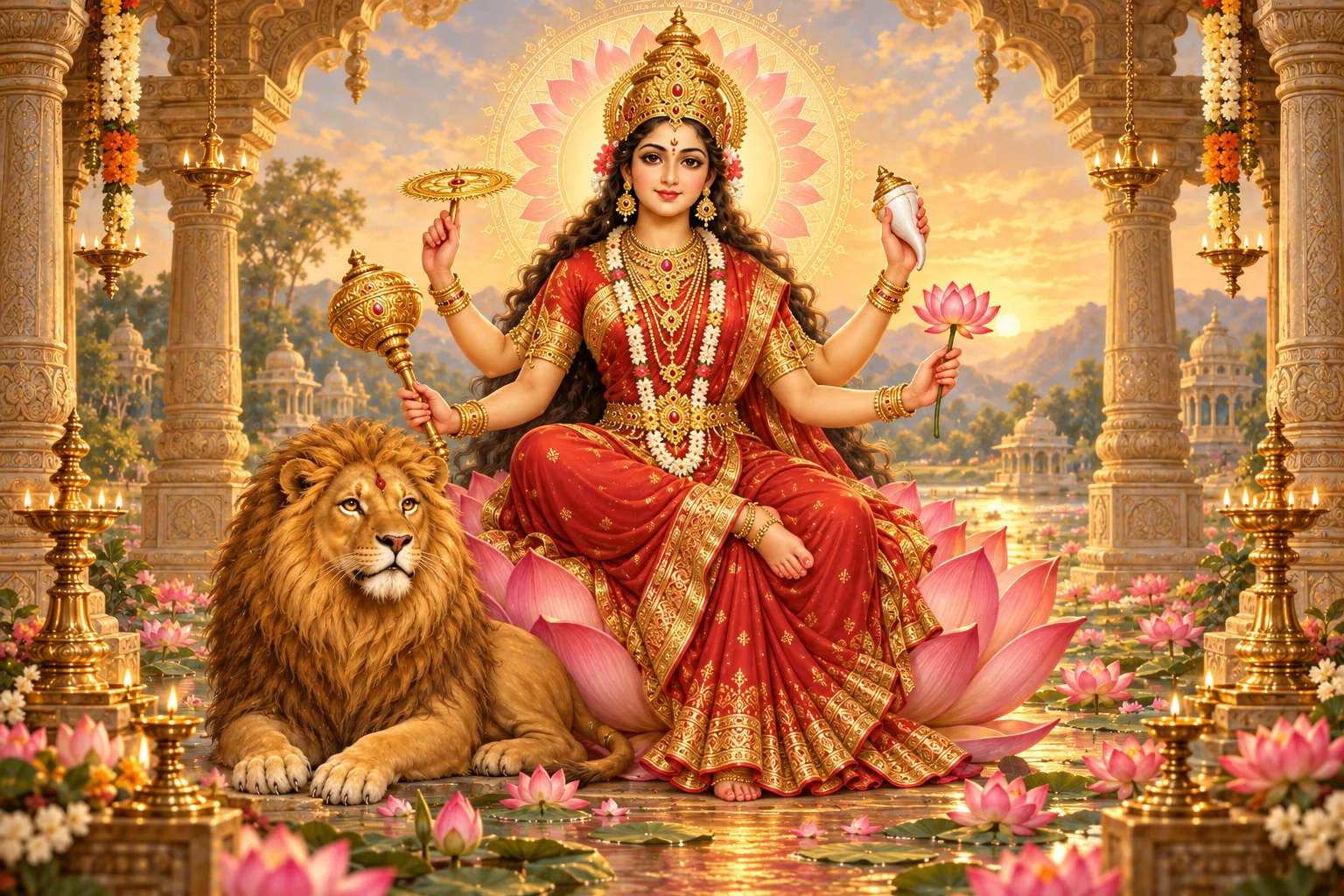
The Morning After the Night
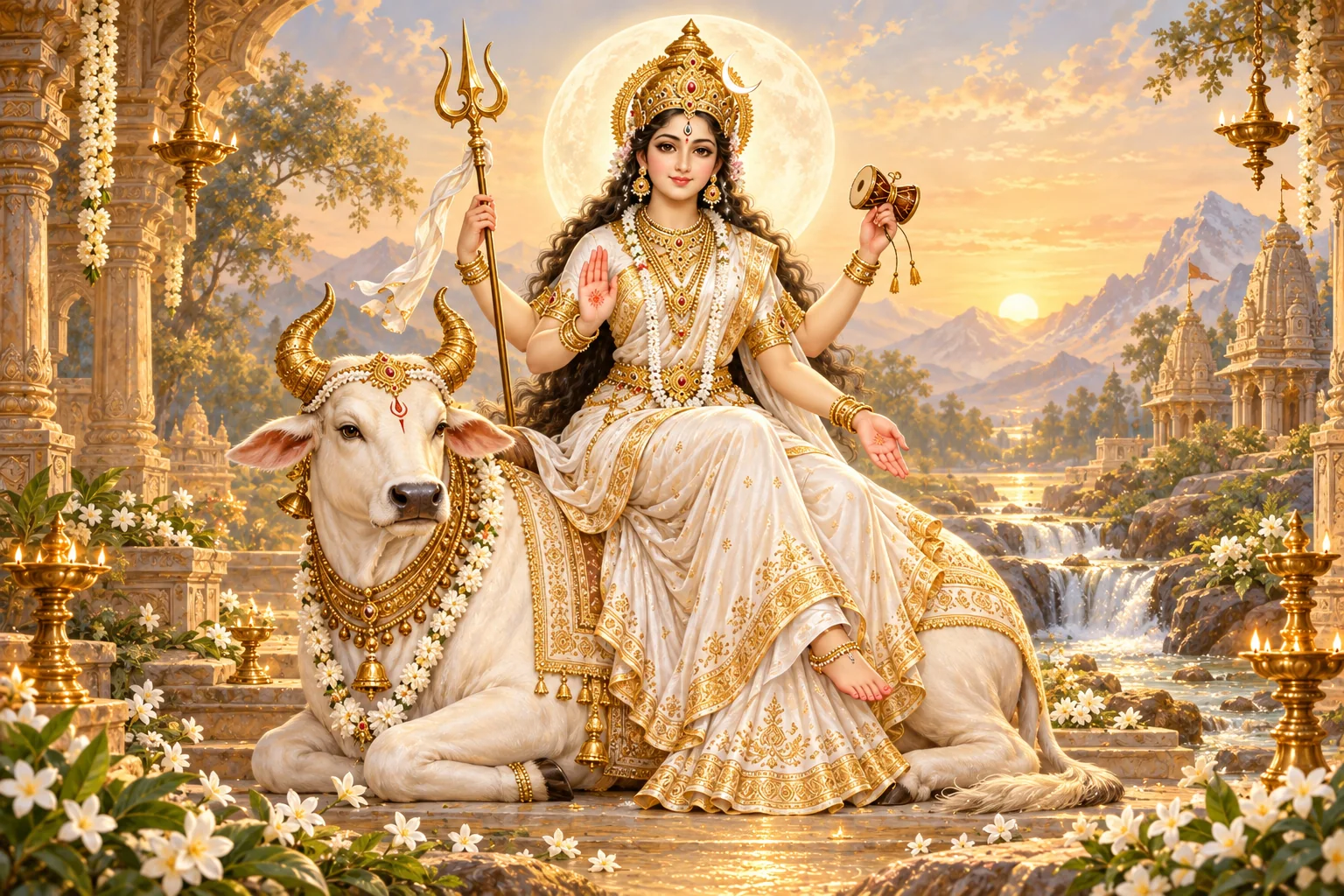
After Kalaratri's darkness, the tradition gives us dawn. Maa Mahagauri — "the exceedingly radiant one" — is the eighth Navdurga, white-clad on a white bull, luminous as the moon on a full-moon night. Her worship falls on Durga Ashtami, the most intense day of Navratri — in 2026, Monday, October 19, a date so full this year that it holds Ashtami, Sandhi Puja and the beginning of Navami in a single morning.
Her story is the gentlest in the whole series: not a battle but a bath — the washing away of everything the hard years had deposited, by the grace of the beloved for whom those years were endured.
Maa Mahagauri at a Glance
| Traditional order | 8th of the Navdurga |
| Tithi | Ashtami (eighth lunar day) — Durga Ashtami / Mahashtami |
| 2026 worship date | Monday, October 19, 2026 (New Delhi, Drik Panchang convention). Ashtami tithi: 8:27 AM Oct 18 → 10:51 AM Oct 19; Sandhi Puja 10:27–11:15 AM on Oct 19 |
| Vahana | White bull (Vrishabha) — like Shailputri, she is Vrisharudha |
| Iconography | Four arms — trishul and Abhaya mudra in the right hands; damaru and Varada mudra in the left |
| Governing planet | Rahu |
| Traditional bhog | Coconut; the Kanya Puja meal of puri, chana and halwa |
| Flower | Night-blooming jasmine; white flowers |
| Day colour (popular custom) | Peacock green in 2026 — a weekday-based custom, not a scriptural rule |
A careful 2026 note: because the Saptami tithi covered both October 17 and 18, the "eighth civil day" (October 18) is not Ashtami — Durga Ashtami follows on October 19. The series landing page lays out the full verified calendar.
The Name: Exceedingly Fair
Maha is great; gauri means fair, bright, radiant — from the same root as Gauri, one of Parvati's most beloved names. Mahagauri is the Devi at her most luminous: tradition compares her glow to the conch, the moon and the white kunda blossom. Clad entirely in white, she is also called Shwetambardhara — "wearer of white garments" — and, riding the white bull, Vrisharudha, the name she shares with her first form, Shailputri. The circle is closing: the eighth form consciously echoes the first.
Her Story: Washed Radiant by the Ganga
Tradition — carried in the Navdurga kathas and Puranic retellings — continues the story begun with Brahmacharini.
Through the long years of tapasya for Bhagwan Shiva — the heat, the frost, the fasts, the dust of ages — the young Devi's body darkened until the sages called her Kali, the dark one. She had poured her form itself into the austerity. When Shiva at last accepted her, he bathed her in the sacred waters of the Ganga flowing from his own matted hair — and the tapasya's deposit washed away. She emerged gauri — radiant beyond telling — and the worlds called her Mahagauri.
The tradition reads this tenderly, and we should too. The story is not about complexion as worth — the same tradition's Kalaratri is dark in glory. It is about renewal: what the struggle cost you is not permanent; grace restores what effort spent. On Ashtami, the day of her worship, devotees traditionally seek exactly this — the washing-away of old karma, old guilt, old weariness.
Iconography: White on White
Maa Mahagauri rides the white bull and wears only white. Her four arms hold: trishul in one right hand, the other raised in Abhaya mudra; damaru (Shiva's drum) in one left hand, the other in Varada mudra. Trident and drum — Shiva's own emblems — in the hands of his radiant consort: the iconography of a marriage of equals.
Tradition assigns her governance of Rahu — the shadow-planet of confusion and obsession — read as her power to calm precisely the murky, obsessive layers of the mind her own story overcame.
Durga Ashtami: The Great Day
Ashtami is Navratri's summit in most of North India, and in 2026 it is unusually concentrated:
- Durga Ashtami / Mahashtami (October 19): intensified puja of the Devi; many families keep their strictest fast today.
- Sandhi Puja (10:27–11:15 AM, Delhi): the 48-minute junction spanning the end of Ashtami (10:51 AM) and the start of Navami — the moment of the Chamunda manifestation, observed with special offerings and, in Bengal's Durga Puja, with 108 lamps.
- Kanya Puja (Kumari Puja): young girls — traditionally nine, representing the Navdurga — are welcomed as the Devi herself: feet washed, tilak applied, fed puri, kala chana and halwa, honoured with gifts. Families do this on Ashtami or Navami; in 2026 the two tithis share October 19, with Navami continuing into October 20, so both days carry the custom.
- Maha Navami also begins this day (Navami tithi from 10:51 AM) — see the Siddhidatri article for how 2026 compresses the ninth worship.
How to Worship Maa Mahagauri at Home
- Bathe early; Ashtami puja is traditionally done in the morning — in 2026, ideally before the Ashtami tithi ends at 10:51 AM (Delhi).
- Offer white flowers (mogra, chameli, raat ki rani) with roli, akshat and, in many family traditions, a chunri to the Devi.
- Offer coconut as bhog — whole or as coconut sweets.
- Perform or plan Kanya Puja — even inviting one or two girls with genuine respect fulfils the custom's heart. Feed them before the family eats.
- Observe Sandhi Puja if your tradition keeps it: a lamp lit and the Devi remembered at the Ashtami–Navami junction (10:27–11:15 AM, Delhi, 2026).
- Chant her mantra (below) and conclude with aarti.
Our Practices & Rituals section covers the shared basics.
Mantra, Prarthana and Meaning
Mantra
ॐ देवी महागौर्यै नमः॥
Om Devi Mahagauryai Namah — "Om, salutations to Devi Mahagauri."
Prarthana (as given in the Navdurga tradition):
श्वेते वृषेसमारूढा श्वेताम्बरधरा शुचिः। महागौरी शुभं दद्यान्महादेव प्रमोददा॥
Shwete Vrishesamarudha Shwetambaradhara Shuchih, Mahagauri Shubham Dadyat Mahadeva Pramodada.
"Mounted on the white bull, clad in white, purity itself — may Mahagauri, the delight of Mahadeva, grant auspiciousness."
Offerings, Flowers and the Day's Colour
- Bhog: coconut — the eighth day's traditional offering; the Kanya Puja meal (puri, kala chana, halwa) is the day's other great offering, eaten by the Devi in the form of her little guests.
- Flowers: night-blooming jasmine is named as her flower in the Navdurga tradition; white blossoms of every kind suit her.
- Colour: the popular calendar assigns peacock green to October 19, 2026 — as ever, a weekday-based custom, cherished but optional.
A Reflection for Ashtami
Mahagauri's gift is the permission to be made new. Her story insists that the grime of long effort — the cynicism, the fatigue, the hardened edges — is washable; it was never your colour, only your weather. Ashtami's disciplines (the fast, the Sandhi lamp, the honouring of children) are all, at root, rituals of starting clean.
On the vrat: Ashtami is the traditional peak of fasting, and also the day it is most over-done. If you have fasted for seven days, let the Kanya Puja food — prasada by definition — be received without guilt where your tradition permits, and break the fast as your family practice directs (many conclude after Ashtami puja, many after Navami). Children being honoured today should never themselves be made to fast.
The series completes tomorrow — in 2026, partly this very day — with the giver of all attainments: Maa Siddhidatri, the ninth form. The whole series lives at Navratri: Nine Forms of Maa Durga.
References
- Drik Panchang — Goddess Mahagauri: iconography, names, mantra, worship day.
- Drik Panchang — Mahashtami 2026 (New Delhi): Durgashtami on October 19; Ashtami tithi timings.
- Drik Panchang — 2026 Shardiya Navratri Calendar (New Delhi): Sandhi Puja timings (10:27–11:15 AM, October 19).
- Durga Saptashati with Devi Kavacham (Gita Press, Gorakhpur) — "Mahagauriti chashtamam"; the Ganga-washing account follows the living Navdurga/Puranic retelling tradition.
Frequently Asked Questions
When is Maa Mahagauri worshipped in Navratri 2026?
Maa Mahagauri is worshipped on Ashtami — Durga Ashtami, Monday, October 19, 2026 (New Delhi, Drik Panchang convention). The Ashtami tithi begins at 8:27 AM on October 18 and ends at 10:51 AM on October 19; the puja day follows the sunrise tithi. Note that October 18 itself is still Saptami at sunrise. Confirm with your city's panchang.
What is Maa Mahagauri's mantra?
Her simple mantra is 'Om Devi Mahagauryai Namah' (ॐ देवी महागौर्यै नमः). The traditional prarthana is 'Shwete Vrishesamarudha Shwetambaradhara Shuchih, Mahagauri Shubham Dadyat Mahadeva Pramodada' — may the pure Mahagauri, white-clad and mounted on the white bull, the delight of Mahadeva, grant auspiciousness.
What is Kanya Puja and when is it done in 2026?
Kanya Puja (Kumari Puja) honours young girls as living forms of the Devi — they are welcomed, their feet washed, fed (traditionally puri, chana and halwa) and given gifts. Most families perform it on Ashtami (October 19, 2026) or Navami; in 2026 both fall on October 19–20, so follow your family's custom.
What bhog is offered to Maa Mahagauri?
Coconut is the traditional eighth-day offering. The Kanya Puja meal of puri, kala chana and halwa is itself an offering in most North Indian homes. Night-blooming jasmine is the flower associated with her; white flowers like mogra also suit her white-clad form.
Why does Sandhi Puja fall on October 19, 2026?
Sandhi Puja is performed across the junction of Ashtami and Navami — the last 24 minutes of Ashtami and first 24 minutes of Navami, when the Devi's Chamunda manifestation is honoured. In 2026 (Delhi) Ashtami ends at 10:51 AM on October 19, so Sandhi Puja runs about 10:27 to 11:15 AM that morning.
Why was Maa Mahagauri dark before becoming radiant?
Tradition says her body darkened through years of exposure during her great tapasya for Bhagwan Shiva. When Shiva accepted her, the waters of the Ganga flowing from his hair washed her radiant — gauri, brilliantly fair. The tradition reads it as renewal: tapas does not disfigure; it transfigures.