Where Shiva Followed His Son into the Hills
Deep in the Nallamala hills of southern Bharat, where dense forest folds over the gorges of the Krishna River, a temple has kept its lamps burning for well over a thousand years. This is Srisailam — the sacred hill — and at its heart stands the Mallikarjuna Jyotirlinga, the second of the twelve supreme abodes of Bhagwan Shiva.
Srisailam is a place of rare completeness. Here Shiva dwells as Mallikarjuna Swamy, and beside him the Goddess dwells as Bhramaramba Devi. A Jyotirlinga and a Shakti Peetha, the masculine and feminine principles of the cosmos, share a single hill. To climb to Srisailam is to walk into a story of divine family, of a parent's love following a child into the wilderness, and of a mountain made holy by that love.
This is the story of why the Mallikarjuna Temple matters — spiritually, historically, and eternally.
Mallikarjuna Jyotirlinga at a Glance
For readers planning a pilgrimage, here are the essential facts about Mallikarjuna Jyotirlinga:
| Detail | Information |
|---|---|
| Temple | Mallikarjuna Swamy Temple (Srisailam) |
| Deity | Bhagwan Shiva as Mallikarjuna; Goddess as Bhramaramba Devi |
| Spiritual status | Second of the 12 Jyotirlingas; also a Shakti Peetha |
| Location | Srisailam, Nallamala hills, Nandyal district, Andhra Pradesh |
| Sacred river | Krishna River (Pathala Ganga) |
| Best known for | Jyotirlinga and Shakti Peetha together; the Kartikeya story |
| Nearby places | Bhramaramba Temple, Pathala Ganga, Sakshi Ganapati, Srisailam Dam, Akkamahadevi Caves |
The Meaning of "Mallikarjuna": The Lord Adorned in Jasmine
The name Mallikarjuna is woven from two words. Mallika means jasmine, the small, fragrant white flower so beloved in temple worship across the South. Arjuna is an ancient name of Shiva, meaning bright, clear, or white — the same root that gives us the pale radiance of a full moon.
Together the name evokes Shiva worshipped with jasmine — the white Linga garlanded in white blossoms, luminous in the lamplight. Tradition also remembers a devoted woman named Chenchu Mallamma and the offering of jasmine to the Lord, and so the deity is lovingly called Mallikarjuna Swamy. The Goddess beside him is Bhramaramba — "the Mother of the bees" — a name whose story we will come to shortly.
To understand why Shiva and Parvati chose this remote hill, we must first hear one of the tenderest stories in our tradition.
The Story of Kartikeya, Ganesha, and a Parent's Love
The Puranas — including the Shiva Purana and the Skanda Purana — preserve a beloved account of the divine family of Kailasa.
Shiva and Parvati had two sons: Ganesha, the elder in wisdom, and Kartikeya (also called Skanda or Murugan), the young commander of the devas. When the time came for the brothers to marry, a gentle rivalry arose over who should wed first. To settle it fairly, Shiva and Parvati set a contest: whoever circled the whole world first would be married first.
Kartikeya, swift and eager, mounted his peacock and set off to race around the earth. Ganesha, thoughtful, did not move at all. Instead he walked slowly around his parents, folded his hands, and said that his mother and father were his whole world — to circle them was to circle all creation. Delighted by his insight, Shiva and Parvati declared Ganesha the winner, and he was married first.
When Kartikeya returned, weary from his long journey, and learned what had happened, he was overcome — not with anger, but with a sorrowful sense of being left behind. Seeking solitude, he withdrew to the hill of Krauncha, far to the south, and would not come home.
A parent's heart cannot rest while a child grieves. Shiva and Parvati followed their son to the hill to be near him and to console him. They took up residence there — Shiva as Mallikarjuna and Parvati as Bhramaramba — and the mountain became Srisailam, sanctified forever by this act of divine tenderness. It is said the parents visit their son on the full-moon day of each month, and the Goddess on the new moon; devotees observe these days with special reverence.
The lesson is quiet but profound: even the Lord of the universe honours the bonds of family, and even divine love expresses itself in following a beloved into the wilderness.
Mallikarjuna: The Second of the Twelve Jyotirlingas
A Jyotirlinga is a place where Shiva is worshipped not as a carved image but as a jyoti — a self-manifest pillar of light and consciousness, beyond form. Across Bharat there are twelve such supreme shrines, and pilgrims traditionally undertake the Dwadasha Jyotirlinga Yatra to visit them all.
In the traditional order recited in the Dwadasha Jyotirlinga Stotra, Mallikarjuna at Srisailam is named second, immediately after Somnath — "Srishaile Mallikarjunam." It is the southern anchor of the great pilgrimage, and for devotees journeying through the twelve, Srisailam is where the yatra turns deep into the Deccan.
The greatness of Srisailam is echoed across our tradition. The Srisailam Jyotirlinga is praised in hymns attributed to Adi Shankaracharya, who is said to have composed the Shivananda Lahari here. To have darshan of Mallikarjuna, it is said, is to be freed from the heaviest of sorrows.
Bhramaramba Devi and the Shakti Peetha
What makes Srisailam almost unique among all sacred sites is that it is both a Jyotirlinga and a Shakti Peetha. The Goddess here is Bhramaramba Devi, and her shrine stands on the same hill as Mallikarjuna, a little above the main temple.
The Shakti Peethas are the places where, in the ancient account of Sati and Daksha's yajna, parts of the Goddess's form are said to have fallen to earth, each becoming a seat of her living power. Srisailam is counted among these Peethas, and so the hill holds the presence of the Divine Mother in her own right.
Her name carries its own legend. Bhramara means a bee, and it is told that the Goddess took the form of a swarm of bees to subdue a demon who tormented the devas — hence Bhramaramba, "the Mother of the bees." Devotees who press an ear to the sanctum wall are said to hear a faint humming, the eternal murmur of the divine bees.
For the pilgrim, this union is deeply meaningful: at Srisailam one may worship Shiva and Shakti together, the two halves of a single reality, without leaving the hill.
Temple History and Architecture
The Srisailam temple complex is ancient, with references reaching back many centuries and inscriptions recording the devotion and patronage of successive dynasties — among them the Satavahanas in early times, and later the Reddy kings and the emperors of Vijayanagara, whose rulers strengthened and expanded the shrine.
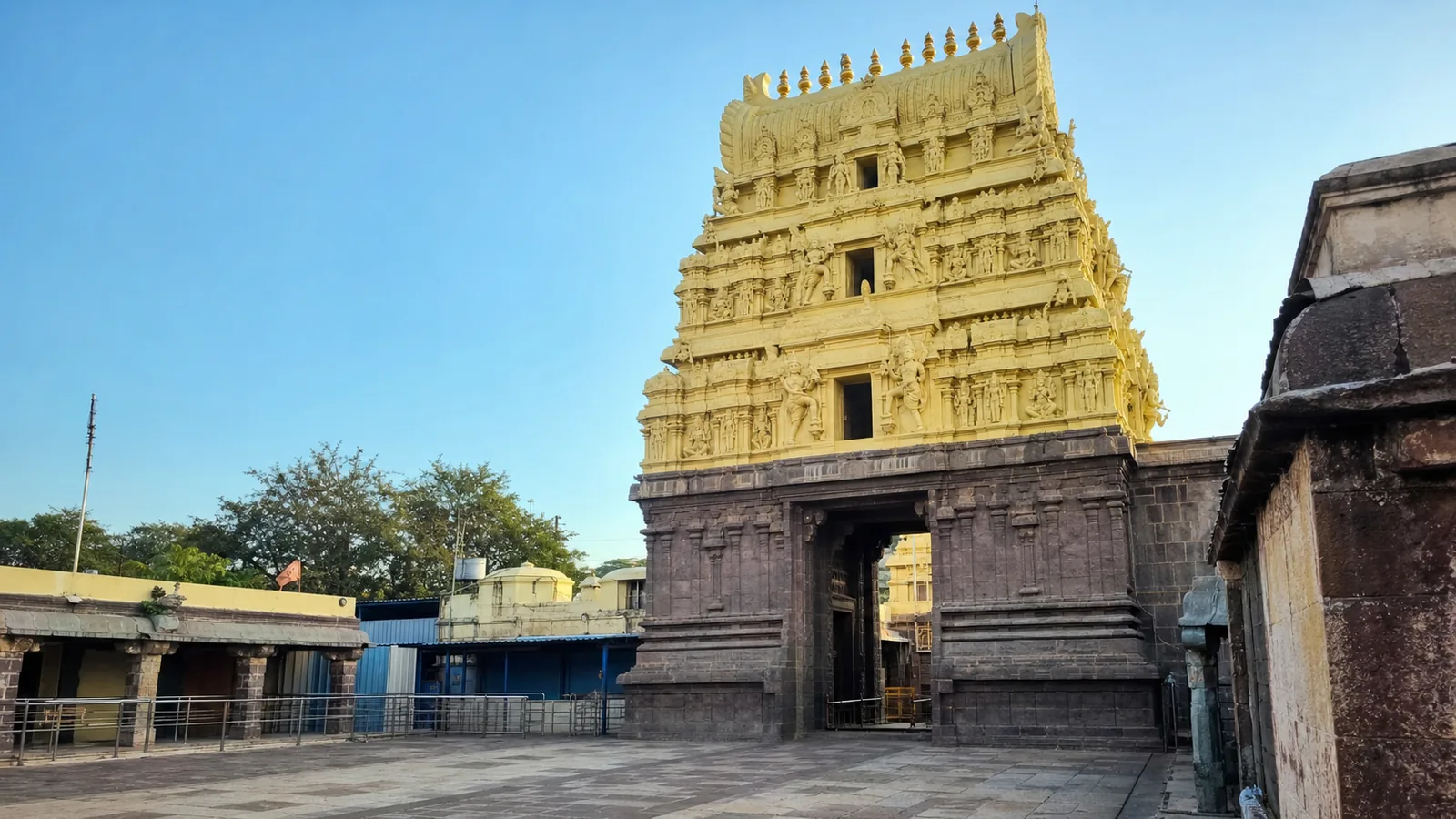
The temple is enclosed by a massive fortified wall — the Prakaram — built of stone and covered in an extraordinary wealth of carving. Its panels depict scenes from the Ramayana, the Mahabharata, and the Puranas, along with rows of deities, dancers, and processions, making the outer wall itself a scripture in stone. The soaring gopurams (gateway towers) rise above the forest canopy, visible to pilgrims as they climb.
Within the sanctum, the Mallikarjuna Jyotirlinga is worshipped in continuous ritual, garlanded and bathed, kept luminous by the lamps of unbroken devotion. Darshan and seva arrangements may vary by day, crowd level and festival season, so devotees should follow the directions of the temple priests and the latest notices from Srisaila Devasthanam.
Darshan, Aarti, and the Pilgrimage Experience
A pilgrimage to Srisailam is best taken slowly. Many devotees first bathe at Pathala Ganga, the ghat where the Krishna River flows far below the temple, purifying themselves before the climb. Reaching the temple, pilgrims pass beneath the carved gopurams and into the great walled courtyard before approaching the sanctum for Mallikarjuna darshan.
The temple observes daily services from the pre-dawn Suprabhata and abhishekam through the midday and evening aartis, each with its own atmosphere — the hush of first light, the fullness of noon, and the deep resonance of the evening lamps as the chant of Om Namah Shivaya rises against the sounds of the forest. Many pilgrims complete their visit by climbing to the Bhramaramba Devi shrine above, so that Shiva and Shakti are honoured together in a single day.
Festivals transform the hill. Mahashivratri draws vast gatherings, and the annual Brahmotsavam and the Kartika masam observances fill Srisailam with processions, music, and light. Because the temple lies within a tiger reserve and forest region, pilgrims are asked to respect the sanctity of both the shrine and the wilderness that guards it.
A note of reverence: temple timings, special darshan arrangements, and photography rules change from time to time and during festivals. It is wise to check the latest guidance on arrival and to follow the priests' directions before the Jyotirlinga.
Sacred Places Near Srisailam
A journey to Mallikarjuna naturally opens into the wider sacred landscape of the hill:
Bhramaramba Devi Temple — The Shakti Peetha shrine of the Goddess, a little above the main temple. No visit to Srisailam is complete without darshan of the Divine Mother alongside Mallikarjuna.
Pathala Ganga — The ghat on the Krishna River far below the temple, reached by steps or a ropeway. A ritual dip here is a traditional beginning to the pilgrimage.
Sakshi Ganapati — A short distance from the town, this shrine of Ganesha is where, by tradition, the Lord keeps a record (sakshi, "witness") of every pilgrim's visit to Srisailam. Many stop here to have their yatra "witnessed."
Srisailam Dam — One of the great dams on the Krishna River, set amid the forested gorges. Its vast reservoir and the surrounding Nallamala scenery draw many visitors.
Akkamahadevi Caves — Reached by boat across the reservoir, these ancient caves are associated with the 12th-century saint-poet Akka Mahadevi, a great devotee of Shiva, and hold a natural Shivalinga in their depths.
How to Reach Srisailam
By air: The nearest airports are at Hyderabad (around 210 km) and Kurnool; from there, road is the usual onward route.
By train: The nearest railheads are Markapur Road and Nandyal, both connected to major cities; buses and taxis run onward to the hill.
By road: Srisailam is best reached by road, through the beautiful and winding forest highway of the Nallamala hills. Regular buses and taxis serve it from Hyderabad, Kurnool, and Nandyal. Because the route passes through a protected forest, night travel is sometimes restricted — plan to arrive in daylight.
Best Time to Visit
The winter months, roughly October to February, offer the most pleasant weather for the climb and the forest roads. Mahashivratri and the month of Kartika are the most spiritually charged times — and also the most crowded. For a quieter Mallikarjuna darshan, weekday mornings in the cooler season are ideal. The monsoon clothes the Nallamala hills in green but can make forest travel harder, so plan accordingly.
What Srisailam Teaches Us Today
Among all the Andhra Pradesh temples and indeed among all the great shrines of Bharat, Srisailam holds a teaching that feels especially close to the human heart.
Its founding story is not about conquest or cosmic battle, but about a family — a son who felt overlooked, and parents who loved him enough to follow him into the hills. In that gesture, the tradition tells us something gentle and enormous at once: that the Divine is not distant, that even the Lord of all honours the bonds of love, and that no child is ever truly beyond the reach of a parent's care.
And in enshrining Shiva and Shakti on a single hill, Srisailam quietly teaches the deepest truth of Sanatan Dharma — that the masculine and feminine, consciousness and power, are not rivals but one reality, forever together. To climb to Srisailam is to be reminded that we, too, are held within that wholeness.
Om Namah Shivaya.
Frequently Asked Questions
Where is the Mallikarjuna Jyotirlinga located?
At Srisailam, in the Nallamala hills of the Nandyal district of Andhra Pradesh, on the banks of the Krishna River.
Why is Mallikarjuna special among the 12 Jyotirlingas?
Mallikarjuna is the second of the 12 Jyotirlingas and is rare because it shares its sacred hill with the Bhramaramba Devi shrine — a revered Shakti Peetha. Both a Jyotirlinga and a Shakti Peetha stand together at Srisailam.
What does the name Mallikarjuna mean?
It combines Mallika (jasmine) and Arjuna (a name of Shiva, meaning bright or white). Together it evokes Shiva worshipped with jasmine — Mallikarjuna Swamy, the Lord adorned in jasmine flowers.
What is the story behind Mallikarjuna Temple?
After Kartikeya circled the earth and returned to find Ganesha had won the contest to marry first, he withdrew in sorrow to a hill. Shiva and Parvati followed him there as Mallikarjuna and Bhramaramba to be near their son, and the hill became Srisailam.
Is Srisailam both a Jyotirlinga and a Shakti Peetha?
Yes. Srisailam is one of the very few places where a Jyotirlinga (Mallikarjuna) and a Shakti Peetha (Bhramaramba Devi) are enshrined together, making it a supremely sacred site for both Shaiva and Shakta devotees.
What is the best time to visit Srisailam?
October to February offers the most pleasant weather. Mahashivratri and the month of Kartika are especially auspicious but crowded; weekday mornings are ideal for a peaceful darshan.
What places can I visit near the Mallikarjuna Temple?
Bhramaramba Devi Temple, Pathala Ganga (the Krishna River ghat), Sakshi Ganapati, the Srisailam Dam, and the Akkamahadevi Caves are the most visited sites around Srisailam.
How can I reach Srisailam?
The nearest major railheads are Markapur and Nandyal, and Hyderabad and Kurnool are the common airports. Srisailam is best reached by road, about 210 km from Hyderabad through the Nallamala forest.
Is photography allowed inside Mallikarjuna Temple?
Photography is prohibited inside the temple according to Srisaila Devasthanam guidance. Devotees should follow the latest temple rules displayed at the premises.