The Sacred Syllable That Became an Island
Before the world was made, the tradition says, there was a sound — Om, the Pranava, the first vibration from which all names and forms arise. Every mantra begins with it; every prayer returns to it. And on the Narmada River in Madhya Pradesh, that eternal syllable seems to take the shape of sacred earth. Here the river parts and comes together again around a single island, drawing an outline that devotees have long associated with the form of ॐ. This is Omkareshwar — the Lord who is Omkara, Bhagwan Shiva dwelling as the primordial sound itself.
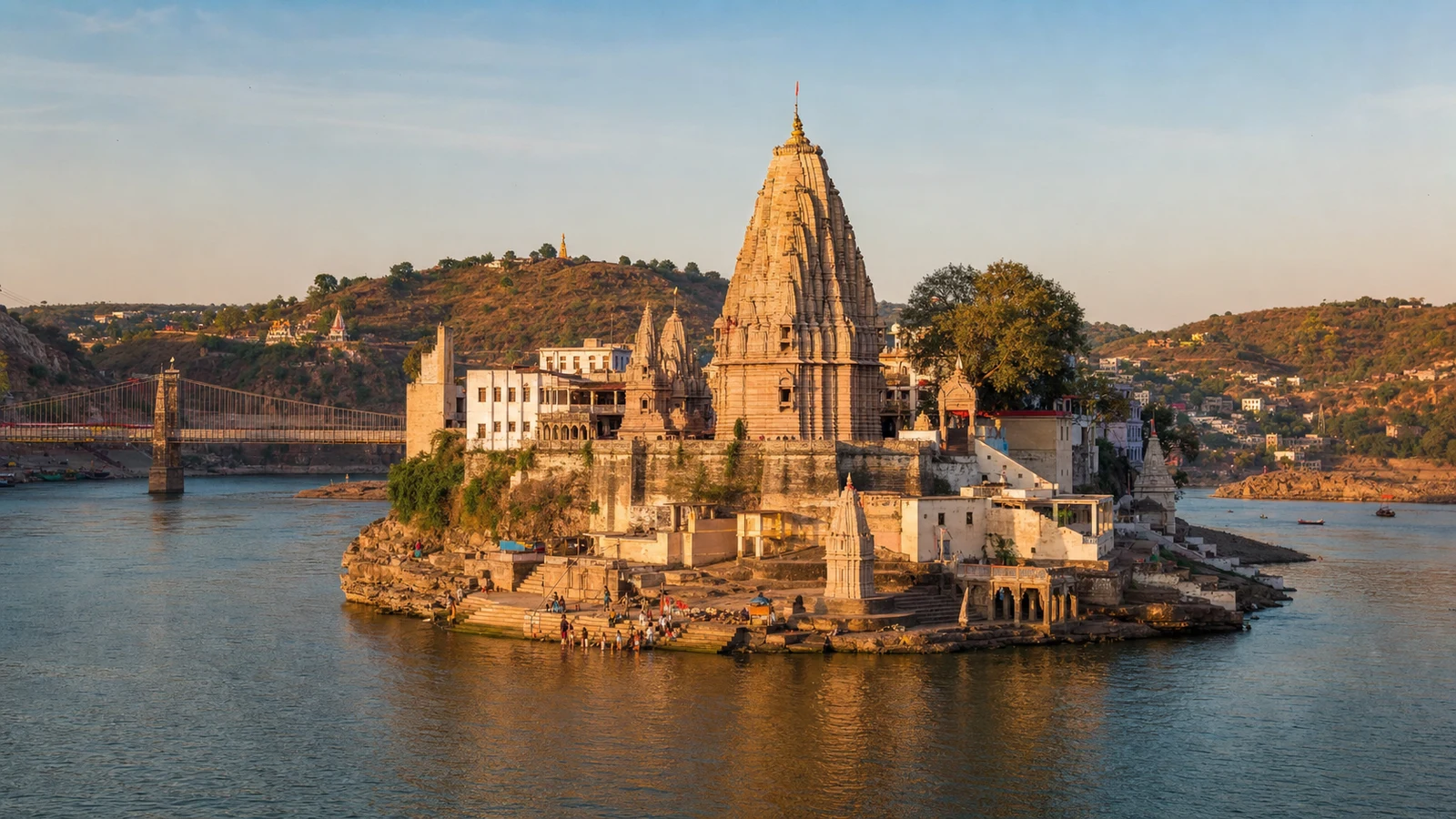
To arrive at Omkareshwar Jyotirlinga is to feel that you have walked into a mantra. The Narmada, one of the holiest rivers in the Sanatan world, flows deep and green around the island of Mandhata, also called Shivpuri. Ghats descend to the water, boats cross with pilgrims and flowers, and above it all the ancient temple keeps its unbroken watch. This is the fourth of the twelve supreme abodes of Shiva, and one of the most serene and soul-stirring of them all.
This is the story of why the Omkareshwar Temple matters — spiritually, historically, and for every pilgrim who longs to stand where the river becomes a prayer.
Omkareshwar Jyotirlinga at a Glance
For readers planning a pilgrimage, here are the essential facts about Omkareshwar Jyotirlinga:
| Detail | Information |
|---|---|
| Temple | Shri Omkareshwar Jyotirlinga Temple (Mandhata) |
| Deity | Bhagwan Shiva as Omkareshwar, the Lord of Omkara (Om) |
| Spiritual status | Fourth of the 12 Jyotirlingas; worshipped together with Mamleshwar (Amareshwar) |
| Location | Mandhata / Shivpuri island, Narmada River, Khandwa district, Madhya Pradesh |
| Sacred river | Narmada, with the traditional Kaveri sangam |
| Island shape | Traditionally associated with the sacred form of ॐ (Om) |
| Nearby places | Mamleshwar, Siddhanath, Gauri Somnath, Govinda Bhagavatpada Caves, Narmada ghats, Maheshwar |
The Meaning of "Omkareshwar": The Lord of Om
The name Omkareshwar is beautifully simple. Omkara is the sacred syllable Om — the Pranava, the sound that the scriptures call the seed of all mantras and the closest word we have for the formless Brahman. Ishwara means Lord. Together, Omkareshwar means "the Lord of Om," Shiva worshipped as the living presence within that primordial sound.
Where Mahakaleshwar at Ujjain reveals Shiva as the Lord of Time, Omkareshwar reveals him as the Lord of the eternal sound — the vibration underlying all creation. When a devotee chants Om Namah Shivaya, the mantra begins with the very name of this shrine; to come to Omkareshwar is to stand inside the first syllable of one's own prayer.
Two great presences share this holy ground — Omkareshwar upon the island and Mamleshwar upon the southern bank — and to understand why, we must turn to the katha preserved in the Puranas.
The Story of the Omkareshwar Jyotirlinga
The most cherished Omkareshwar story is the tale of the Vindhya mountain's penance, told across the tradition.
The Vindhya range, which stretches across the heart of Bharat, once grew proud and restless. Humbled at last and longing for grace, the Vindhya turned to the one refuge that never fails — Bhagwan Shiva. On the bank of the sacred Narmada, the mountain fashioned a linga of earth and gave itself over to severe tapasya, worshipping Shiva day and night with a heart emptied of all pride.
Moved by such devotion, Shiva appeared to grant a boon. As the Vindhya rejoiced, the rishis and devas who had gathered begged the Lord not to depart but to remain there forever, so the world might always have his darshan on the Narmada. Shiva agreed, and the Puranas tell that his radiance settled into two sacred forms upon that holy stretch of river — Omkareshwar, the Lord of Om upon the island, and Mamleshwar (also revered as Amareshwar), upon the southern bank. From that day the two have been worshipped together as the fourth Jyotirlinga.
The island carries another beloved memory as well — that of King Mandhata, the great and righteous emperor of the Suryavansha. It is said that Mandhata performed such intense tapasya to Shiva upon this island that the Lord blessed him, and the island and its hill came to bear his name to this day: Mandhata. So the very ground of Omkareshwar is doubly hallowed — by a mountain's humility and a king's devotion, both laid at the feet of Mahadev.
Why Omkareshwar Is Special Among the 12 Jyotirlingas
A Jyotirlinga is a place where Shiva is worshipped not as a carved image but as a jyoti — a self-manifest pillar of light and consciousness, beyond form. Across Bharat there are twelve such supreme shrines, and pilgrims traditionally undertake the Dwadasha Jyotirlinga Yatra to visit them all. You can follow the whole journey through our 12 Jyotirlingas series, one sacred abode each week.
In the traditional order recited in the Dwadasha Jyotirlinga Stotra, Omkareshwar is named fourth, coming after Somnath on the coast of Gujarat, Mallikarjuna in the Nallamala hills, and Mahakaleshwar at Ujjain. For a pilgrim moving through the twelve, Omkareshwar is where the journey comes down to the water — from Mahakal's city of time to Omkara's island of sound, both cradled in Madhya Pradesh.
Several things set the Omkareshwar Mandhata shrine apart:
- It is the Jyotirlinga of Om itself. Alone among the twelve, this shrine is bound to the Pranava — the sacred syllable at the root of every mantra. Its very name is the sound with which worship begins.
- The island is associated with Om. The land of Mandhata, ringed by the Narmada, is traditionally said to resemble the form of ॐ — as though the river drew the syllable upon the earth.
- It is worshipped with Mamleshwar. Omkareshwar and Mamleshwar are honoured together in the Jyotirlinga pilgrimage, a rare and beautiful feature observed by devotees who take darshan of both.
- It stands on the Narmada. To worship Shiva here is also to worship on the banks of the Narmada, whose very sight is said to purify — a river so holy that many sadhus take its full circumambulation as a lifelong vow.
Omkareshwar and Mamleshwar: The Two Sacred Forms
No pilgrimage to Omkareshwar is complete without a loving word about Mamleshwar. Standing on the southern bank of the Narmada, facing the island across the water, the Mamleshwar Temple — also known as Amareshwar or Amreshwar — is honoured as the paired shrine of the Jyotirlinga tradition, for devotees hold that the light of Shiva is revered through both forms.
Devotees who wish to complete their darshan in the fullest spirit therefore cross to the island for Omkareshwar and also worship at Mamleshwar on the bank — an old shrine, quieter and deeply atmospheric, its ancient stone carrying an air of great antiquity. Together the two remind us of a gentle truth of our dharma — that the Divine is never confined to a single point, and that reverence offered to either form reaches the same infinite Lord. This is why many pilgrims honour both with equal love.
The Narmada, Mandhata Island and the Parikrama
Much of the magic of Omkareshwar lies in the Narmada River temple setting itself. The Narmada is among the most sacred rivers of Sanatan Dharma, revered as a goddess and a giver of liberation; it is said that while the Ganga purifies those who bathe in her, the mere sight (darshan) of the Narmada is enough to bless. At Omkareshwar the river runs deep and clear around the island, and tradition speaks of a second sacred stream, the Kaveri, that branches from the Narmada and rejoins it — the two waters meeting at a sangam that helps shape the Om of the island.
Reaching Mandhata island is itself part of the experience — pilgrims cross by ferry boats over the green water, or over the footbridges and suspension bridge (jhula) that now link the banks to the island. And once there, the great devotional act is the Omkareshwar Parikrama — the circumambulation of the whole island on foot. The path winds along the Narmada, past bathing ghats and small shrines, up to the hill temples and back, so that the pilgrim walks a reverent circle around the island traditionally revered as Om. Many who love the Narmada also know Omkareshwar as a major halt on the far longer Narmada Parikrama, the years-long walk around the entire river.
Temple History and the Adi Shankaracharya Connection
The Omkareshwar temple is ancient, its stone shrines rising in the old Nagara style of central Bharat, and it has drawn pilgrims for many centuries. The island is dotted with temples that speak of a long and layered sacred history.
But Omkareshwar holds a place in the Sanatan story far beyond its own walls, for it is bound to the life of Adi Shankaracharya. By cherished tradition, it was here on the bank of the Narmada — in a cave beneath the temple — that the young Shankara met his guru, Govinda Bhagavatpada, and was initiated into the path of renunciation. From that meeting flowed the life's work that would gather the wisdom of the Upanishads and rekindle dharma across Bharat. The Govinda Bhagavatpada Caves are revered to this day, and in recent years a grand statue honouring Adi Shankaracharya as a young seeker has been raised here — so that the island remembers not only the Lord of Om but the great acharya who found his path upon its shore.
Omkareshwar Darshan and the Pilgrimage Experience
An Omkareshwar darshan is best taken unhurried, with the whole day given to the island and the river. Many pilgrims first descend to the Narmada ghats for a bath or a quiet prayer before entering the presence of the Lord. Then, crossing to Mandhata, they climb the winding lanes and steps up to the sanctum, where the Jyotirlinga is worshipped in continuous ritual.
The temple is arranged over more than one level, and the Jyotirlinga rests in a setting always touched by sacred water. The most stirring times come in the holy month of Shravan, when the island fills with the chant of Om Namah Shivaya, and on Mahashivratri, when devotees keep the night-long vigil of Mahadev.
A note of reverence: Darshan timings, aarti schedules and the rules of the island parikrama can change from time to time and during festivals — please confirm the latest arrangements through the official Omkareshwar temple website or trustworthy local guidance before your visit. The closest rituals upon the Jyotirlinga are performed by the temple priests, while devotees should follow the current darshan arrangements and temple staff instructions.
Sacred Places Near the Omkareshwar Temple
A pilgrimage to Omkareshwar opens naturally into the wider sacred landscape of the island and the Narmada. These are the most cherished places near Omkareshwar temple:
Mamleshwar Temple — The paired shrine on the southern bank, traditionally worshipped together with Omkareshwar in the Jyotirlinga pilgrimage. Ancient and serene, it is an essential part of Omkareshwar darshan.
Siddhanath Temple — An old and majestic temple on the heights of the island, admired for its stone carving and linked with the great Siddhas said to have worshipped here — the climb rewards the pilgrim with a sweeping view of the Narmada.
Gauri Somnath Temple — Home to a tall Shiva linga of dark stone, this revered shrine on the island is one of the important stops on the parikrama.
Govinda Bhagavatpada Caves — The sacred cave on the Narmada bank linked with Adi Shankaracharya's meeting with his guru — a place of deep stillness and Advaita memory.
The Narmada Ghats — The stone steps descending to the river, where pilgrims bathe, offer prayers and watch the evening aarti to the goddess Narmada; the spiritual heart of any visit.
The Island Parikrama Path & Bridges — The circumambulation route around Mandhata, reached by the footbridges and the suspension bridge (jhula) that connect the banks to the island — the classic devotional walk of Omkareshwar.
Sailani Island — A tranquil, scenic spot on the Narmada waters near Omkareshwar, loved for its calm sunsets — a gentle counterpoint to the busy temple lanes.
Maheshwar — The historic riverside town of Rani Ahilyabai Holkar, about 70 km away, famed for its grand ghats, temples and the timeless Maheshwari weave — a rewarding extension for pilgrims travelling the Narmada.
How to Reach Omkareshwar
By air: The nearest major airport is Indore (Devi Ahilyabai Holkar Airport), roughly 77–80 km away and connected to cities across Bharat. Taxis and buses run onward to Omkareshwar in about two hours.
By train: The nearest rail options are around 12–15 km from the temple, including Sanawad / Omkareshwar Road depending on the route and service. For wider connections, Khandwa Junction (about 70–72 km) and Indore are convenient major railheads, with road transport onward to the temple.
By road: Omkareshwar is well linked by road and is easily reached from Indore, Ujjain, Khandwa and Maheshwar, with regular buses, taxis and private vehicles serving the town. Many pilgrims combine it with Ujjain's Mahakaleshwar as part of a Madhya Pradesh Jyotirlinga journey.
Best Time to Visit Omkareshwar
The winter months, roughly October to March, offer the most pleasant weather for a visit, when the Narmada is calm and the island is at its loveliest. The most spiritually charged — and most crowded — times are the holy month of Shravan (Sawan) with its Monday worship, Mahashivratri, and Narmada Jayanti, the festival of the river goddess. For a quieter Omkareshwar darshan, weekday mornings outside the festival season are ideal. Whenever you go, allow unhurried time for the river bath, both shrines, and the parikrama — Omkareshwar rewards those who linger by its water.
What Omkareshwar Teaches Us Today
Among all the great Jyotirlingas, Omkareshwar carries a teaching as simple and as vast as the syllable it enshrines. Om is the sound of oneness — the Pranava from which all things arise and into which they return. To walk the parikrama around an island traditionally associated with Om is to be reminded, with each step, that behind the countless names and forms of the world there is one undivided reality, present not somewhere distant but here, in the flow of a river and the shape of a stone. It is fitting that the young Adi Shankaracharya, who would teach the oneness of Atman and Brahman to all of Bharat, first found his path upon this very shore.
The Narmada teaches the same lesson in her own quiet way — flowing on, unattached, giving her blessing to all who come and asking nothing in return. To sit on her ghats at Omkareshwar and hear the temple bells and the chant of Om rising over the water is to feel one's restlessness dissolve into something larger and more peaceful. We come carrying our worries and leave a little emptier of ourselves, a little fuller of the Lord. That is the gift of Omkareshwar — to remind us that our truest name, like the island's, is Om, and that the Lord of that sacred sound is never far.
Om Namah Shivaya.
Frequently Asked Questions
Where is the Omkareshwar Jyotirlinga located?
Omkareshwar stands on Mandhata (Shivpuri) island in the Narmada River, in Khandwa district, Madhya Pradesh. The Narmada wraps around the island, which is traditionally associated with the sacred shape of Om.
Which number Jyotirlinga is Omkareshwar among the 12?
Omkareshwar is traditionally counted as the fourth of the 12 Jyotirlingas, after Somnath, Mallikarjuna and Mahakaleshwar — named as 'Omkaram' in the Dwadasha Jyotirlinga Stotra.
Why is Omkareshwar island associated with the shape of Om?
The Narmada divides and rejoins around the island so that its outline is traditionally said to resemble the sacred syllable 'ॐ' (Om). Devotees revere the whole island as a living form of Omkara, the primordial sound.
What is the connection between Omkareshwar and Mamleshwar?
Omkareshwar is spoken of through two sacred forms — Omkareshwar on the island and Mamleshwar (also called Amareshwar or Amreshwar) on the southern bank of the Narmada. The two are traditionally worshipped together in the Jyotirlinga pilgrimage, so a complete visit includes both.
What is the Omkareshwar Parikrama?
It is the reverent circumambulation of the Mandhata island on foot, along a path that follows the Narmada past ghats, shrines and hill temples. Omkareshwar is also a major point on the far longer Narmada Parikrama. Route and rules can change, so check local temple guidance before you set out.
What is the story behind the Omkareshwar Jyotirlinga?
The best-loved katha tells of the Vindhya mountain performing penance to Bhagwan Shiva on the Narmada, worshipping an earthen linga until the Lord appeared and, at the prayer of sages, remained here in two forms — Omkareshwar and Mamleshwar. The island and hill are also linked with the tapasya of the great King Mandhata.
Who is Adi Shankaracharya in relation to Omkareshwar?
By cherished tradition, the young Adi Shankaracharya met his guru Govinda Bhagavatpada in a cave on the Narmada bank at Omkareshwar and was initiated into the path of renunciation. The Govinda Bhagavatpada cave near the temple is revered for this reason.
How can I reach the Omkareshwar temple?
The nearest major airport is Indore, roughly 77–80 km away. Nearby rail options are around 12–15 km from the temple, including Sanawad / Omkareshwar Road depending on route and service; Khandwa Junction (about 70–72 km) and Indore offer wider connections. Omkareshwar is well linked by road from Indore, Ujjain, Khandwa and Maheshwar.
What is the best time to visit Omkareshwar?
October to March offers the most pleasant weather. The month of Shravan (Sawan), Mahashivratri and Narmada Jayanti are especially auspicious but very crowded; weekday mornings outside the festival season are best for a peaceful darshan.
What places can I visit near the Omkareshwar temple?
The Mamleshwar Temple, Siddhanath Temple, Gauri Somnath Temple, the Govinda Bhagavatpada Caves, the Narmada ghats, the island parikrama path and the connecting bridges are all close by. Sailani Island and the historic riverside town of Maheshwar make rewarding day trips.