
Where Shiva Waits in the Forest
Some Jyotirlingas stand on the open sea. Some stand in the middle of a great city, surrounded by lamps and bells and the noise of a thousand years. Bhimashankar stands in a forest.
To reach it you climb out of the plains of Maharashtra into the Sahyadri, the Western Ghats, where the road narrows and the hills close in on either side. Mist comes down without warning and lifts just as suddenly. Somewhere below the ridge, water is falling that you can hear but cannot see. And then, in a fold of that green wilderness, a low temple of dark stone: Bhimashankar Jyotirlinga, one of the twelve supreme abodes of Bhagwan Shiva.
There is no grandeur here of the kind that announces itself. The shrine is small, weathered and quiet, and the forest presses right up against its walls. That is precisely its power. Here Shiva is not the deity of a city or a coastline; he is the presence in the rain, the stone and the standing trees.
This is article #6 in our weekly "12 Mondays, 12 Jyotirlingas" journey. After the sea at Somnath, the hills of Srisailam, the ghats of Ujjain, the island in the Narmada and the snows of Kedarnath, the yatra turns into the Western Ghats.
Bhimashankar Jyotirlinga at a Glance
| Detail | Information |
|---|---|
| Temple | Shri Bhimashankar Jyotirlinga Temple |
| Deity | Bhagwan Shiva as Bhimashankar, worshipped as a swayambhu Jyotirlinga |
| Spiritual status | One of the 12 Jyotirlingas of Bhagwan Shiva |
| Location | Sahyadri range, Western Ghats, Maharashtra (commonly associated with Pune district) |
| Altitude | Around 1,000 metres above sea level |
| Setting | Surrounded by the Bhimashankar Wildlife Sanctuary |
| Sacred river | The Bhima, traditionally believed to rise in this region |
| Architecture | Ancient stone shrine, commonly described with Nagara-style and Hemadpanti influences |
| Distance from Pune | Around 110–125 km by road, depending on route |
| Distance from Mumbai | Around 200–225 km by road, depending on route |
| Major festivals | Mahashivratri and the Mondays of Shravan |
The Meaning of "Bhimashankar"
Shankar is one of the most loved names of Mahadev, "the one who brings auspiciousness." Bhima carries the sense of the mighty, the vast, the awe-inspiring. Together, Bhimashankar is "the mighty Shankar", Shiva in the fullness of his strength.
But the name has a second life here, for it is also the name of the asura whose story belongs to this hill, and of the river said to rise from it. The place, the being liberated there, and the water flowing from it all carry a single name. What was once terror becomes, after Shiva's touch, a river that feeds a whole land.
Elsewhere among the twelve, Shiva is the Lord of Time at Mahakaleshwar and the Lord of the sacred syllable at Omkareshwar. Here he is the strength that ends what has grown too strong.
The Katha of Bhimashankar: The Asura and the Manifestation
The story begins with power that had forgotten dharma.
One widely told tradition speaks of Bhima, also called Bhimasura, described as the son of Kumbhakarna, the great sleeping brother of Ravana. Born after the events of the Ramayana, he grew up without knowing his father. When his mother finally told him that Kumbhakarna had fallen at the hands of Bhagwan Rama, the asura did not grieve. He resolved on revenge, not only against Vishnu, but against the whole order of dharma that had brought his father down.
Like many asuras before him, he sought power through tapasya, and his long, severe penance won him a boon of immense strength. As the Puranas show again and again, strength without dharma turns quickly into cruelty. Bhimasura overran the devas, harassed the rishis, and made righteousness dangerous to practise in his territory.
His final arrogance undid him. He imprisoned a devout king, a lifelong worshipper of Shiva, and demanded that he abandon Mahadev and worship the asura instead. The king refused, fashioning a linga in his cell and continuing his worship regardless. When Bhimasura discovered this and raised his weapon to strike the sacred linga itself, the thing he had never reckoned with happened.
Bhagwan Shiva manifested on that spot.
The Puranas do not linger over the battle. What they emphasise is its manner: the asura's power, which no one else could face, met the one power it could not stand against and was reduced to ash. Dharma, forced into hiding, was restored in an instant.
Then the devas and rishis made the request that shapes every Jyotirlinga story: that Shiva not leave, but remain, so the ground where dharma had been restored would stay a refuge for all who came after. Mahadev consented, and it is that presence which is worshipped here as the Bhimashankar Jyotirlinga.
Tradition adds one beautiful detail: the sweat that flowed from Shiva's body after that exertion ran down this hill and became the Bhima River. The water of the region is understood as having emerged from the moment of Shiva's victory, which is why the Bhima River origin is revered here as sacred, and not merely geographical.
You may also see official tourism references connect Bhimashankar with Shiva's victory over Tripurasura. The details differ across regional retellings, but the spiritual centre remains the same: Mahadev manifests in the Sahyadri to end adharma, bless the devas and devotees, and remain here as one of the twelve Jyotirlingas.
Why Bhimashankar Is Special Among the Jyotirlingas
A Jyotirlinga is a place where Shiva is worshipped not as an image shaped by human hands but as a jyoti, a self-manifest pillar of light and consciousness. There are twelve such supreme abodes across Bharat; follow the whole journey in our 12 Jyotirlingas series, one sacred abode each week.
Bhimashankar is article #6 in this Monday series (our travelling order, not a claim about the traditional list). Several things make this Jyotirlinga in Maharashtra unlike any other stop on the route:
- It is a forest shrine. Most Jyotirlingas grew a town or a city around them. Bhimashankar has a forest instead, legally protected as a wildlife sanctuary, so the sacred setting survives in a way that is genuinely rare.
- The Jyotirlinga is swayambhu: self-manifest, not carved. Shiva appearing of his own will rather than being installed.
- The sacred and the natural are inseparable. The river, the katha and the hill share a single name.
- It is a shrine you reach through rain. For much of the year the approach itself is mist, water and green.
It is the first of two Maharashtra Jyotirlingas this series will visit; the other is Trimbakeshwar near Nashik.
Temple Architecture and Sacred Setting
The Bhimashankar temple history is layered, as at most ancient tirthas: an old sacred site, worship continuing across centuries, and structures added and repaired by different hands in different eras.
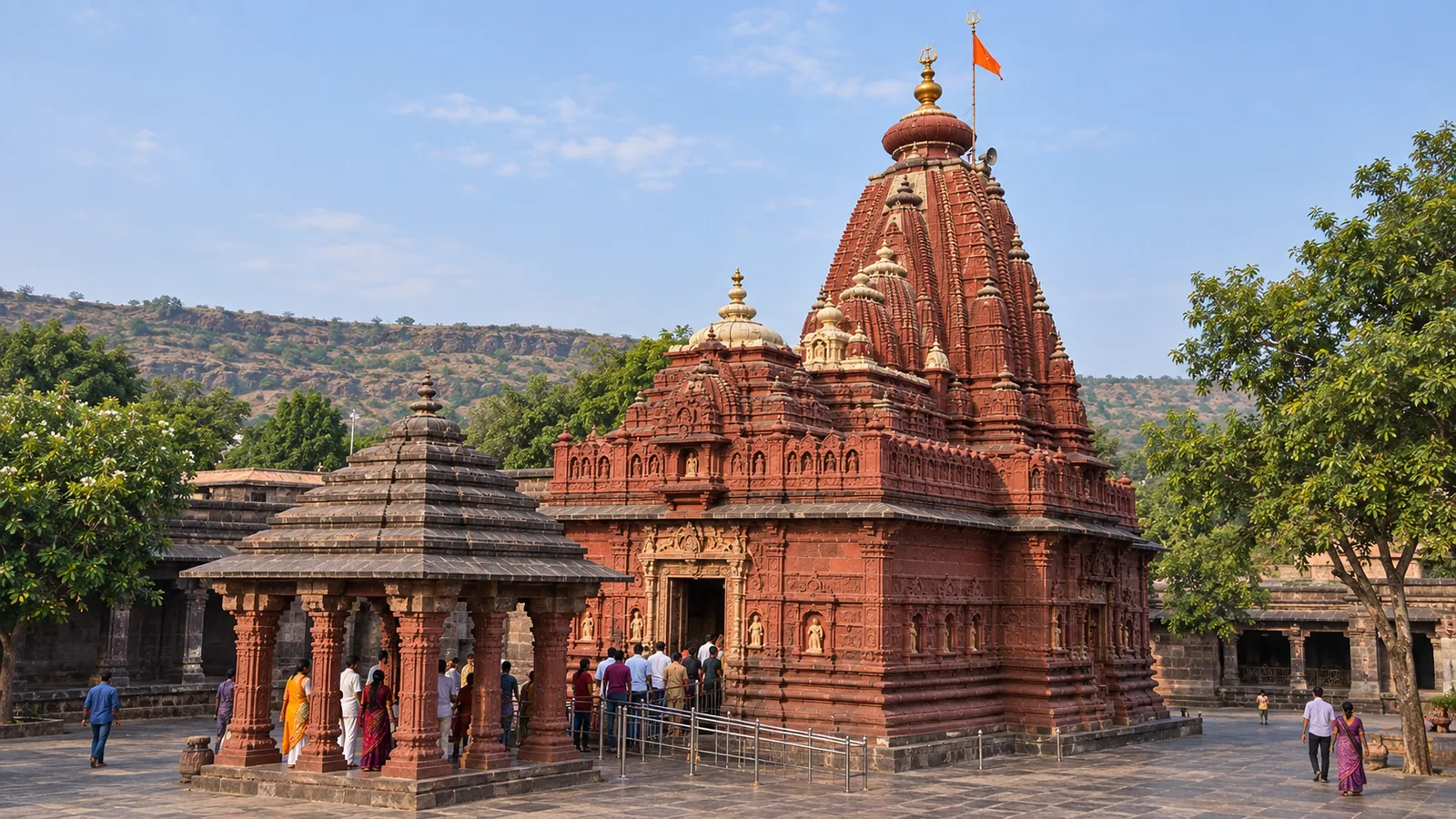
The shrine is built of dark local stone, low and solid, in a style commonly described as showing Nagara-style features with Hemadpanti influence (the mortarless, interlocking technique associated with the Yadava period in Maharashtra). The shikhara and parts of the surrounding structure are traditionally attributed to eighteenth-century Maratha-era patronage, with the statesman Nana Phadnavis commonly named in that connection. In front of the temple hangs a large bell of European make, associated with Chimaji Appa and the Maratha campaigns on the Konkan coast, an unexpected piece of history in a forest clearing.
The carving is not lavish. What you notice instead is the weight of the stone, the moss in every joint, and how completely the building belongs to the hillside. The sanctum lies below the courtyard, so darshan means stepping down into a cool, dim chamber where the swayambhu Jyotirlinga rests. Around the temple lie small tirthas revered by pilgrims (Mokshakund, Sarvatirtha and Kusharanya), along with the shrines of Kamalaja Devi and Shani.
The Wildlife Sanctuary and the Spirituality of the Forest
The temple does not stand at the edge of a forest. It stands inside one.
The Bhimashankar Wildlife Sanctuary protects a stretch of Western Ghats forest among the richest in Maharashtra. Maharashtra Tourism notes Bhimashankar's blend of pilgrimage, biodiversity and scenic beauty, while official protected-area listings recognise the sanctuary itself. It is best known as a stronghold of the Indian giant squirrel (the Shekru, state animal of Maharashtra), a large, russet, extraordinarily agile creature that lives high in the canopy and is far more often heard than seen. The forest also shelters leopards, barking deer, hornbills, and a wealth of birds, butterflies and endemic plants.
For a pilgrim this is not a footnote. Our tradition has never treated the forest as an obstacle around a temple. The aranya, the wilderness, is where rishis went to sit and where tapasya was performed, because the mind grows quiet when nothing manufactured is there to distract it. Sanatan Dharma places Shiva in exactly such settings: on Kailash, in cremation grounds, among trees and rock and running water, wherever the human world thins out.
Stand outside the temple at dawn and what you hear is water dripping from leaves, a hornbill down the slope, wind in a canopy whose top you cannot see. Shiva as the presence in silence, in rain, in stone and in the wilderness: here that is not a metaphor but the experience of standing there.
This places a duty on those who come. Carry no plastic into the sanctuary, leave no waste, do not feed or chase animals, and do not stray from permitted paths. Treating the forest as part of the tirtha is not modern environmentalism grafted onto dharma; it is dharma.
Bhimashankar Darshan: The Pilgrimage Experience
Most pilgrims arrive early, when mist is still lying in the valleys. From the parking and market area a long flight of steps descends towards the temple, lined with stalls selling bel patra, flowers, rudraksha and prasad. The descent itself feels like an entry: the road noise falls away behind you, trees rise on both sides, and the air cools with each step.
At the courtyard, devotees take darshan of Nandi before turning to the sanctum. Inside, the chamber is small and low; on a quiet weekday morning you may get a few unhurried moments before the Jyotirlinga. Water, bel patra and flowers are offered according to the temple's current arrangements, and the Om Namah Shivaya of those behind you fills the stone room continuously. Afterwards most pilgrims sit a while in the courtyard. Bhimashankar darshan rewards that: this is a shrine that reveals itself to people who do not rush away.
Mahashivratri is the greatest night here, and the Mondays of Shravan (the Sawan Somvars) bring the largest gatherings of the year. If you seek quiet, avoid those days; if you seek the collective heat of devotion, there is no better time.
A note of reverence: Darshan arrangements, aarti timings, queue systems and rules for offerings and abhishek can change from season to season and on festival days, and vehicle and forest access is also subject to change. Please confirm current arrangements from the temple administration, Maharashtra Tourism and the Maharashtra Forest Department before you travel, and follow the instructions of temple staff and forest officials at all times.
How to Reach Bhimashankar
By air: The nearest major airport is Pune International Airport, from where the journey continues by road. Mumbai's airport is the alternative for international arrivals, with a longer drive.
By train: Pune is the most convenient railhead for the road approach. Karjat is commonly used by those coming from the Mumbai side, particularly for the Khandas trekking routes.
Pune to Bhimashankar by road: Commonly around 110–125 km depending on route, usually via Rajgurunagar (Khed) and Manchar, then climbing west into the ghats, typically three to four hours. State transport buses run this route, and shared and private vehicles are widely available.
Mumbai to Bhimashankar by road: Commonly around 200–225 km depending on route. Travellers either take the Pune highway and approach via Manchar, or go through Karjat towards Khandas for the trekking approach. Allow a full day for a return trip, and more in the monsoon.
The last stretch: The final ghat section is narrow, winding and steep, with sharp bends and poor visibility in mist. Drive slowly, use your horn on blind curves, and avoid it after dark or in heavy rain. Parking near the temple is limited and fills early on Mondays, festival days and weekends.
The Bhimashankar Trek and How to Approach It Safely
The Bhimashankar trek from the Khandas side is well known among trekkers in Maharashtra, on routes commonly called the Ganesh Ghat and Shidi Ghat trails. Ganesh Ghat is the longer and gentler; Shidi Ghat is shorter, steeper, and includes exposed rock sections and iron ladders.
These are genuine mountain treks, not temple steps, and for many devotees a deeply meaningful way to arrive, climbing to Shiva rather than driving to him. If you trek, treat the following as non-negotiable:
- Do not attempt the ladder route in the monsoon or after heavy rain. Wet rock and iron rungs are dangerous, streams rise quickly, and rescue in that terrain is slow and difficult.
- Go with experienced local guides, and never alone. The forest is dense and trails are easy to lose in mist.
- Start early and finish in daylight, and carry water, food, a charged phone, basic first aid and shoes with proper grip.
- If the weather turns, turn back. The road route to the same darshan will still be there.
- Follow all forest department rules, including restrictions on entry, timings or routes.
There is no lesser darshan for arriving by road. Mahadev is not counting steps.
Sacred and Natural Places Near Bhimashankar
Gupt Bhimashankar: A short forest walk from the main temple, where a stream flows over rock and a linga is revered in a quiet clearing. Gupt means hidden, and tradition associates this spot with the sacred origin of the Bhima.
Nagphani Point: The highest point in this part of the Sahyadri, named for its resemblance to a serpent's hood, with views far over the Konkan. The cliffs are sheer and often cloud-covered; stay well back from the edges.
Hanuman Lake: A small, calm forest lake, good for quiet sitting and for glimpsing the Shekru and forest birds.
Bombay Point: A viewpoint known for sunsets over the Ghats, looking towards the Konkan plains.
Ahupe Waterfalls: In the hills some distance away, spectacular in and just after the monsoon. Sahyadri waterfalls are beautiful and genuinely dangerous: rocks are slippery and water levels rise without warning. Keep to a safe viewing distance.
Manchar and Rajgurunagar (Khed): Towns on the Pune road, the usual places to eat and refuel. Rajgurunagar is named for the revolutionary Shivaram Hari Rajguru.
Pune: The base city for this yatra, itself full of sacred and historic places, including Kasba Ganpati, Parvati Hill and Shaniwar Wada.
Best Time to Visit Bhimashankar
- July to September (monsoon): The Sahyadri at its most magnificent: streaming mist, full waterfalls, green in every direction. This is also the season of Shravan, when devotion here peaks. But rain is heavy, roads are slippery, leeches are common on forest paths, and treks become hazardous. Come, but come carefully.
- October to February: For most travellers the best window. The forest is still green, the air cool and clear, and conditions underfoot far safer.
- March to June: Hotter and drier, the forest less lush, though the hills stay cooler than the plains. Mahashivratri falls in this period and draws immense crowds.
Weekdays are far quieter than weekends. Shravan Mondays and Mahashivratri are the most crowded days of the year.
Safety and Official Guidance
Bhimashankar is a forest pilgrimage in mountain terrain, and reverence here includes good sense:
- Confirm current arrangements before travelling. Darshan timings, offering rules, parking and forest access can all change. Rely on the temple administration, Maharashtra Tourism and the Maharashtra Forest Department, not on old blog posts, including this one.
- Respect sanctuary rules absolutely, and stay on permitted paths.
- Do not take risks in the monsoon, not on rocks, not near waterfalls, not on the ladder trek.
- Plan for the vulnerable. The steps are long and can be slippery; take care of elderly members of your group and of small children.
- Carry rain protection through much of the year, along with water, basic medicines and a torch.
What Bhimashankar Teaches Us Today
Bhimasura's story is not really about a monster. It is about what happens when strength grows without dharma to hold it.
He was not weak; he was extraordinarily powerful, and the power was honestly earned through years of penance. What he lacked was any check upon it. The turning point comes when he demands that a devotee stop worshipping Shiva and worship him instead: not violence, but the demand to be worshipped in the place of the Divine. The answer of the katha is quiet and absolute: what sets itself up in the place of the Divine cannot stand.
Then there is what Shiva did after. He did not simply end the tyranny and depart. He stayed, so that ordinary people, for as long as this world lasts, would have somewhere to go. Every Jyotirlinga carries that promise, but here it is felt with particular tenderness, because the place he chose is not a palace or a city. It is a forest.
That is perhaps the deepest teaching of this shrine. We look for the sacred in scale: in height, in gold, in crowds. Bhimashankar puts it in a low stone room under the trees, where the loudest sound is rain falling through leaves. Shiva is in the silence. He is in the water on the rock. He is in the wilderness that does not need us to notice it in order to be holy.
Come here slowly, if you can. Sit a while in the courtyard after darshan, and let the forest do what it has been doing on this hill for a very long time.
Om Namah Shivaya.
Frequently Asked Questions
Where is the Bhimashankar Jyotirlinga located?
Bhimashankar Temple stands in the Sahyadri range of the Western Ghats in Maharashtra, in the forested hills commonly associated with Pune district, roughly 110–125 km from Pune depending on the route. The shrine sits at around 1,000 metres above sea level and is surrounded on all sides by the Bhimashankar Wildlife Sanctuary.
Is Bhimashankar one of the 12 Jyotirlingas?
Yes. Bhimashankar is one of the 12 Jyotirlingas of Bhagwan Shiva, worshipped as a swayambhu (self-manifest) form. In our weekly Monday series it is article #6, but that is only the order in which we are travelling through the twelve, and not a claim about its place in the traditional recitation order.
What is the story of Bhimasura at Bhimashankar?
One widely told tradition speaks of Bhima, or Bhimasura, a mighty asura described as the son of Kumbhakarna. Empowered by long penance, he tormented the devas and the righteous, and finally turned his violence against the worship of Shiva himself. Bhagwan Shiva manifested at this spot, ended his tyranny, and restored dharma. Some official tourism references also connect Bhimashankar with Tripurasura; both traditions remember Shiva's victory over adharma in the Sahyadri.
Does the Bhima River originate at Bhimashankar?
Traditional belief holds that the Bhima River rises in this sacred region of the Sahyadri, near the shrine, and flows eastward across Maharashtra to eventually join the Krishna. Pilgrims revere the small stream near the temple as the sacred beginning of that river, and the katha connects it with Shiva's own presence at this place.
How do I reach Bhimashankar from Pune?
Pune to Bhimashankar is commonly around 110–125 km by road depending on the route, usually via Rajgurunagar (Khed) and Manchar, and it is normally driven in about three to four hours. State transport buses and private vehicles both serve the route. The nearest major airport is Pune International Airport, and Pune is also the most convenient railhead.
How far is Bhimashankar from Mumbai?
Mumbai to Bhimashankar is commonly around 200–225 km by road depending on the route chosen. Travellers usually approach either through Karjat and the Khandas side or via the Pune highway and Manchar. Karjat is a common railhead for the Khandas approach, and Pune is the usual railhead for the road route.
What is the best time to visit Bhimashankar?
The monsoon and the months just after it, roughly July to February, are the most beautiful, when the Sahyadri is green and the forest is alive with mist and waterfalls. The monsoon itself is spiritually stirring but slippery, so travel with care. Shravan Mondays and Mahashivratri are the most devotional periods, and also the most crowded.
Is the Bhimashankar trek difficult?
The treks from the Khandas side are popular but genuinely demanding, involving long climbs, rock sections and, on some routes, iron ladders. They become dangerous during and after heavy rain, when the rock is slippery and streams swell without warning. Anyone attempting a trek should go with experienced local guides, in a group, in daylight, and should simply take the road route instead if conditions are poor.
What is the Bhimashankar Wildlife Sanctuary known for?
The sanctuary surrounding the temple protects dense Western Ghats forest and is best known as a home of the Indian giant squirrel, the Shekru, which is the state animal of Maharashtra. The forest also shelters leopards, barking deer, hornbills and a great variety of birds, insects and endemic plants. Visitors should follow all forest department rules and stay on permitted paths.
Which places can I visit near the Bhimashankar temple?
Close to the shrine are Gupt Bhimashankar, Nagphani Point, Hanuman Lake and Bombay Point, all within the sanctuary area. A little further lie the Ahupe waterfalls, and on the road back are Manchar and Rajgurunagar (Khed) before Pune. Forest paths should be walked only where permitted and only in safe weather.