
Where Ganga Descends as Godavari
Some tirthas announce themselves from far away. Trimbakeshwar gathers around you slowly: the road from Nashik narrowing between fields, the Sahyadri ridges darkening ahead, and then the great flat-topped mass of Brahmagiri Hill standing over a small town of old wadas and temple spires. In the monsoon the hill streams with waterfalls and cloud drags across its face; the black stone of the town shines with rain. It looks less like a destination and more like something the earth itself is doing.
At the foot of that hill stands the Trimbakeshwar Jyotirlinga, one of the twelve Jyotirlingas of Bhagwan Shiva, and beside it, held in a square stone tank, the infant Godavari, the river the tradition lovingly calls the Ganga of the south. This is the rare tirtha where a river is born and a Jyotirlinga stands at her cradle: Shiva and Ganga together, as they are on his own matted locks, here spread out across a hillside in Maharashtra.
This is article #8 in our weekly "12 Mondays, 12 Jyotirlingas" journey. After the sea at Somnath, the hills of Srisailam, the ghats of Ujjain, the island in the Narmada, the snows of Kedarnath, the forest of Bhimashankar and the lanes of Kashi, the yatra comes to the source of a river.
Trimbakeshwar Jyotirlinga at a Glance
| Detail | Information |
|---|---|
| Temple | Shri Trimbakeshwar Temple |
| Deity | Bhagwan Shiva as Trimbakeshwar, "the three-eyed Lord" |
| Spiritual status | One of the 12 Jyotirlingas of Bhagwan Shiva |
| Unique feature | Three lingas in one sanctum, revered as Brahma, Vishnu and Mahesh |
| Location | Trimbak, Nashik district, Maharashtra |
| Sacred hill | Brahmagiri, traditional birthplace of the Godavari |
| Sacred kund | Kushavarta Kund, the visible emergence of the Godavari |
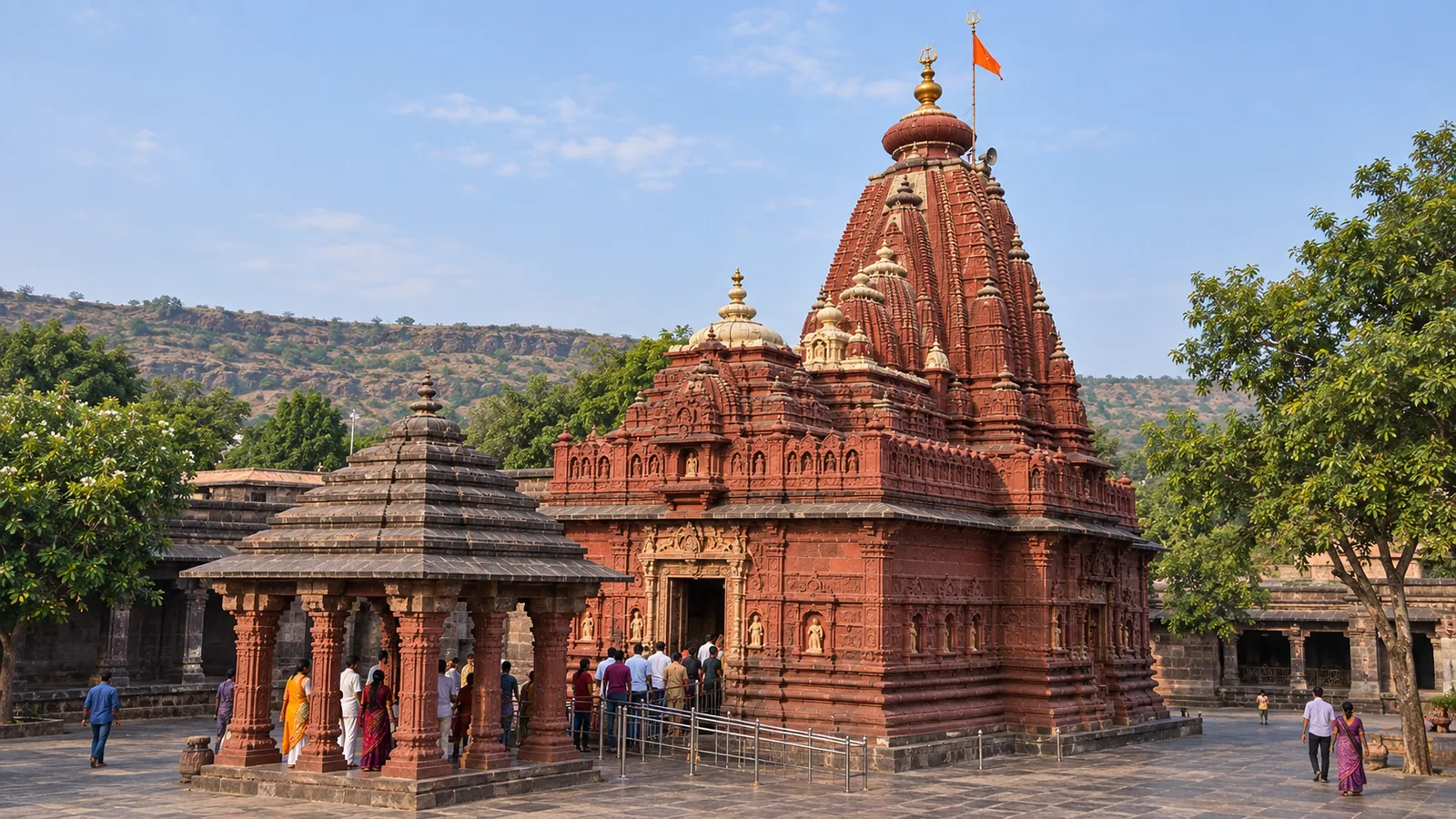
| Architecture | Black stone, Hemadpanthi style |
| Present structure | Commonly credited to Peshwa Balaji Baji Rao (Nanasaheb Peshwa), 18th century |
| Associated rituals | Narayan Nagbali, Tripindi Shraddha, Kaal Sarp Puja |
| Great gathering | Simhastha Kumbh Mela of Nashik–Trimbak |
| Distance from Nashik | About 28–30 km by road; Nashik Road station about 40 km |
| Nearest airports | Nashik (Ojhar) Airport; Mumbai for international arrivals |
The Meaning of "Trimbakeshwar"
Trimbakeshwar, written also as Tryambakeshwar, carries one of the oldest names of Shiva in the entire tradition. Tryambaka, the three-eyed one, is the name by which the Rigveda calls him in the Mahamrityunjaya mantra: tryambakaṁ yajāmahe, "we worship the three-eyed one." Join it with ishwara, the supreme lord, and the name becomes the three-eyed Lord, he whose third eye is not an organ but an opening: the eye of knowledge that sees through time, through appearance, through death itself.
The town of Trimbak simply takes his name, the way a child takes a parent's. And at this particular tirtha the "three" of Tryambaka deepens into something found nowhere else among the twelve, as we shall see in the sanctum itself: a linga that holds the threefold face of divinity.
The Katha of Trimbakeshwar: Gautama Rishi, Ahalya and the Descent of Godavari
The story of this Jyotirlinga, told in the Shiva Purana and cherished in local tradition, belongs to Gautama Rishi and his wife Ahalya, who lived in tapasya on Brahmagiri.
Once, tradition says, a great drought seized the land for many years. Moved by the suffering around him, Gautama performed austerities to Varuna and received an unfailing supply of water, a pit that never went dry. His ashram became a refuge: grain grew, animals were watered, other rishis and their families gathered there and were sustained through the famine.
But sustained generosity can breed envy in those it feeds. Some of the rishis, wishing to be free of their debt to Gautama, contrived his downfall. Through their doing, a cow entered Gautama's grain field, and when the rishi gently tried to drive her away with a handful of grass, she fell lifeless. The horrified Gautama was declared guilty of go-hatya, the gravest of sins, and told that only Ganga herself could wash it away.
Gautama did not argue his innocence. He climbed Brahmagiri and gave himself to the worship of Shiva, fashioning lingas, performing abhishek, praying with the whole of his being that Ganga might descend and purify him. Bhagwan Shiva, pleased with a devotion that accepted humiliation without bitterness, appeared with Mata Parvati and granted the prayer. Ganga came down upon Brahmagiri, and in this southern land she took a new name: Godavari, also called Gautami Ganga after the rishi whose tapasya brought her.
But rivers born of grace are not easily held. The stream kept vanishing into the hill, playful and elusive, until Gautama encircled her with a ring of kusha grass and bound her to the spot: the origin of Kushavarta, the kund where she still rises. Then Gautama, the devas and Ganga herself prayed that Shiva remain at this place forever. He consented, and manifested as the Trimbakeshwar Jyotirlinga at the foot of the hill where the river was born.
It is worth pausing on what this katha actually honours. Gautama was innocent; the sin was manufactured by jealousy. Yet he neither defended himself nor cursed his accusers; he turned the false accusation into an occasion for tapasya, and out of that acceptance came a river that has fed half the Deccan for thousands of years. The wrong done to one rishi became water for millions. That is the alchemy this tirtha remembers.
Why Trimbakeshwar Is Special Among the Jyotirlingas
A Jyotirlinga is a place where Shiva is worshipped not as an image shaped by human hands but as jyoti, a self-manifest pillar of light and consciousness. There are twelve such supreme abodes across Bharat; follow the whole journey in our 12 Jyotirlingas series. Trimbakeshwar is article #8 in this Monday series (our travelling order, not a claim about the traditional list). Several things make this Jyotirlinga in Maharashtra unlike any other:
- The three-faced linga. Within the sanctum are three small lingas, revered as Brahma, Vishnu and Mahesh together. At every other Jyotirlinga, Shiva alone is the form; here the entire Trimurti (creator, sustainer, dissolver) is honoured in one shrine. The three-eyed Lord holds the threefold divinity within himself.
- A river is born here. No other Jyotirlinga stands at the very source of a great river. The Godavari, longest river of peninsular Bharat, begins on Brahmagiri above the temple.
- It is a Kumbh tirtha. Trimbak and Nashik together host the Simhastha Kumbh Mela, one of the four great Kumbh gatherings, when the amrit of the samudra manthan is said to have touched this land.
- It is a seat of ancestral rites. For centuries, families have come here for Narayan Nagbali, Tripindi Shraddha and Kaal Sarp Puja, making Trimbakeshwar a place of healing between the living and their ancestors.
Temple History and the Black-Stone Hemadpanthi Architecture
The worship at Trimbak is far older than any structure that stands today; the tirtha appears in Puranic tradition and has drawn pilgrims for as long as the Godavari has been honoured as Ganga's southern form.
The present temple is commonly credited to Peshwa Balaji Baji Rao (Nanasaheb Peshwa) in the 18th century, when the Maratha power rebuilt and endowed tirthas across Bharat. It is among the finest temples of that age in the Deccan: built entirely of black basalt stone in the style commonly described as Hemadpanthi, a manner of construction associated with the Deccan, using dark local stone fitted with massive precision. The shikhara rises in carved tiers crowned with a golden kalash, and the whole temple sits within a great stone enclosure, so that entering the courtyard feels like stepping into a quieter, older century.
There is a particular beauty in the material itself. In the rains, the black stone darkens and gleams, the courtyard mirrors the sky, and Brahmagiri looms behind the shikhara streaked with white waterfalls. Trimbakeshwar in the monsoon is one of the most quietly magnificent sights among all the twelve.
Within the sanctum, the Jyotirlinga rests in a depression in the floor: three small lingas in one setting, the Trimurti in living rock. A jewelled crown, honoured by tradition as dating from great antiquity, is associated with the deity and ceremonially displayed at appointed times.
Kushavarta Kund: The Cradle of the Godavari
A short walk from the temple lies Kushavarta Kund, the stepped square tank where the Godavari, having travelled unseen through the body of Brahmagiri from her birthplace above, rises again into the light of day. This is the spot where Gautama Rishi is said to have bound the wandering stream with kusha grass; the name remembers that act: kusha-avarta, the eddy held by kusha.
By tradition, a pilgrimage to Trimbakeshwar begins here: snan at Kushavarta, then darshan of the Jyotirlinga. The kund is also the principal bathing site of the Simhastha Kumbh Mela, when lakhs of sadhus and grihasthas descend into this small square of water that carries the weight of a very great story.
Above the town, the hillside path leads to Gangadwar ("the door of Ganga"), a shrine on the flank of Brahmagiri where the young river is honoured as she comes down through the rock, and further up to the plateau of Brahmagiri itself, where the traditional sources of the Godavari are venerated. The climb is a tirtha of its own: hundreds of stone steps, wind, cloud, and the Deccan opening out below.
Trimbakeshwar Darshan: The Pilgrimage Experience
Trimbak is a small town, and the yatra here has an unhurried, old-world texture that the great city tirthas cannot offer.
Pilgrims typically bathe or sprinkle Godavari jal at Kushavarta Kund, then walk the short distance to the temple through lanes lined with shops selling bel patra, flowers, and rudraksha, for which the Trimbak region is famous. Within the stone enclosure, the queue moves through the courtyard toward the sanctum. The garbhagriha is small and the linga rests low, so darshan is brief and close; on ordinary days the crowd is gentle, while Shravan Mondays, Mahashivratri and festival days bring long lines that wind through the courtyard.
Take time afterwards to simply sit in the courtyard. The proportions of the black stone temple against the green or mist-hung mass of Brahmagiri reward stillness; this is not a tirtha to rush.
Those with time and sound legs climb to Gangadwar and Brahmagiri. Allow several hours, carry water, and treat the stone steps with respect, especially in rain.
Narayan Nagbali, Tripindi Shraddha and Kaal Sarp Puja
Trimbakeshwar is one of the principal seats in Bharat for certain remedial and ancestral rites, performed here by hereditary purohits according to long-established vidhi:
- Narayan Nagbali: a rite traditionally performed for the shanti of ancestors whose passing was troubled or whose rites remained incomplete, and in expiation of harm done knowingly or unknowingly to living beings, particularly the serpent. Trimbakeshwar is regarded as the foremost place for this vidhi.
- Tripindi Shraddha: an offering made for ancestors of the last three generations who may not have received proper shraddha, restoring the bond of remembrance and gratitude between the living and the departed.
- Kaal Sarp Puja: a shanti rite associated with a particular configuration of the planets in a birth chart, performed by those who seek graha-shanti through prayer at this tirtha.
We write about these with care. In the Sanatan understanding, such rites are acts of shraddha (faith, remembrance and responsibility), not transactions of fear. No shastra teaches that Mahadev, who is Ashutosh, quickly pleased, deals in threats. If your family tradition or your own heart calls you to one of these vidhis, approach it as an offering of love toward your ancestors and a prayer for harmony, and arrange it through authorised local purohits at Trimbakeshwar, confirming current arrangements on the ground. Be cautious with unverified online agents, and be wary of anyone who uses fear to sell a ritual. Reverence is the currency here; fear is counterfeit.
The Simhastha Kumbh Mela
When Brihaspati enters Simha rashi, the Simhastha Kumbh Mela comes to Nashik and Trimbak, one of the four great Kumbh gatherings of Bharat, held at the places where drops of amrit fell during the samudra manthan. Sadhus of the akhadas, pilgrims in lakhs, and the small town of Trimbak becomes, for a season, one of the largest gatherings of faith on earth, with the shahi snan at Kushavarta Kund and at Ramkund in Nashik. If your yatra coincides with a Kumbh year, expect extraordinary crowds and plan through official channels well in advance.
How to Reach Trimbakeshwar
By air: The nearest airport is Nashik Airport at Ojhar, north of Nashik city, with domestic connections. Mumbai's Chhatrapati Shivaji Maharaj International Airport, roughly 170–180 km away, is the major option for pilgrims flying in from other parts of Bharat or from abroad; from Mumbai, Trimbakeshwar is a drive of about four to five hours depending on traffic.
By train: The nearest major railhead is Nashik Road station, about 40 km from Trimbak, well connected to Mumbai, Pune, Delhi and central Bharat. Taxis and buses run from the station via Nashik city.
By road: Trimbakeshwar is about 28–30 km from Nashik city, a comfortable drive of under an hour. Maharashtra State Transport buses run frequently from Nashik, and taxis and autos are easily arranged. From Pune, the distance is roughly 230–240 km via Sangamner or Sinnar, five to six hours by road.
For the Brahmagiri–Gangadwar climb: this is a genuine hill walk on stone steps, not a stroll. Start early, carry water, wear grippy footwear, and turn back without embarrassment if rain makes the stone treacherous. Elderly pilgrims should attempt it only with support, in fair weather, at their own pace, and remember that darshan of Trimbakeshwar and snan at Kushavarta are complete in themselves; the hill is a blessing for those who can climb it, not an obligation for those who cannot.
Sacred Places Near the Trimbakeshwar Temple
Kushavarta Kund: The sacred tank of the Godavari's emergence, steps from the temple; snan here traditionally precedes darshan.
Brahmagiri Hill: The great hill above Trimbak, revered as the birthplace of the Godavari, climbed by a long flight of stone steps.
Gangadwar: The shrine on Brahmagiri's flank where the young Godavari is honoured as she descends through the rock.
Neel Parbat (Neelachal): The hill near Trimbak associated with Neelambika Devi and with Dattatreya tradition.
Anjaneri Hill: Between Nashik and Trimbak, revered as the birthplace of Hanuman ji, named for Mata Anjani; a beautiful trek in its own right.
Panchavati, Nashik: The sacred grove on the Godavari where Bhagwan Ram, Mata Sita and Lakshman ji lived during vanvas.
Kalaram Temple: The great black-stone Ram temple of Panchavati, another jewel of Peshwa-era building.
Sita Gufa: The cave in Panchavati traditionally associated with Mata Sita.
Ramkund: The holiest bathing ghat on the Godavari in Nashik city, and a principal site of the Simhastha Kumbh.
Sundarnarayan Temple: The graceful 18th-century Vishnu temple by the Godavari in Nashik.
Saptashrungi Devi, Vani: The shakti-peetha of the Devi of seven peaks, a longer drive from Nashik, often joined to a Trimbakeshwar yatra.
Best Time to Visit Trimbakeshwar
- October to March: The most comfortable season: clear days, cool mornings, ideal for the temple, Kushavarta and the Brahmagiri climb. Mahashivratri falls in this period and is the temple's greatest day, with corresponding crowds.
- June to September (monsoon and Shravan): Trimbak at its most beautiful: Brahmagiri wrapped in cloud, waterfalls on every face of the hill, the black stone gleaming. Shravan, and especially its Mondays, brings great crowds of Shiva bhaktas. But paths, steps and stone become genuinely slippery; climb only with care, and let the elderly enjoy the rain from the courtyard rather than the hillside.
- April to June: Hot by day, though Trimbak is milder than the plains. Move in the early morning and evening.
Safety and Official Guidance
- Do not rely on this or any article for current darshan timings, puja arrangements or fees. These change with season and festival. Confirm from official sources (the Maharashtra Tourism page on Trimbakeshwar, the Nashik district portal and the Nashik Municipal Corporation tourism page) and from the temple administration on the ground.
- For Narayan Nagbali, Tripindi Shraddha or Kaal Sarp Puja, arrange the vidhi through authorised local purohits at Trimbakeshwar and confirm details in person; avoid unverified online intermediaries.
- On Brahmagiri and Gangadwar: start early, carry water, wear proper footwear, and do not climb during heavy rain; wet basalt is unforgiving. Keep children close on the steps.
- At Kushavarta Kund, bathe with care on the wet stone steps and follow the instructions of local authorities, especially during festivals and the Kumbh.
- During Shravan, Mahashivratri and the Simhastha Kumbh, expect very large crowds, parking restrictions and altered routes; follow police and temple staff directions.
- Keep valuables minimal, and treat the small town gently; it has been receiving guests for a very long time.
What Trimbakeshwar Teaches Us Today
Every element of this tirtha teaches the same quiet lesson from a different side.
Gautama Rishi teaches that a false accusation, met without bitterness, can become tapasya, and that the answer to being wronged is not always vindication; sometimes it is a river.
The Godavari teaches how the sacred moves through the world: born in a moment of grace on one hilltop, then flowing a thousand miles, feeding fields and cities of people who will never see Brahmagiri. Blessings are like that. They begin somewhere small and specific, and end up everywhere.
And the linga itself (Brahma, Vishnu, Mahesh held in one small hollow of black stone) teaches what the third eye of Tryambaka sees: that creation, preservation and dissolution are not three quarrelling powers but one movement, the way a single wave rises, stands and falls. We divide what the three-eyed Lord sees whole.
If you go, go in the rains at least once in your life. Take snan at Kushavarta while the clouds drag over Brahmagiri, walk to the black temple with wet marigolds in your hands, and stand before the three-faced Jyotirlinga where a rishi's sorrow became a river. Somewhere on the hill above you, Ganga is still descending.
Om Namah Shivaya.
Frequently Asked Questions
Where is the Trimbakeshwar Jyotirlinga located?
The Trimbakeshwar Temple stands in the town of Trimbak in Nashik district, Maharashtra, at the foot of Brahmagiri Hill. It is roughly 28–30 km from Nashik city and about 40 km from Nashik Road railway station, and is easily reached by bus or taxi from Nashik.
Is Trimbakeshwar one of the 12 Jyotirlingas?
Yes. Trimbakeshwar is one of the 12 Jyotirlingas of Bhagwan Shiva. In our weekly Monday series it is article #8, but that is simply the order in which we are travelling through the twelve and is not a claim about its position in the traditional recitation order.
What does the name Trimbakeshwar mean?
Trimbakeshwar, or Tryambakeshwar, comes from tri-ambaka (the three-eyed one), a very ancient name of Shiva that appears in the Vedic Mahamrityunjaya mantra, joined with ishwara, the supreme lord. So Trimbakeshwar means the three-eyed Lord, and the town of Trimbak takes its name from him.
Why is the Trimbakeshwar Jyotirlinga called three-faced?
The linga at Trimbakeshwar is unique among the twelve: within the sanctum are three small lingas revered as Brahma, Vishnu and Mahesh together. Nowhere else among the Jyotirlingas is the threefold form of divinity worshipped in this way within a single shrine, which is why Trimbakeshwar is honoured as an embodiment of the Trimurti.
What is the story of Gautama Rishi and Trimbakeshwar?
Tradition tells that Gautama Rishi and his wife Ahalya lived in tapasya on Brahmagiri. When the rishi was burdened by the sin of Go-hatya through the trickery of others, he worshipped Shiva and prayed for Ganga to descend and purify him. Shiva was pleased, Ganga came down on Brahmagiri as the river Godavari, and at the request of Gautama and all the devas, Shiva remained there forever as the Trimbakeshwar Jyotirlinga.
Is Trimbakeshwar the origin of the Godavari River, and what is Kushavarta Kund?
Yes, by long tradition. Brahmagiri Hill above Trimbak is revered as the birthplace of the Godavari, which is why the river is also called Gautami Ganga. The stream is honoured at Gangadwar on the hillside and emerges visibly at Kushavarta Kund, the sacred stepped tank near the temple where Gautama Rishi is said to have held the river with a ring of kusha grass. Pilgrims take snan in the kund before darshan, and it is a principal bathing site of the Simhastha Kumbh Mela.
Which rituals is Trimbakeshwar famous for?
Trimbakeshwar is a traditional seat for ancestral and remedial rites, most notably Narayan Nagbali, Tripindi Shraddha and Kaal Sarp Puja, performed here by hereditary priests. These are acts of shraddha and prayer offered in faith, not transactions driven by fear. If you wish to perform them, arrange the vidhi through authorised local purohits and confirm current arrangements locally rather than through unverified online agents.
How do I reach Trimbakeshwar from Nashik and Mumbai?
Trimbakeshwar is about 28–30 km by road from Nashik city, with regular state transport buses and taxis from Nashik. The nearest railhead is Nashik Road station, around 40 km away. The nearest airport is Nashik (Ojhar) Airport, while Mumbai's international airport, roughly 170–180 km away, is the major option for those flying in from other cities or abroad.
What is the best time to visit Trimbakeshwar?
October to March is the most comfortable season, with pleasant weather for the temple and the Brahmagiri area. The monsoon, from June to September, turns the hills lush and the waterfalls full. It is beautiful, but paths and stone steps become slippery, so climbing needs care. Shravan, Mahashivratri and the Simhastha Kumbh period bring the largest crowds.
Which places can I visit near the Trimbakeshwar Temple?
Around Trimbak are Kushavarta Kund, Brahmagiri Hill, Gangadwar, Neel Parbat and Anjaneri Hill, revered as the birthplace of Hanuman ji. In and around Nashik are Panchavati, the Kalaram Temple, Sita Gufa, Ramkund and the Sundarnarayan Temple, and the Saptashrungi Devi shrine at Vani lies a longer drive from the city.